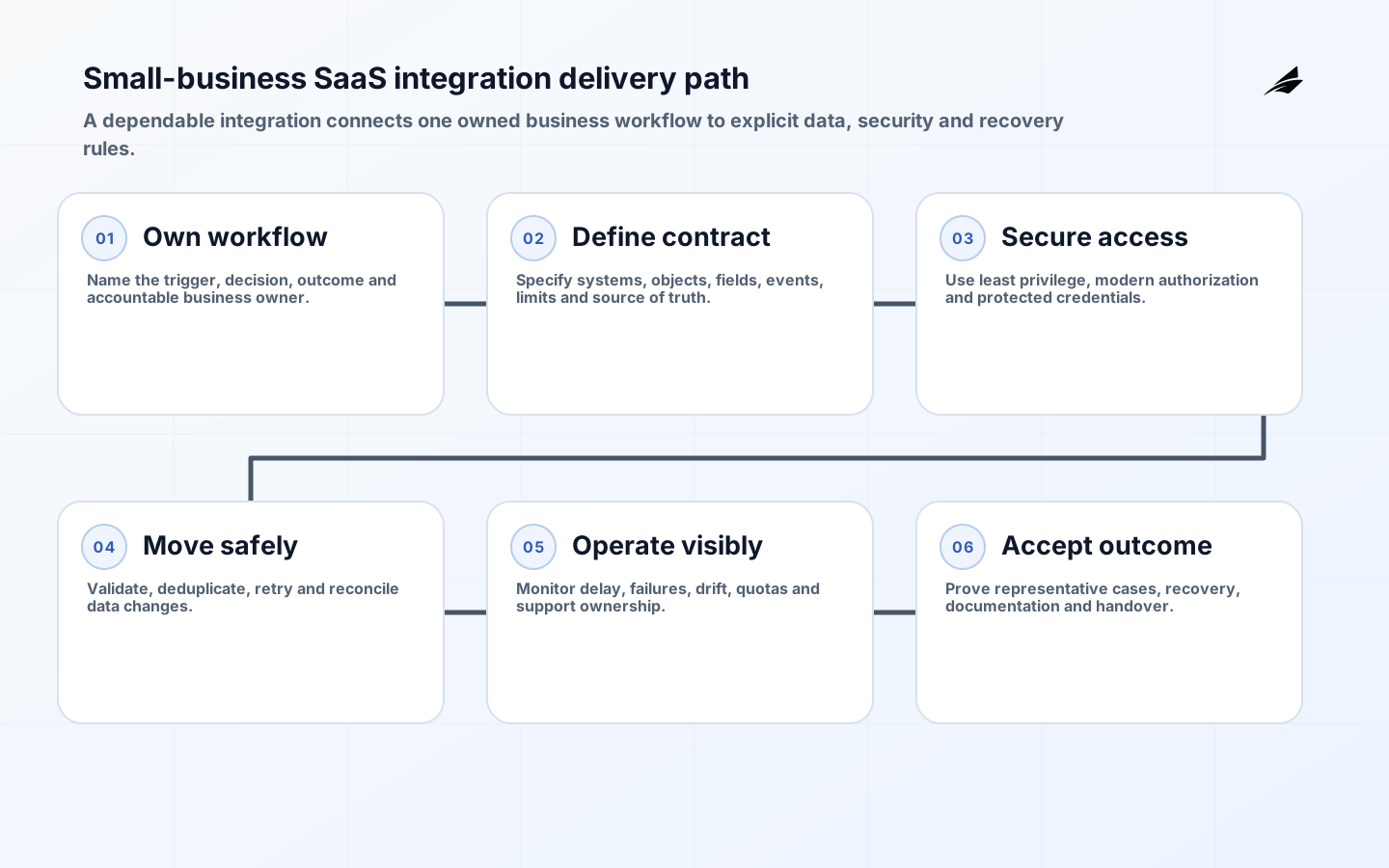
SaaS integration services for a small business should remove a specific operational burden without creating an invisible chain of fragile automations. The implementation begins with the business event and outcome: a qualified lead becomes a customer, an approved order reaches fulfillment, an invoice is issued, or an employee receives the right access. Software choices come afterward. When teams begin with “connect these apps,” they often copy fields without deciding which system owns the record, how duplicates are resolved or what happens when one service is unavailable.
This checklist is designed for CRM, accounting, ecommerce, support, marketing, identity and internal workflow integrations. It covers API and webhook contracts, data mapping, authorization, reliability, privacy, testing and handover. The standard is not that a demonstration moved one record successfully. The integration should process normal and exceptional cases, preserve an audit trail, respect vendor limits and let a named person identify and recover failed work. Small teams benefit from simple architecture, but simplicity must include clear ownership and observable failure.
1. Define the workflow and system boundary
Write the workflow in plain language before mapping endpoints. Identify the trigger, actors, decisions, authoritative record, expected completion time and business consequence of failure. Draw each system and manual handoff. Decide whether the integration creates, updates, synchronizes or merely references data. Bidirectional synchronization is often unnecessary and substantially harder because concurrent edits require conflict rules. Prefer one owner per important field and an explicit downstream projection. Document excluded workflows so stakeholders do not assume the first release covers every variant.

List operational constraints: transaction volume, peak periods, retention, regions, plan limits, acceptable delay and support hours. Identify sandbox availability and whether test accounts can represent permissions and data sizes. Record vendor ownership and escalation contacts. If a product offers only exports or scheduled polling, state the resulting freshness and cost. A small business should avoid a custom real-time pipeline when a daily managed export meets the decision need. Conversely, payroll, inventory or access changes may require stronger timing and evidence.
| Checklist item | Decision | Evidence |
|---|---|---|
| Source of truth | System and field owner for each record | Approved ownership matrix |
| Trigger | Event, schedule or user action | Example payload and timing |
| Completion | Business-visible successful outcome | Acceptance scenario |
| Exception | Who decides when records conflict or fail | Runbook and escalation path |
2. Establish API, event and data contracts
Capture the exact API version, endpoints, schemas, required fields, identifiers, pagination, rate limits and error model. Store representative request and response examples without live secrets or personal data. For webhooks, document event names, ordering guarantees, redelivery, signature verification and retention. A webhook is a notification, not always the authoritative record; many designs use the event to fetch current state. Define how API deprecation notices are received and who tests a new version before the old one ends.
Create a field-level mapping with type, format, allowed values, null behavior, transformation, owner and sensitivity. Stable external IDs are essential for idempotent updates and reconciliation. Do not match people or companies solely by a mutable name or email without an approved identity rule. Normalize time zones, currencies, country codes and decimal precision explicitly. Preserve original values where transformation could lose meaning. Version the mapping so historical records can be explained after either SaaS product changes its model.
3. Design authorization and credential handling
Use supported OAuth flows or narrowly scoped service identities instead of shared user passwords. RFC 9700 updates OAuth security practice and rejects several legacy patterns; follow the provider’s current implementation and use proof mechanisms or PKCE where applicable. Request only permissions required by the workflow and separate read, write and administrative access. Record which legal entity controls each account. Avoid tying a critical integration to an employee’s personal SaaS identity because departure or role changes can silently disable it.
Store client secrets, tokens and signing keys in a managed secret store, encrypt them in transit and at rest, and restrict retrieval to the runtime identity. Define rotation and revocation. Verify webhook authenticity using the provider’s documented scheme; where a standard profile such as HTTP Message Signatures is used, enforce covered components, time and replay requirements. Never treat a secret query parameter or source IP alone as sufficient proof. Log security decisions without recording tokens or sensitive payloads.
| Failure | Required behavior | Operator evidence |
|---|---|---|
| Duplicate event | Return success after idempotent no-op | Event ID linked to original processing |
| Temporary provider error | Retry with bounded backoff and jitter | Attempt count and next schedule |
| Invalid business data | Quarantine for owned correction | Field error and source record link |
| Expired authorization | Stop protected work and alert owner | Credential identity and renewal path |
| Rate limit | Honor reset guidance and reduce demand | Quota, backlog and projected recovery |
4. Build for retries, idempotency and reconciliation
Assume networks and SaaS APIs fail. Put durable work in a queue or equivalent store before acknowledging important events. Assign an idempotency key derived from the business operation or provider event, not a random retry attempt. Apply bounded exponential backoff with jitter and honor provider retry guidance. Distinguish transient failures from permanent validation or authorization errors. Move exhausted work to a visible quarantine with enough context for replay after correction. Ensure replay cannot duplicate invoices, notifications or fulfillment.
Reconciliation is the safety net for lost events, partial failure and manual edits. Schedule a query that compares authoritative records, integration state and destination state for a defined window. Report missing, duplicate, stale and conflicting records. Define automatic repair only for unambiguous cases; route business conflicts to an owner. Store processing checkpoints transactionally so a restart resumes safely. Test provider timeouts after the provider committed a change, because this uncertain outcome is where idempotency and lookup by external ID matter most.
5. Minimize and govern data
Move only fields required for the workflow. Classify personal, financial, health, credential and confidential business data before creating mappings. Confirm lawful purpose, retention, deletion and regional requirements with the responsible organization. Mask production data in nonproduction and restrict logs, screenshots and support exports. Integration platforms often centralize access to many systems, so their administrators, connectors and audit records require review. A no-code tool reduces coding effort but does not remove data-protection accountability.
Define deletion and correction propagation. If the destination must retain an accounting record, distinguish lawful retention from active marketing use. Record consent or communication preference ownership rather than letting two systems overwrite each other. For vendors and subprocessors, review data location, breach notification, backup and exit. Provide an export of mappings, workflow definitions and processing history where possible. Data governance should be visible in the implementation checklist, not left as a policy reference that engineers cannot apply.
6. Test normal, boundary and failure cases
Build tests around representative business scenarios: new record, update, duplicate, cancellation, deletion, missing optional value, invalid enum, large payload, out-of-order event and concurrent change. Verify both data and side effects. Use contract tests against documented schemas and a small sandbox suite against the real provider. Control third-party responses in automated tests so vendor availability does not make the build unreliable. Re-run critical tests after API, permission, mapping or plan changes.
Exercise failure intentionally: delayed webhooks, 429 rate limits, 401 authorization failures, timeouts, malformed signatures and provider outage. Confirm alert routing, backlog growth, replay and reconciliation. Test daylight-saving and month-end boundaries where schedules or accounting are involved. Acceptance should be performed by someone who understands the business record, not only by the developer. Capture before-and-after examples and ensure the result is understandable without database access. The owner should be able to explain which system now contains the authoritative value.
7. Roll out, monitor and hand over
Start with a controlled cohort or date range. Run in shadow mode where feasible, comparing proposed changes before allowing writes. Backfill historical records through a separate, rate-controlled process so it does not compete with live events. Define rollback: disable writes, drain or preserve queued work, restore prior mapping and reconcile partial records. Monitor completion ratio, processing delay, retries, quarantine age, authorization expiry, quota usage and schema drift. Alert the person who can act, not a generic mailbox.
Handover includes a diagram, account and credential ownership, mapping version, vendor limits, dashboards, runbooks, replay procedure, reconciliation report and change calendar. Assign business and technical owners with deputies. Review the integration after the first month and before annual SaaS renewals. Remove obsolete connectors and permissions. A service provider should disclose recurring license, platform, support and change costs separately. The small business should retain access to its data and enough documentation to change vendors without reconstructing the workflow from logs.
Key takeaways
- Begin with an owned business workflow and explicit source of truth.
- Version API, event and field contracts with stable identifiers.
- Use least-privilege authorization and protected, rotatable credentials.
- Design idempotency, retries, quarantine and reconciliation together.
- Test failures and hand over operational evidence, not only code.
Frequently asked questions
Should a small business use an integration platform or custom code?
Use the simplest option that meets security, reliability, scale and ownership needs. Platforms accelerate common connectors; custom code is justified for complex rules, strong testing, unusual protocols or product-critical control. Evaluate exportability and recurring cost in either case.
Is real-time synchronization always better?
No. Real-time events add ordering, retry and operational complexity. Choose freshness from the business decision. Scheduled batches are often safer for reporting, while inventory, access and fulfillment may require event-driven updates.
Who owns an integration after launch?
Name both a business owner for data and outcomes and a technical owner for runtime, security and change. A supplier can operate the implementation, but the business retains authority over process, risk and vendor decisions.
Conclusion
A dependable SaaS integration is a small operational product. Its workflow, contracts, identity, failure behavior, data rules and support ownership are explicit and tested. Implement one valuable flow end to end, prove duplicates and outages can be recovered, and expand through versioned mappings rather than accumulating disconnected automations. That discipline gives a small business the efficiency it wanted without replacing manual work with hidden technical debt.