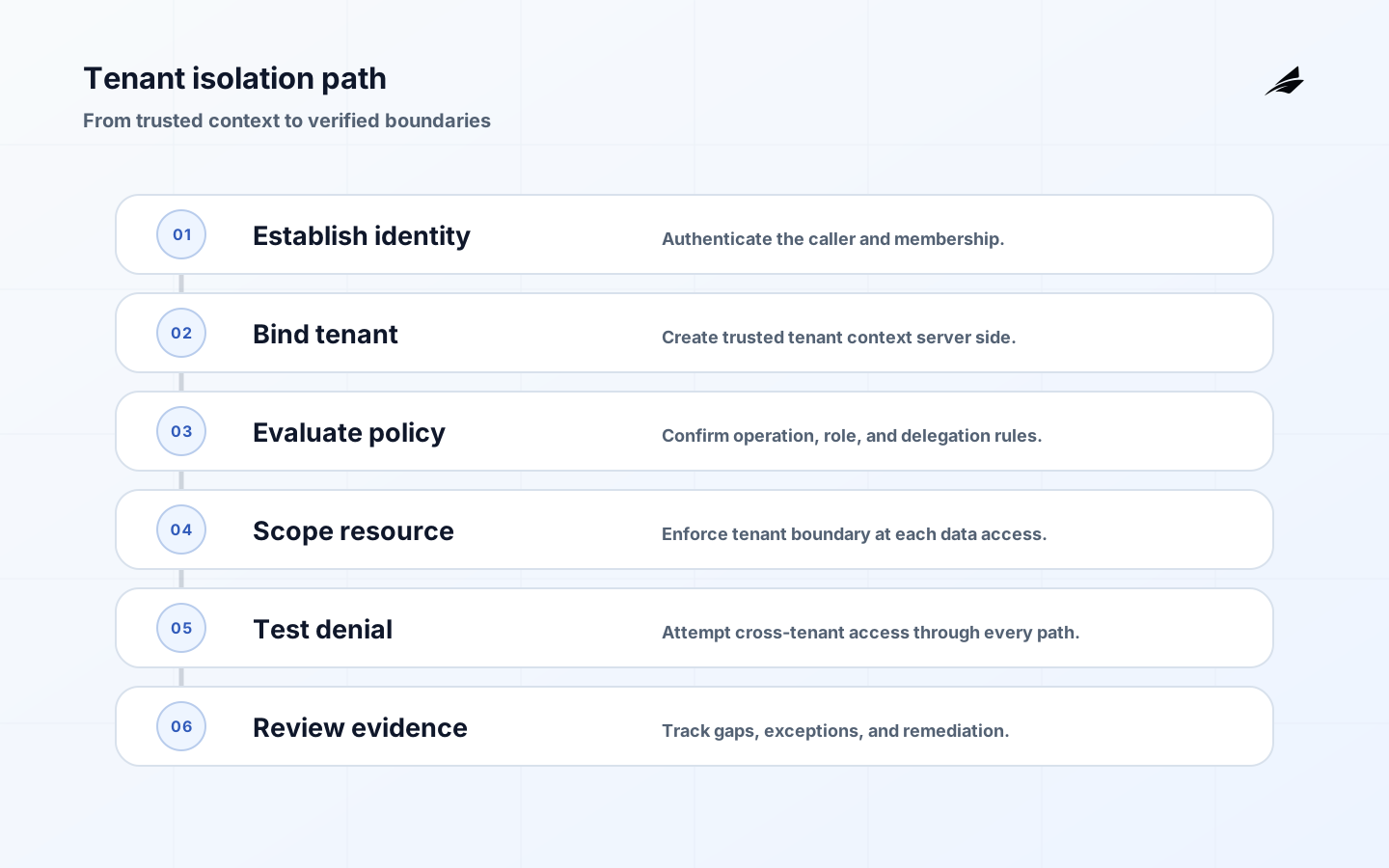
Tenant isolation is a product-engineering concern because it shapes what a customer can trust in the product, what an operator can explain, and what a delivery team can change safely. For IT managers, the work is not to collect more tooling or policy language. It is to make one important decision visible: what state is authoritative, who owns it, which controls enforce it, and how the team learns when reality differs from the plan.
Why Tenant isolation Matters
Tenant isolation is not a checkbox supplied by authentication. A legitimate user can be authenticated and authorized for a feature while still being able to retrieve another customer's record if tenant context is missing, forged, or ignored in one service. This becomes harder to see as data moves through search indexes, queues, object storage, analytics, support tools, and background jobs. IT managers need an assurance model that follows the customer boundary through the whole system, not just through the login page.
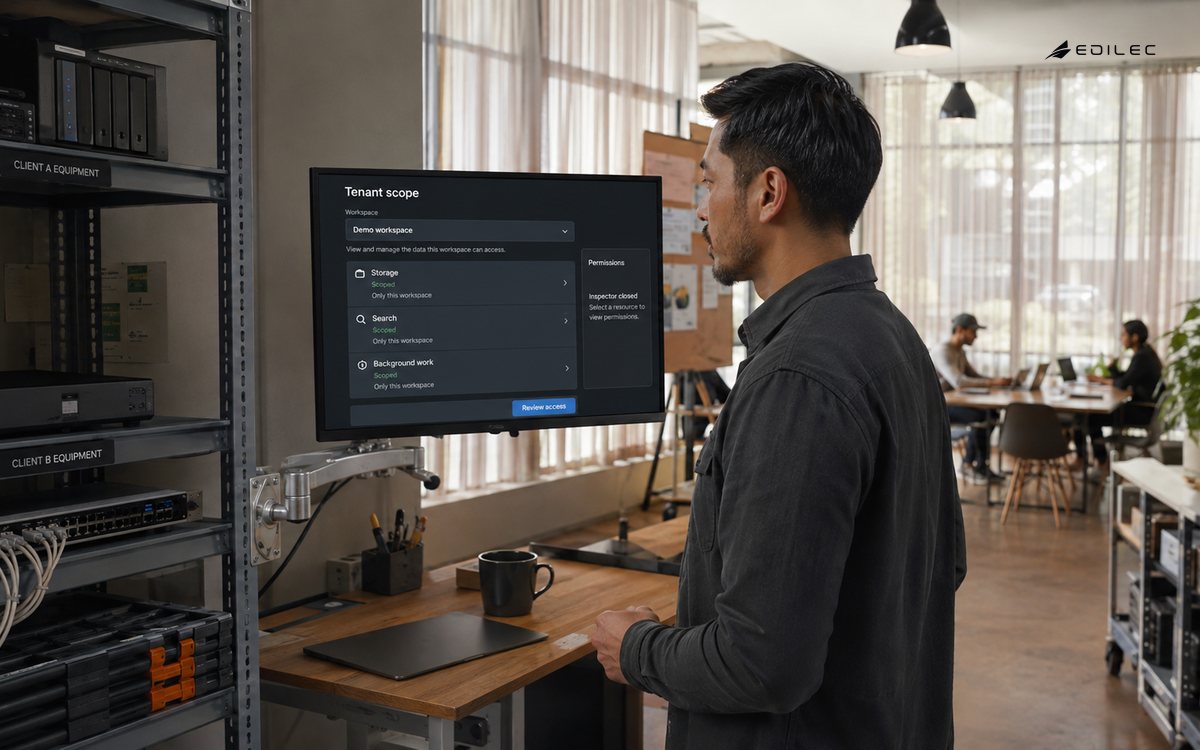
Choose isolation controls at every resource boundary and verify them independently. A pooled database may be appropriate, but it needs tenant-aware queries, constraints, and tests. A shared object store needs policy or scoped credentials that prevent cross-tenant reads. Background work must carry trusted tenant context from the initiating action, not reconstruct it from a mutable payload. The goal is defense in depth: one missing application check must not become a cross-tenant disclosure.
Build the Operating Model
Think in terms of an isolation chain: identity establishes the caller, a trusted service maps that caller to tenant membership, policy determines allowed operation, resource access enforces the tenant scope, and telemetry records the decision. Different layers can use different technology, but they should agree on the tenant identifier and its source. The chain needs to cover human users, service accounts, administrative tools, and recovery procedures. The forgotten path is usually the one that creates the incident.
| Isolation pattern | Strength | Tradeoff |
|---|---|---|
| Silo | Dedicated resource boundary | Higher provisioning and operating cost. |
| Pool with policy | Efficient shared infrastructure | Requires consistent fine-grained enforcement. |
| Bridge | Selective dedicated resources | Adds placement and lifecycle complexity. |
| Application-only filter | Flexible in simple paths | Too fragile when it is the sole control. |
Write a tenant-context contract for requests and jobs. State where the context is created, which component may sign or attach it, how it is validated, which operations require it, and how a missing or conflicting value fails. Never let a browser or integration choose the tenant simply by sending an arbitrary identifier. For cross-tenant administration, use an explicit, audited delegation rule instead of a hidden bypass. These rules make architecture reviews and incident investigation much less speculative.
Design the Architecture and Controls
Match the pattern to the risk. Siloed resources offer strong coarse boundaries and can fit regulatory or noisy-neighbor needs, but increase operational overhead. Pooled resources improve efficiency, yet demand fine-grained policy enforcement and disciplined data access code. Bridge models can mix the two by tier or workload. Whatever pattern is chosen, test the actual enforcement point with negative cases: a valid identity from tenant A requesting a known resource from tenant B should be denied everywhere.
Cross-tenant errors frequently hide in secondary systems. A search index may omit the tenant filter. A cache key may contain only a record identifier. A CSV export worker may use an administrator credential and forget to scope the query. A support tool may allow an operator to switch tenants without recording authority. Treat these as design flaws, not merely bugs in one endpoint. The corrective action should add a guardrail that makes the unsafe pattern harder to repeat.
Roll Out with Evidence
Create a resource inventory before selecting a universal solution. List every data store, API, queue, analytics sink, file store, cache, and operational tool that handles customer context. For each, document the isolation mechanism, owner, evidence, and negative test. Prioritize high-sensitivity and high-volume paths first. Introduce reusable libraries or policy middleware only after the contract is clear; a shared abstraction is valuable when it prevents omissions, not when it hides a still-uncertain design.
| Signal | What it can reveal | First response |
|---|---|---|
| Query without tenant predicate | A data access path can leak records | Block the change and add a scoped repository rule. |
| Cache key collision | Context is missing from shared state | Include tenant and authorization version in the key. |
| Admin cross-tenant access | A delegation path lacks evidence | Require case, reason, expiry, and audit record. |
| Negative test failure | A boundary does not enforce isolation | Trace identity, policy, and resource layers before release. |
Operate and Measure
Track cross-tenant authorization test coverage, tenant-context validation failures, denied requests by boundary, data-access queries lacking a tenant predicate, privileged support sessions, and remediation age for discovered gaps. Also watch noisy-neighbor signals such as per-tenant resource saturation; availability isolation is part of the customer boundary too. A useful review does not promise zero risk. It identifies which boundaries are verified, which rely on convention, and what evidence would detect a regression quickly.
- Treat tenant context as trusted server-side state.
- Enforce boundaries in identity, policy, resource, and telemetry layers.
- Test denial paths as deliberately as allowed paths.
- Inventory secondary systems, not only core APIs.
- Make delegated administration explicit and auditable.
Implementation Detail
Take a shared document-download service as a concrete case. The request begins with a signed-in user, but the download service must still derive a trusted tenant and verify that the requested document belongs to it before issuing a short-lived URL. The object-store prefix is helpful, yet it is not sufficient if a service credential can read every prefix. Combine the application check with a resource policy or scoped credential where the platform supports it. Then test a valid tenant A identity requesting a known tenant B document.
Data migration deserves the same scrutiny as request handling. A backfill job that runs with broad database access can bypass the safeguards used by the application. Require it to process an explicit tenant scope, log counts without sensitive payloads, and fail closed when context is ambiguous. For analytics and search, validate that indexes include tenant scope and that queries cannot omit it by accident. These secondary paths often contain copied data and fewer reviewers, which makes them attractive sources of boundary drift.
Review Before Scaling
Before scale changes, add isolation tests to continuous delivery. Seed two tenants with deliberately similar record identifiers and assert that each API, export, cache, background job, and support view returns only the intended records. Add tests for delegation and administrator workflows, because they need narrow exceptions to the ordinary rule. Track a negative-test suite as a release requirement for changes to shared data access. It is more reliable than relying on code review memory across dozens of services.
Isolation ownership should be distributed but accountable. Platform teams can supply context propagation, policy libraries, and resource templates. Product teams remain responsible for applying the contract to their data and workflows. Security and IT can define review evidence and escalation thresholds. Hold a regular boundary review that examines new stores, exception paths, and failed tests. The purpose is not to require a universal architecture; it is to make every deviation a conscious, evidenced decision.
Keep a short incident playbook for a suspected isolation failure. It should say how to stop further access, preserve relevant decision and audit evidence, identify the affected tenant scope, notify the appropriate owners, and validate the fix with negative tests. Preparing this path does not assume a breach will occur; it makes the organization capable of acting carefully if a boundary alarm is real. Review this evidence with the owner of tenant isolation, the people who operate the surrounding workflow, and the team responsible for customer communication. Agree on one change, one measure, and one follow-up date. That closed loop keeps local fixes from becoming unexamined policy and makes the next decision easier to defend.
Key Takeaways
- Make tenant isolation a named operating decision rather than an implicit implementation detail.
- Keep customer impact, evidence, and recovery visible to the team that owns the workflow.
- Start with a narrow path, learn from real outcomes, and expand only after the controls hold.
Frequently Asked Questions
Where should a team start with tenant isolation? Start where an incorrect decision would create meaningful customer, commercial, or operational harm. Map the current state, the owner, the boundary, and the evidence available during failure. How much process is enough? Use the smallest process that makes the decision repeatable, reviewable, and recoverable. Add rigor when the data, action, or customer consequence makes a shortcut unsafe.
Conclusion
Strong tenant isolation work is not a one-time project. It is a durable agreement between product, engineering, and operations about how the system behaves under ordinary and difficult conditions. When the contract, controls, telemetry, and recovery path agree, IT managers can improve the product without turning each release or customer exception into a new source of uncertainty.
The practical continuity test for tenant isolation is whether a qualified teammate who did not design the workflow can inspect the current state, understand the relevant decision and its limits, and take the next safe action without improvised access or tribal knowledge. Keep the owner, evidence location, escalation route, and recovery rule visible. That discipline makes routine operations calmer and gives the organization a reliable starting point when a customer, release, or incident exposes a new edge case.
Sources
The implementation advice in this tenant isolation guide is grounded in AWS tenant isolation fundamentals, AWS SaaS tenant isolation strategies, NIST SP 800-207: Zero Trust Architecture, OWASP Application Security Verification Standard. These references are useful for checking platform-specific controls and terminology during delivery; the decisions here still need to be applied to the product's data, risk, and customer context.