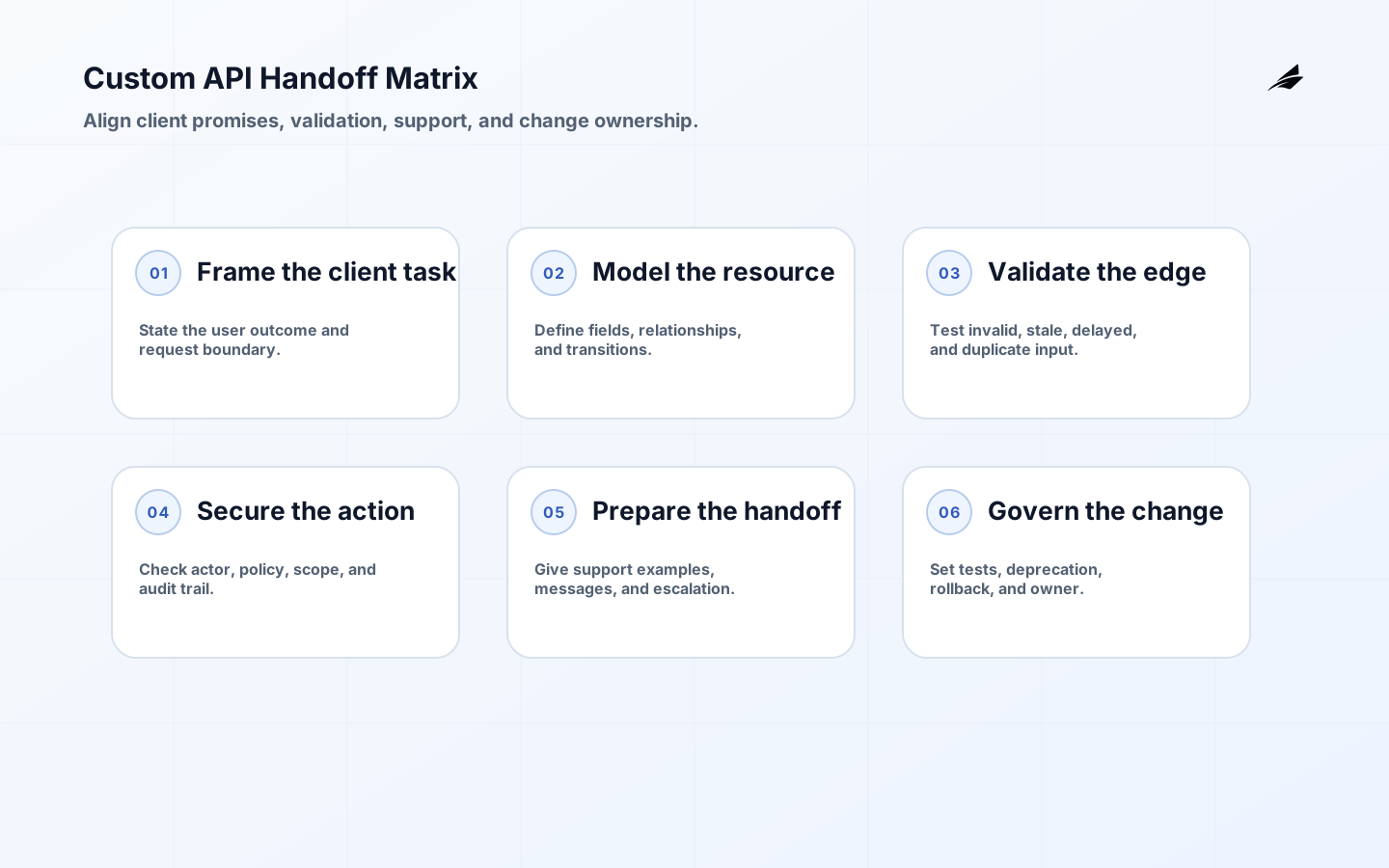
REST API contracts are the promises an organization makes to every client, integration, support team, and future maintainer of a service. For IT managers, a contract is not merely an OpenAPI file generated at release time. It is the documented behavior of resources, methods, validation, authorization, errors, pagination, compatibility, and change ownership. This practical guide frames REST API contracts as a production decision: make the boundary visible, choose controls that fit the risk, and keep enough evidence to revise the approach when real use contradicts the plan.
Set the REST API contracts boundary

Start with the business resource and the action a client is entitled to perform. Use HTTP method semantics consistently, make identifiers and relationship scope unambiguous, and describe what happens on repeat requests or conflicting changes. The IETF HTTP Semantics specification anchors the shared vocabulary; following it reduces custom client logic and gives intermediaries predictable behavior.
| Situation | Decision to make | Evidence to keep |
|---|---|---|
| New optional field | Clients can ignore unknown data | Add it with examples and monitor parsing |
| Changed meaning | Existing values acquire a new business rule | Create a new representation or versioned behavior |
| List endpoint | Large result sets need stable navigation | Define ordering, cursor semantics, and limits |
| Async operation | Work cannot finish within the request | Return accepted state and a status resource |
Make the critical REST API contracts decisions explicit
Choose a versioning and evolution policy before external clients depend on the first endpoint. Additive fields are often compatible, but changing a field’s meaning, tightening a previously accepted input, or changing an authorization rule can break behavior without changing a path. A contract review should include consumers, security, support, and the service owner. Decide how deprecation is announced, how long it is supported, and what telemetry proves clients have moved.
- Which user or business outcome is REST API contracts expected to improve, and how will the team recognize success?
- For custom REST API handoff, ask: Which system, module, or role owns each material decision and its authoritative data?
- For custom REST API handoff, ask: What does a normal outcome, a delayed outcome, and an exception look like to a user?
- For custom REST API handoff, ask: Which action must be idempotent, auditable, or subject to a higher level of review?
- For custom REST API handoff, ask: What change can be released independently without weakening an existing customer path?
- For custom REST API handoff, ask: Which metric and real support example will be reviewed after the release?
Deliver a small, testable REST API contracts slice
Treat the contract as an executable agreement. Validate request and response examples, run consumer or integration tests for important clients, and compare generated documentation with deployed behavior. Return predictable error shapes; RFC 9457 defines a standard problem-details format that can carry machine-readable categories without exposing internal implementation details. Test malformed inputs, unauthorized access, concurrency conflict, pagination edges, and partial failure.
| Failure pattern | Why it harms the workflow | Control to introduce |
|---|---|---|
| Undocumented semantics | Clients depend on accidental behavior | State repeat, ordering, and deletion rules |
| Breaking validation | A stricter parser rejects real client input | Measure and notify before enforcement |
| Opaque errors | Consumers retry unsafe requests | Use stable problem categories and guidance |
| Unowned deprecation | Old versions never retire | Assign an owner and traffic-based exit rule |
Operate REST API contracts as a living capability
Give each public operation an owner and monitor it as a product surface. Track status codes, contract-validation failures, client-version usage, error categories, and latency by dependency. Publish a change log that says what a client must do, not simply what implementation changed. That record is especially important when multiple vendors or internal teams integrate on different release schedules.
Review contract hazards before handoff
A frequent failure is documenting a resource but leaving behavior implicit: whether PUT is safe to repeat, whether deletion is immediate, whether a list is ordered, or whether a missing record is hidden by authorization. Clients then infer rules from one observed response and build fragile workarounds. Another is letting a gateway rewrite errors until the caller loses the original recovery signal.
- Walk one representative record through valid, rejected, delayed, and conflicting states.
- Verify that the actor, relevant policy or version, and result are discoverable after the fact.
- For custom REST API handoff, test the most likely retry, timeout, stale-data, or concurrent-change behavior.
- For custom REST API handoff, confirm that monitoring names the affected capability rather than only the infrastructure component.
- Give support a clear customer-safe message and an escalation route for the exception.
- Document the rollback or correction path before traffic is expanded.
Measure whether REST API contracts reduce friction
Measure contract test coverage for critical operations, unknown-field or validation failure rate, deprecated-client traffic, error-category volume, and support tickets attributable to integration ambiguity. Pair the dashboard with periodic review of examples from actual clients; real payloads find evolution gaps that a static schema can miss.
Prepare a production rollout for REST API contracts
Contract discovery should start with the client decision, not the database table. Ask what a caller needs to accomplish, what it can safely retry, how it learns that an asynchronous operation finished, and which errors require a user correction rather than another network attempt. Record examples from actual clients, including regional formats, optional data, and legacy identifiers. Those examples make ambiguity visible before it turns into a compatibility promise.
A release is ready when a consumer can implement the contract from published behavior and examples, then receive the same behavior from a deployed environment. Test method semantics, cache headers where relevant, pagination continuation, authorization concealment rules, idempotent repeats, and error categories. Run these tests against a versioned contract artifact as well as the service. This detects a drift that unit tests inside one repository can miss.
For long-lived integrations, hold a regular compatibility review that includes the oldest supported client. Deprecation is a migration service: provide an alternative, a deadline, observed usage, and a person responsible for consumer questions. A version prefix alone does not solve the hard part, which is knowing when an old client can stop receiving production support without disrupting a customer workflow.
Keep a representative contract example suite outside any one client implementation. Include a successful request, an authorization denial, a validation problem, an empty page, a concurrency conflict, and an accepted asynchronous operation. Review it whenever a policy or data model changes. This protects the organization from a subtle but common regression: the API remains syntactically valid while the business meaning that consumers relied on has changed underneath it.
Assign a named contract owner for every externally consumed operation. That owner need not approve every implementation detail, but they should be accountable for compatibility decisions, consumer communication, examples, and the evidence used to retire old behavior. Clear ownership keeps urgent fixes from quietly changing an agreement that other teams or customers still depend on.
Use examples to settle hidden assumptions
A custom software API contract is the shared boundary between a product decision and the teams that implement, integrate, support, and eventually change it. Start with a workflow example rather than a list of fields. For an order, show the request, the accepted response, the later status transition, the duplicate request, and the rejected transition. These examples reveal whether the API is describing a resource, issuing a command, or accidentally mixing both.
Handoffs fail when the contract leaves time and authority implicit. State whether an accepted request means “validated”, “queued”, or “completed”; give timestamps and identifiers enough meaning to support reconciliation; and identify which service owns the final record. If a client must poll, define the status model and retry interval. If a webhook is involved, define delivery attempts, signatures, duplicate handling, and replay support.
Custom delivery also needs a change budget. A team may coordinate a breaking change across its own application, but a mobile client, customer integration, or data export can remain in the field longer than expected. Keep generated documentation tied to the same source as validation, then add contract tests that exercise the cases prose cannot settle. OpenAPI describes the interface, while OWASP API Security Top 10 keeps authorization and abuse cases in the review. Review the test fixtures when the business rule changes; stale fixtures are a quiet form of contract drift.
Security belongs at the operation and data boundary. Confirm that the identity is authorized for the specific resource and transition, that error responses do not disclose existence or internal topology, and that bulk endpoints have limits. Make the negative cases first-class in the handoff package so a receiving team can verify protection without needing private context from the original implementer.
Key takeaways for IT managers
- REST API Contracts should be owned as a business and operational decision, not an isolated framework task.
- Define authority, failure behavior, and acceptance evidence before expanding the implementation.
- For custom REST API handoff, release one meaningful path with observability and recovery instead of several unconnected features.
- For custom REST API handoff, use standards and official documentation to guide contracts, security controls, and maintenance choices.
- For custom REST API handoff, review production evidence regularly and retire assumptions that real use has disproved.
REST API contracts become durable when they are tied to a real workflow, an explicit owner, and feedback from production. For custom REST API handoff, start with a narrow capability, protect the behavior people already depend on, and expand only after the operating evidence is clear. Related reading: software modernization roadmaps, quality assurance for custom systems, and software support playbooks.
Frequently asked questions
What is the first artifact for a custom API?
A concise workflow contract with resource meaning, commands or transitions, examples, authority, failure states, and ownership. An OpenAPI document can then encode the interface details.
How do contract tests help?
They run a repeatable agreement between a provider and its consumers, catching incompatible fields, statuses, and examples before deployment. They should include rejected and delayed cases, not only successful responses.
What should a handoff contain?
The contract, examples, test fixtures, authentication assumptions, limits, migration notes, dashboards, runbook, known exceptions, and a named owner for future changes.
Conclusion
A dependable custom software contract is visible in the handoff: examples, authority, security, recovery, and a named owner for change. Start with one complete workflow, test the negative cases, and expand when the receiving team can run it independently.