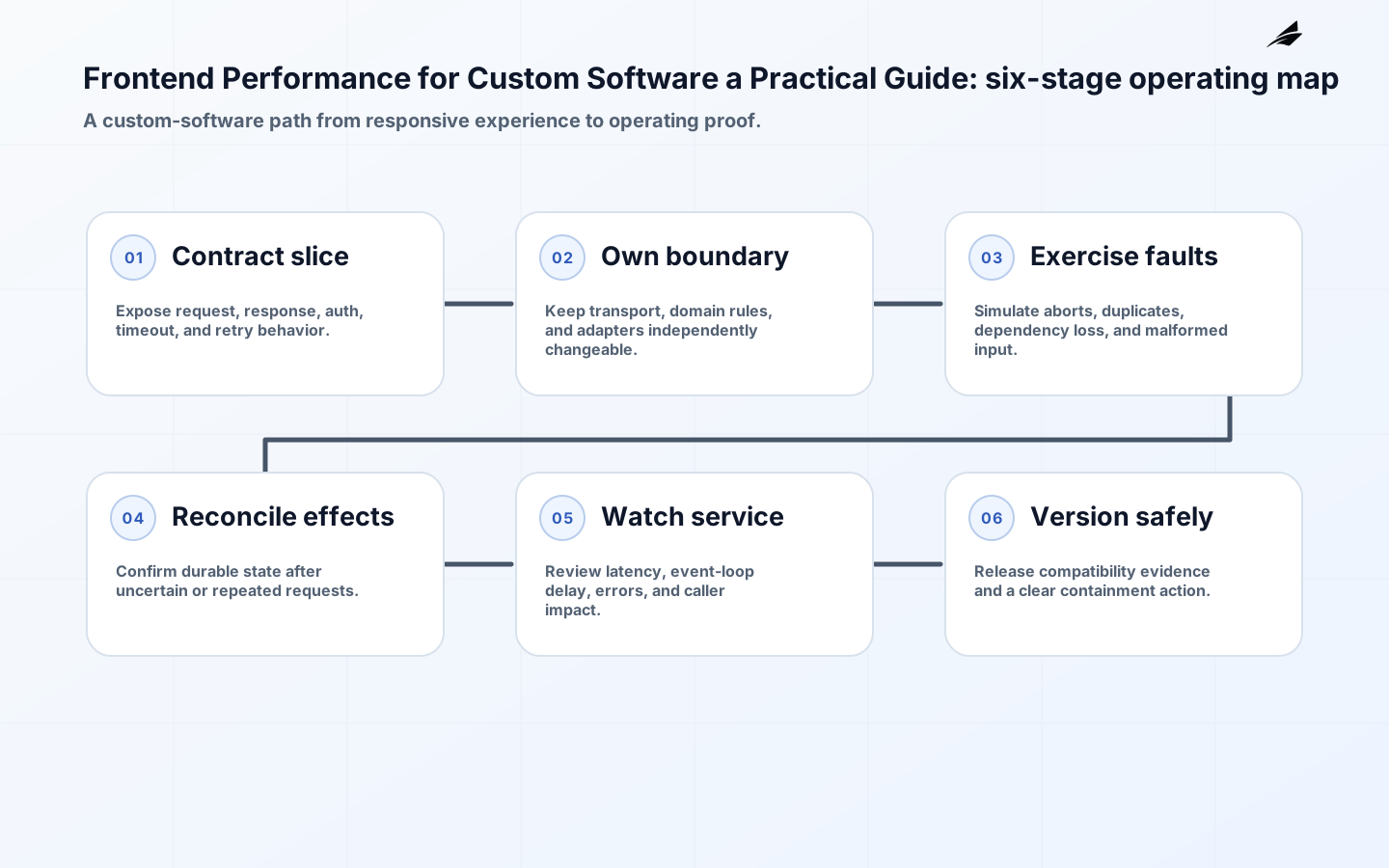
Frontend performance affects trust long before a user sees a finished screen or a deployment turns green. For founders, its practical job is to make the user-visible path responsive on the devices and networks customers actually use. For custom frontend performance, the work starts by tracing an actual decision from trigger to durable outcome, including the moment a person needs to understand a delay or reverse a mistake. For the performance contract, RFC 9110: HTTP Semantics and RFC 9457: Problem Details for HTTP APIs provide a useful baseline for explicit responses and failure semantics; the local system still needs a domain-specific promise. This article uses frontend performance as a visible, practical phrase rather than a label for generic engineering work.
Define the frontend performance operating boundary
Start by making the boundary testable. In this case, the trigger is a navigation or interaction that begins a meaningful task; the durable record is field measures segmented by route, device, connection, and release; and the working mechanism is a rendering path with a protected critical resource and interaction budget. Those three statements reveal where authority, timing, and evidence actually live. For custom frontend performance, decide which actor may start or alter the operation, what an external caller is allowed to infer from each status, and which transition is irreversible. For custom frontend performance, then walk through a late dependency, a duplicate request, incomplete data, and an authorized correction. For custom frontend performance, that exercise usually finds ambiguous states before a dashboard or integration embeds them. The OWASP application testing guide supports adverse-path testing, while the application must identify the exact correlation data and audit information its operators need.
| Decision area | Question to settle | Evidence to retain |
|---|---|---|
| Trigger | a navigation or interaction that begins a meaningful task | Initiator, time, and input identity |
| Durable state | field measures segmented by route, device, connection, and release | Stable identifier and transition history |
| Authority | Who may change or override it? | Role and decision record |
| Completion | What counts as done? | Visible outcome and reconciliation rule |
Choose a performance model that fits the task
For custom frontend performance, the model should preserve the behaviour customers and colleagues rely on, not merely fit a familiar framework. For frontend performance, use field data to select a slow cohort, then use local profiling to attribute the cost to resources, rendering, or JavaScript work. Write down guarantees separately from assumptions. For custom frontend performance, delivery, ordering, freshness, compatibility, permission, and completion can each have different rules. For custom frontend performance, a reliable contract distinguishes an accepted request from applied work and confirmed business completion. For custom frontend performance, that stops product copy, API responses, and internal reports from promising more certainty than the system has earned. For custom frontend performance, ask a domain owner to describe one ordinary case and one expensive failure using the exact fields and statuses the product exposes. For custom frontend performance, those examples produce clearer interfaces and sharper tests than abstract architecture terminology.
Measure the user journey
Build recovery into the normal path. Roll back the release or experiment that moved a field metric, then retain the trace and asset diff for the affected cohort. For custom frontend performance, give material work a stable business identifier, persist consequential transitions, and attach correlation context before processing crosses a service, queue, browser, or human handoff. For custom frontend performance, every retry needs a budget, delay policy, owner, and terminal state; otherwise a temporary dependency problem becomes an invisible accumulation of work. For custom frontend performance, where an operation changes a customer-visible result, make the state machine readable by support as well as by code. Use Web Content Accessibility Guidelines 2.2 to keep status, error, focus, and next action understandable.
Test and release the performance contract
Test what the contract says will happen under realistic pressure. For custom frontend performance, use cases with missing or stale input, changed permissions, delayed dependencies, repeated actions, partial completion, and correction after a visible result. For custom frontend performance, run at least one controlled fault exercise before broad release so the displayed state, telemetry, and operator procedure must agree. For custom frontend performance, roll out with a bounded cohort or reversible capability where possible, state the stop condition in advance, and compare the changed experience with a baseline. Review evidence with the people who answer operational questions. For custom frontend performance, they often identify that a technically successful transition has left a user without an understandable next step, which is a product defect even when logs look clean. For frontend performance, a release comparison should retain route-level measurements, resource changes, and the device or network segment that regressed.
- Prove one ordinary frontend performance outcome with representative data.
- Exercise a duplicate, delay, or stale-state path before broad rollout.
- Give the first responder a correlation identifier and bounded correction action.
- Evaluate release evidence against the promised customer or business outcome.
Operate frontend performance with useful signals
For frontend performance, measure p75 LCP, INP, and CLS by route; transferred JavaScript; long-task time; and task completion. For custom frontend performance, segment the figures by the dimension that changes the experience: route or task, client version, dependency, tenant, device, error class, or ownership group. For custom frontend performance, a healthy average can conceal a cohort with no viable path, so inspect distributions and recent changes as well as totals. For custom frontend performance, every alert and recurring review should have a named owner, a starting question, and a next decision. That turns observability into a working feedback loop. For custom frontend performance, it also distinguishes a sudden incident from chronic friction that should become planned improvement, preventing teams from treating an accumulating operational cost as normal background noise.
| Signal | What it may reveal | First response |
|---|---|---|
| Outcome delay | The path no longer meets its promise | Inspect the affected cohort and dependency |
| Repeated action | A caller may not trust state | Check idempotency and displayed status |
| Unknown failure | The taxonomy is incomplete | Preserve context and classify the case |
| Manual workaround | The designed path is insufficient | Review the rule, interface, and ownership |
Govern frontend performance evolution
Keep frontend performance adaptable by naming the contract owner, approval needed for a breaking change, retention and privacy implications of the records, and expiry date for temporary compatibility or exceptions. For custom frontend performance, treat examples, schemas, fixtures, release notes, and runbooks as product surface rather than paperwork. For custom frontend performance, when the same question recurs in support, testing, or review, turn the answer into a visible rule before automating it; this avoids encoding a shortcut that only works for the original team. Related perspectives include Design Systems for Custom Software: a Practical Guide, Code Review Systems for Custom Software: a Practical Guide, Test Strategy in Production: Confidence Without Slow Delivery. For custom frontend performance, each helps with an adjacent constraint while leaving the local business decision explicit.
Make frontend performance part of delivery
For custom software, frontend performance is an operating characteristic of the product, not a polish pass after features are complete. Define the user task, target route, representative device, and data volume before implementation. An internal operations screen may need to render a dense table for a low-powered laptop; a public page may need a fast first response for a wide range of mobile connections. The target context determines the right optimization.
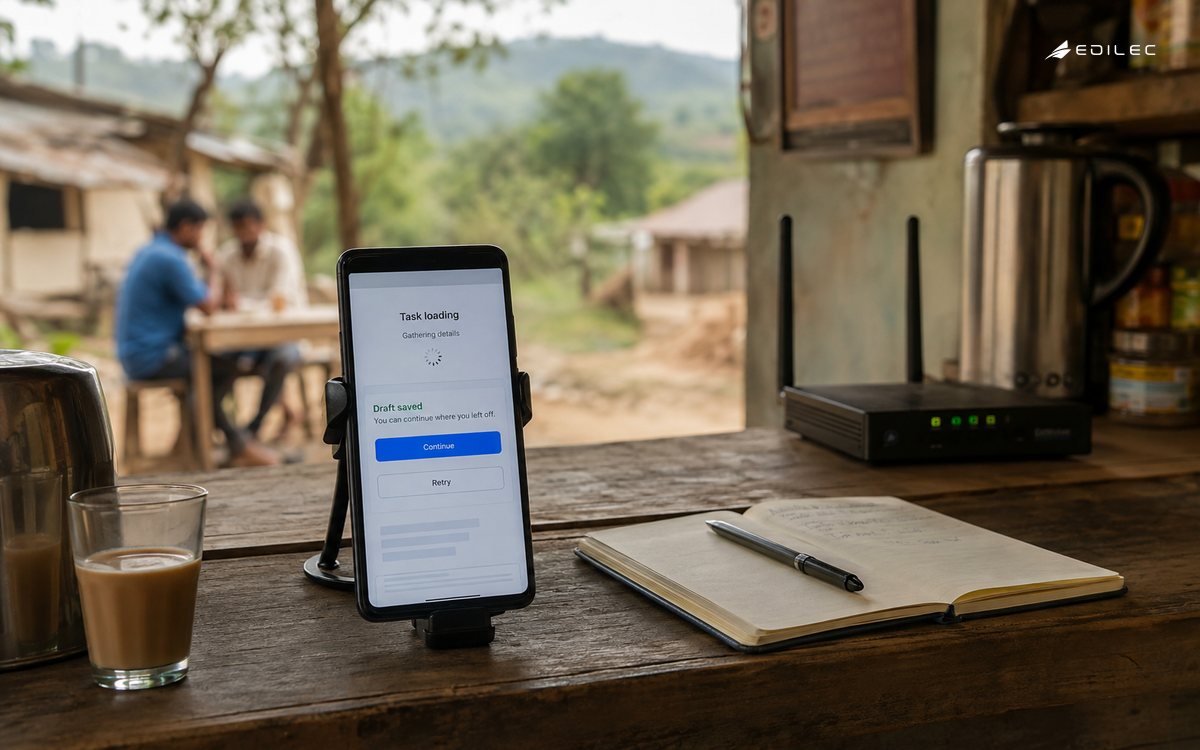
Budget the whole path: server response, transfer, parse and compile work, rendering, interaction, and backend wait. A fast browser bundle cannot rescue an API that returns too much data, and a quick API cannot rescue a page that renders thousands of nodes before accepting input. Put a measurement beside each boundary so the team can tell which owner can act.
Choose data fetching patterns based on freshness and user intent. Paginate or virtualize large collections, cancel obsolete searches, debounce only where it protects the backend without delaying committed input, and cache data whose staleness is acceptable. Document whether a user sees a snapshot, live state, or eventually refreshed result; performance and correctness are connected when people make decisions from the screen.
Keep performance checks close to the route’s acceptance criteria. A representative trace, a field-data view, and a regression threshold are enough to begin. When a threshold is exceeded, record whether the cause was a dependency, a query, a render path, or a device-specific assumption. Avoid optimizing a synthetic score while the user’s actual task remains slow or confusing.
Plan the rollout as carefully as the code. Release a heavier component behind a flag, observe route-specific measures, and retain a fallback when the new path degrades completion. This is especially important for software used by staff with fixed hardware or restricted networks. The best performance practice is one that keeps the product usable while the team learns.
| Boundary | Owner to involve | Measure |
|---|---|---|
| API payload | Backend and product | Bytes, freshness, query time |
| Client code | Frontend team | Transfer, parse, compile |
| Interaction | Frontend and design | Input delay and completion |
| Rollout | Product and support | Task success and fallback use |
Takeaways
- Anchor frontend performance in a named outcome and durable evidence.
- Design late, duplicate, and corrective paths before broad adoption.
- For custom frontend performance, measure the experience of real cohorts and assign signals to a decision owner.
- For custom frontend performance, evolve contracts deliberately so operating knowledge does not remain trapped in individuals.
For a related decision, compare this approach with Design Systems for Custom Software: a Practical Guide, Code Review Systems for Custom Software: a Practical Guide, Test Strategy in Production: Confidence Without Slow Delivery. For custom frontend performance, each adjacent article treats a different boundary; use the links to test whether the same ownership, evidence, and recovery expectations hold in the surrounding system.
Frontend Performance for Custom Software: a Practical Guide FAQ
What is the first decision for frontend performance for custom software: a practical guide?
For frontend performance for custom software: budgets, tasks and recovery, begin by naming the user or operational outcome, the accountable owner, and the evidence that will show whether the outcome is safe. For custom frontend performance, that boundary determines the smallest useful first implementation and gives the team a shared test for scope.
How should a team handle failure in frontend performance for custom software: a practical guide?
In frontend performance for custom software: budgets, tasks and recovery, classify each failure by its next safe action: correct, retry, reconcile, escalate, or stop. For custom frontend performance, preserve state and a correlation record so a person does not guess whether the first attempt took effect, especially when the boundary can create an external side effect.
When is the implementation ready to expand?
Expand frontend performance for custom software: budgets, tasks and recovery after a representative path works with realistic data, known exceptions, observable ownership, and a rehearsed recovery. For custom frontend performance, a larger rollout should add confidence, not conceal unresolved ambiguity in a wider queue.
Conclusion: operate frontend performance for custom software: a practical guide with evidence
The durable version of frontend performance for custom software: a practical guide is not the one with the most components. For custom frontend performance, it is the one whose promise is explicit, whose boundaries are understandable, whose failure states preserve a safe next action, and whose evidence reaches the people responsible for the result. For custom frontend performance, start with one complete path, measure what users and operators actually experience, and let observed risk decide where the next investment belongs.