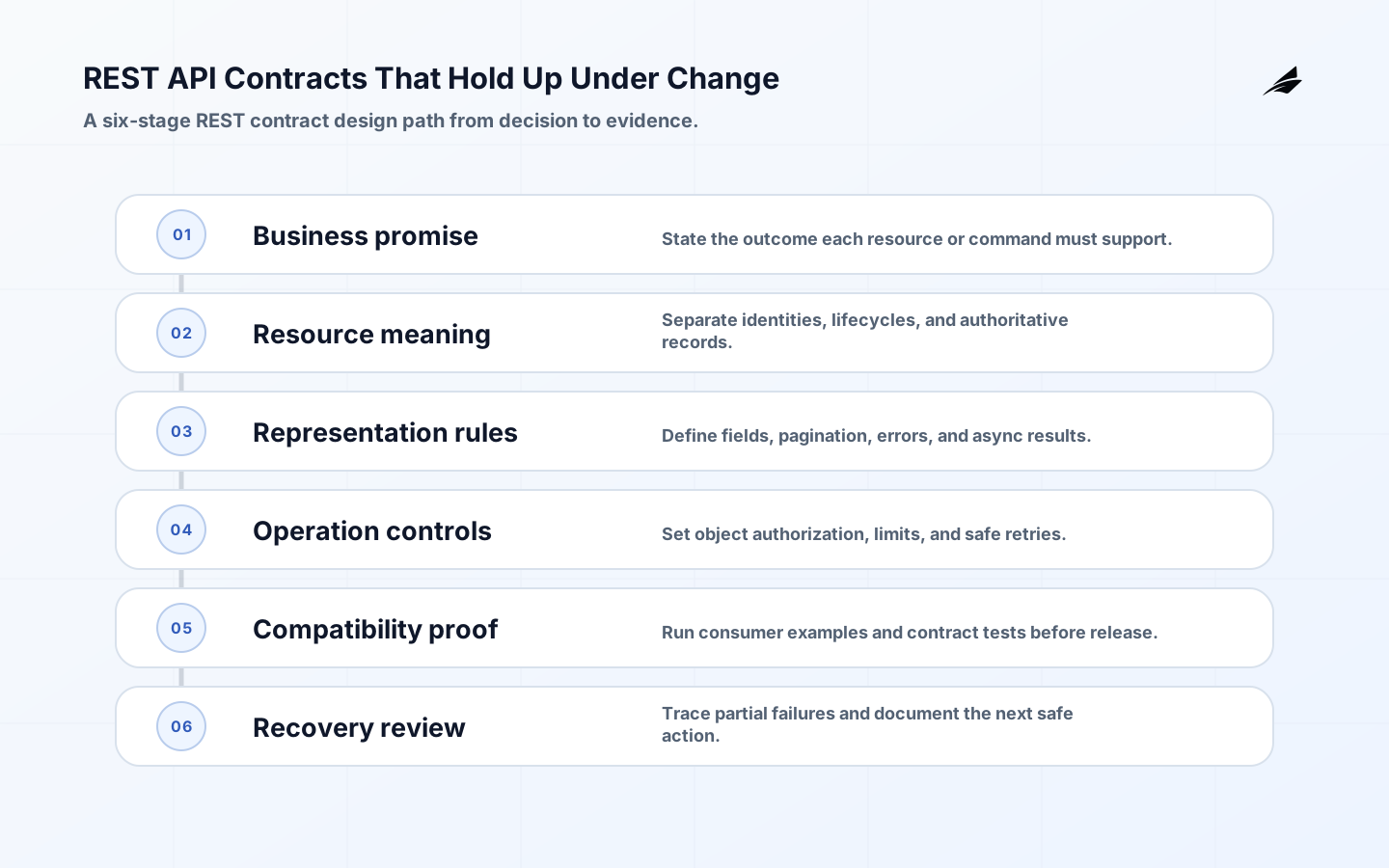
A contract review that survives contact with a real client. Ask a consumer to implement one meaningful flow from the document alone. If the client must infer whether a timeout is safe to retry, whether an empty collection differs from an absent field, or which identifier support needs, the contract is incomplete. Resolve those ambiguities in examples and tests before polishing naming. A useful review records the decision, the owner, the compatibility consequence, and the evidence that will be checked after release. This keeps REST API contracts useful to product, support, and operations as well as to developers, with frontend performance guidance available when the contract shapes a user journey.
REST API contracts are the durable promises an API makes to people and software: what an operation means, which representations it accepts and returns, how authority is checked, and what a caller should do when work cannot complete. An endpoint list is not enough. The HTTP Semantics specification defines the meaning of methods and status codes, but an application still has to state its resource model and business outcomes. A useful contract lets a consumer integrate without reading server code and lets the provider change internals without surprising that consumer. Treat it as a product surface with an owner, review process, examples, and compatibility policy rather than as a generated artifact produced at the end of a sprint.
Treat the contract as a product surface
Start from the caller's goal. A request to cancel an order is not merely an update to an order row: it has eligibility rules, an actor, a possible refund process, a finality condition, and a record of why it changed. Decide whether an API exposes a resource representation, a command, or both. Name fields by business meaning, state which are client supplied or server generated, and distinguish a missing field from an explicit null where that distinction matters. Link related workflows through stable identifiers rather than nesting an entire internal model. This makes the contract a useful boundary for Node.js APIs and for client code that must render outcomes honestly.
| Mistake | Why it breaks consumers | Fix |
|---|---|---|
| Expose persistence models directly | Database changes become accidental public API changes. | Publish a representation designed for the operation and map it deliberately. |
| Use 200 for every outcome | Clients cannot distinguish success, validation failure, pending work, or refusal. | Use status semantics and a documented body for each meaningful outcome. |
| Hide behavior in prose only | Generated clients and tests cannot reliably verify the promise. | Maintain schemas, examples, and executable contract tests. |
| Make retries unspecified | Timeouts create duplicate or contradictory business actions. | Define idempotency keys, operation IDs, and reconciliation behavior. |
Design resources and commands with business meaning
Use HTTP methods consistently, but do not force every business action into a misleading CRUD shape. A resource can be created, retrieved, and updated through familiar semantics; a complex operation such as 'approve', 'recalculate', or 'submit' may need a command representation with explicit input and outcome. The important test is whether a reader can predict the effect and retry behavior. A PATCH request should state which patch format and concurrency rule it uses. A DELETE response should say whether deletion is immediate, soft, asynchronous, or prohibited by retention. Preserve the original request or an audit reference when consequences are material. That clarity is more valuable than an aesthetic URL convention.
- Define the identifier, lifecycle, and source of authority for each top-level resource.
- Use pagination, filtering, and sorting rules that make result windows reproducible and bounded.
- Specify field formats, time zones, precision, and locale assumptions instead of relying on examples alone.
- Return links or operation identifiers when a caller must follow asynchronous work.
- Make authorization outcomes deliberate; avoid converting forbidden access into a misleading empty result.
Make errors actionable and safe
Error design is part of the contract. RFC 9457 standardizes a problem-details format that can carry a stable type, title, status, detail, and instance. Use a consistent shape, but choose error types around actions a caller can take: correct invalid input, authenticate, request access, retry later, inspect an operation, or contact support with a correlation ID. Do not expose stack traces, SQL, internal host names, or permission details that help an attacker. Conversely, do not make every failure an opaque 'something went wrong'; a user cannot repair a form without safe field-level information. Keep validation errors separate from unexpected faults and record full diagnostic context only in protected logs.
| Outcome | Consumer response | Provider responsibility |
|---|---|---|
| Invalid input | Correct named fields or business preconditions. | Return stable validation codes and safe field context. |
| Unauthenticated or forbidden | Authenticate or seek appropriate access. | Check authority server-side without exposing protected resource details. |
| Accepted for processing | Poll or receive a documented completion notification. | Persist an operation state and recover it after restart. |
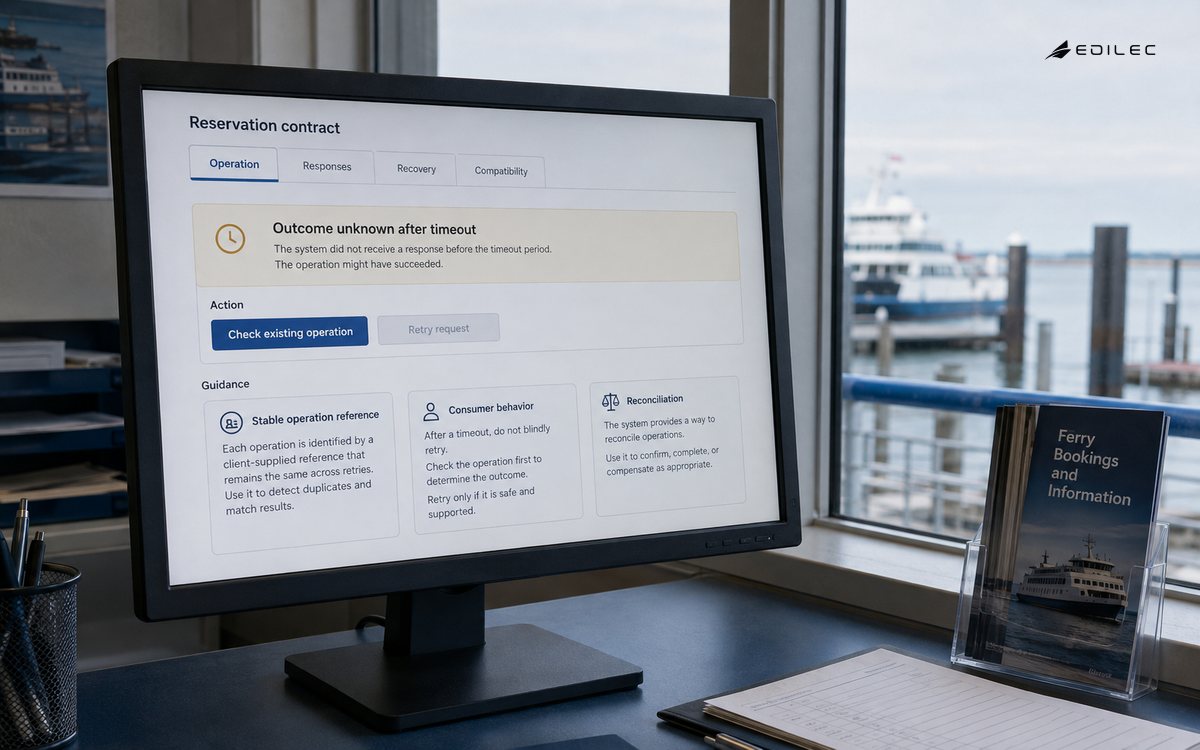
| Dependency uncertainty | Avoid unsafe duplicate submission and inspect status. | Reconcile using a durable business or idempotency identifier. |
Make the specification executable
An OpenAPI document is useful when it is treated as a reviewed contract, not a decoration. The OpenAPI Specification supports describing paths, operations, schemas, security, and examples in a machine-readable form. Keep examples synchronized with the actual service, validate responses in integration tests, and run consumer-driven checks for critical clients. Schema validation alone does not verify authorization, semantic constraints, ordering, or side effects, so pair it with scenario tests. During review, ask what an older client will observe, whether an added field changes interpretation, and how a failed deployment leaves the contract. Contracts should evolve through additive change when possible, then explicit deprecation with usage evidence and a migration path.
Contract governance benefits from a consumer inventory, but do not confuse a list of API keys with an understanding of dependency. Identify the teams, applications, automated jobs, and external partners that use a critical operation; record their support contacts, release constraints, and expected migration window. Add telemetry for operation and version use before publishing a removal date. For changes involving money, access, or regulated records, run a sample migration with a real consumer and reconcile outcomes. Keep release notes focused on behavior: a renamed field matters only because of the meaning or client work it changes. This turns compatibility from a technical afterthought into a manageable service commitment.
Also decide where contract knowledge lives when an incident occurs. The on-call engineer should be able to find the current specification, an example request, the owning team, recent compatibility decisions, and a consumer-safe status message without searching deployment history. Keep these references near the service and review them after material incidents. A contract that is technically precise but unavailable to the people restoring service cannot deliver its full value.
Secure the whole contract
Security belongs to request semantics, not only an API gateway. The OWASP REST Security Cheat Sheet covers useful concerns including transport protection, input validation, access control, and rate limiting. Apply them to the object and action the contract names: a valid user may read one account but not another, and an administrator may view a record without permission to change its status. Define scopes, tenant boundaries, sensitive-field masking, audit events, and abuse limits in the service contract and test them through the real route. Review GraphQL tradeoffs as a contrast: different transport styles still need the same clarity about cost, field-level authority, and response behavior.
- Review each operation for object-level authorization, not only route-level authentication.
- Set and test limits for request size, pagination depth, rate, and expensive query parameters.
- Log policy decisions and correlation IDs without putting credentials or sensitive bodies in logs.
- Publish deprecation dates only after measuring consumers and providing a supported migration route.
- Exercise old clients, duplicate requests, partial failures, and rollback in a staging environment close to production.
Key takeaways
- REST API contracts describe business behavior, not merely URLs and JSON shapes.
- Choose resource and command representations that make effects and retries predictable.
- Document actionable, safe error outcomes using a consistent representation.
- Keep specifications executable with examples, integration tests, and compatibility review.
- Security and versioning must be expressed at the object and operation boundary.
REST contract questions
REST contract checks for the next release
Choose compatibility evidence by risk
| Decision | Concrete test | Owner evidence |
|---|---|---|
| Scope | Name one journey and its non-goal. | Approved outcome and boundary |
| Authority | Identify the source of truth and correction route. | Owner, identifier, and audit record |
| Failure | Exercise timeout, duplicate, stale, and denied cases. | Observed response and recovery step |
| Change | State what can evolve without surprising a consumer. | Compatibility note and review date |
For a low-risk read endpoint, a schema diff and representative response fixtures may be enough. For a payment, entitlement, or deletion operation, add replay tests, authorization cases, timeout handling, and reconciliation against the authoritative record. Test a request from an older client, a duplicate request, and a response with an unknown additive field. The goal is not to freeze every byte. It is to prove that intended change remains distinguishable from accidental behavior.
Should every API have an OpenAPI document? Public, cross-team, and long-lived APIs benefit greatly from one, but the value comes from verification and ownership, not the file itself. Is PATCH always better than PUT? Neither is inherently better; choose the method and representation whose replacement or partial-update semantics you can state precisely. How should errors be versioned? Keep stable error types and additive fields where possible, and avoid making clients parse human prose. When is a breaking change acceptable? When there is a clear consumer inventory, migration plan, support window, and a reason compatible evolution cannot meet the need.
Conclusion
A contract is the part of an API that other teams build their work around. Make it intentional: describe the business operation, model outcomes and errors honestly, verify the promise continuously, and evolve it with consumer evidence. That discipline turns integration from a guessing game into a manageable engineering relationship.
A contract is ready for a real change when a consumer can predict both the successful representation and the failure boundary. For a cancellation endpoint, record whether the request is accepted, completed, refused, or awaiting an external system; then make the operation identifier and reconciliation record visible to support. For a search endpoint, define ordering, cursor expiry, empty results, authorization filtering, and the response behavior when a downstream index is stale. These details keep the promise testable under traffic rather than merely attractive in a schema review. The HTTP semantics and problem-details references above provide interoperable building blocks, while the service owner still decides which business states are safe to expose.
For a contract review, inspect one complete request from client intent through durable outcome. Record the accepted input, authorization decision, response state, retry rule, and support reference. Then compare the same operation with an older client and with a dependency that times out. A useful compatibility test is not just a schema diff: it proves that the client can distinguish completed work from accepted work, a safe retry from a duplicate side effect, and a permission refusal from an empty result. Keep the decision close to the operation owner so that a later field or status change has a person responsible for explaining its impact.
Review examples with product, support, and security before release. Their questions often expose a contract ambiguity earlier than a generated client does.
Frequently asked questions
For REST API contracts, decide first which operation and representation a consumer must rely on, then document status semantics, safe retries, and the support identifier. What should a team decide first? The REST contract path needs a bounded decision, an accountable owner, and evidence for the next change; this case records checkpoint 1 for that topic. How much design is enough? The REST contract path needs a bounded decision, an accountable owner, and evidence for the next change; this case records checkpoint 2 for that topic. Can the work be iterative? The REST contract path needs a bounded decision, an accountable owner, and evidence for the next change; this case records checkpoint 3 for that topic. Which evidence matters after launch? The REST contract path needs a bounded decision, an accountable owner, and evidence for the next change; this case records checkpoint 4 for that topic. The REST contract path needs a bounded decision, an accountable owner, and evidence for the next change; this case records checkpoint 5 for that topic.