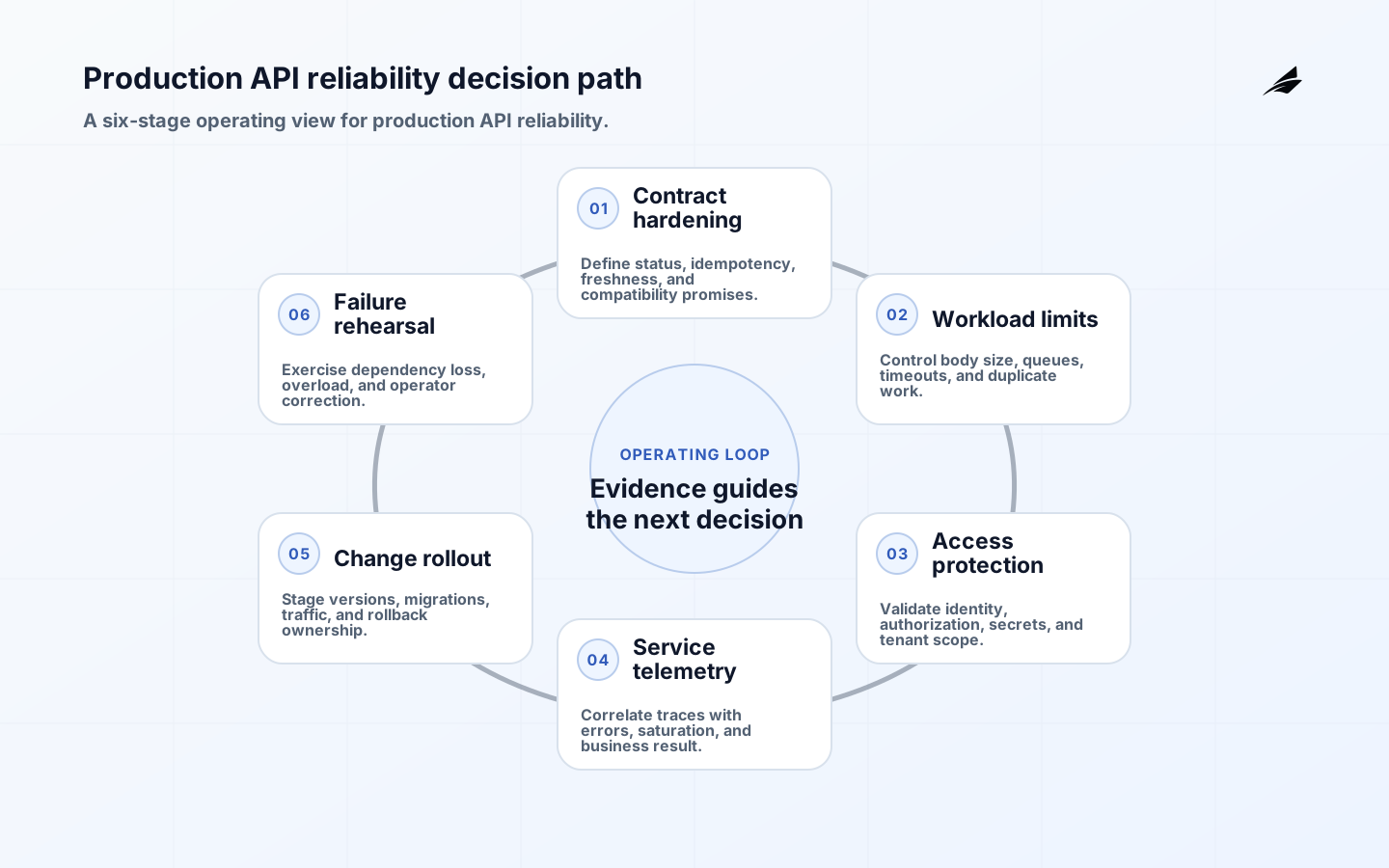
A production Node.js API is more than a responsive endpoint. It is a time-bounded operation with a caller, an authorization decision, downstream dependencies, duplicate-work risk, telemetry, and a recovery plan. This guide focuses on the changes required when an API moves from a successful demo to a service other teams and customers rely on.
Define the Node.js API contract before the handler for production API reliability
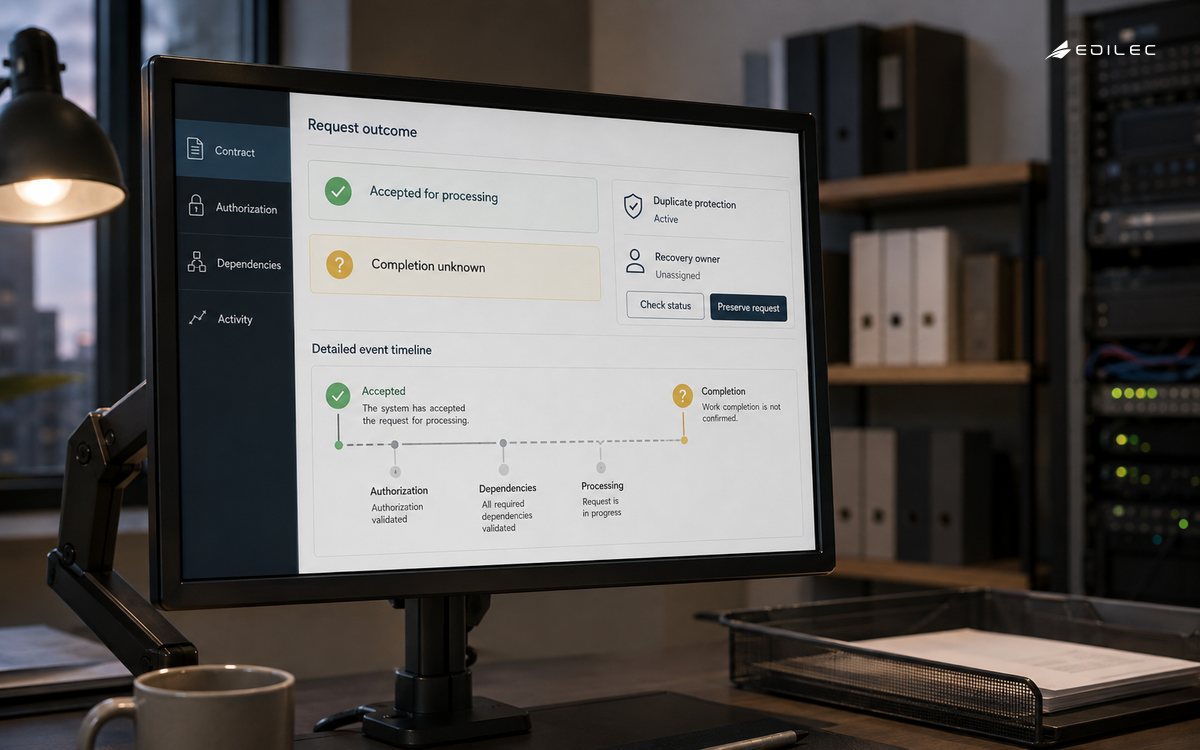
Write the contract from the caller's point of view. Name the resource or command, required fields, valid values, permission rule, response representation, and status for each expected outcome. RFC 9110 is a useful reference for HTTP semantics, while OpenAPI provides a machine-readable way to describe an HTTP API. Neither specification decides your business rules. It does force a valuable conversation about whether a request has succeeded, is accepted for later processing, conflicts with current state, or is invalid. Keep errors structured and stable enough for callers to act on, but do not disclose internal topology, secrets, or stack traces. Version deliberate changes; undocumented behavior is still behavior once clients depend on it.
| Concern | Contract decision | Production evidence |
|---|---|---|
| Input | Required shape and validation error | Rejected-field reason and rate |
| Identity | Authentication and authorization rule | Denied access audit event |
| Success | Synchronous result or accepted job | Correlation ID and outcome |
| Failure | Retryable versus terminal response | Dependency and timeout classification |
Control concurrency, timeouts, and duplicate work for production API reliability
Treat a request as cancelable work with a budget. Configure timeouts for inbound requests and downstream calls, propagate cancellation where libraries support it, and ensure resources are released when a client disconnects. Avoid expensive CPU work on the event loop; move it to an appropriate worker or service so one request cannot delay unrelated clients. Use bounded queues and concurrency limits around dependencies that cannot absorb unlimited parallel work. For commands that may be retried by clients, gateways, or queues, record an idempotency key or durable command identity before applying the side effect. A retry policy without idempotency is an instruction to create duplicate orders, emails, or state transitions under normal failure conditions.
- Set explicit deadlines for every outbound dependency call.
- Bound request bodies, pagination, concurrency, and queued work.
- Use an idempotency key for externally visible commands that can be retried.
- Keep CPU-heavy transformations off the main request path.
- Classify failures so callers and operators know whether retry is safe.
Make security checks part of the request path for production API reliability
Authentication establishes who or what made a request; authorization establishes what that identity may do to this particular resource. Keep those checks close to the command and data access boundary instead of relying only on a route prefix. Validate input before it reaches interpreters or data stores, parameterize database queries, and apply least privilege to service credentials. Limit error detail returned to callers while retaining protected diagnostic detail internally. Consider rate limits, quotas, and abuse controls as part of API design because they preserve service availability for legitimate callers. REST API contracts in production goes deeper on compatibility and representation choices; the Node service still needs to enforce the resulting decision at runtime.
| Risk | Practical control | Review signal |
|---|---|---|
| Overbroad access | Resource-level authorization | Denied versus successful access by role |
| Input abuse | Size limits and schema validation | Rejected request patterns |
| Dependency exhaustion | Timeouts, circuit breaking, and backpressure | Queue depth and dependency latency |
| Duplicate command | Idempotency record and reconciliation | Repeated keys and correction events |
Operate Node.js APIs with decision-ready telemetry for production API reliability
An API needs more than a total error percentage. Capture latency by route and outcome, dependency timing, queue age, saturation, deployment version, and a correlation identifier that follows a business operation. Avoid logging secrets or unbounded payloads; observability should not create a second data exposure. Define alerts around action: a sustained rise in timeout errors may call for traffic reduction or a dependency investigation, while an unexpected authorization denial rate may signal a client rollout problem. During release, compare the user-visible completion rate and reconciliation queue, not just process health. A server that returns 200 quickly while silently dropping a background action is operationally unhealthy.
Release API changes with an operational plan for production API reliability
Before deployment, identify callers, queued jobs, scheduled tasks, and operators affected by the API change. Roll out behind a bounded cohort or compatibility route when behavior is new, and keep a rollback condition such as a rise in a particular error class or a failed reconciliation. Test the deployed route through the same gateway, identity system, and network controls that production callers use; an in-process test cannot expose every header, timeout, proxy, or certificate issue. Update the runbook with expected states, safe retry rules, and the source of truth for diagnosis. After release, review a small sample of real correlation traces from request through side effect. That practice catches missing telemetry and unexpected client assumptions while the change is still easy to correct.
Review Node.js API behavior under pressure for production API reliability
- Send malformed, oversized, duplicated, unauthorized, and late requests through the deployed ingress so validation, proxy, and error behavior are observed as callers will experience them.
- Force a downstream timeout and confirm the request budget, cancellation behavior, cleanup, retry classification, and caller response all prevent a stalled dependency from consuming capacity indefinitely.
- Exercise the same command twice with one idempotency key and then with distinct keys to prove duplicate prevention and reconciliation work under real persistence conditions.
- Load a bounded concurrency test that includes slow dependencies and verify queue depth, event-loop delay, memory, and connection pools remain within the service's operating limits.
- Inspect logs and traces for one successful and one failed business operation to ensure a correlation identifier joins API intake, downstream work, asynchronous processing, and customer-facing result.
- Practice disabling a new route or rollout cohort and explain what happens to in-flight work, accepted jobs, retries, and users who have already seen a pending status.
Capacity planning belongs in API design when an endpoint can trigger expensive work. Establish the maximum request size, concurrency, dependency fan-out, and time a caller may consume, then test those limits before a marketing event or integration rollout discovers them for you. A clear refusal or queued result is often a better product response than accepting work the service cannot complete reliably.
Finally, document ownership for every dependency budget. A caller needs to know which endpoint owns the decision to queue, reject, or retry; an operator needs to know which upstream team receives evidence when a dependency exceeds its agreed behavior. Explicit budgets turn a vague performance complaint into an actionable service relationship.
Authoritative Node.js API references for production API reliability
Read Node's HTTP documentation alongside the IETF's HTTP Semantics to understand the runtime and protocol layers. The OpenAPI Specification supports durable API descriptions, and OWASP's REST Security Cheat Sheet provides security-focused review questions. Use them to check concrete contracts, not to replace testing against the systems and clients that will actually use the API.
Node.js API takeaways
- Defines success, pending, invalid, conflict, and failure states explicitly.
- Bounds time, concurrency, body size, and dependency work.
- Makes retried commands idempotent and reconcilable.
- Enforces authorization and validation at the resource boundary.
- Uses telemetry that connects process health to user outcomes.
Does Node.js handle parallel requests? Yes, its event loop handles many I/O operations efficiently, but CPU-heavy work and unbounded dependencies can still block useful progress. Should every endpoint be idempotent? Safe reads should be naturally idempotent; commands that may be retried and have external effects need an explicit idempotency strategy. What timeout should we choose? Set a budget based on the user expectation and dependency behavior, then make the caller's deadline shorter than the server's ability to do useful work. Are 500 errors enough? No. Callers and operators need stable classifications that distinguish invalid requests, conflicts, temporary dependency failures, and internal faults.
Reliable Node.js APIs come from disciplined contracts and controlled execution, not from route count. Make the request lifecycle explicit, bound the work, secure the resource, and retain enough evidence to recover when a real dependency fails.
Practical decisions for production API reliability
Give every dependency a time budget and every uncertain side effect a reconciliation path. Bound body size and concurrency, protect expensive queries, use backpressure, and test a slow provider with many callers. Watch saturation, rejected work, event-loop delay, connection-pool pressure, and queue age. Before changing a response or authentication rule, inventory clients and exercise additive changes with a small cohort. A production API earns trust when operators can explain what changed, who is affected, and what safe action is available.
Related reading for production API reliability
Compare this guide with What Changes When Rest API Contracts Move into Production, Test Strategy in Production: Confidence Without Slow Delivery, React State Design Decisions That Matter before the First Build. During contract hardening for production API reliability, these adjacent articles help connect the implementation choice to ownership, delivery, and operations.
Production Node.js APIs: Reliability Decisions Beyond the First Endpoint FAQ
What changes when a Node.js API reaches production?
Production adds explicit limits for concurrency, timeouts, downstream uncertainty, telemetry, compatibility, rollout, and operator recovery.
What is the practical starting point?
Set a time budget, duplicate-work rule, and actionable rollout signal for one endpoint before adding another reliability mechanism.
When should the team scale the approach?
Broaden the reliability program when the first service has known saturation behavior, useful traces, tested rollback, and owners for the resulting signals.
Conclusion: production API reliability
Production Node.js API reliability is the discipline of making limits and recovery visible before real load exposes them. Pair the request contract with access controls, telemetry, staged change, and failure rehearsal so endpoint correctness is only the beginning.