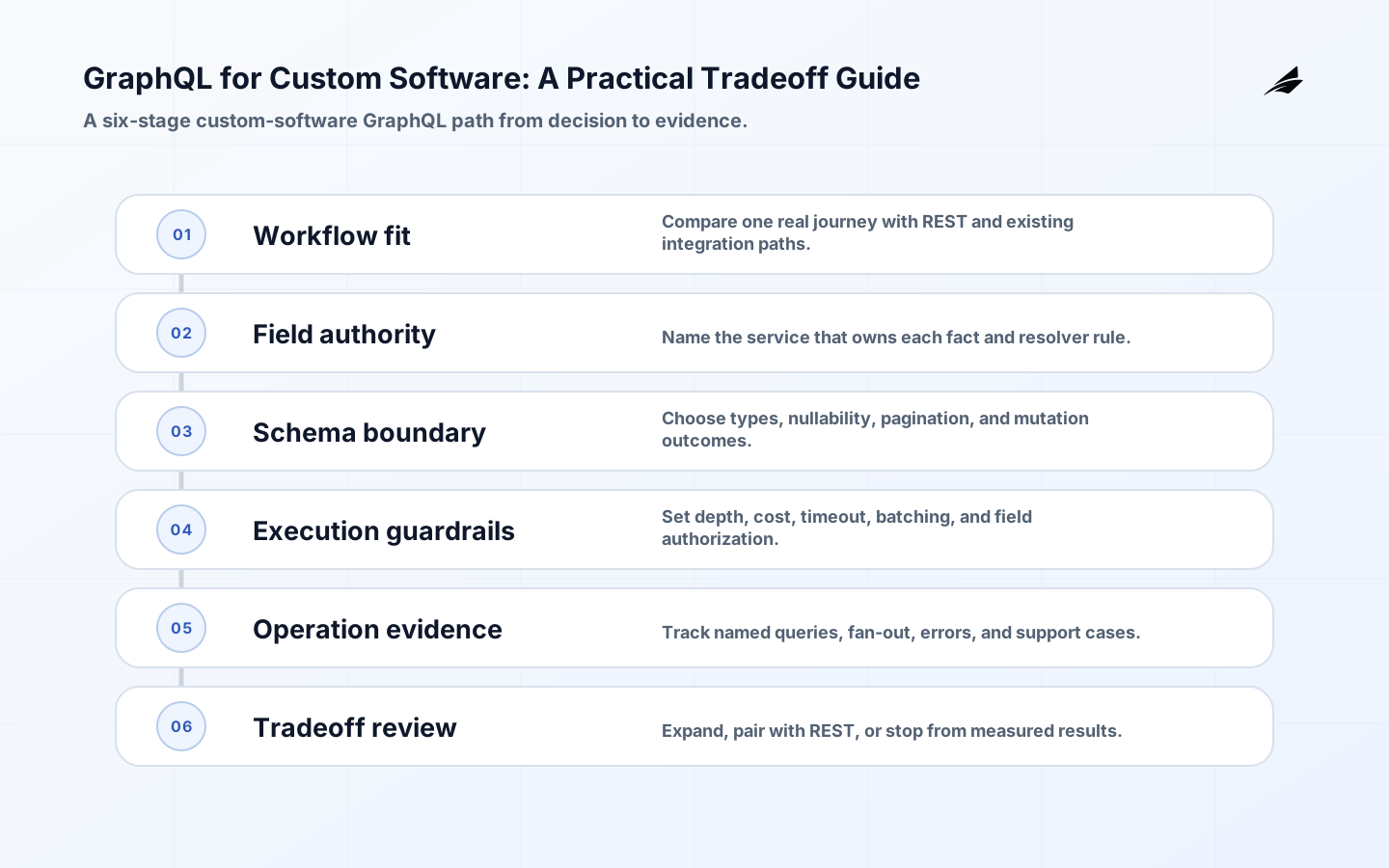
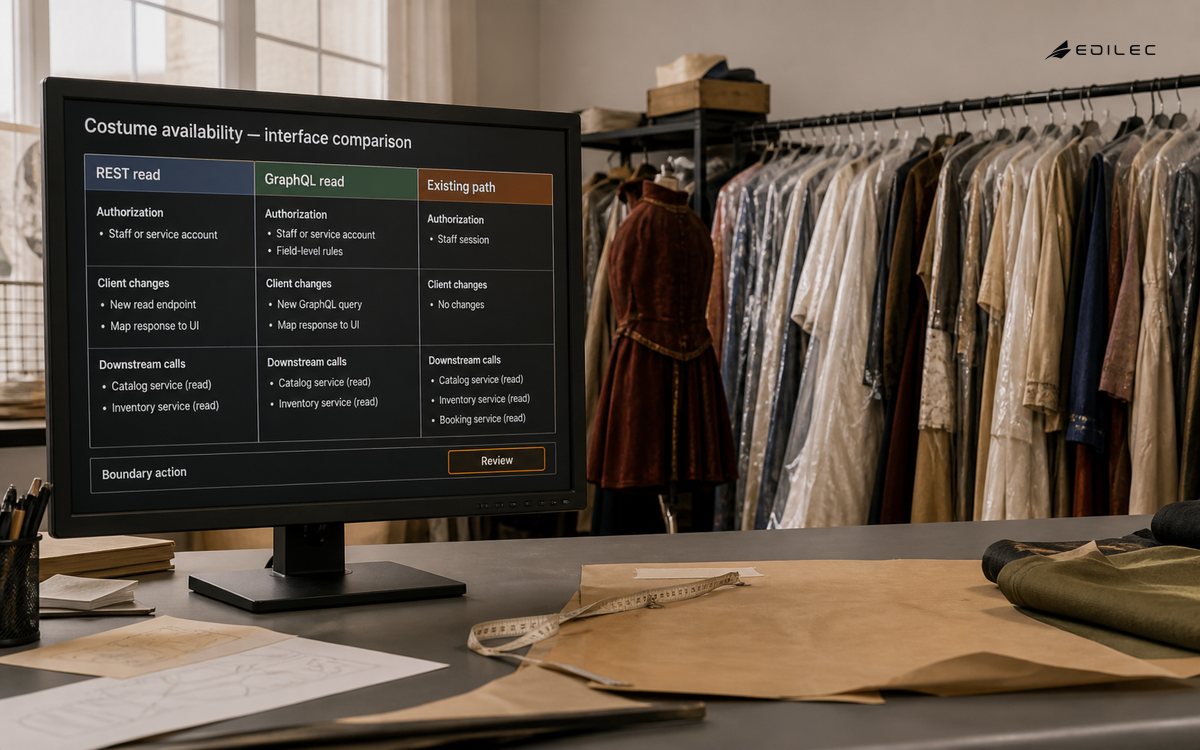
Choose GraphQL for the boundary that benefits from it. For custom software, compare one real workflow in three forms: a REST resource sequence, a GraphQL query or mutation, and the existing integration path. Score each against client change frequency, authorization granularity, caching, observability, downstream fan-out, and team ownership. This makes the tradeoff concrete. It may lead to a GraphQL read model beside REST commands, which is often more practical than converting every capability.
GraphQL tradeoffs are best understood as a set of operating commitments, not as a verdict that GraphQL is better or worse than REST. A graph can give product teams a precise, typed client interface and reduce round trips for connected screens. It also centralizes query planning, authorization, caching, cost control, and observability in ways that a founder should budget for before a public schema becomes widely used. This practical guide frames GraphQL tradeoffs as a production decision: make the boundary visible, choose controls that fit the risk, and keep enough evidence to revise the approach when real use contradicts the plan.
Set the GraphQL tradeoffs boundary
Use GraphQL when the client needs to compose related data across clear domain boundaries and the team can own the graph as a product. Do not introduce it merely to avoid designing resource contracts. The GraphQL specification defines the language and execution model, while its validation rules and execution model make the boundary concrete. The important local work is deciding which fields exist, what each resolver is allowed to reveal, and which service remains authoritative for the fact.
| Situation | Decision to make | Evidence to keep |
|---|---|---|
| Connected dashboard read | A view needs related facts from several services | Consider a graph with owned field resolvers |
| Partner command API | Consumer needs stable durable operations | Prefer explicit REST commands or webhooks |
| Deep relationship traversal | A query could expand without a natural bound | Require pagination and complexity limits |
| Sensitive field | Access depends on record context | Authorize inside the resolver, not only at gateway |
Make the critical GraphQL tradeoffs decisions explicit
Compare GraphQL and REST against the actual interaction pattern. A mobile or dashboard view with varied, connected read needs may benefit from field selection and a shared graph. A straightforward integration that needs durable commands, cacheable documents, or broad intermediary support may remain simpler with REST. It is common and sensible to use both. The decision should be driven by client composition, authorization complexity, change cadence, and operational capability rather than fashion.
- Which user or business outcome is GraphQL tradeoffs expected to improve, and how will the team recognize success?
- Which GraphQL type and resolver owns each field and its authoritative source?
- What do complete data, partial data, and a resolver error look like to the client?
- Which mutation must be idempotent, auditable, or subject to field-level review?
- What schema addition or deprecation can ship without weakening a client operation?
- Which operation metric and support example will be reviewed after release?
Deliver a small, testable GraphQL tradeoffs slice
Start with a small schema backed by owned domain services. Make nullability meaningful, document pagination, batch resolvers to avoid N+1 queries, and add query depth, breadth, and time limits before exposing the endpoint widely. Test authorization at the field and record level, including alternate query paths that reach the same sensitive fact. Persisted queries can make known client operations easier to identify and govern, but they do not remove the need for resolver-level controls.
| Failure pattern | Why it harms the workflow | Control to introduce |
|---|---|---|
| N+1 query pattern | One query fans out to repeated database calls | Batch or cache scoped resolver loads |
| Gateway-only authorization | Alternate fields reveal the same data | Apply policy at field and record boundaries |
| Unbounded query | A valid query exhausts downstream capacity | Enforce cost, time, and pagination controls |
| Schema permanence | Old fields remain forever | Deprecate with usage telemetry and an owner |
Operate GraphQL tradeoffs as a living capability
A graph needs telemetry that connects an incoming operation to resolver and downstream-service cost. The GraphQL best-practices guide explains several useful production concerns, while the OWASP GraphQL Cheat Sheet covers query limits and authorization risks. Track operation name, normalized query signature, execution duration, resolver errors, query complexity decisions, cache behavior, and downstream fan-out, while avoiding sensitive request values in logs.
Stress-test GraphQL tradeoffs before they become customer work
The classic failure is allowing an introspectable graph to become a convenient bypass around domain boundaries. A client discovers a field that reaches a database-backed resolver, then a later policy change has to be replicated across many paths. Another is treating field selection as automatic performance: one request can still trigger dozens of downstream calls or an expensive unbounded traversal.
- Run a representative query with valid, forbidden, partial, and expensive selections.
- Verify that client identity, field policy, schema version, and result path are discoverable.
- Test resolver timeout, stale source data, duplicate mutation, and concurrent-change behavior.
- Confirm that monitoring names the operation, field, and downstream capability.
- Give support a customer-safe explanation for partial data and a resolver escalation route.
- Document schema rollback, field deprecation, or mutation correction before traffic expands.
Measure whether GraphQL tradeoffs reduces friction
Measure p95 operation latency by named operation, resolver fan-out, rejected complex queries, authorization denials, cache hit rate, schema-deprecation usage, and database queries per request. These measures reveal whether the graph is simplifying client work without transferring hidden cost to the server.
Prepare a production rollout for GraphQL tradeoffs
GraphQL discovery should inventory the client screens and the ownership of every fact they need. A schema field is an API commitment, even when it reads conveniently from an existing database. Ask whether the field has a stable meaning, whether the viewer may see it in every relationship path, and what happens when its source service is slow. This avoids a graph that begins as a UI convenience and becomes the only undocumented map of business data.
Acceptance for a new graph operation should include a known query signature, bounded variables, field-level authorization cases, pagination limits, and a trace showing resolver fan-out. Run a realistic high-cost query as well as the intended screen query. The team should be able to reject or reshape the former with a clear client response, rather than discovering the limit during an availability incident. Test schema evolution with old and new client operations side by side.
Treat the schema registry and operation catalog as operational artifacts. They should show owners, deprecation state, usage, and the downstream systems touched by critical fields. That evidence lets a founder see the true ongoing cost of flexibility. It also makes an informed hybrid design possible: a graph for composed reads and explicit service endpoints or events for commands and integrations.
Make trade-offs visible to non-specialists through a simple operational budget: the maximum accepted query cost, which fields require elevated review, the team that owns schema governance, and the alert condition for a harmful operation. These are business choices expressed technically. They help a founder decide whether the flexibility delivered to clients is worth the ongoing cost of field-level controls, tracing, schema evolution, and expertise on the team.
Key takeaways for founders
- GraphQL Tradeoffs should be owned as a business and operational decision, not an isolated framework task.
- Define field authority, resolver failure behavior, and acceptance evidence before expanding the implementation.
- Release one meaningful GraphQL operation with observability and recovery instead of several unconnected features.
- Use GraphQL specifications and security guidance to shape contracts, controls, and maintenance choices.
- Review operation evidence regularly and retire schema assumptions that real use has disproved.
Custom-software GraphQL FAQ
What should the first GraphQL tradeoffs review decide? Custom-software GraphQL needs a bounded decision, an accountable owner, and evidence for the next change; this case records checkpoint 2 for that topic. How much design is enough? Custom-software GraphQL needs a bounded decision, an accountable owner, and evidence for the next change; this case records checkpoint 3 for that topic.
Custom-software GraphQL tradeoff check
Design the first schema for change you can observe
| Decision | Concrete test | Owner evidence |
|---|---|---|
| Scope | Name one journey and its non-goal. | Approved outcome and boundary |
| Authority | Identify the source of truth and correction route. | Owner, identifier, and audit record |
| Failure | Exercise timeout, duplicate, stale, and denied cases. | Observed response and recovery step |
| Change | State what can evolve without surprising a consumer. | Compatibility note and review date |
Name nullability deliberately, avoid generic JSON escape hatches, and define deprecation behavior before clients depend on a field. Cap query depth and list size, use persisted operations for trusted application traffic where appropriate, and expose correlation identifiers for support. Measure resolver latency and downstream calls by operation name; aggregate endpoint latency alone can hide a single expensive field.
- When should a team revisit GraphQL tradeoffs? custom-software GraphQL needs a bounded decision, an accountable owner, and evidence for the next change; this case records checkpoint 4 for that topic.
- Should every GraphQL edge case block the first release? No. Classify it, expose safe handling in the schema, and provide an accountable resolver recovery route.
- Who owns a GraphQL field decision? The domain owner and technical owner share it; support, security, and client teams contribute operation evidence.
Conclusion: make GraphQL tradeoffs easier to change and trust
GraphQL tradeoffs become durable when it is tied to a real workflow, an explicit owner, and feedback from production. Custom-software GraphQL needs a bounded decision, an accountable owner, and evidence for the next change; this case records checkpoint 5 for that topic. For custom GraphQL work, compare software modernization roadmaps, quality assurance for custom systems, and software support playbooks as adjacent boundaries.
For custom software, the GraphQL decision should begin with a specific workflow and a known integration burden. Compare the cost of composing fields in a graph with the cost of maintaining a REST or event boundary, including authorization, caching, retries, schema review, and incident diagnosis. A small query slice can reveal whether the graph removes duplicated client orchestration or merely moves coupling into resolvers. Keep the first release narrow enough that its owners can explain every field, downstream call, timeout, and customer-visible error. See the official reference 1 for the relevant protocol or guidance.
A custom-software team can test the GraphQL choice with one journey and a deliberately small schema. Compare the graph with a conventional endpoint or event contract for field ownership, authorization, caching, partial failure, query limits, and operational diagnosis. Document the downstream calls a resolver makes and the timeout behavior a client will see. If the graph reduces duplicated orchestration without creating an unowned composition layer, expand the slice. If it only hides coupling, stop or pair it with a simpler boundary.
The smallest useful proof includes a client, a domain owner, a failure case, and a supportable release path.
The practical proof should include a real client query, one authorization denial, one partial dependency failure, and a named team that can change the schema. Compare the result with a simpler endpoint so the graph earns its operational cost instead of inheriting it silently.
Frequently asked questions
For GraphQL for custom software, compare one real workflow with alternative interfaces and choose the smallest boundary that improves client change without hiding cost. What should a team decide first? Custom-software GraphQL needs a bounded decision, an accountable owner, and evidence for the next change; this case records checkpoint 6 for that topic. How much design is enough? Custom-software GraphQL needs a bounded decision, an accountable owner, and evidence for the next change; this case records checkpoint 7 for that topic. Can the work be iterative? Custom-software GraphQL needs a bounded decision, an accountable owner, and evidence for the next change; this case records checkpoint 8 for that topic. Which evidence matters after launch? Custom-software GraphQL needs a bounded decision, an accountable owner, and evidence for the next change; this case records checkpoint 9 for that topic. Custom-software GraphQL needs a bounded decision, an accountable owner, and evidence for the next change; this case records checkpoint 10 for that topic.