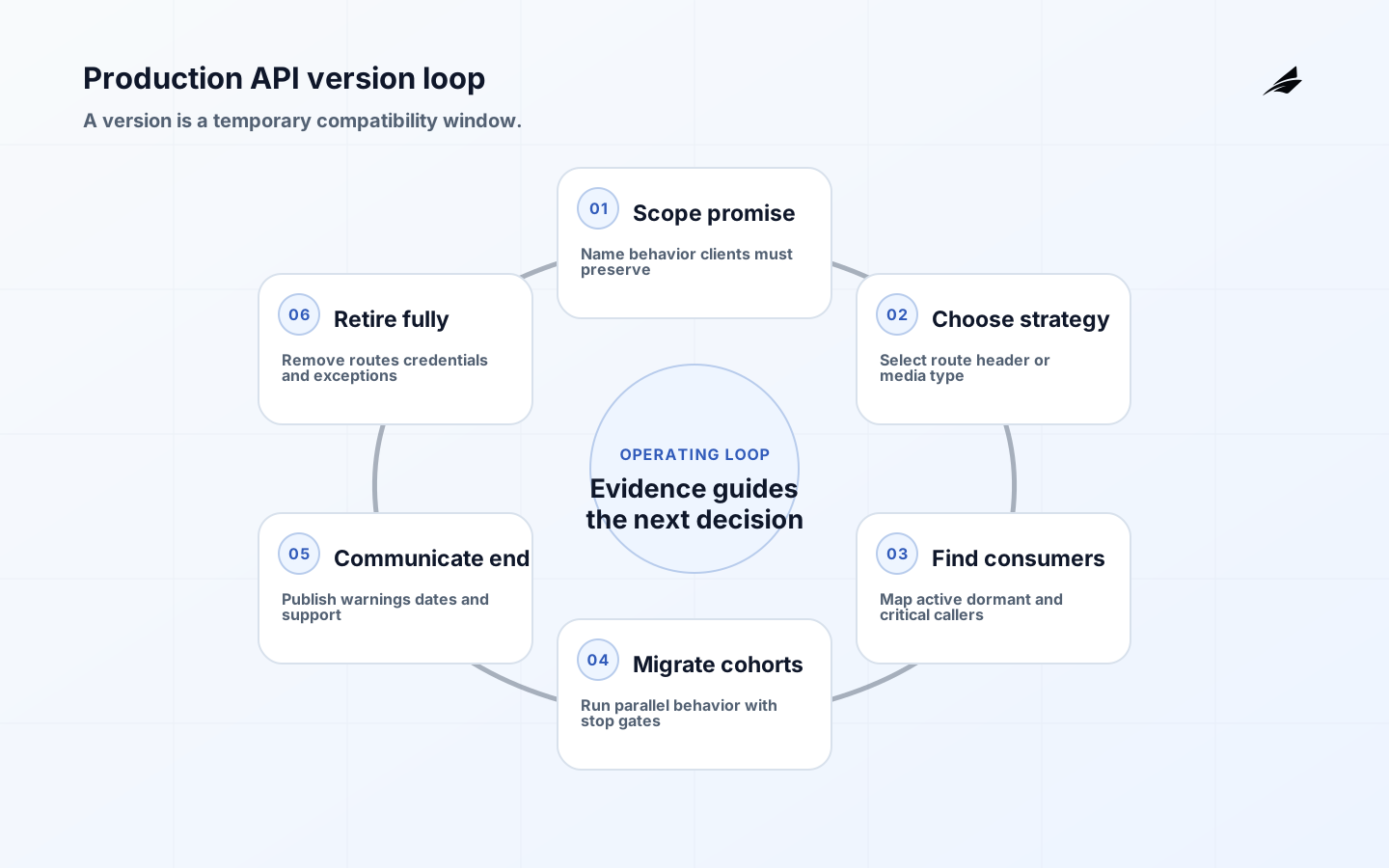
API versioning becomes a production problem when an interface has real callers, not when a team chooses a number for a route. In development, a breaking change may be a quick refactor. In production, it becomes a coordination problem involving mobile releases, partner schedules, data exports, caches, support commitments, security patches, and the team's ability to know which clients still depend on old behavior. A version is therefore a compatibility window with an operating cost, not a decorative label.
Good versioning gives consumers a predictable way to adopt change while giving the provider a credible way to remove old behavior. Decide what must remain stable, how a client selects a contract, how usage will be measured, which migrations can run in parallel, and what evidence closes the old path. The safest strategy is the one your gateways, documentation, SDKs, test suite, and support team can apply consistently.
Start with Edilec's REST API contracts guide for IT managers, REST API decisions before the first build, and error handling guide. Versioning only works when the underlying contract and failure behavior are already explicit.
Decide what the version actually protects
Name the compatibility surface before selecting a versioning mechanism. It may include URL paths, headers, media types, authentication scopes, field meanings, enum values, pagination order, error types, rate limits, idempotency rules, and side effects. A route that stays the same while a default changes can still break a client. Conversely, an internal implementation rewrite may require no new version if the observable promise remains intact.
Separate protocol and business compatibility. RFC 9110 defines HTTP method and representation semantics, while the product decides whether changing a status from pending to rejected alters a workflow. For each proposed change, write the consumer task, old result, new result, and acceptable migration behavior. This makes a review concrete and avoids arguing about whether a diff is technically additive when the user outcome is not.
| Change | Likely impact | First review question |
|---|---|---|
| Add optional field | Often compatible | Do strict parsers or generated models reject it? |
| Rename or remove field | Breaking | Can a replacement coexist with a clear precedence rule? |
| Narrow enum | Breaking for unseen values | What do old clients do with the new case? |
| Change default | Behavioral break | Which callers rely on omission meaning the old default? |
| Change sort or paging | Workflow break | Can clients still reconcile pages and deduplicate? |
| Change authorization | Security and availability risk | Which callers need new scope and how is denial handled? |
Choose a versioning strategy you can operate
A path version is visible and easy to route, but it can multiply documentation and monitoring. A header or media type keeps resource names stable, but proxies, caches, generated clients, and support tools must preserve and display the selected contract. Google’s API versioning guidance is a useful reference for stable resource identity and compatibility decisions; the right local choice depends on how consumers deploy and how your edge infrastructure handles content negotiation.
Do not create versions to avoid making a difficult compatibility decision. A new label with the same ambiguous errors, hidden defaults, or undocumented side effects simply moves the problem. Conversely, do not stretch one version beyond its promise because adding a migration layer feels inconvenient. Record the reasons, operational cost, support duration, and security implications for the selected strategy. A version should be easy to identify in requests, traces, logs, dashboards, and incident reports.
Find real consumers before you announce a cutoff
Inventory known clients from repositories, credentials, gateway configuration, partner agreements, SDK usage, jobs, exports, and support records. Then compare that list with production traffic and contract tests. Unknown callers are a risk, but traffic alone can miss dormant batch jobs, disaster-recovery images, or quarterly integrations. Record client owner, deployment cadence, data sensitivity, release route, last use, and ability to test the replacement. An old version with one critical partner is a different retirement problem from an old version used by thousands of disposable scripts.
Measure business completion where possible. A client can send a version header while failing to parse a new error or silently dropping a field. Sample outcomes with privacy controls, compare retries and fallback rates, and give support a way to distinguish old-version behavior from general service failure. Use Edilec's Node.js APIs for custom software as a related implementation lens: a clean service boundary makes version-specific adapters easier to isolate.
Run migration in compatible stages
Publish the new contract, examples, test credentials, fixtures, and migration notes before enforcing anything. Let providers serve both versions, or let an adapter translate at a controlled boundary, while consumers move. Canary internal clients first, then selected partners, then broader cohorts. Keep old and new results comparable for a meaningful period. If the two versions intentionally diverge, log the semantic difference and make the choice visible to the business owner instead of assuming a technical translation is lossless.
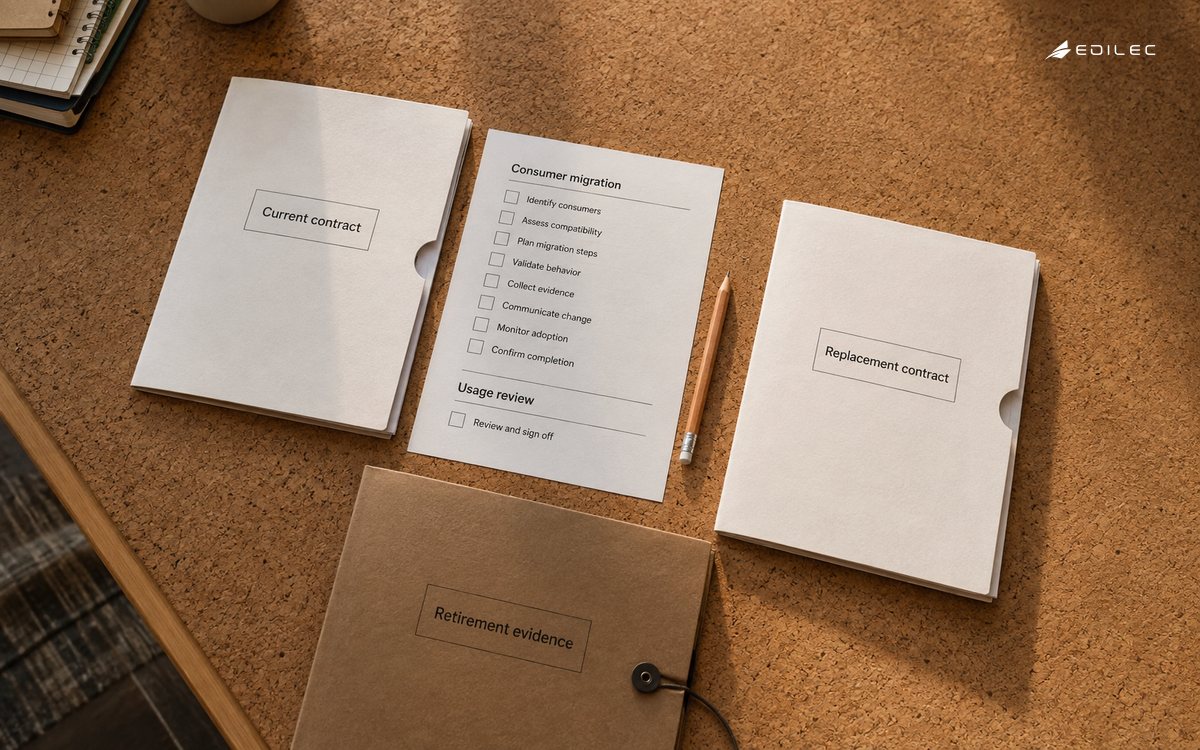
Define rollback in terms of compatibility rather than deployment alone. If the new version exposes a security defect, the team may need to block old behavior too. If only a migration bug appears, restore the previous consumer route while preserving completed business effects and avoiding duplicate replay. Every stage needs an owner, stop condition, support message, and evidence that the next cohort can be admitted. A date without an operational gate is a schedule, not a migration plan.
| Stage | Required evidence | Decision |
|---|---|---|
| Prepare | Contract, examples, fixtures, owner, and threat review | Ready for controlled consumers |
| Parallel | Both versions available with comparable telemetry | Behavior is explainable |
| Canary | Named clients complete representative workflows | Expand or repair |
| Warn | Deprecation notice and measured old traffic | Consumers have a real response path |
| Enforce | Old calls fail safely for a controlled cohort | Remaining callers are known |
| Retire | Traffic, commitments, credentials, and runbooks reviewed | Remove code and exceptions |
Communicate deprecation as a customer promise
A deprecation notice should name the affected version, the change, the reason, the replacement, the first warning date, the enforcement date, support contact, test route, and any behavior that cannot be translated. Use the channels consumers actually monitor. RFC 8594 defines a Deprecation HTTP response field for signaling that a resource is deprecated; it can complement human communication, but it is not a substitute for a migration owner or an agreed support window.
Make exceptions visible and temporary. A partner that cannot deploy before the cutoff may need a short extension, a separate adapter, or a commercial decision. Record why, who approves it, how it is isolated, and when it expires. Avoid a private permanent route that only one support engineer knows. During the window, patch and monitor the old version with the same seriousness as the new one; the OWASP API Security risks highlight inventory and authorization risks that grow when legacy surfaces are forgotten.
Retire the old version completely
Retirement is more than returning an error. Remove routing, credentials, SDK examples, schema entries, policy exceptions, test fixtures that imply support, and capacity reservations. Verify that caches, event consumers, scheduled jobs, recovery images, and external documentation no longer call the old path. Keep a short audit record of traffic, commitments, approvals, and the final change so an incident investigator can distinguish a planned removal from a missing route.
If the old version must remain for security or legal reasons, name it as a supported exception and fund its operating burden. It needs a patch path, access review, rate limits, monitoring, and a sunset trigger. A version that cannot be retired because its owner, usage, or replacement is unknown is a portfolio debt item. Put it on a visible roadmap rather than letting every future release carry the compatibility tax.
Use production evidence to improve the next release
After the migration, review what was harder than expected: an unknown client, a strict parser, an undocumented enum, a partner approval cycle, a cache that hid traffic, or a rollback that preserved infrastructure but not business state. Update the contract template, consumer inventory, telemetry, and procurement terms. The aim is to make the next change cheaper without assuming every API or partner has the same risk profile.
Track the remaining portfolio: active versions, age, consumer count, support cost, security exceptions, migration lead time, and retirement success. These measures are useful only when they change a decision. If an old version has no traffic but still appears in recovery code, the action is cleanup. If it has critical traffic and no owner, the action is governance. Production versioning is healthy when the service can explain both its current promise and the cost of changing it.
Key takeaways for production API versioning
- Treat a production API version as a compatibility window with a defined owner and cost.
- Classify changes from consumer-visible meaning, not only route or schema differences.
- Inventory real and dormant consumers before setting a retirement date.
- Use parallel behavior, cohort migration, explicit stop conditions, and business outcome evidence.
- Communicate deprecation through technical signals and human support routes.
- Retire routing, credentials, documentation, policy exceptions, and recovery paths together.
Production API versioning questions
When is a new API version justified?
Create one when the observable contract changes in a way that cannot be introduced compatibly and affected consumers cannot move together. Give it a clear support window, migration guide, owner, monitoring, and retirement gate. Do not use a version number to hide an unresolved semantic decision.
How long should an old API version remain available?
Set the window from consumer release cycles, contractual commitments, security exposure, operational cost, and evidence that the replacement works. Publish the dates and an exception route. A short window that no critical consumer can meet is not a plan; it is an unacknowledged outage risk.
Can a deprecated version remain indefinitely?
It can, but the organization must consciously fund support, patching, authorization, monitoring, capacity, and documentation for it. If nobody can name an owner or retirement trigger, record it as a risk and resolve the dependency rather than treating the route as free.
Conclusion: retire versions with evidence
API versioning in production is disciplined change management. Protect the parts consumers rely on, select a mechanism your platform can operate, inventory real usage, migrate in cohorts, communicate clearly, and retire old behavior with evidence. When versions are treated as temporary compatibility products rather than permanent branches, teams can evolve interfaces without turning every customer or partner release into a crisis.