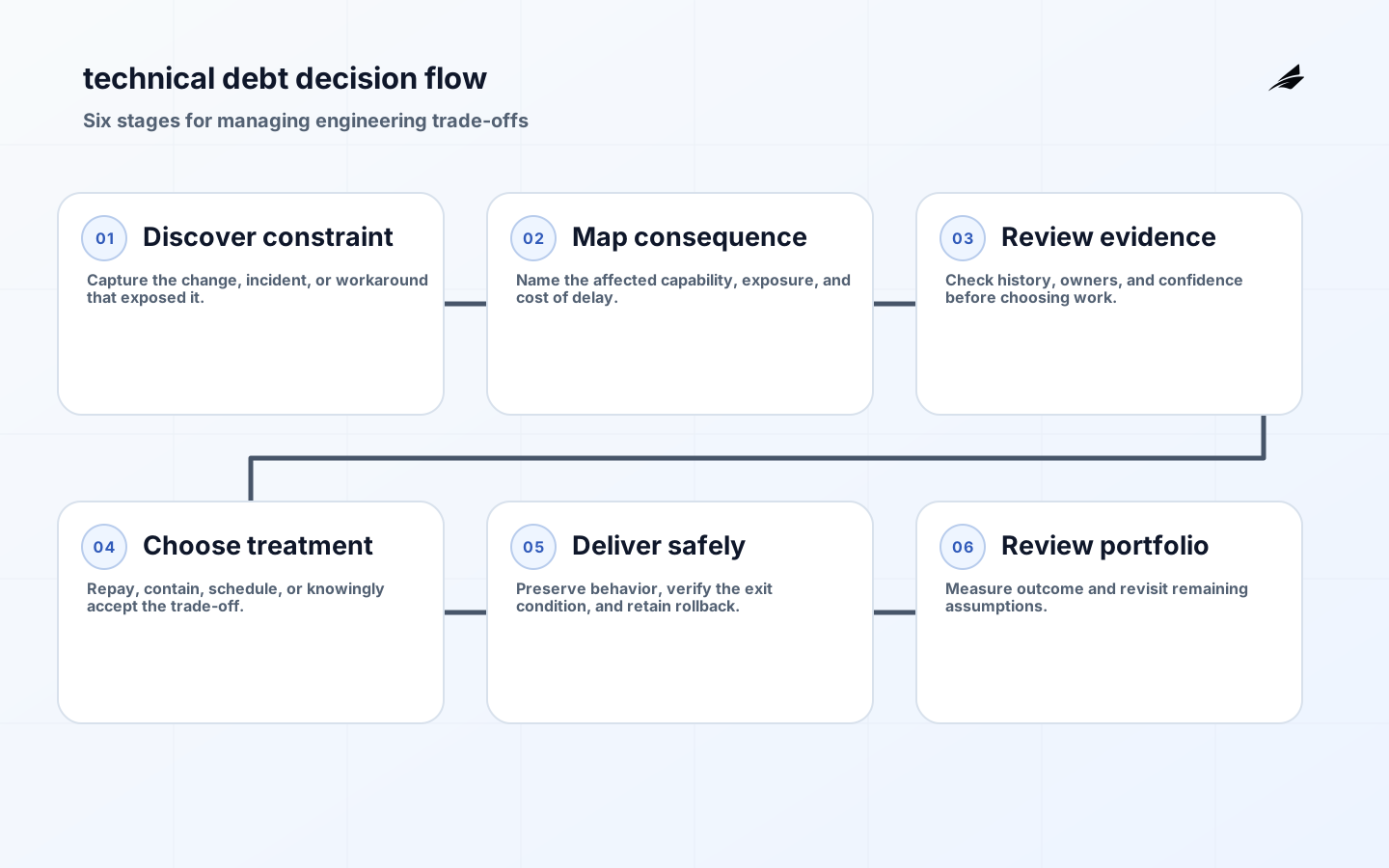
Technical debt is not a synonym for old code, a backlog label, or a reason to rewrite a system. It is the future cost and risk created when a technical choice makes later change, operation, or assurance harder. A shortcut can be sensible when it buys learning or protects a deadline; it becomes debt when its consequence is invisible, unowned, or continually deferred. The Software Engineering Institute's debt-management work is useful because it treats debt as something to make visible and manage in planning. That is the plain-language starting point: name the choice, the affected capability, the consequence, and the decision date. Teams can then discuss a real trade-off instead of arguing about code style in the abstract.
See debt as a portfolio of consequences
An item belongs in a technical debt portfolio when it has a credible link to a future constraint: slower delivery, higher incident exposure, security uncertainty, costly onboarding, or a blocked product decision. This definition includes architecture, tests, documentation, deployment pipelines, dependency versions, and operational controls. It deliberately excludes merely unfamiliar code. A module may look inelegant yet be stable, well understood, and cheap to change; a clean-looking integration may hide an unsupported dependency and be much riskier. Give every candidate a short consequence statement such as 'a schema change requires three manual reconciliations' or 'an authorization rule cannot be tested independently.' This creates a useful bridge from software modernization to day-to-day planning.

| Debt shape | Observable consequence | Useful first evidence |
|---|---|---|
| Design debt | A business rule is duplicated across services, so a policy change has an unpredictable blast radius. | Dependency map, change history, and a specific failed or delayed change. |
| Quality debt | Tests or environments do not detect a regression before release. | Escaped defect, flaky-test trend, and the missing acceptance scenario. |
| Operational debt | Recovery requires expert memory or an unsafe manual action. | Runbook gap, incident timeline, and time to restore a known failure. |
| Security debt | The team cannot show whether a sensitive path meets its required control. | Threat model, verification result, or an unreviewed authorization boundary. |
Inventory debt with evidence
A useful inventory is not a wish list of refactors. Start from evidence already generated by work: repeated support tickets, time spent locating ownership, failed deployments, slow reviews, vulnerability reports, and changes that touch too many files. Pair these signals with an owner who understands the capability, not simply the repository. GitHub's code-scanning guidance illustrates one source of repeatable evidence, but automated findings still require context and triage. Record scope, current workaround, likely consequence, confidence, and the smallest next investigation. This stops a scan result or a developer's intuition from becoming an automatic rewrite request. It also allows a product manager to see why a technical item matters without pretending that every risk can be reduced to a single severity score.
- Use incident reviews to capture the conditions that made diagnosis or recovery expensive, not only the immediate bug.
- Ask maintainers which change they avoid because the system gives them poor feedback or unclear safety boundaries.
- Separate an observed consequence from the proposed repair; several repairs may address the same constraint.
- Mark assumptions explicitly when an item is based on anticipated growth rather than an existing failure.
- Retire inventory entries once evidence shows that the consequence no longer applies or has been accepted by the accountable owner.
Prioritize by cost of delay and exposure
Do not rank debt only by estimated engineering effort. Compare the cost of carrying it with the cost and risk of treatment. A fragile payment reconciliation path deserves attention before a harmless internal abstraction because a failure affects money, trust, and recovery time. Frequency matters too: a five-minute workaround performed hundreds of times may be more valuable to remove than a rare annoyance. Google's monitoring guidance supports the discipline of choosing signals that explain a service's health rather than collecting every possible metric. For debt, track a few decisive measures: lead time for the affected change, incident recurrence, manual effort, and time to produce assurance evidence. Review those measures after the repair; otherwise the team has only a story about improvement.
| Decision | When it fits | Guardrail |
|---|---|---|
| Repay now | The item blocks a committed outcome, creates unacceptable exposure, or has a narrow safe repair. | Define a testable exit condition and protect product scope from expanding around it. |
| Contain | The root change is large but immediate harm can be reduced. | Add monitoring, an ownership path, or a temporary control with an expiry date. |
| Schedule | The consequence is real but can wait for a planned boundary such as a migration. | Keep the evidence current; do not treat a date as resolution. |
| Accept | The impact is low and stakeholders knowingly prefer the current trade-off. | Document the decision, review trigger, and person who may revisit it. |
Make repayment a product change
Debt repayment changes a system's ability to deliver, so it needs the same clarity as a user-facing change. State the capability being improved, the boundaries that must stay compatible, the migration or rollback path, and the evidence that will demonstrate success. A rewrite with no measurable constraint removed is an expensive bet. For a risky area, first add characterization tests, event logs, or a read-only shadow path; those investments make behavior visible before it is altered. Security-related remediation should also map to explicit verification expectations rather than a vague claim of hardening. The OWASP Application Security Verification Standard is a credible reference for defining testable security requirements. Link the work to authentication flows when the debt sits at an identity boundary, where a rushed change can create a new exposure.
Before approving a repayment item, hold a short challenge review. Ask which user or operator will notice the difference, which constraint will disappear, how the team will know the repair did not change a neighboring rule, and what work becomes possible afterward. For example, replacing a shared authorization helper may reduce security uncertainty, but the completion evidence should include exercised roles and a mapped migration of every caller, not a claim that the code is cleaner. This review also exposes items that are really feature proposals, capacity work, or missing product decisions. Keep those in their proper planning lanes. A debt portfolio gains credibility when it is willing to say 'investigate further' or 'accept for now' instead of converting every discomfort into a technical project.
Operate the debt portfolio
A portfolio works when it enters ordinary planning rather than an annual clean-up week. Review new items in the same cadence as incidents, roadmap changes, and major dependency updates. Give the review a limited purpose: confirm evidence, choose a treatment, check accepted risks, and remove stale entries. Product and operations partners should attend when they own the consequence, because they can explain timing and customer impact that the code alone cannot reveal. Keep a short decision record for material choices, including what was declined and why. This practice complements code review systems: review should catch local regressions, while portfolio management makes cross-release constraints visible. The outcome is not an empty backlog; it is a smaller set of understood promises.
- Measure age by consequence and ownership, not by the date a ticket was created.
- Set review triggers for incidents, upcoming regulatory changes, major product bets, and end-of-support dates.
- Reserve capacity transparently, but allow urgent evidence to change the sequence.
- Make temporary containment visible to on-call and support teams so it is not mistaken for a permanent fix.
- Publish completed outcomes: removed manual steps, shorter recovery, safer releases, or a retired unsupported component.
Key takeaways
- Technical debt is a future constraint created by a technical choice, not simply code that looks old.
- Evidence and a named consequence turn a subjective complaint into a decision a mixed team can make.
- Prioritize carrying cost, exposure, frequency, and the safety of the proposed treatment together.
- Repayment needs compatibility, rollback, and success criteria just as a feature does.
- A small, regularly reviewed portfolio is more useful than a vast refactoring backlog.
Technical debt FAQ
Is all technical debt bad? No. A deliberate, time-bound shortcut can be a rational investment when the team records what it traded away and when to revisit it. Should teams assign a single dollar value? Use monetary estimates when they are credible, but do not invent precision. Time lost, incidents, blocked commitments, and assurance gaps can be clearer evidence. Who owns the portfolio? The owner should be accountable for the affected capability; engineering leads maintain the technical evidence, while product and operations leaders participate in prioritization. When is a rewrite justified? When incremental change cannot safely remove the constraint, the target behavior is known, and the migration can be staged and verified.
Conclusion
The practical value of technical debt language is that it makes trade-offs discussable before they become emergencies. Start with one capability that is hard to change or recover, document the consequence and evidence, then choose the smallest responsible treatment. That discipline produces a debt portfolio that informs delivery instead of competing with it.