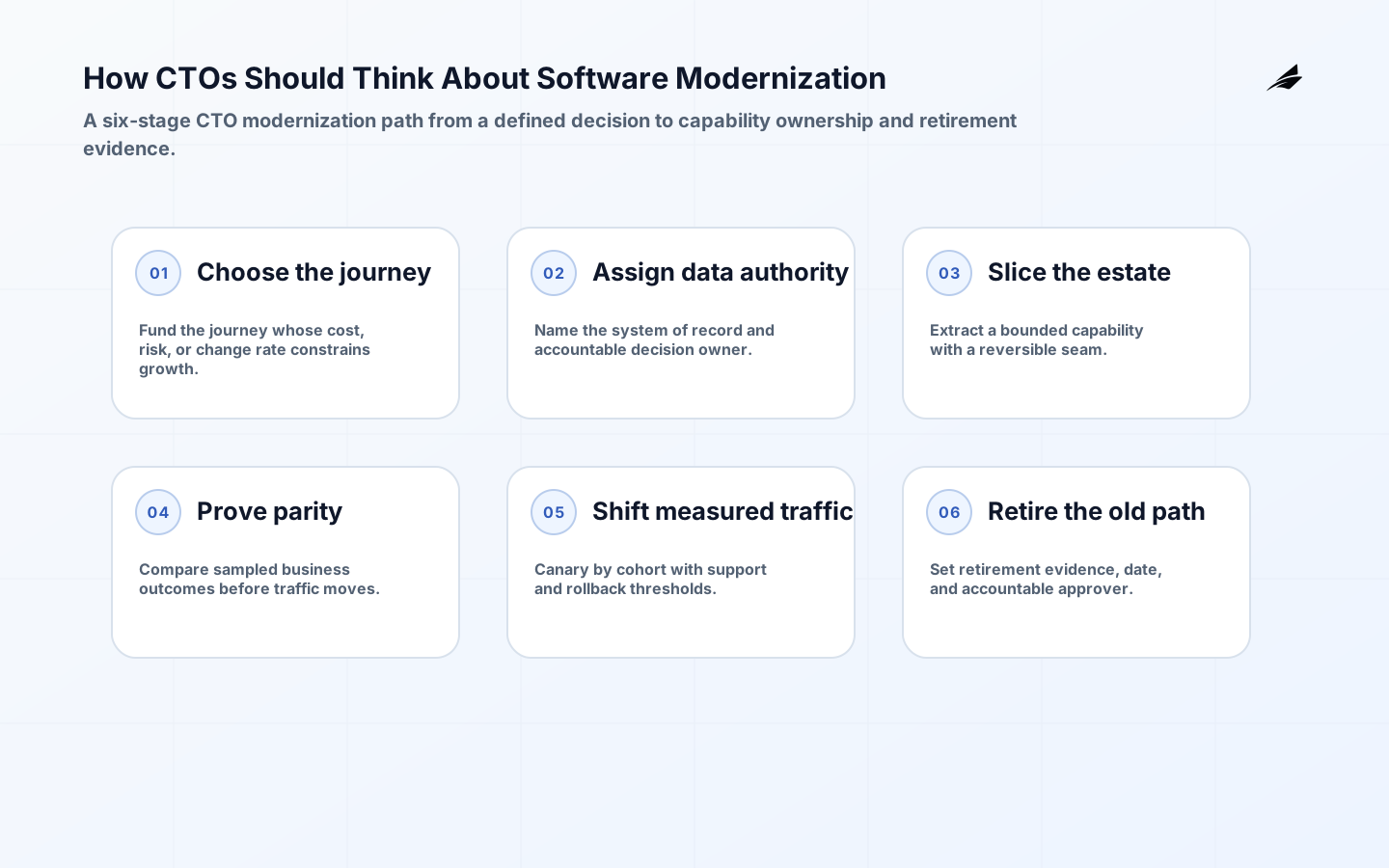
Software modernization is a portfolio decision, not a contest to replace every old component with a newer framework. (CTO intake evidence 1) CTOs should begin with the business journeys whose reliability, cost, or pace of change constrains the company. (CTO intake evidence 1) The aim is to improve those journeys while preserving the records, integrations, and operational knowledge that already keep the business running. (CTO intake evidence 1) This practical guide frames software modernization as a production decision: make the boundary visible, choose controls that fit the risk, and keep enough evidence to revise the approach when real use contradicts the plan. (CTO intake evidence 1)
Set the software modernization boundary
Map the system around capabilities and interfaces rather than repository names. A customer onboarding journey may span an old database, a partner API, a batch job, and a newer web application; replacing one of those parts is not modernization unless the journey becomes easier to change or operate. (CTO intake evidence 1) The Strangler Fig Application pattern provides a useful migration idea: place a new route around a bounded part of the legacy system and move responsibility deliberately instead of attempting a single cutover. (CTO intake evidence 1)
| Situation | Decision to make | Evidence to keep |
|---|---|---|
| Stable but costly system | It works yet blocks frequent business changes | Encapsulate first and target the constrained capability |
| Unsupported runtime | Patches or staffing are no longer viable | Prioritize a bounded replacement with security controls |
| Entangled database | Many applications write the same records | Assign data authority before extracting services |
| Batch-only visibility | Failures appear after customer impact | Add observability before moving traffic |
Make the critical software modernization decisions explicit
Choose modernization candidates by urgency of change, blast radius, data sensitivity, and the ability to observe outcomes. (CTO intake evidence 1) A capability that changes often and has a clear boundary is usually a stronger first slice than a central system with poorly understood data semantics. (CTO intake evidence 1) Decide explicitly whether the target is replacement, encapsulation, replatforming, or retirement. Those are different commitments with different evidence requirements.
- Which user or business outcome is software modernization expected to improve, and how will the team recognize success? (CTO intake evidence 1)
- Which system, module, or role owns each material decision and its authoritative data? (CTO intake evidence 1)
- What does a normal outcome, a delayed outcome, and an exception look like to a user? (CTO intake evidence 1)
- Which action must be idempotent, auditable, or subject to a higher level of review? (CTO intake evidence 1)
- What change can be released independently without weakening an existing customer path? (CTO intake evidence 1)
- Which metric and real support example will be reviewed after the release? (CTO intake evidence 1)
Deliver a small, testable software modernization slice
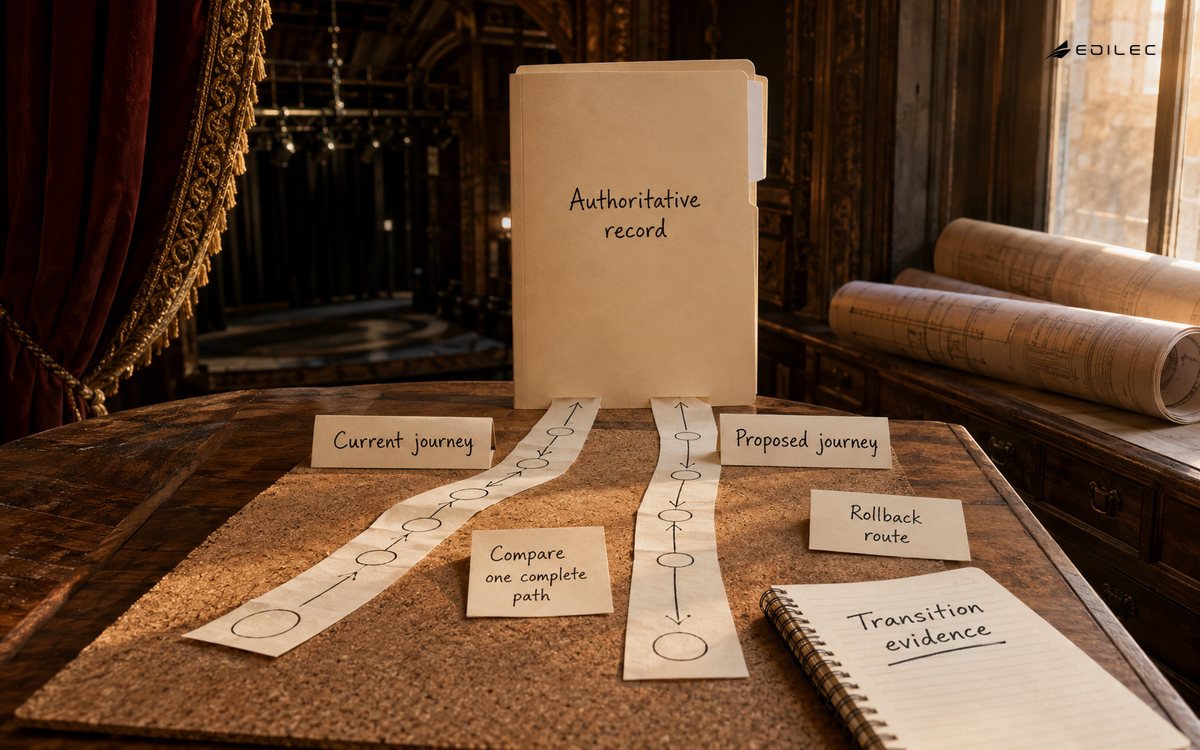
Build a thin vertical slice that includes the real contract, security rules, monitoring, and support path. (CTO intake evidence 1) Run it against production-like records, compare its outcome with the current path, and make rollback a product requirement rather than a deployment detail. (CTO intake evidence 1) When data must move, state whether the migration is a one-time copy, a dual-write period, or a source-of-truth transfer; ambiguity here is where reconciliation work multiplies. (CTO intake evidence 1)
| Failure pattern | Why it harms the workflow | Control to introduce |
|---|---|---|
| Big-bang cutover | Unknown edge cases surface together | Move traffic through a controlled route |
| Dual-write drift | Two stores disagree about an outcome | Use reconciliation and a named source of truth |
| Endless coexistence | Legacy cost persists without a retirement trigger | Set decommission evidence and a date |
| Platform-first roadmap | Technology changes without business outcome | Review capability measures with product leaders |
Operate software modernization as a living capability
Modernization should leave teams with clearer ownership, not a second estate nobody can support. (CTO intake evidence 1) Publish service boundaries, on-call expectations, dependency maps, and decommission criteria before traffic moves. (CTO intake evidence 1) The AWS modernization guidance emphasizes strategy choices; use that framing to make assumptions and acceptance criteria visible to finance, product, and operations. (CTO intake evidence 1)
Use the AWS migration-operations integration guidance to make operating ownership part of the modernization plan, not a post-cutover task. (CTO intake evidence 1) The AWS operational readiness guidance adds a concrete review for alarms, runbooks, support ownership, and recovery. (CTO intake evidence 1) For the architecture choice itself, the AWS modern application strategy helps compare replacement, replatforming, and incremental change against the target journey. (CTO intake evidence 1)
Review risks before they become customer work — CTO modernization
The expensive mistake is treating a platform migration as proof that the customer workflow improved. (CTO intake evidence 1) A new runtime can still preserve synchronous chains, opaque batch failures, and unclear data ownership. (CTO intake evidence 1) Another trap is keeping every legacy path "just in case" until the team owns both environments indefinitely. (CTO intake evidence 1) Define the evidence that allows retirement before the replacement grows complex.
- Replay a representative customer journey through the legacy and replacement paths, including delay and conflicting data. (CTO intake evidence 1)
- Attach the migration cohort, data owner, policy version, and resulting business state to the review record. (CTO intake evidence 1)
- Test the most likely retry, timeout, stale-data, or concurrent-change behavior. (CTO intake evidence 1)
- Confirm that monitoring names the affected capability rather than only the infrastructure component. (CTO intake evidence 1)
- Give support a modernization-specific customer message and an escalation route for an incomplete hand-off. (CTO intake evidence 1)
- Document the rollback or correction path before traffic is expanded.
Measure whether software modernization reduces friction
Measure delivery lead time for the target capability, incident frequency and recovery time, cost per transaction where relevant, and the proportion of traffic still using the legacy route. (CTO intake evidence 1) Pair those numbers with qualitative support evidence: can a responder locate the responsible service and explain a failed request without reconstructing history from several systems? (CTO intake evidence 1)
Prepare a production rollout for software modernization
A modernization discovery should produce more than an inventory. For each target journey, record its initiating event, users, data authority, dependencies, service objective, failure modes, and current manual reconciliation. (CTO intake evidence 1) This often exposes that the costliest risk is not a visibly old application but an undocumented handoff between systems. (CTO intake evidence 1) Bring the people who operate that handoff into the design review; their exception cases are part of the system behavior the new slice must either preserve or deliberately eliminate. (CTO intake evidence 1)
Define acceptance before migration begins. A new route should show comparable or better correctness for a sampled set of real scenarios, traceable ownership for failure, measured capacity under expected load, and a recovery process that does not require editing two sources of truth. (CTO intake evidence 1) For a regulated or financially material capability, include evidence retention and access reviews. (CTO intake evidence 1) This makes the go or no-go decision about the customer journey rather than an argument about whether a deployment succeeded. (CTO intake evidence 1)
Modernization programs also need an exit discipline. When a slice reaches its retirement threshold, remove obsolete infrastructure, credentials, monitors, runbooks, and data feeds alongside the old code. (CTO intake evidence 1) Leaving those artifacts in place creates false alerts and invites accidental routing back to the legacy path. (CTO intake evidence 1) The final review should verify that a new maintainer can locate the current owner and operational record without relying on the migration team. (CTO intake evidence 1)
A CTO can keep the program honest with a quarterly capability review. (CTO intake evidence 1) Compare the promised journey outcome with traffic migration, operational load, and the remaining retirement work. (CTO intake evidence 1) When the evidence shows that the new route is carrying the intended responsibility, move the next boundary. (CTO intake evidence 1) When it does not, correct the contract or ownership model before adding another platform component. (CTO intake evidence 1) This cadence turns a multi-year modernization ambition into a sequence of decisions that can be funded, stopped, or accelerated with real evidence. (CTO intake evidence 1)
Key takeaways for CTOs
- Software Modernization should be owned as a business and operational decision, not an isolated framework task. (CTO intake evidence 1)
- Define authority, failure behavior, and acceptance evidence before expanding the implementation.
- Release one meaningful path with observability and recovery instead of several unconnected features. (CTO intake evidence 1)
- Use standards and official documentation to guide contracts, security controls, and maintenance choices. (CTO intake evidence 1)
- Review production evidence regularly and retire assumptions that real use has disproved. (CTO intake evidence 1)
Software Modernization FAQ — CTO modernization
What should the first software modernization review decide? It should decide the valuable workflow, the authoritative owner for its critical facts, the failure that would cause real harm, and the smallest release that can prove a safer or faster result. (CTO intake evidence 1) [CTO modernization intake: it should decide] How much design is enough? Enough to make normal outcomes, exceptions, permissions, and rollback understandable to the people who will run the system; details can grow with evidence rather than speculation. (CTO intake evidence 1) [CTO modernization intake: enough to make]
- When should a team revisit software modernization? Revisit it after an incident, a material workflow change, a security finding, or a metric that shows rising manual recovery. (CTO intake evidence 1)
- Should every edge case block the first release? No. Classify it, make the safe handling visible, and provide an accountable recovery route. (CTO intake evidence 1)
- Who owns the decision? The business capability owner and technical owner share it; support, security, and client teams contribute the evidence that keeps the decision grounded. (CTO intake evidence 1)
Conclusion: make software modernization easier to change and trust
Software Modernization becomes durable when it is tied to a real workflow, an explicit owner, and feedback from production. (CTO intake evidence 1) Start with a narrow capability, protect the behavior people already depend on, and expand only after the operating evidence is clear. (CTO intake evidence 1) [CTO modernization intake: start with a] Related reading: software modernization roadmaps, quality assurance for custom systems, and software support playbooks.
A CTO should also reserve capacity for retirement work. Removing an old route, credential, monitor, and support habit is part of the modernization value, not cleanup after the program. (CTO intake evidence 1) Track that removal evidence beside the new capability so the estate becomes simpler as well as newer. (CTO intake evidence 1)
A CTO should reserve capacity for retirement work. Removing an old route, credential, monitor, and support habit is part of modernization value, not cleanup after launch.