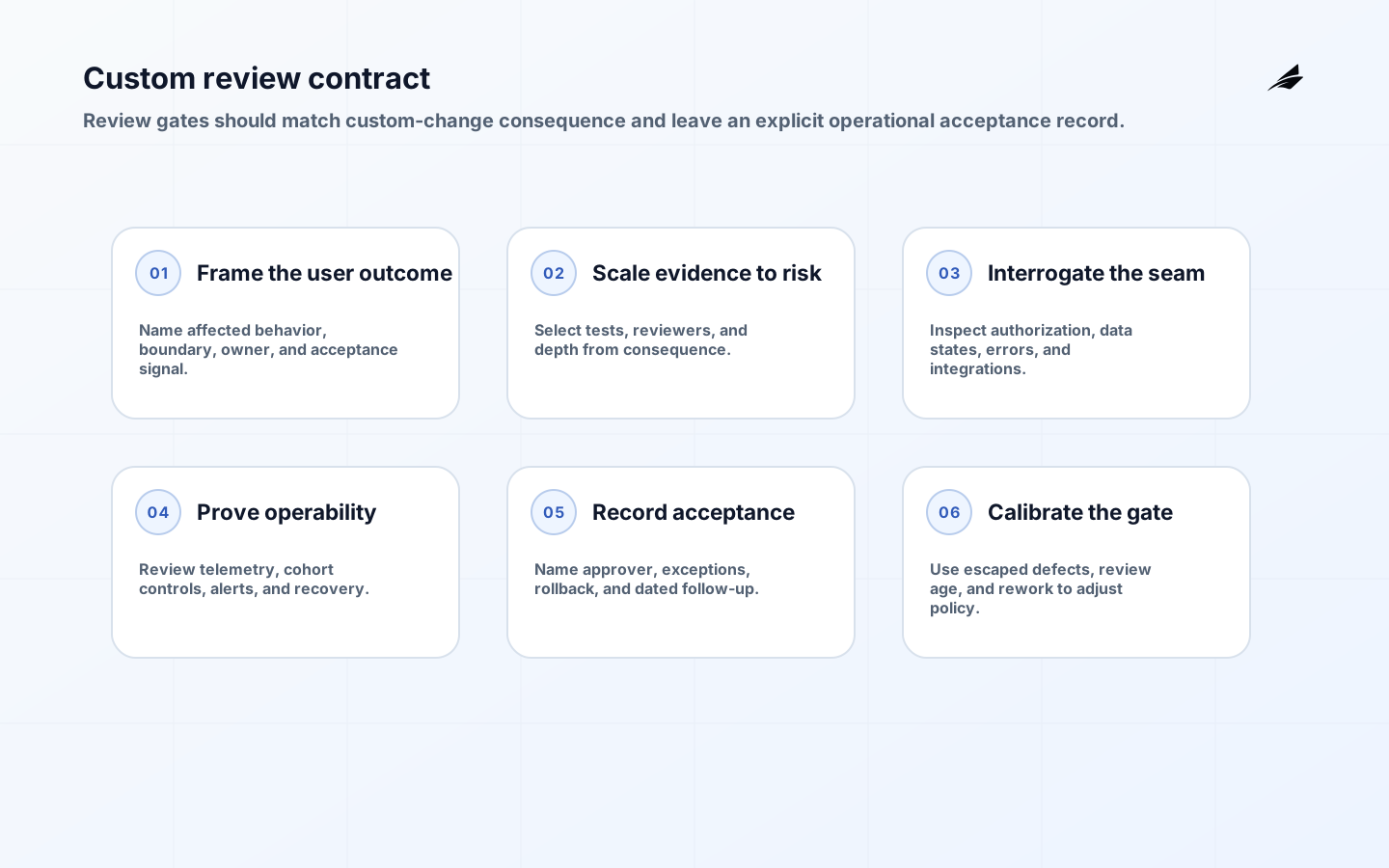
Code review systems for custom software should create confidence in a change without turning delivery into a ceremony of unread pull requests. Custom work often contains unfamiliar business rules, integration contracts, and operational assumptions, so the review system must make intent and consequence visible. Start by defining what review must establish, then place repeatable checks in automation and reserve human attention for judgment. Google’s code review guidance is valuable because it treats review as a team practice: quality, clarity, respectful feedback, and sustainable speed belong together.
Define the review contract
Every change should state the problem, the boundary, expected behavior, test evidence, operational effect, and rollback or follow-up. The reviewer should be able to answer whether the change is correct, maintainable, secure, observable, and appropriate for the user. Separate blocking issues from suggestions and state who can approve high-risk work. RFC 9110 and RFC 9457 are useful references when API behavior and error evidence are part of the review. A review system becomes predictable when authors know what evidence is expected and reviewers know which decisions they own. Templates should prompt reasoning, not collect empty checkboxes.

| Risk | Required evidence | Reviewer |
|---|---|---|
| Low | Build, formatting, focused tests | Peer or author |
| Business behavior | Examples, edge cases, regression test | Feature owner |
| Security boundary | Negative tests and threat notes | Security-aware peer |
| Release or migration | Rollback, monitoring, reconciliation | Operations owner |
Shape changes for human understanding
A reviewable change is coherent and small enough to explain. Separate mechanical movement from behavior where possible, keep intermediate states buildable, and avoid mixing a large refactor with an unrelated feature. Small changes reduce merge conflicts and make feedback actionable, but artificial fragmentation is equally harmful when no single commit reveals the real behavior. Track first response, time to decision, rework after review, and time to integration. Do not optimize the first number if the others show shallow approval or repeated reopening.
Automate evidence at the review boundary
Formatting, compilation, unit tests, dependency checks, secret scanning, static analysis, and policy checks should run before a reviewer spends scarce attention. Failures must explain the rule and the next safe action. Keep fast checks near the author and schedule expensive suites where their signal is worth the wait. For APIs, validate status, error shape, idempotency, and compatibility; RFC 9110 and RFC 9457 provide precise vocabulary for HTTP behavior and problem details. Automation should reduce noise, not replace a risk decision.
| Concern | Example question | Evidence |
|---|---|---|
| Behavior | What happens on a duplicate request? | Idempotency test and expected state |
| Access | Can a tenant read another tenant’s record? | Negative authorization tests |
| Failure | What if the dependency times out? | Bounded retry and recovery test |
| Operations | How will support detect and undo it? | Dashboard, runbook, rollback |
Review security, accessibility, and data boundaries
Reviewers should ask how identity is established, where authorization is enforced, what data is logged, and how secrets and dependencies are handled. For browser features, verify keyboard flow, focus, labels, errors, contrast, and responsive behavior against WCAG 2.2. For data changes, check retention, migration order, backups, and the possibility of partial writes. These concerns are easiest to miss when a change is presented only as a visual feature or a green build.
Connect review to release evidence
Approval is not the same as production readiness. Link the change to a tested deployment path, configuration, migration, alert, rollback, and owner. Use progressive exposure when the consequence is material. Review the degraded path, including rate limits, duplicate messages, partial integrations, and stale clients. Retain build and provenance evidence appropriate to the service. A review system is stronger when release operators can trace a deployed change back to the decision and its acceptance evidence.
Measure flow and learning
Use queue age, first-response time, change size, review rounds, rework, escaped defects, rollback frequency, and post-release incidents together. Segment by risk and team; a single average hides bottlenecks and dangerous outliers. Sample reviews for the quality of comments and the clarity of decisions. When a defect escapes, ask which evidence was absent, misunderstood, or too difficult to obtain. Then change the system: improve tests, clarify ownership, reduce coupling, or remove a low-signal rule.
- State the user or operational outcome before discussing implementation.
- Match reviewer expertise and evidence to the consequence of the change.
- Keep changes coherent, small, and easy to revert.
- Automate repeatable checks and make failures actionable.
- Include authorization, data, accessibility, and failure behavior where relevant.
- Use escaped defects to improve the review system rather than punish authors.
Takeaways
Custom software needs a code review system that makes unfamiliar decisions legible. Define the contract, shape changes for understanding, automate repeatable evidence, inspect security and operational boundaries, and measure whether the team reaches a confident release with less waiting and rework.
A custom review example
For a bulk update endpoint, the review record should identify the actor, allowed scope, maximum batch, idempotency behavior, partial success shape, audit event, rate limit, and rollback. Tests cover valid records, unauthorized records, duplicates, missing records, dependency timeouts, and retry. The reviewer checks that an operator can reconcile partial completion and that clients can understand the problem response. Release evidence includes a small cohort, a dashboard, and a switch. This is the kind of concrete decision guidance that makes a review system useful for custom software rather than a generic approval ritual.
Custom review gate signals
For a bulk update endpoint, identify actor, tenant scope, maximum batch, validation order, idempotency key, partial response, audit event, rate limit, notification, and recovery route. Test valid, mixed, replayed, duplicate, missing, unauthorized, timed-out, and retried requests. Inspect data ownership and whether support can find the request from a correlation id. Release to a small cohort with a dashboard and switch. If a bulk operation can be queued, do not force a long synchronous transaction; if confirmation is needed, return a durable request reference rather than pretending downstream work has finished. Record accepted risks and follow-up owners so later changes can distinguish intentional behavior from temporary coupling.
How to review high-consequence work
Start with the change record rather than the diff alone. Name the user outcome, data authority, identity and authorization rule, failure behavior, migration, alert, rollback, and owner. Let automation prove repeatable properties, then assign reviewers who understand business, security, and operation. Test duplicate, delayed, unauthorized, partial, and rollback paths. Release to a cohort and compare customer impact and correction work. If a reviewer cannot explain the expected state after a failure, the contract is incomplete. After deployment, sample traces and audit records to verify the evidence represented production. Keep accepted risks and follow-up visible, and expire them when the service changes.
A concrete review gate for custom software
Consider a bulk case-reassignment endpoint used by a support operations team. The change record should state who may invoke it, which tenant and queue scopes are allowed, the maximum batch size, how a retry is identified, what happens when only some records pass validation, which audit event is written, and how an operator reconciles the result. A green build is necessary but insufficient. Unit tests can prove selection and transition rules; contract tests can protect clients from changing status or error fields; integration tests can exercise identity, queue persistence, and notification boundaries; an end-to-end scenario can prove a valid batch, a mixed batch, a duplicate request, a denied request, a timed-out dependency, and a retry after an ambiguous response. The reviewer should inspect whether a long-running batch belongs in a queue rather than a synchronous transaction, whether a partial response gives a safe next action, and whether a support operator can find the request from a correlation identifier. A small internal cohort should receive the feature behind a switch, with metrics for processing time, correction, duplicate work, authorization denial, and queue age. After release, compare the cohort with the existing workflow and record accepted risks. This example turns review depth into a set of concrete decisions rather than an arbitrary approval count.
| Decision | Evidence to collect | Stop or change when |
|---|---|---|
| Scope | Representative workflow, owner, and measurable baseline | The boundary or outcome remains ambiguous |
| Safety | Negative, failure, recovery, and permission scenarios | A critical state has no tested response |
| Operations | Telemetry, runbook, capacity, and escalation | No named owner can respond |
| Release | Cohort, rollback, comparison, and acceptance record | The result cannot be compared with baseline |
Custom software also needs a review boundary for changes that cross code and operations. A new state may change reporting, permissions, notifications, retention, and runbook instructions even if the diff is small. Put those consequences in the review record and assign owners who can accept them. Treat emergency changes as a faster path with follow-up evidence, not as a permanent bypass. Reviewers should explain blocking concerns in terms of behavior and consequence, while authors should be able to answer without a private meeting. A manager can sample merged changes monthly, compare review age and rounds with escaped defects and rework, and remove checks that produce warnings nobody can act on. The system improves when it catches important risk early and keeps routine work moving.
Which review signal should change next?
Bring the review record to the service owner, data owner, and delivery owner. For custom software gates, choose the next control from observed behavior rather than from a target count of shipped features.
FAQ
Do all pull requests need the same approval count?
No. Use risk and ownership. A documentation change may need a light path, while a permission, data, migration, or release change needs reviewers who can evaluate the consequence.
What should API reviewers inspect?
Inspect compatibility, status and error semantics, authentication, authorization, idempotency, rate limits, observability, timeouts, and client behavior when the dependency fails.
How can review become faster without becoming weaker?
Keep changes understandable, automate low-level checks, publish ownership, rotate reviewers, and measure escaped defects and rework alongside queue speed.
Conclusion
A dependable code review system gives every custom change a proportionate path from intent to evidence to release. It protects quality while keeping the team moving because it makes the important questions visible and the routine ones automatic.