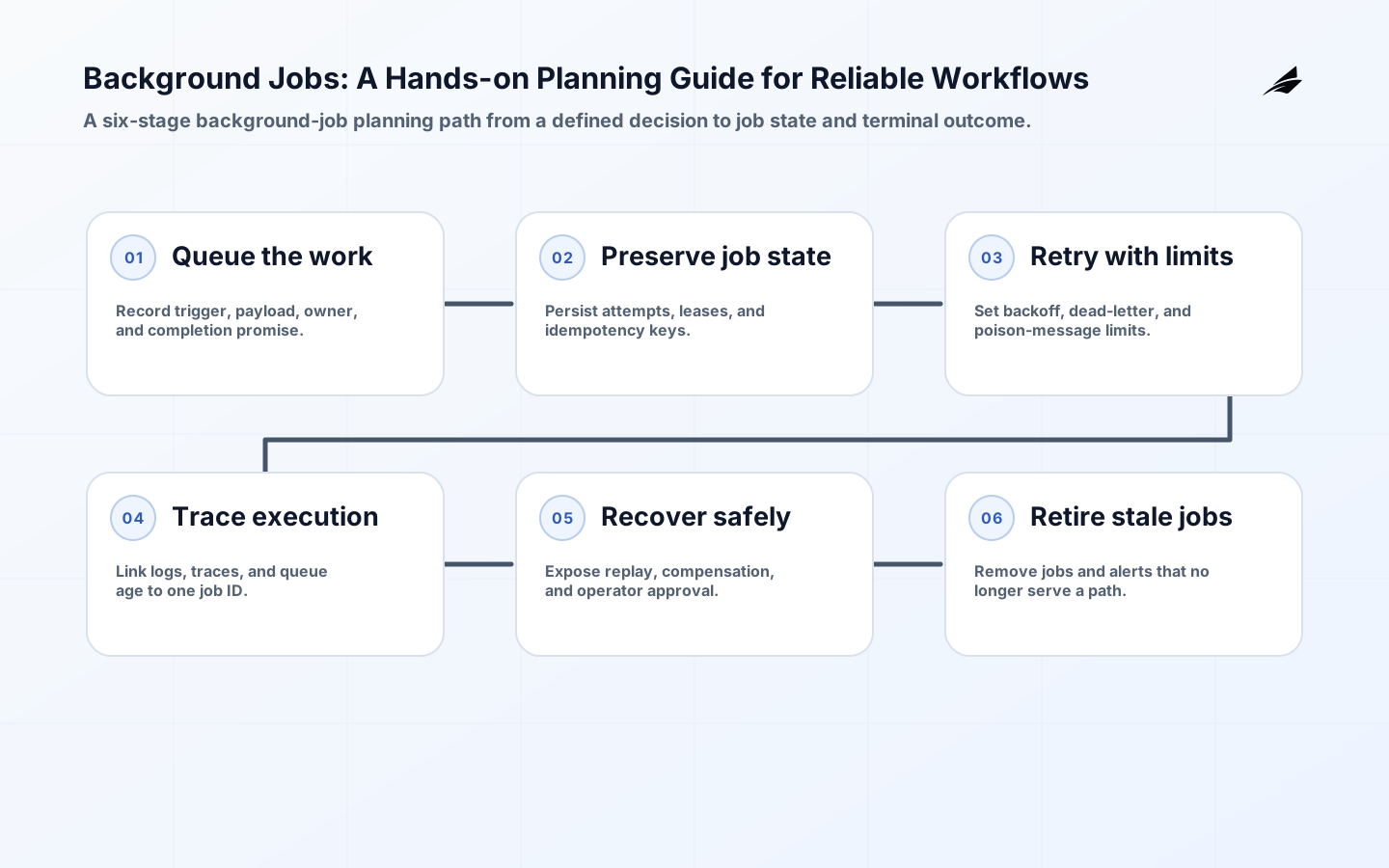
Background Jobs: Hands-on Planning Guide is a practical guide to background jobs for teams that need a result they can operate, not a fashionable architecture diagram. In this context, background-job work means durable work that continues after a request returns, with recorded state, an owner, and an explainable outcome. The work is valuable only when a person can see the promised outcome, understand its limits, and recover when reality disagrees with the happy path for a durable background-job workflow.
The planning move that changes the conversation is to begin with a decision boundary. For background jobs, Name the business completion rule before choosing a queue; an accepted message is a handoff, not evidence that an invoice, import, or notification is complete. That framing connects technical choices to the people who approve, perform, support, and audit the work for a durable background-job workflow.
Set the background jobs decision boundary
Name the business completion rule before choosing a queue; an accepted message is a handoff, not evidence that an invoice, import, or notification is complete Write the promise in plain language: reader, desired outcome, authoritative record, timing, owner, and intervention threshold. This prevents a technical handoff from being mistaken for completion.
For background jobs, a boundary also creates an honest non-goal. The first release does not need to solve every adjacent workflow. It needs an observable path with real state, a known exception, and a person who can make the next safe decision.
| Question | Useful answer | Evidence to keep |
|---|---|---|
| What outcome matters? | A concrete completion or decision. | Business record and acceptance example. |
| What can fail? | Named conditions with recovery paths. | Classification and owner. |
| Who decides? | A role able to change rules or stop rollout. | Decision log. |
| What proves success? | Behavior in the relevant environment. | Trace, test, or workflow record. |
Choose architecture that preserves the promise — background-job planning
Choose delivery semantics deliberately. Standard queues may deliver a message more than once, so consumers need idempotency. A workflow engine earns its cost when work crosses timers, people, or external callbacks. Draw the boundary between trusted state, side effects, and observability before implementation for a durable background-job workflow. It reveals where inputs are validated, who can trigger an effect, and how a later reader can reconstruct the decision for a durable background-job workflow.
In background jobs architecture, prefer interfaces that make safe behavior ordinary. Stable identifiers, explicit data ownership, reviewable change impact, and a modest first scope matter more than novelty. An architecture that the current team cannot explain or operate is not ready for broad adoption for a durable background-job workflow.
Implement one complete observable path — background-job planning
Persist an idempotency key, entity version, attempt count, and failure category. Couple the database update and the handoff with an outbox or equivalent transactionally safe pattern. Include authorization, real state, a representative error, and a visible outcome in the first vertical slice for a durable background-job workflow. A polished demonstration that skips those concerns can support a conversation, but it is not evidence that background jobs can carry production work.
- Name accountable business and technical owners.
- Capture a stable identifier for material actions.
- Exercise normal, invalid, and interrupted cases.
- Show state and next action to the relevant reader.
- Document correction, rollback, and communication steps.
| Choice | Use it when | Trade-off |
|---|---|---|
| Small pilot | Workflow and ownership are still being learned. | Some manual handling remains. |
| Guarded rollout | Happy path is proven but scope needs control. | Support coordination increases. |
| Broad adoption | Recovery and measurement are routine. | Governance costs become visible. |
| Redesign | Core boundary no longer fits the task. | Short disruption prevents a larger false economy. |
Design the failure path before scale — background-job planning
The seductive failure is a dashboard that says queued while a customer-facing effect failed later. Poison messages, ambiguous timeouts, and endless retries need explicit terminal states and reconciliation. Put failure states beside the happy path. The team should know what is retried, reversible, or sent to human review, and how a user or support agent finds current state without needing raw infrastructure access.
- Could a timeout leave an ambiguous result?
- Can a repeated action cause a second effect?
- Does a public message reveal too much?
- What happens to late, missing, or unauthorized data?
- Who notices, and what can that person do?
Operate from signals instead of anecdotes — background-job planning
Track oldest eligible-job age, acceptance-to-business-completion time, retry distribution, dead-letter reasons, and duplicate suppression. Trace request, enqueue, worker attempt, and downstream call with a business identifier. Review these with the people receiving the consequences, not solely maintainers. Combine technical timing, business completion, support evidence, and a small sample of real cases to determine whether the stated promise holds.
Establish a baseline before changes and annotate releases, policy changes, and unusual load. That turns “it got worse” into an investigation with evidence. The best background jobs metrics connect a system event to the person or record affected.
Capacity planning for background jobs starts with the work profile, not CPU count. Measure arrival bursts, payload size, service-time percentiles, dependency limits, and the maximum acceptable age for each priority class. Reserve a bounded concurrency pool for slow external systems so a vendor incident cannot consume every worker. When a job changes data, record the version it expected and make the reconciler compare that expectation with current state before retrying. This is the difference between recovering a delivery attempt and replaying a business decision.
Recovery drills should include a worker crash after an external call, a duplicate delivery, a poisoned input, and a deliberately unavailable dependency. Practice finding the affected operation from the customer record, explaining the state to support, and repairing it without editing a queue by hand. Those exercises expose missing identifiers, unsafe retry defaults, and dashboards that describe infrastructure rather than completion.
Priority is a business policy, not a queue property. Define which jobs may overtake others, what deadline makes a result stale, and whether a customer can cancel or amend work while it waits. A single FIFO rule can be correct for a ledger and wrong for notifications; a high-throughput queue can be correct for image conversion and unsafe for ordered account changes. Encode that distinction in job type, admission control, and runbook language rather than relying on worker folklore.
Make ownership and change behavior explicit — background-job planning
Treat retry policy and payload retention as product and security decisions. Review failures with support owners, especially where a retry can delay or repeat an irreversible action. Version decisions that affect consumers, retain enough history for audit and learning, and make current rules easy to find for a durable background-job workflow. Maturity means a new team member can understand a problem and take the next safe action without private memory for a durable background-job workflow.
The technical foundation for this approach is Temporal durable execution and Amazon SQS delivery semantics. Those references describe mechanisms and standards; applying them responsibly still requires a local decision about users, risk, and operating constraints for a durable background-job workflow. Additional implementation context appears in PostgreSQL transaction isolation and OpenTelemetry traces.
Related engineering decisions — background-job planning
Adjacent decisions often decide whether background jobs succeeds in practice. Read Production Test Strategy: Evidence, Risk, and Release Decisions, Monorepo Structure: Cost, Ownership and Scaling Guide, How CTOs Should Think About Caching Strategy to connect this topic with testing, architecture, delivery, and operational ownership. These are design context, not a substitute for observing the workflow in front of you.
Key takeaways for background jobs
- Background jobs are a contract for a real outcome, not a tool configuration.
- Name ownership, authoritative state, recovery, and evidence before expanding scope.
- Use a complete pilot to learn the failure path as well as the happy path.
- Measure the promise in the workflow where people rely on it.
Background jobs FAQ
What should be decided first? — background-job planning
When does work need durable state? When it outlives a request, crosses a failure boundary, or requires a later explanation.
What is the most common planning mistake? — background-job planning
How are retries chosen? Retry bounded transient faults with jitter; stop known validation or authorization failures.
When is the work ready to expand? — background-job planning
Should a user wait? Return an operation identifier and visible state when the work is material.
Conclusion: make background jobs accountable before scaling it
The durable test for background jobs is straightforward: can the team describe the promised outcome, show current state, recover from a known failure, and explain the decision to the person affected? Begin with one accountable path, retain evidence that matters, and widen adoption only when that path behaves reliably for a durable background-job workflow. It is a quieter form of progress, but it creates software that earns trust under ordinary pressure for a durable background-job workflow.
Background Jobs: A Hands-on Planning Guide for Reliable Workflows: a decision example
Begin with the business promise, not the queue technology. “Send the renewal notice” is not the same as “place a message on a queue.” Name the record that proves the notice was accepted, the recipient who owns the next action, and the maximum acceptable delay. A worker can then report queued, processing, sent, retrying, or parked without asking support to infer meaning from logs. For a billing export, the durable outcome might be an export record with a download location and checksum; for image processing, it might be a versioned derivative tied to the source object. The promise determines the state model, retention period, and recovery path.

Make the background-jobs delivery decision inspectable
Choose delivery semantics per side effect. At-least-once delivery is often a practical default, but it requires an idempotency key and a durable record of the effect. Store that key at the boundary that owns the effect, not only in the worker memory. If a payment provider accepts a request and the process dies before saving success, the retry should query by the provider reference or idempotency token before creating a second charge. AWS guidance on retries and idempotency makes the same distinction: repeating an operation is safe only when the effect is deliberately made repeatable. Backoff should also have a ceiling and a human disposition.
Capacity planning should follow queue age and business deadlines together. A queue with low average depth can still breach a promise if one partition is stuck or a poison message blocks a fair-share lane. Track oldest age, attempt count, processing duration, success rate, and parked work by job type. Set alerts against an action: add workers, pause intake, inspect a dependency, or contact an affected customer. Keep concurrency bounded around the slowest downstream service. A worker that maximizes local throughput while overwhelming an external API is not healthy capacity.
Rehearse the awkward middle states before launch. Stop a worker after its external call and before its final database write; replay the job and prove the result is harmless. Expire a lease while the first worker is still running. Send malformed input to the dead-letter path and require a responder to identify the source, version, attempts, and safe next action. Link the job identifier to customer-facing status and a support search. This makes background work a product capability with an accountable recovery process rather than an invisible pile of asynchronous code.
Frequently asked questions — background-job planning
What should be decided first? Start with the user-visible outcome, the accountable owner, the evidence of completion, and the failure or correction path. Technology follows those constraints.
How do we keep the first release manageable? Choose a bounded vertical slice with real users, representative failure cases, and a rollback or containment route. Expand only when the operating evidence is clear.
What should be reviewed after launch? Review the agreed outcome, exceptions, support effort, cost, recovery behavior, and any change in risk. Turn the findings into a named decision, not an unowned backlog.
Conclusion — background-job planning
A dependable background-job design makes the promise, state, recovery route, and next review explicit before volume rises.