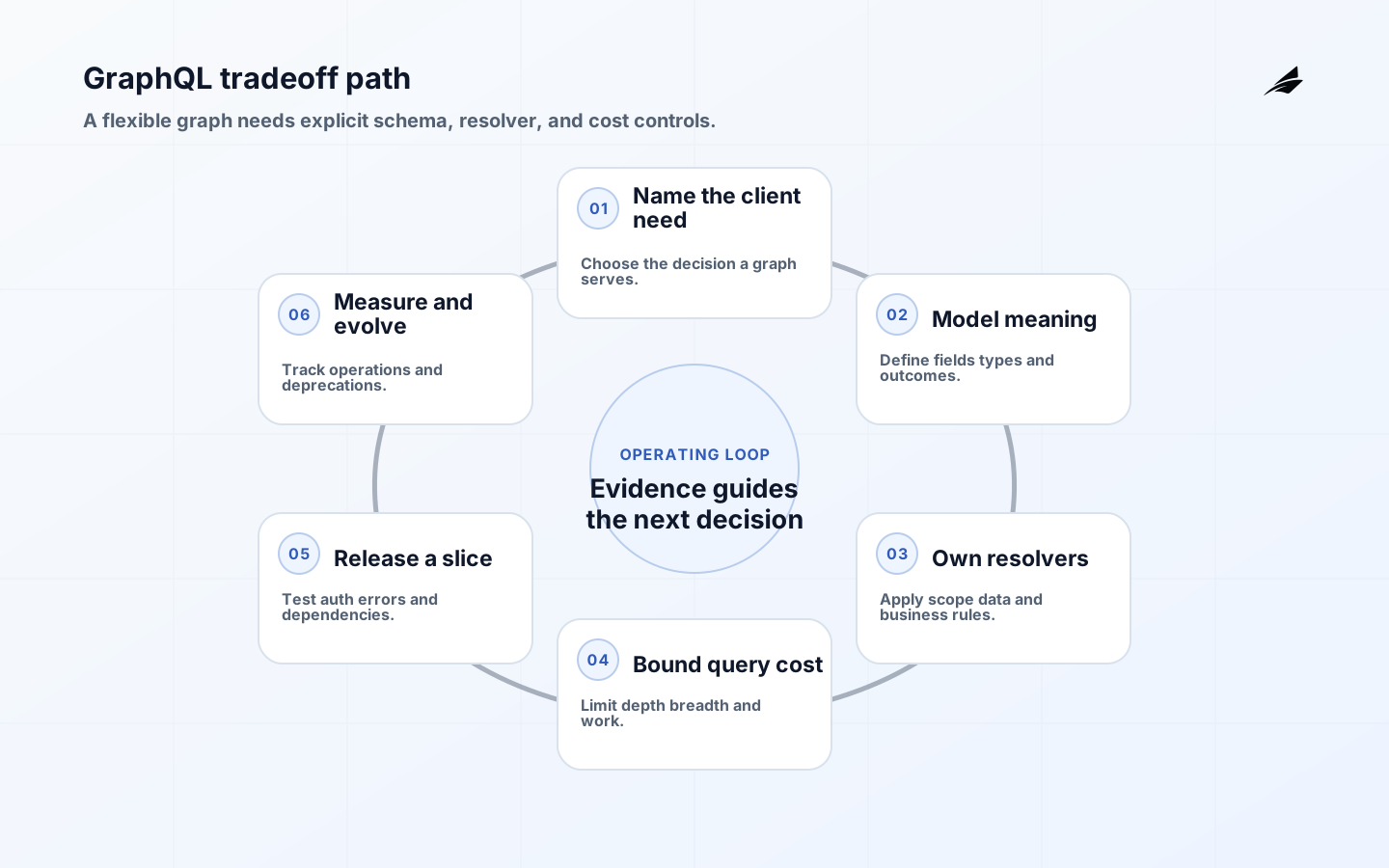
GraphQL tradeoffs are easiest to understand when the question is not “Is GraphQL better?” but “Which client and operating problem does a graph solve, and what responsibility does it add?” A typed schema can let a client request related fields without waiting for a new endpoint for every screen. It can also make resolver cost, authorization, caching, errors, and evolution less visible than they are in a collection of resource routes. The GraphQL schema guidance grounds the language and type model; the application still has to decide which data may be requested, by whom, at what cost, and with what recovery.
Make the GraphQL boundary explicit
Start with a client decision that needs related data: a portfolio view, a case workspace, or a mobile screen that combines a customer, current task, and next action. Identify the data authority, permission boundary, freshness requirement, and acceptable latency. If the client only needs simple create, read, update, and delete operations with stable representations, a REST contract may be easier to operate. The plain-language REST API contracts guide helps frame that comparison.
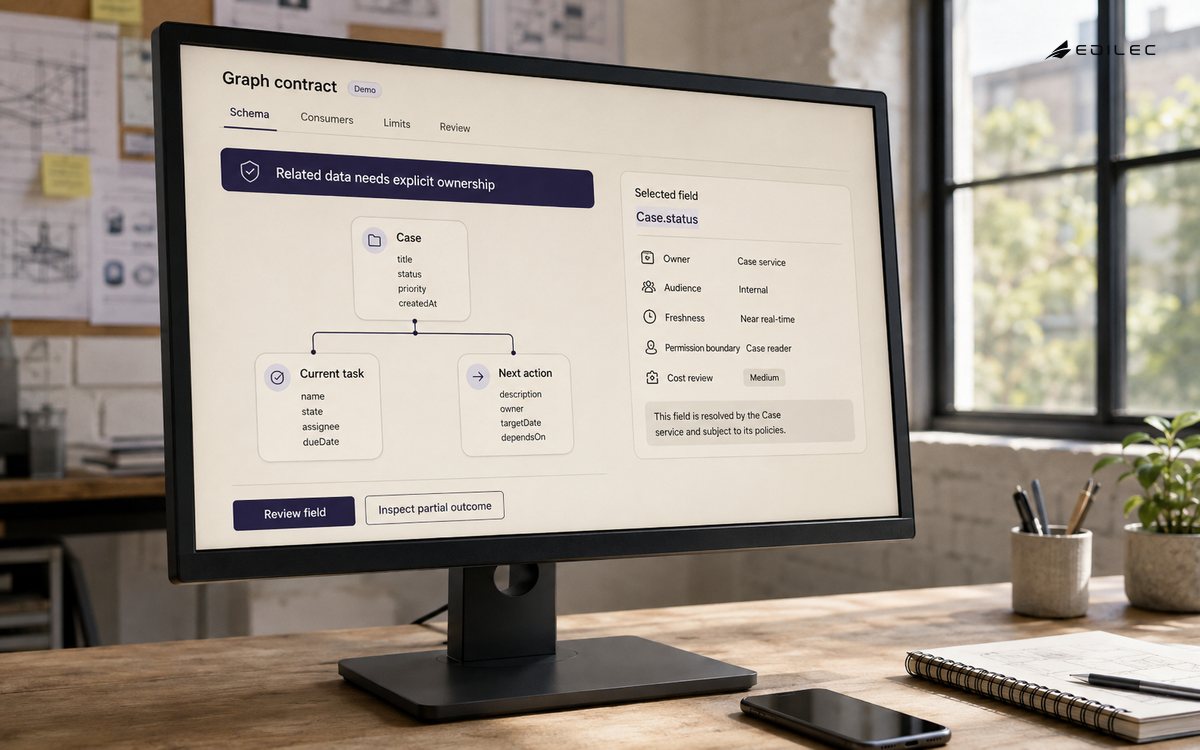
Name the owners of the graph, schema review, resolver implementation, security policy, performance budget, and consumer migration. A graph without field ownership becomes an organizational map of nobody’s responsibility. Decide whether the endpoint is public, partner-facing, internal, or allowlisted; that choice affects introspection, query logging, rate limits, and release controls.
| Decision | GraphQL can help when | Tradeoff to own |
|---|---|---|
| Client shape | Different clients need related fields or different projections | Flexible queries complicate cost, caching, and observability |
| Schema | Business concepts need a shared typed vocabulary | A schema is a long-lived contract that needs deprecation discipline |
| Composition | A screen combines data across services or domains | Resolver orchestration can add latency and failure coupling |
| Evolution | Clients need additive fields without endpoint proliferation | Unused fields and old clients remain a governance burden |
| Security | Field-level policy can follow domain concepts | Every resolver and nested object needs explicit authorization |
Design the schema for meaning, not storage
Model business concepts and user decisions rather than exposing database tables. A Customer, Case, or Approval should express the vocabulary a consumer needs, even if its data comes from several stores. Choose nullability deliberately: a missing value, an unavailable dependency, a forbidden field, and an optional property may need different explanations. Use input objects for commands and return types that communicate whether a mutation completed, is pending, or was rejected.
Make field contracts reviewable
For every field, document owner, audience, cost, freshness, pagination, error meaning, and deprecation plan. For lists, set limits and cursor behavior. For mutations, define idempotency, authorization, side effects, and a stable way to retrieve status. GraphQL best practices provides the core vocabulary for schemas, queries, mutations, and subscriptions; your contract must add business semantics that the specification cannot infer.
Treat resolvers as application boundaries
A resolver is not a permission check by virtue of being code behind a typed field. It must load data within the caller’s scope, enforce object-level authorization, handle missing or stale dependencies, and expose safe errors. Keep domain decisions in named services rather than burying them in a resolver that only one team understands. The Node APIs guide is a useful companion for separating transport handling from application behavior.
Avoid the N+1 pattern by batching repeated lookups where the data authority and authorization model remain safe. Batching is an optimization, not a license to load records the caller cannot see. Cache only when the key includes the relevant identity and freshness boundary. Treat a cross-service resolver as a distributed operation with timeouts, partial failure, and trace context.
Bound query cost and authorization
The flexibility of a graph is also an input surface. Limit query depth, breadth, aliases, list sizes, and execution cost; require pagination; cap timeouts; and rate-limit by an identity or operation class. GraphQL security guidance describes concerns such as query complexity and introspection that teams should translate into local controls. The OWASP GraphQL cheat sheet adds practical considerations for batching, authorization, and denial-of-service resistance.
| Control | What it protects | Implementation evidence |
|---|---|---|
| Object authorization | A caller reads or mutates another tenant’s object | Resolver test with allowed and denied identities at nested fields |
| Depth and cost limits | A query consumes excessive resolver or database work | Measured cost model, rejection response, and exception policy |
| Pagination limits | A list returns unbounded data | Cursor contract, maximum page size, and query tests |
| Timeout and cancellation | One dependency stalls the whole operation | Deadline propagation, partial error policy, and trace evidence |
| Operation visibility | Support cannot identify an expensive or failing request | Named operations, safe variables, resolver timing, and owner |
Make nulls and errors useful to clients
A client needs to distinguish “there is no value” from “the value could not be loaded” and “the caller may not see it.” Choose a policy that is safe for the data and predictable for the UI. Use structured error categories and a correlation or operation identifier without leaking stack traces or sensitive topology. For partial data, document which fields may be null and how the client should continue or recover.
Mutation responses should represent business outcomes, not just transport success. A command may be accepted for processing, completed, rejected by a domain rule, or uncertain after a timeout. Provide a durable operation or object identifier so the client can query status. Avoid hiding a partial failure behind a top-level success message that makes support reconstruct the actual state from logs.
Choose client and server coupling deliberately
A graph reduces some endpoint coordination but increases shared schema coupling. Decide how clients discover fields, whether queries are persisted, how code generation is versioned, and how deprecations are removed. A mobile client that ships on a slow schedule may benefit from additive schema evolution; an internal application with one team may prefer explicit operations that are easier to trace. The right choice depends on the number of consumers, release independence, and consequence of a stale client.
Release a bounded graph before opening every field
Begin with a small query and one mutation whose authority and cost are known. Instrument operation name, caller class, resolver latency, data-source calls, error category, and result size. Add limits before traffic increases. Run authorization, nested-object, partial failure, and query complexity tests. Then expand the schema by domain boundary rather than adding fields because a consumer asks for a convenient database value.
Keep a deprecation record with consumer usage, replacement field, owner, and removal date or condition. If the graph fronts several services, rehearse a dependency outage and confirm the UI receives a truthful partial or pending state. The GraphQL security review is a useful internal companion for examining the attack surface before a public or partner-facing release.
Operate from signals that lead to action
Track p50 and tail latency by named operation, resolver and data-source timing, query rejection, error category, response size, cache behavior, and aged pending operations. Avoid logging full sensitive queries or variables by default. Alert on a signal that has an owner and runbook: cost-limit rejections may indicate an abusive client or a missing persisted operation; a rise in nulls may indicate a dependency or permission change.
Make the tradeoffs explicit before committing
GraphQL trades endpoint proliferation for schema and resolver governance. It can improve client composition while making cost less obvious. It can provide a shared vocabulary while creating field-level coupling. It can support additive evolution while requiring deprecation discipline. Write the chosen benefits, accepted costs, guardrails, and review triggers in an architecture decision so a future team can tell whether the original assumptions still hold.
A graph should be compared with the interfaces it replaces, not with an idealized diagram. Review the REST API contracts guide when resource ownership is clearer than graph composition, and review the Node APIs guide when resolver work is becoming application orchestration. Those comparisons keep the decision grounded in consumer count, failure behavior, and operating capacity instead of syntax preference.
When the graph grows, re-check the original client need and the cost envelope. A field that was cheap for one list may become expensive when nested under a new connection, and a permissive schema may expose a relationship whose audience was never defined. Keep operation names, consumer usage, and field owners current. If a field cannot be explained to support or security reviewers, delay expansion until the contract and observability are stronger.
GraphQL tradeoffs takeaways
- Which client decision needs a graph rather than a simpler resource contract?
- Who owns each field, resolver, permission rule, and performance budget?
- How are depth, breadth, pagination, aliases, and dependency cost bounded?
- What do null, partial data, error, pending, and unauthorized mean?
- How will named operations, consumer usage, deprecations, and incidents be observed?
GraphQL tradeoffs FAQ
Is GraphQL always better than REST?
No. GraphQL is useful when clients need flexible related data and the organization can govern a shared schema and resolver layer. Simple, cacheable resource operations or a small number of consumers may be clearer with REST. Compare the operating cost, not only the request shape.
Does a typed schema enforce permissions?
No. A schema says what can be requested structurally. The resolver or domain service must check the caller, object, tenant, action, and current business state. Test nested object access and mutation authorization explicitly.
How do we avoid expensive queries?
Require pagination, set depth and cost limits, measure resolver work, batch safe repeated reads, use persisted operations for important clients, and reject requests with a clear category. Keep a review path for exceptions and never rely on an average query size to represent the worst case.
Conclusion: make the graph accountable
GraphQL can be a strong client contract when its flexibility is matched by discipline. Model business meaning, give fields owners, authorize every object, bound cost, tell the truth about partial outcomes, and operate from named signals. The tradeoff is worthwhile when the graph makes a real client decision easier without making the system’s risks invisible.