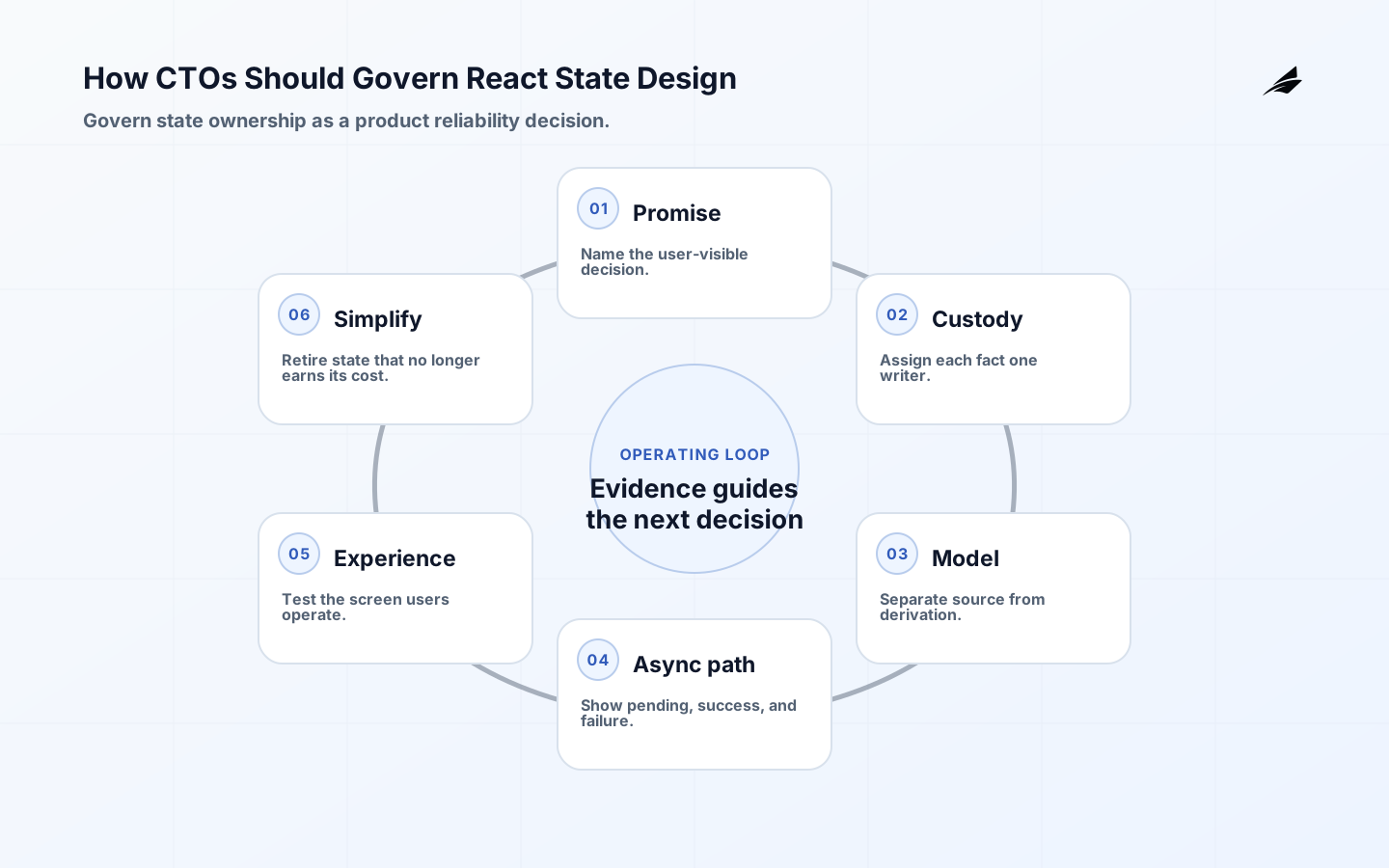
React state design matters when a customer-support console shows contradictory statuses after a user edits a record, changes tabs, and receives a server refresh at the same time. This guide is for CTOs who need to design React state around a small set of authoritative facts and deliberate transitions so the interface can remain correct under real interaction. The planning unit is a user task with a source of truth, visible states, server boundary, error path, and recovery action. For React-state ownership, that framing keeps the work tied to a decision people can inspect, rather than to a tool purchase or a collection of isolated tickets in the opening promise.
Start with the state decision the operator must make
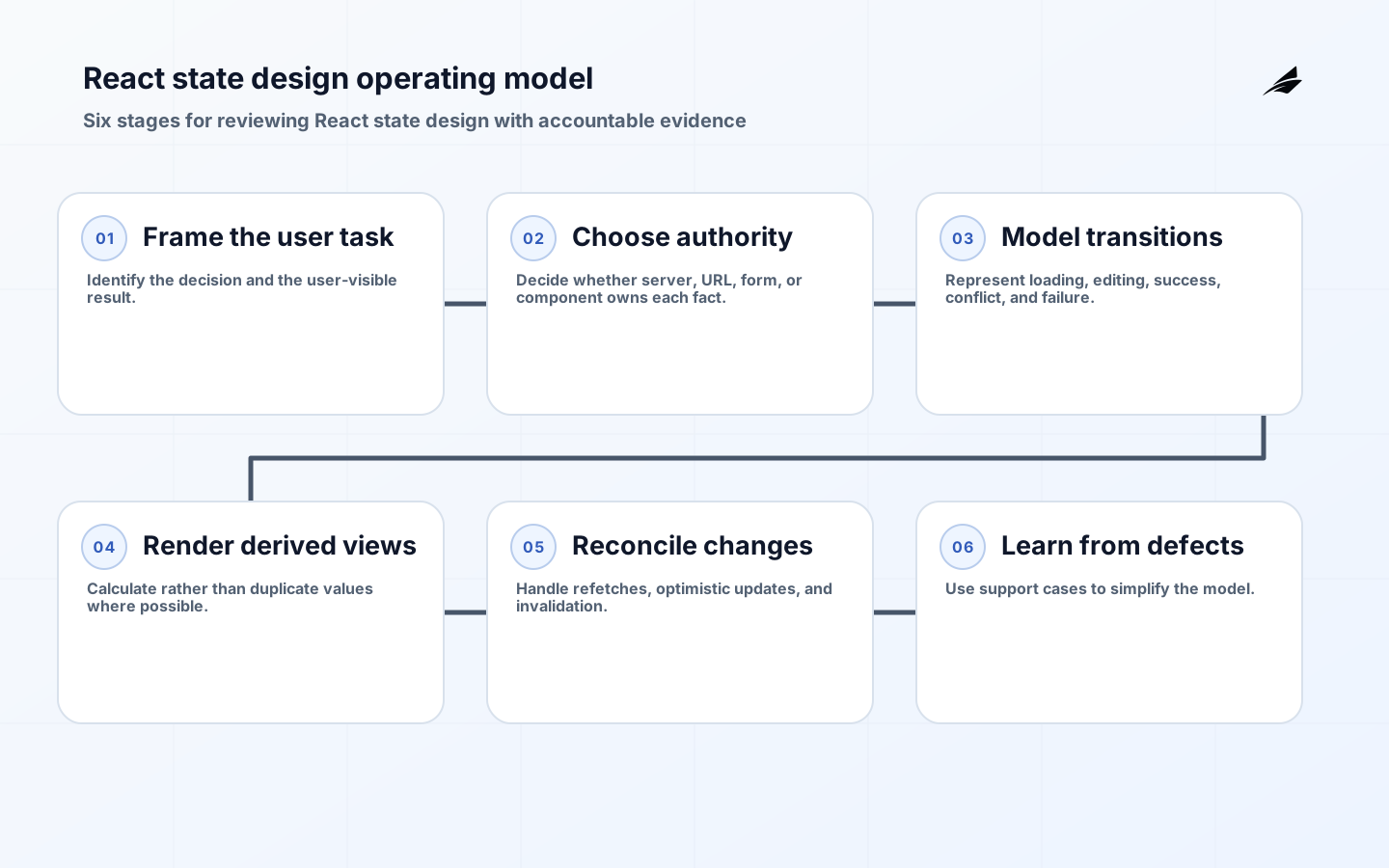
React state design starts with a user task, not with a choice of library. A support agent may need to inspect an account, edit a delivery preference, and know whether the change was accepted. Write that sequence down with the evidence shown at each step. The result is a better design question than “where should state live?”: which facts are authoritative at each point, what may be edited locally, and what must be confirmed by the service?

| Question | Working rule | Evidence to collect |
|---|---|---|
| Outcome | Name the decision or task that must improve. | a customer-support console shows contradictory statuses after a user edits a record, changes tabs, and receives a server refresh at the same time |
| Authority | Identify who owns the fact and who may change it. | a user task with a source of truth, visible states, server boundary, error path, and recovery action |
| Risk | Describe the costly failure before selecting technology. | copying the same fact into multiple hooks, URL parameters, caches, and form fields without deciding which value wins |
| Measure | Choose a signal that can change the next investment decision. | stale-data reports, duplicate requests, abandoned forms, state-related defects, interaction latency, and time to reproduce a support case |
Trace state custody across the support interaction
The React guidance on choosing state structure recommends avoiding contradictory and redundant state. For a CTO, that principle translates into a system rule. Do not keep isApproved, status, and canShip as separately mutable facts when one domain state can derive the others. A compact, explicit model is easier to test, easier to recover after a refresh, and less likely to display an impossible promise to a customer.
For React-state ownership, map the path from request to outcome with the people who operate it in the design boundary. For React-state ownership, include entry points, systems of record, permissions, dependencies, handoffs, and the place where a person can correct an exception in the design boundary. For adjacent implementation concerns, read What Changes When Frontend Performance Moves into Production, What Changes When Internal Tool Ux Moves into Production, and What Changes When Test Strategy Moves into Production. For React-state ownership, these related guides help distinguish a local implementation choice from the wider delivery practices that keep a service understandable in the design boundary.
| Boundary | Decision to make | Operational check |
|---|---|---|
| Input | Define identity, required fields, and validation responsibility. | Can an invalid React state design request be rejected with a useful reason? |
| Authority | State the source of truth and who can override it. | Can a reviewer explain which record or rule produced the React state design result? |
| Change | Version behavior that clients, users, or operators rely on. | Can the team deploy a compatible change and observe its effect? |
| Recovery | Give failures an owner, reference, and safe next action. | Can support resolve a disputed case without an unsafe workaround? |
Build a state transition that can be observed
Separate server state from interface state. Data fetched from a service has freshness, invalidation, and authorization concerns; a focused input, an open panel, or a temporary draft has a different lifecycle. The distinction does not force a particular library, but it does prevent a cache from becoming an unreviewed global store. Put URL state in the URL when it should survive navigation and be shareable; keep it out when it would expose sensitive or noisy details.
Make transitions first-class in workflows that can fail. A save action may be idle, validating, submitting, accepted, rejected, or conflicted with another update. Model the states users need to see, and attach an action that makes sense in each one. An optimistic update can improve responsiveness, but it needs a defined rollback and a way to explain a rejected mutation. Hiding that complexity in boolean flags is how forms get stuck or silently overwrite newer information.
- Write one React state design decision record with owner, boundary, and success condition.
- Collect ordinary, invalid, delayed, and contradictory examples before estimating broad scope.
- Assign an accountable operator for exceptions and a named escalation path.
- For React-state ownership, add correlation references that connect the user-visible outcome to supporting records in the design boundary.
- Test the recovery path as deliberately as the successful path.
- Review stale-data reports, duplicate requests, abandoned forms, state-related defects, interaction latency, and time to reproduce a support case after the first release before expanding the design.
Bound asynchronous state failure
State ownership should follow the smallest component boundary that needs coordinated updates. Lift state only when siblings genuinely need it, and use a reducer when actions and transitions deserve names. Context is valuable for stable cross-cutting values and carefully managed shared state, but it is not a performance or architecture cure. Measure rerenders and interaction delay before moving everything behind a provider.
Test React guidance against local transitions
For React-state ownership, the design choices above should be checked against primary guidance and then tested against local constraints in the operating review. Useful references include React: choosing the state structure, React: sharing state between components, React: scaling up with reducer and context, Web.dev rendering performance. For React-state ownership, these sources explain standards and supported behavior; they do not replace the organization’s own decision about owners, legal obligations, service targets, and user impact in the operating review. In this React state design context, turn the guidance into concrete configuration, review evidence, and runbooks that a team can use during a release or incident.
Measure stale-state recovery and change cost
Test state design with interruptions rather than only a clean click path. Change a record in a second tab, lose connectivity during a save, navigate away and back, receive an expired authorization response, then retry. These cases show whether the interface has retained a misleading local value or can guide the person toward recovery. Instrument client errors and mutation outcomes with enough correlation to join them to service-side events.
A quarterly review of the busiest task can surface disproportionate complexity. Trace every mutable fact, classify its authority, and remove one redundant field or unneeded global dependency. The goal is not an immaculate component tree. It is an interface where a user can understand what happened, what is pending, and how to proceed when the network or another person changes the underlying record.
Key takeaways
- React state design should begin with a real operational decision, not an abstract technology preference.
- Use a user task with a source of truth, visible states, server boundary, error path, and recovery action as the unit of planning and review.
- Make authority, change behavior, and recovery visible before scaling a design.
- For React-state ownership, use authoritative guidance as an input, then validate the result with representative local cases in the operating review.
- Let stale-data reports, duplicate requests, abandoned forms, state-related defects, interaction latency, and time to reproduce a support case determine whether the next increment is justified.
Frequently asked questions
What is the smallest useful scope for React state design? For React-state ownership, start with a support workflow whose outcome and recovery can be observed. For React-state ownership, the first release should prove ownership and behavior under normal and uncomfortable cases in the operating review. It does not need to centralize every adjacent process.
When should a person intervene? A product or support owner should step in when a React workflow reaches a conflict, destructive action, or ambiguity the interface cannot resolve. Preserve the server response and user context so the state model can be improved from the case.
How do we know the design is ready to expand? Extend the state model after interruption tests, server conflicts, and recovery actions behave predictably for the first workflow. Adoption is meaningful only when users can still understand the interface during a failed save or refresh.
Make state ownership an architectural decision
CTO-level review should ask where a fact is born, who may change it, and how long it remains authoritative. A text field draft belongs to the form until submission; the saved record belongs to the server; a permission decision belongs to the access boundary rather than a convenience context. When those distinctions are blurred, teams duplicate state and spend their time reconciling representations. React’s guidance on choosing state structure is most useful when treated as a design review prompt: group values that change together, avoid contradictory flags, and derive what can be derived.
Give async state a visible contract
Loading, success, empty, stale, and failed states are product behavior, not incidental branches. For every request, decide whether the previous value remains visible, whether a retry is safe, and what the user should do next. This is especially important when a shared hook is reused across screens with different risk. A small state machine or reducer can be clearer than several booleans when transitions have ordering rules.
Apply CTO React state governance
A CTO state-governance decision example
Review a support edit with one state owner, one server transition, one conflict case, and a visible recovery step. For React-state ownership, for React state design, the review is complete only when a teammate can explain what happened from the evidence without relying on memory in the delivery example. Record the state owner, invalidation rule, review date, and transition signal that would justify a boundary change. For React state design, keep the implementation tied to observable transitions so a teammate can explain a conflict from the screen and its records. For React state design, preserve the state ownership map, transition trace, and boundary-change cost beside the CTO decision example so the decision remains reviewable.
| Check | Example question | Evidence |
|---|---|---|
| Boundary | What is deliberately out of scope? | Decision record |
| Ownership | Who can change the behavior? | Named owner |
| Failure | What happens after rejection or timeout? | Test and runbook |
| Review | What signal changes the decision? | Metric or audit |
Frequently asked questions about React state design
What should a team decide first about React state design?
Begin with a decision the product must make and list the facts needed to render it. A CTO should be able to point to the owner of each fact, its lifetime, and its invalidation rule. State that is duplicated across components is an architecture liability because its contradictions become user-visible.
How should React state design be introduced safely?
Ship the support edit with explicit draft, pending, conflict, and recovery states, plus a test that exercises a stale server response. Widen shared state only after the first support workflow survives refresh, concurrent edits, delayed responses, and permission changes. For React state design, preserve the state ownership map, transition trace, and boundary-change cost beside the safe-introduction check so the decision remains reviewable.
What is a useful review signal for React state design?
Use a state signal tied to the promise: conflict recovery, stale-data exposure, successful save, or time spent in an ambiguous state. Read transition traces with support examples so a lower error count does not conceal a workflow that leaves operators unsure what happened. For React state design, preserve the state ownership map, transition trace, and boundary-change cost beside the review-signal check so the decision remains reviewable.
React state governance references
Continue with What Changes When Frontend Performance Moves into Production, What Changes When Internal Tool Ux Moves into Production, What Changes When Test Strategy Moves into Production. Use the linked guides to place React state ownership beside frontend performance, testing, and delivery decisions.
Conclusion
React state design becomes a durable advantage when the team designs the decision, authority, evidence, and recovery path together. Begin with a customer-support console shows contradictory statuses after a user edits a record, changes tabs, and receives a server refresh at the same time, keep the first change narrow enough to observe, and use real operating signals to guide the next investment. For React-state ownership, that is how a technical choice becomes a service people can trust in the FAQ.