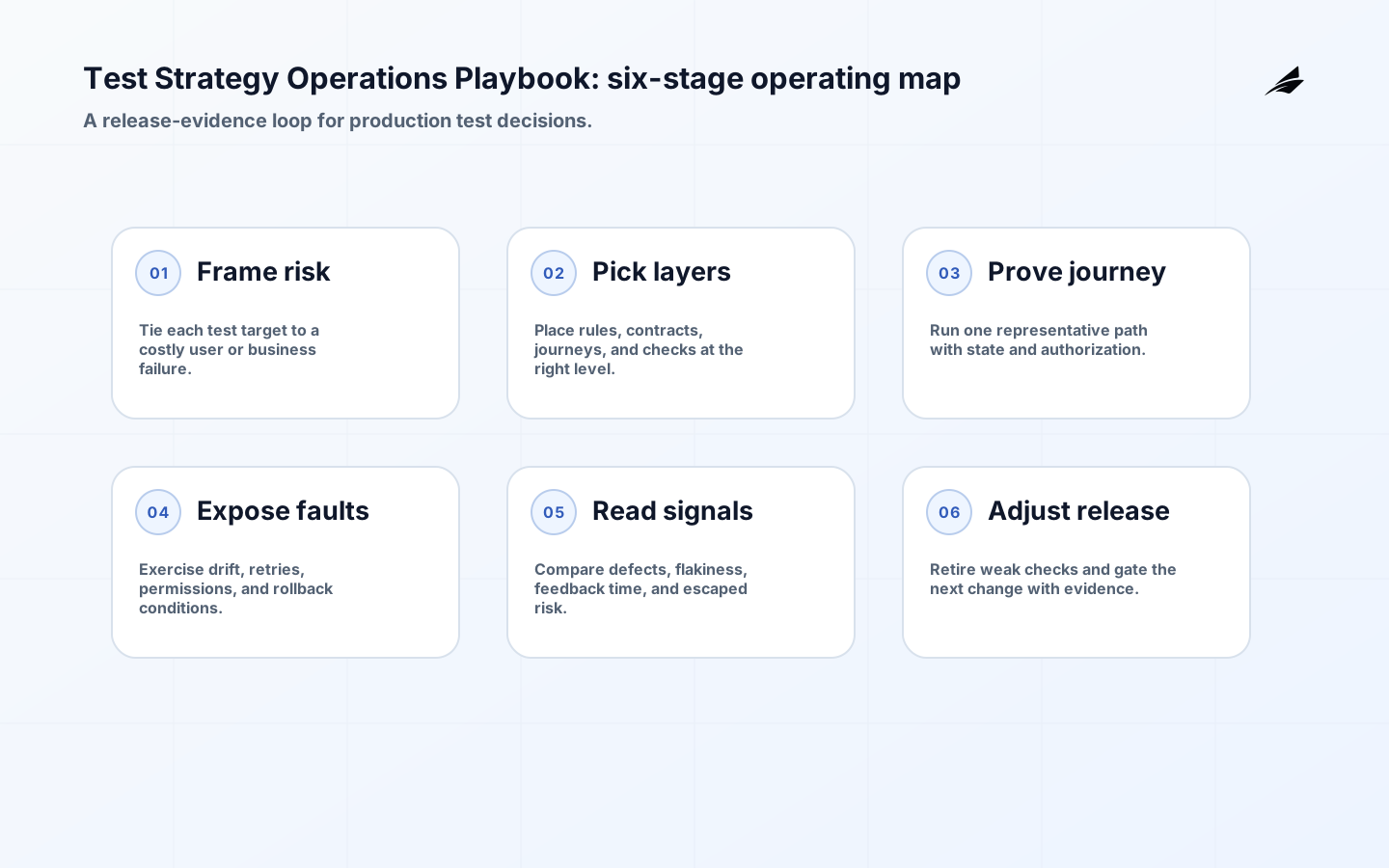
Test Strategy: Operations Playbook is a practical guide to test strategy for teams that need a result they can operate, not a fashionable architecture diagram. In this context, test strategy means a risk model expressed through executable checks, review practice, environments, and release decisions. For production test strategy, the work is valuable only when a person can see the promised outcome, understand its limits, and recover when reality disagrees with the happy path.
For production test strategy, the planning move that changes the conversation is to begin with a decision boundary. For test strategy, start with failures expensive to repair, such as incorrect money movement, data exposure, blocked operations, or irreversible migration; choose the smallest behavior that would expose each risk. For production test strategy, that framing connects technical choices to the people who approve, perform, support, and audit the work.
Set the test strategy decision boundary
Start with failures expensive to repair, such as incorrect money movement, data exposure, blocked operations, or irreversible migration; choose the smallest behavior that would expose each risk. For production test strategy, write the promise in plain language: reader, desired outcome, authoritative record, timing, owner, and intervention threshold. This prevents a technical handoff from being mistaken for completion.
For test strategy, a boundary also creates an honest non-goal. The first release does not need to solve every adjacent workflow. For production test strategy, it needs an observable path with real state, a known exception, and a person who can make the next safe decision.
| Question | Useful answer | Evidence to keep |
|---|---|---|
| What outcome matters? | A concrete completion or decision. | Business record and acceptance example. |
| What can fail? | Named conditions with recovery paths. | Classification and owner. |
| Who decides? | A role able to change rules or stop rollout. | Decision log. |
| What proves success? | Behavior in the relevant environment. | Trace, test, or workflow record. |
Choose test layers that expose production risk
Separate fast deterministic checks from boundary checks. Unit tests protect rules, contract and integration tests protect assumptions, and a narrow end-to-end suite protects critical journeys. Continuous integration makes the relevant evidence routine. For production test strategy, draw the boundary between trusted state, side effects, and observability before implementation. For production test strategy, it reveals where inputs are validated, who can trigger an effect, and how a later reader can reconstruct the decision.
In test strategy architecture, prefer interfaces that make safe behavior ordinary. For production test strategy, stable identifiers, explicit data ownership, reviewable change impact, and a modest first scope matter more than novelty. For production test strategy, an architecture that the current team cannot explain or operate is not ready for broad adoption.
Prove one operationally meaningful journey
Write a compact charter for each workflow: risk owner, invariants, realistic fixtures, and release decision. Isolate external dependencies so production availability never becomes a test prerequisite. For production test strategy, include authorization, real state, a representative error, and a visible outcome in the first vertical slice. A polished demonstration that skips those concerns can support a conversation, but it is not evidence that test strategy can carry production work.
- Name accountable business and technical owners.
- Capture a stable identifier for material actions.
- Exercise normal, invalid, and interrupted cases.
- Show state and next action to the relevant reader.
- Document correction, rollback, and communication steps.
| Choice | Use it when | Trade-off |
|---|---|---|
| Small pilot | Workflow and ownership are still being learned. | Some manual handling remains. |
| Guarded rollout | Happy path is proven but scope needs control. | Support coordination increases. |
| Broad adoption | Recovery and measurement are routine. | Governance costs become visible. |
| Redesign | Core boundary no longer fits the task. | Short disruption prevents a larger false economy. |
Make failure evidence part of release scope
Automation of convenient happy paths is not a strategy. Schema drift, permissions, clock boundaries, retries, and rollout compatibility are easy to miss; brittle browser tests often prove rules better checked at a lower layer. Put failure states beside the happy path. For production test strategy, the team should know what is retried, reversible, or sent to human review, and how a user or support agent finds current state without needing raw infrastructure access.
- Could a timeout leave an ambiguous result?
- Can a repeated action cause a second effect?
- Does a public message reveal too much?
- What happens to late, missing, or unauthorized data?
- Who notices, and what can that person do?
Use test signals to guide the next release
Watch escaped defects by risk class, flaky-test rate, median feedback time, quarantined checks, and changes lacking verification evidence. A pipeline engineers routinely rerun is reporting lost trust. Review these with the people receiving the consequences, not solely maintainers. For production test strategy, combine technical timing, business completion, support evidence, and a small sample of real cases to determine whether the stated promise holds.
For production test strategy, establish a baseline before changes and annotate releases, policy changes, and unusual load. That turns “it got worse” into an investigation with evidence. The best test strategy metrics connect a system event to the person or record affected.
A useful test strategy distinguishes product confidence from pipeline ceremony. For example, an authorization rule deserves direct tests over role and record combinations, a payment boundary deserves a contract test against a realistic failure response, and a checkout journey deserves only a few browser-level proofs. Map each check to the failure it is meant to catch and remove checks that no longer have a credible risk. The resulting suite is easier to interpret when it fails.
Test data is architecture. Time zones, partial records, deleted users, unusual permissions, and concurrent changes often determine whether an operational system behaves correctly. Keep those cases close to the named rule rather than hiding them behind generic fixture builders. When production reveals a new class of defect, first decide which invariant would have detected it; then add the smallest durable check at that boundary.
Release confidence should be proportional to the reversibility and blast radius of a change. A copy edit may need link checks and review, while an identity-provider migration needs contract tests, staged access, monitoring, and a rehearsed rollback. Make this proportionality explicit so teams do not either slow ordinary work with ceremonial gates or ship consequential changes under the same thin evidence. The strategy becomes credible when it changes behavior before a difficult release.
Make test ownership and change behavior explicit
Treat fixtures and test accounts as governed data. After an incident, ask whether evidence was absent, distant from the fault, or ignored, then improve the system rather than adding an unowned test. For production test strategy, version decisions that affect consumers, retain enough history for audit and learning, and make current rules easy to find. For production test strategy, maturity means a new team member can understand a problem and take the next safe action without private memory.
The technical foundation for this approach is Google SRE testing for reliability and GitHub continuous integration. For production test strategy, those references describe mechanisms and standards; applying them responsibly still requires a local decision about users, risk, and operating constraints. Additional implementation context appears in NIST security testing guide and Practical test pyramid.
Related test-strategy decisions
Adjacent decisions often decide whether test strategy succeeds in practice. Read Frontend Performance: A First-Principles Operating Guide, Internal Tool UX That Helps People Finish Work, How Engineering Teams Should Think About Background Jobs to connect this topic with testing, architecture, delivery, and operational ownership. For production test strategy, these are design context, not a substitute for observing the workflow in front of you.
Turn risk into a test strategy that a team can run
Begin with a risk register that names the user-visible consequence, not merely the technical component. “Order total is wrong” is a testable concern; “checkout service” is only a location. Rank each concern by impact, likelihood, detectability, and reversibility. The ranking chooses where to spend scarce environment time and where a release must stop. It also keeps low-risk cosmetic changes from inheriting the same ceremony as money, identity, or data-retention changes.
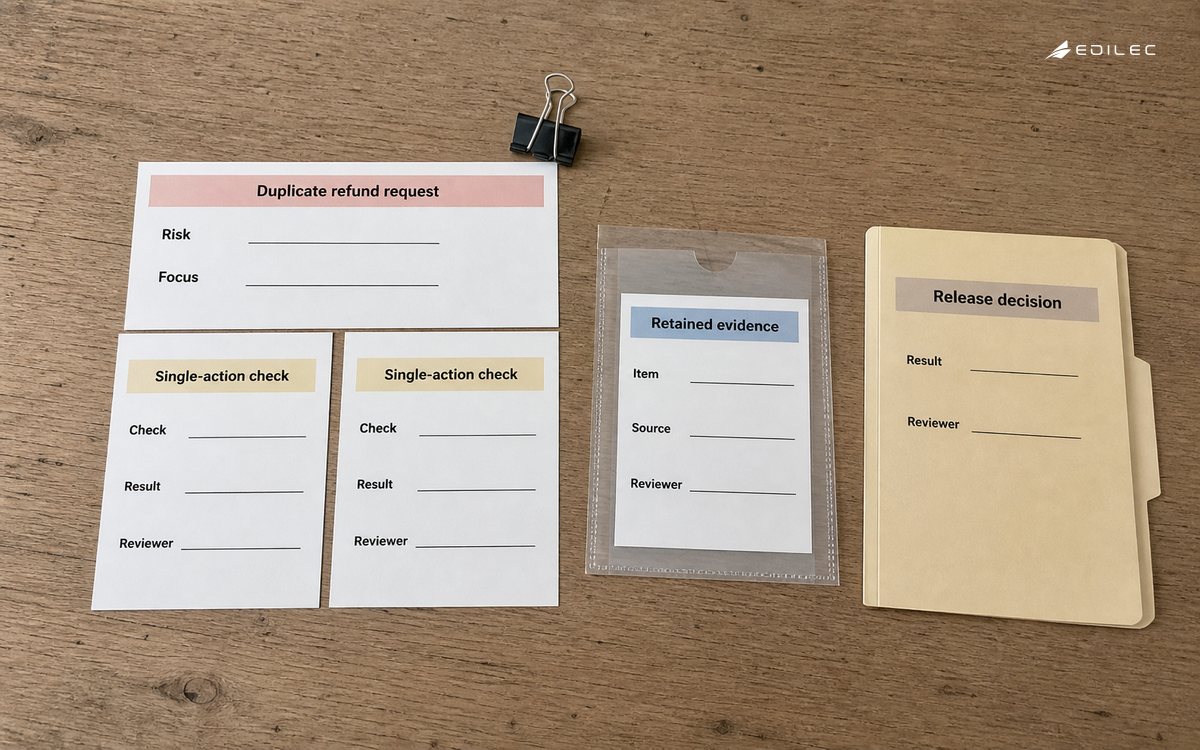
For each high-risk item, write one invariant and one observable. An invariant might say that a retry never creates a second charge. The observable might be an idempotency record tied to the order and payment provider response. Test the invariant at the narrowest useful boundary, then prove one representative journey across boundaries. This pairing gives the team a fast diagnostic when the broad journey fails: it can distinguish a broken rule from a broken integration.
A practical test strategy has a maintenance budget. Assign an owner to fixtures, test accounts, service contracts, and quarantine decisions. Define when a flaky check is fixed, isolated, or removed, and record the reason. If a test fails because an upstream sandbox changed, the repair belongs with the boundary owner; if the assertion exposed a real regression, the release decision belongs with the product and engineering owner. The distinction prevents “green” from becoming a social rather than technical signal.
Use a release note that links each material change to evidence and residual risk. A small change can be approved when the relevant checks pass and rollback is clear. A migration may require a rehearsal, sampled verification, and a staffed observation window even when automated checks are green. This proportional model lets teams move quickly on ordinary work while making high-blast-radius work deliberately visible.
When an incident occurs, add a test only after stating the behavior that should have been protected. The durable fix may be a contract, a monitor, a fixture, a permission rule, or a runbook step rather than another end-to-end script. Review the new evidence in the same place as the original risk decision. Over time, this creates a living strategy whose shape follows real failure rather than an inherited test-count target.
| Risk signal | First proof | Escalation evidence |
|---|---|---|
| Duplicate side effect | Idempotency assertion | Provider trace and replay result |
| Unauthorized access | Role and record matrix | Denied request log and audit event |
| Stale data | Freshness boundary test | Timestamp metric and user decision |
| Partial migration | Read/write compatibility check | Sampled reconciliation and rollback plan |
Key takeaways for test strategy
- Test strategy is a contract for a real outcome, not a tool configuration.
- Name ownership, authoritative state, recovery, and evidence before expanding scope.
- For production test strategy, use a complete pilot to learn the failure path as well as the happy path.
- Measure the promise in the workflow where people rely on it.
For a related decision, compare this approach with Frontend Performance: A First-Principles Operating Guide, Internal Tool UX That Helps People Finish Work, How Engineering Teams Should Think About Background Jobs. For production test strategy, each adjacent article treats a different boundary; use the links to test whether the same ownership, evidence, and recovery expectations hold in the surrounding system.
Test Strategy: Operations Playbook FAQ
What is the first decision for test strategy: operations playbook?
For test strategy for production operations: evidence, risk and release decisions, begin by naming the user or operational outcome, the accountable owner, and the evidence that will show whether the outcome is safe. For production test strategy, that boundary determines the smallest useful first implementation and gives the team a shared test for scope.
How should a team handle failure in test strategy: operations playbook?
In test strategy for production operations: evidence, risk and release decisions, classify each failure by its next safe action: correct, retry, reconcile, escalate, or stop. For production test strategy, preserve state and a correlation record so a person does not guess whether the first attempt took effect, especially when the boundary can create an external side effect.
When is the implementation ready to expand?
Expand test strategy for production operations: evidence, risk and release decisions after a representative path works with realistic data, known exceptions, observable ownership, and a rehearsed recovery. For production test strategy, a larger rollout should add confidence, not conceal unresolved ambiguity in a wider queue.
Conclusion: operate test strategy: operations playbook with evidence
The durable version of test strategy: operations playbook is not the one with the most components. For production test strategy, it is the one whose promise is explicit, whose boundaries are understandable, whose failure states preserve a safe next action, and whose evidence reaches the people responsible for the result. For production test strategy, start with one complete path, measure what users and operators actually experience, and let observed risk decide where the next investment belongs.