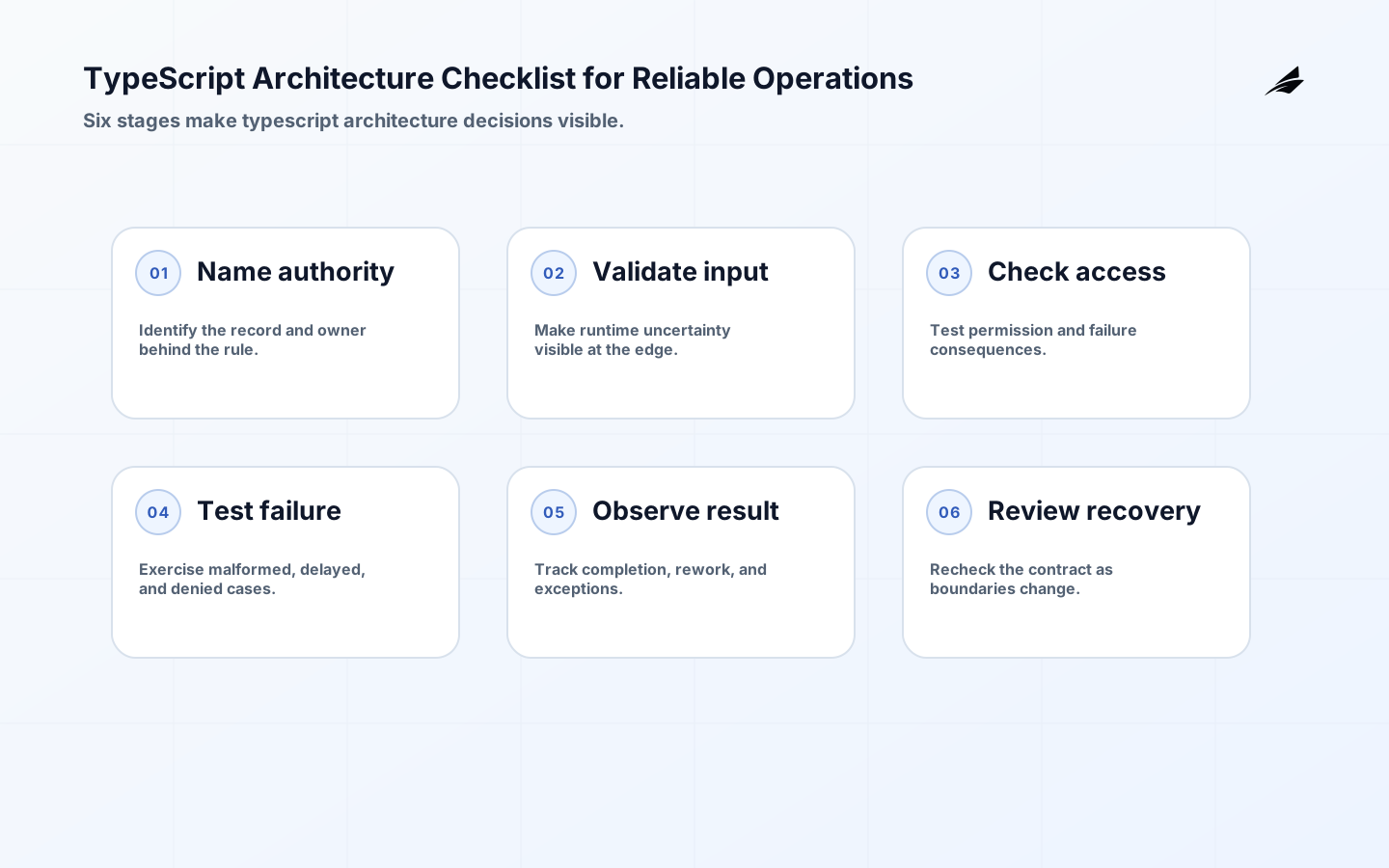
Use this checklist at three moments: before a boundary is introduced, during implementation, and after the first production change. Beforehand, name the owner, source of truth, compatibility promise, and failure consequence. During implementation, test malformed input, authorization, cancellation, and partial dependency failure. Afterwards, compare the promised behavior with logs, support reports, and real response samples. The checklist is useful because it turns architecture from a one-time diagram into an operating habit.
Define the typescript architecture decision
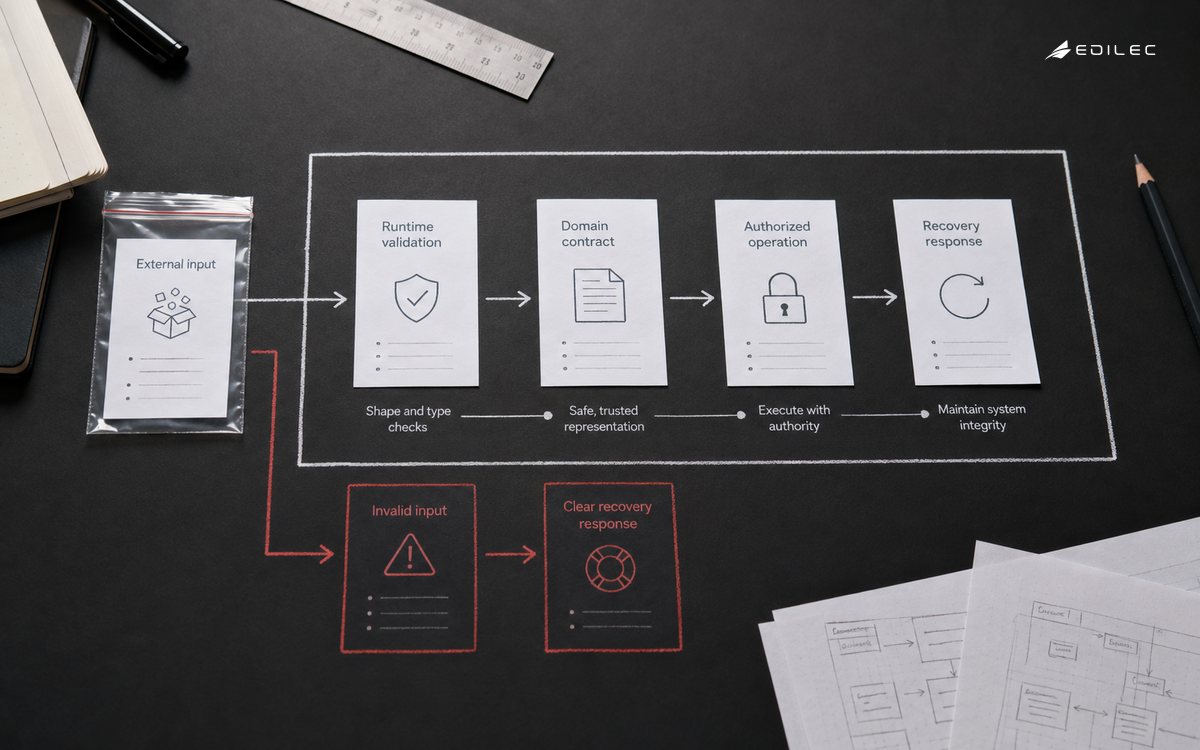
For typescript architecture, use a concrete journey rather than a principle alone. Trace who initiates work, what inputs are trusted, which component makes a decision, and what a customer or operator sees if completion is uncertain. The important boundary is where a local implementation choice becomes someone else's dependency. A concise written example is stronger than a broad diagram with unnamed arrows because designers, reviewers, and support staff can challenge it. That shared view keeps a happy-path demonstration from being mistaken for a durable contract.
The first serious risk is often an assertion hides unvalidated input or a shared type exposes implementation details. Treat that case as a design requirement, not something to hide after launch. Name the failure signal, safe immediate behavior, retained evidence, and person or service that can correct it. Useful controls include a documented boundary, testable negative paths, visible ownership, and a route to recovery. These controls need not be elaborate on day one, but consequential work needs enough structure that its outcome can be reconstructed, explained, and improved.
| Question | Decision | Evidence |
|---|---|---|
| What matters? | a web and API codebase must share domain concepts as teams add features | A representative journey and owner. |
| What can fail? | an assertion hides unvalidated input or a shared type exposes implementation details | A negative-path test. |
| What limits risk? | Bound inputs, behavior, and recovery. | A review or release record. |
| What shows progress? | Track outcomes and exceptions. | A trend reviewed regularly. |
Plan the first typed contract
Before selecting a platform or creating a large backlog, start at untrusted inputs and deployable component boundaries. Include people who receive the consequence of a failure as well as those implementing the change. Their work often reveals an unrecorded policy, data-quality issue, or recovery step that an architecture sketch misses. Write acceptance criteria for normal completion, expected delay, invalid input, unavailable dependency, and reversal. This creates a small testable path with a real outcome instead of a program measured only by technical activity or a list of technologies.
Assign an owner for the boundary and make supporting ownership explicit: who changes the rule, who monitors it, who can pause a rollout, and who speaks to affected users. Ownership does not mean one person performs every task. It means no exception is abandoned between teams. Keep the first release reversible where possible, and record the conditions that would make the team stop, repair, or expand it. This discipline is valuable when typescript architecture crosses products, services, or operational responsibilities.
Design runtime validation evidence
Design typescript architecture so illegal or uncertain outcomes are visible rather than accidental. Keep authoritative records, transformations, permissions, and recovery steps distinct enough to review. The authoritative references used in this guide are TypeScript Handbook, HTTP Semantics, NIST Secure Software Development Framework, OWASP API Security Project. They provide constraints and vocabulary, but they do not select a product boundary, service level, or operational owner. Test each recommendation against the real user journey and against the evidence a support team would need to investigate a harmful outcome.
| Design area | Decision to make | Failure-aware test |
|---|---|---|
| Boundary | Which input and outcome belong here? | Send incomplete or contradictory input. |
| Authority | Which record or rule wins? | Make two sources disagree. |
| Recovery | Who corrects an exception? | Simulate a delayed dependency. |
| Observation | What must be visible later? | Reconstruct one outcome. |
Deliver typed changes with rollback
Release typescript architecture in a scope the team can observe, support, and reverse. Feature flags, staged traffic, compatibility windows, and dual paths are helpful only when their exit conditions are written down. Every temporary bridge needs a review date and owner; otherwise it becomes another system future teams infer from logs and folklore. Compare expected results with observed behavior during rollout, and delay expansion when the team cannot explain a discrepancy. Controlled change is less dramatic than a broad launch, but it preserves options when evidence contradicts an assumption.
- Write one representative success case and one consequential failure case before implementation.
- Automate objective, repeatable checks and reserve human review for judgment and context.
- Release in a scope that can be observed, supported, and reversed.
- Turn each production finding into a changed control, named limit, or consciously accepted risk.
Measure compile and runtime signals
Measure typescript architecture with signals that describe both outcome and recovery: completion quality, latency where it affects people, exceptions, rework, and the age of unresolved cases. Baselines matter more than universal targets. Compare the capability with its previous behavior and investigate sharp changes in context. Pair aggregate metrics with evidence from a few real cases, because a stable average can hide a harmful edge condition. The review should end in a decision to retain the design, tune a control, remove an unused path, or fund a clearly described improvement.
Expose unsafe assumptions
A common failure in typescript architecture is treating a documented decision as permanent even when the surrounding system changes. Review the assumptions that made the current approach reasonable and name the evidence that would trigger reconsideration. Distinguish a temporary limitation from an accepted long-term constraint. That plain-language record lets teams explain why a compromise exists without pretending that an old implementation detail is a business rule. It also makes it easier for a new maintainer to challenge the right thing rather than rebuild the same uncertainty elsewhere.
Recheck the contract at boundaries
Review TypeScript architecture when a type crosses a package or service boundary. Check whether it represents an intentional contract or leaks a transport or persistence shape. Inspect runtime validation failures too: they show where the compiled model and real inputs diverge. A small adapter at that point can preserve the domain model and give maintainers a clear place to improve error handling. Keep that adapter tested whenever a supplier, schema, or shared package changes its representation.
Key takeaways
- Make the typescript architecture decision concrete through one consequential journey.
- Define failure behavior and recovery ownership before scaling.
- Keep evidence close to the boundary so support can reconstruct outcomes.
- Use operating signals to decide whether to expand, contain, or retire the approach.
Frequently asked questions (FAQ)
A reliable TypeScript system also knows what it cannot prove. Static types do not validate JSON, prevent a revoked permission, or guarantee that two writes arrived in the intended order. Pair compiler checks with runtime validation, explicit HTTP semantics, structured logs, and a recovery path. That combination makes failures legible to both the person using the product and the engineer responsible for restoring it. Where should a growing team start with typescript architecture? Start with the workflow where uncertainty currently costs the most time, trust, or customer impact. Describe the actor, authoritative record, expected outcome, and exception owner. That model is enough to select a first control, write meaningful tests, and decide what must be visible before the topic spreads across every service or screen. It produces a better first conversation than arguing about a preferred platform in the abstract.
How much process is enough for typescript architecture? Use controls proportional to consequence. A small release does not need a large platform, but it does need named ownership, testable behavior, safe handling of uncertainty, and evidence support can use. For TypeScript architecture, set a shared compiler baseline, validate untrusted input, and make module boundaries explicit. Add project references, published contract packages, and stricter dependency rules when multiple applications share domain concepts or build cost rises. Static types are helpful only when the team keeps runtime uncertainty at the edge instead of escaping it with broad assertions. Review the path after release and remove controls that do not improve a real decision.
Use the checklist as a recurring conversation between the people who design a boundary and the people who live with its consequences. At intake, ask which user or operator would notice an incorrect result first. During implementation, capture a representative payload, a denied request, a delayed dependency, and a recovery action. After release, compare those examples with actual traces and support cases. If the evidence differs, update the contract or the implementation instead of adding an exception that nobody owns. This cadence keeps typed interfaces connected to runtime reality. It also gives leaders a way to sequence work: repair the boundary that creates the most expensive uncertainty, then verify that the repair changed the observed outcome before widening the program.
A checklist should leave behind evidence that another person can inspect without asking its author to translate the result. Store the representative input, expected outcome, observed signal, and recovery decision with the change record. When a contract crosses a package or service boundary, include the compatibility window and the owner who can retire it. This makes review useful after the original implementation has moved on and helps operations recognize whether a failure is new, tolerated, or already covered by an explicit response.
Conclusion
Strong typescript architecture practice makes change easier to understand without making behavior mysterious. Keep the first promise narrow, test the boundary where another person depends on it, and make recovery visible before expanding the design. Related reading: React State Design Checklist for Reliable Digital Operations, Node. APIs Checklist for Reliable Digital Operations, A Field Guide to Monorepo Structure for Growing Teams.