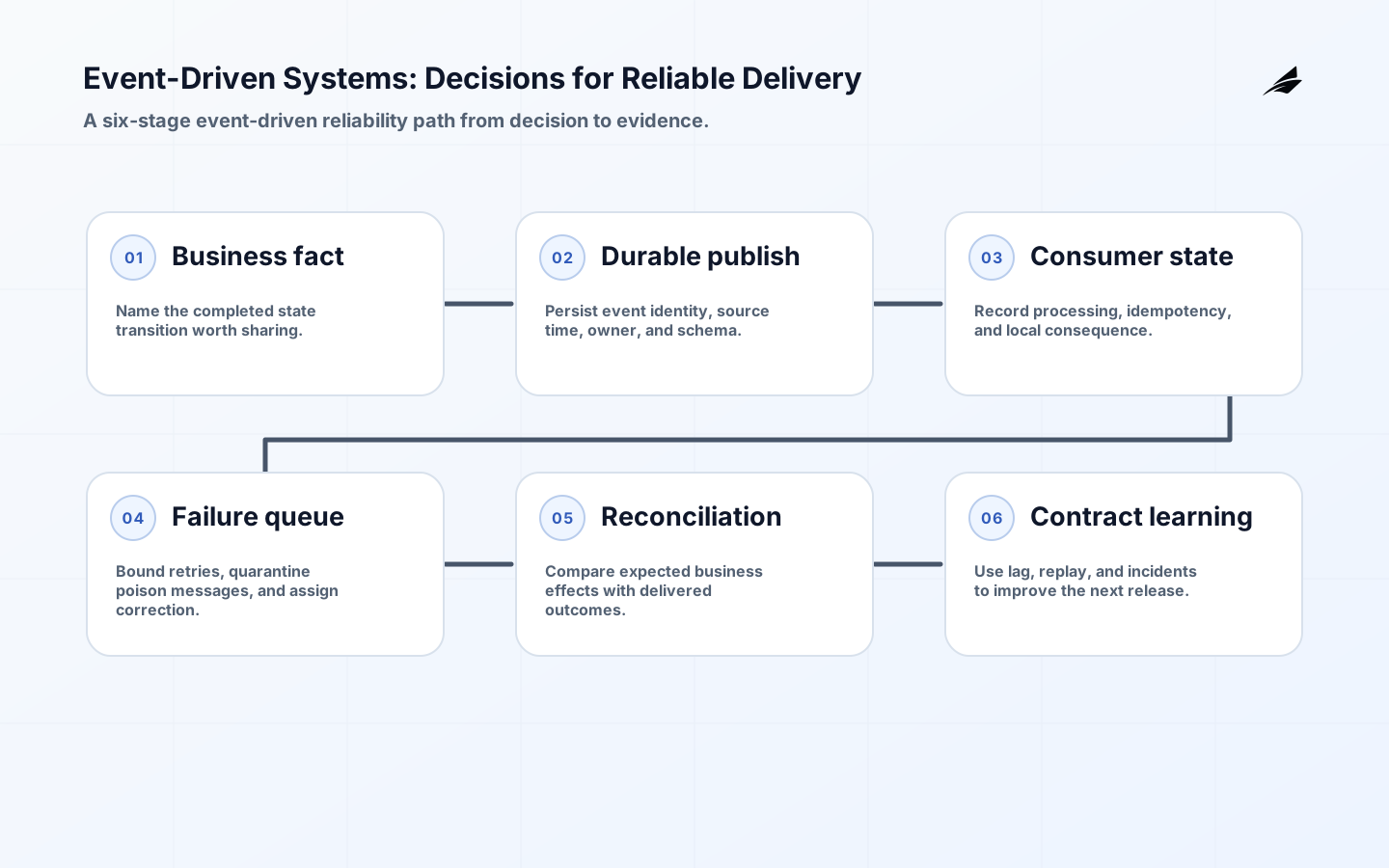
Start an event-driven system with a business fact. Name the fact that another team needs to react to: an order accepted, a payment authorized, a bag scanned, or a shipment delayed. Do not begin with a broker topology. Define the producer authority, event identity, occurrence time, schema owner, consumers, retention need, and correction path. A fact should describe something that happened; a command should ask another component to do something. Mixing them makes retries and audit trails harder to reason about.
How Engineering Teams Should Think About Event-driven Systems
Event-driven systems are not a tool choice made in isolation. They make a business outcome dependable when normal work meets delay, ambiguity, change, or failure. For engineering teams, the central decision is whether to emit a fact after it is durably true, with enough context for independent consumers to act safely. Make that decision visible before implementation: name the user or system that starts the work, the accountable owner of the outcome, the evidence that proves success, and the boundary where a person must intervene. The useful result is a service people can explain, support, and improve under ordinary pressure.
Make the event-driven systems decision explicit
Write the decision as a short operational statement, then test it against real examples from order changes, identity lifecycle, inventory movement, and notification fan-out. In this case, the team should emit a fact after it is durably true, with enough context for independent consumers to act safely. The unit of work is an event; its trigger is a completed business state transition rather than an intention or UI gesture; and its meaningful states are recorded, published, consumed, retried, quarantined, or reconciled. Event delivery needs a bounded decision, an accountable owner, and evidence for the next change; this case records checkpoint 1 for that topic. Event delivery needs a bounded decision, an accountable owner, and evidence for the next change; this case records checkpoint 2 for that topic.
The non-negotiable rule is that the producer owns the event meaning and consumers own their local consequences. For event delivery, the owner reviews the contract before release. In event-driven reliability, this evidence is tied to checkpoint 1 and a named recovery owner. Amazon EventBridge concepts and Transactional outbox pattern are useful references because they describe concrete delivery or interface guarantees rather than vague aspirations. Their lesson is not to copy a platform pattern wholesale. For event delivery, support receives the recovery reference before rollout. In event-driven reliability, this evidence is tied to checkpoint 2 and a named recovery owner.
| Decision element | Question to settle | Evidence to keep |
|---|---|---|
| Outcome | What does a successful event mean to the business? | Named owner, completion condition, and user-visible result |
| Boundary | When is an event accepted, changed, or refused? | Input validation, authorization rule, and state transition |
| Failure | How will the team handle a shared event that disguises a synchronous command or has no schema ownership? | Classification, recovery action, and escalation owner |
| Observation | Which signal will show healthy operation? | publish lag, consumer lag, schema compatibility failures, and unreconciled business outcomes |
Model event identity and consumer state
Model the event as something with history, not as a mutable line on a dashboard. The state sequence recorded, published, consumed, retried, quarantined, or reconciled should have allowed transitions, an effective time, and a responsible actor or service. Event delivery needs a bounded decision, an accountable owner, and evidence for the next change; this case records checkpoint 3 for that topic. Event delivery needs a bounded decision, an accountable owner, and evidence for the next change; this case records checkpoint 4 for that topic. Event delivery needs a bounded decision, an accountable owner, and evidence for the next change; this case records checkpoint 5 for that topic.
Ownership must survive organizational boundaries. For event delivery, operators can identify the next safe action. In event-driven reliability, this evidence is tied to checkpoint 3 and a named recovery owner. AsyncAPI document structure reinforces the value of explicit structure or repeatable checks, while OpenTelemetry traces supports carrying useful context across system boundaries. For event delivery, the team records the evidence beside the decision. In event-driven reliability, this evidence is tied to checkpoint 4 and a named recovery owner.
| Model concern | Practical design choice | Review question |
|---|---|---|
| Identity | For event delivery, retain a stable business identifier that connects the fact to its related record. | Can a support person find the same case across systems? |
| State | Make legal transitions explicit and reject or park ambiguous inputs. | Does each state tell the user and operator what comes next? |
| Authority | Bind approval and access checks to the requested action. | Who may change this state, and who may correct it later? |
| History | Retain actor, time, reason, and correlation context. | Could the team explain this outcome six weeks later? |
Reconcile delivery disorder with bounded recovery
A reliable event-driven system must account for a shared event that disguises a synchronous command or has no schema ownership. Event delivery needs a bounded decision, an accountable owner, and evidence for the next change; this case records checkpoint 6 for that topic. Event delivery needs a bounded decision, an accountable owner, and evidence for the next change; this case records checkpoint 7 for that topic. Automated retries need a ceiling and a reason. Event delivery needs a bounded decision, an accountable owner, and evidence for the next change; this case records checkpoint 8 for that topic. Otherwise a fast workaround becomes an invisible second workflow.
Start with operating signals that answer a decision, not every metric available from a framework. Publish lag, consumer lag, schema compatibility failures, and unreconciled business outcomes should be reviewed alongside a small sample of completed and failed cases. Event delivery needs a bounded decision, an accountable owner, and evidence for the next change; this case records checkpoint 9 for that topic. Event delivery needs a bounded decision, an accountable owner, and evidence for the next change; this case records checkpoint 10 for that topic. This is where an event-driven system becomes a managed service rather than a launch artifact.
Release one replayable business fact
The first release should prove one high-value path in order changes, identity lifecycle, inventory movement, and notification fan-out, including its unhappy path. Name events in the past tense, give them an owner and schema version, and use an outbox or equivalent durable publish boundary. Event delivery needs a bounded decision, an accountable owner, and evidence for the next change; this case records checkpoint 12 for that topic. Event delivery needs a bounded decision, an accountable owner, and evidence for the next change; this case records checkpoint 13 for that topic.
Use change review to ask four questions: what business behavior is changing, which event states or contracts are affected, how will the team observe the new behavior, and how will it reverse or compensate if wrong? For event delivery, the service can pause without losing business state. Keep the reference focused on the decision at hand, and record the answer alongside the delivery change so it remains useful after the original implementers move on.
Event contract takeaways
- Start with the outcome: emit a fact after it is durably true, with enough context for independent consumers to act safely.
- Treat the producer owns the event meaning and consumers own their local consequences as a checkable service rule.
- Model event state and ownership before adding automation or interface detail.
- Design recovery for a shared event that disguises a synchronous command or has no schema ownership; do not rely on an informal workaround.
- Review publish lag, consumer lag, schema compatibility failures, and unreconciled business outcomes with real cases, not in isolation.
- Expand subscriptions only after one event path can be replayed, reconciled, and corrected.
An event is worth publishing when it represents a durable business fact that another team can consume without guessing what happened. Define whether the event means accepted, completed, cancelled, or corrected work; include a stable identity and enough provenance to reconcile it later. Consumers should make duplicate delivery harmless and should expose a state that operators can repair without editing a queue by hand. Measure end-to-end business completion alongside broker lag, because a healthy transport can still deliver the wrong outcome or omit a correction.
Reliable event delivery starts with a precise statement of what has become true. Separate an accepted command from a completed business fact, and include the identifiers needed to reconcile both. A consumer should record its own processing state, make duplicate delivery harmless, and expose a repair path when an event arrives late or out of order. Measure business completion and correction time beside transport lag and retry volume. Those measures show whether the event contract helps the organization or merely moves uncertainty into another queue.
Replay is an operating capability only when its scope and business reconciliation are both visible.
See event-driven systems security guidance and API versioning guidance when the event contract crosses an external boundary.
Frequently asked questions about event-driven systems
What should the first event-driven systems release include?
Event delivery needs a bounded decision, an accountable owner, and evidence for the next change; this case records checkpoint 14 for that topic. The first release does not need every future variation. Event delivery needs a bounded decision, an accountable owner, and evidence for the next change; this case records checkpoint 15 for that topic. For event delivery, the next change has a measurable acceptance condition.
How do we know when an event-driven system is ready to scale?
Event-driven reliability check
Make delivery semantics visible to operators

| Decision | Concrete test | Owner evidence |
|---|---|---|
| Scope | Name one journey and its non-goal. | Approved outcome and boundary |
| Authority | Identify the source of truth and correction route. | Owner, identifier, and audit record |
| Failure | Exercise timeout, duplicate, stale, and denied cases. | Observed response and recovery step |
| Change | State what can evolve without surprising a consumer. | Compatibility note and review date |
At-least-once delivery means consumers must tolerate duplicates; ordering is usually scoped to a key rather than global; and a poison message needs a bounded quarantine path. Store an idempotency key and the consumer outcome, then make replay a tested operation with clear limits. CloudEvents can standardize envelope metadata, but it does not decide business ownership or exactly-once side effects.
For event-driven systems, readiness means a producer can show when a fact became durable, a consumer can reject or replay a bad message safely, and reconciliation identifies missing effects. Expand subscriptions after the event schema, ownership, and retry behavior have held up under real delivery disorder.
Conclusion
Good event-driven systems work is disciplined decision-making. Event delivery needs a bounded decision, an accountable owner, and evidence for the next change; this case records checkpoint 16 for that topic. Event delivery needs a bounded decision, an accountable owner, and evidence for the next change; this case records checkpoint 17 for that topic. For a further perspective on sustainment, see the related practical guide.
Frequently asked questions
For event-driven systems, name the business fact, producer authority, delivery guarantee, replay boundary, and correction route before selecting infrastructure. What should a team decide first? Event delivery needs a bounded decision, an accountable owner, and evidence for the next change; this case records checkpoint 18 for that topic. How much design is enough? Event delivery needs a bounded decision, an accountable owner, and evidence for the next change; this case records checkpoint 19 for that topic. Can the work be iterative? Event delivery needs a bounded decision, an accountable owner, and evidence for the next change; this case records checkpoint 20 for that topic. Which evidence matters after launch? Event delivery needs a bounded decision, an accountable owner, and evidence for the next change; this case records checkpoint 21 for that topic. Event delivery needs a bounded decision, an accountable owner, and evidence for the next change; this case records checkpoint 22 for that topic.
Continue with software modernization for custom software when an event boundary also changes service ownership.