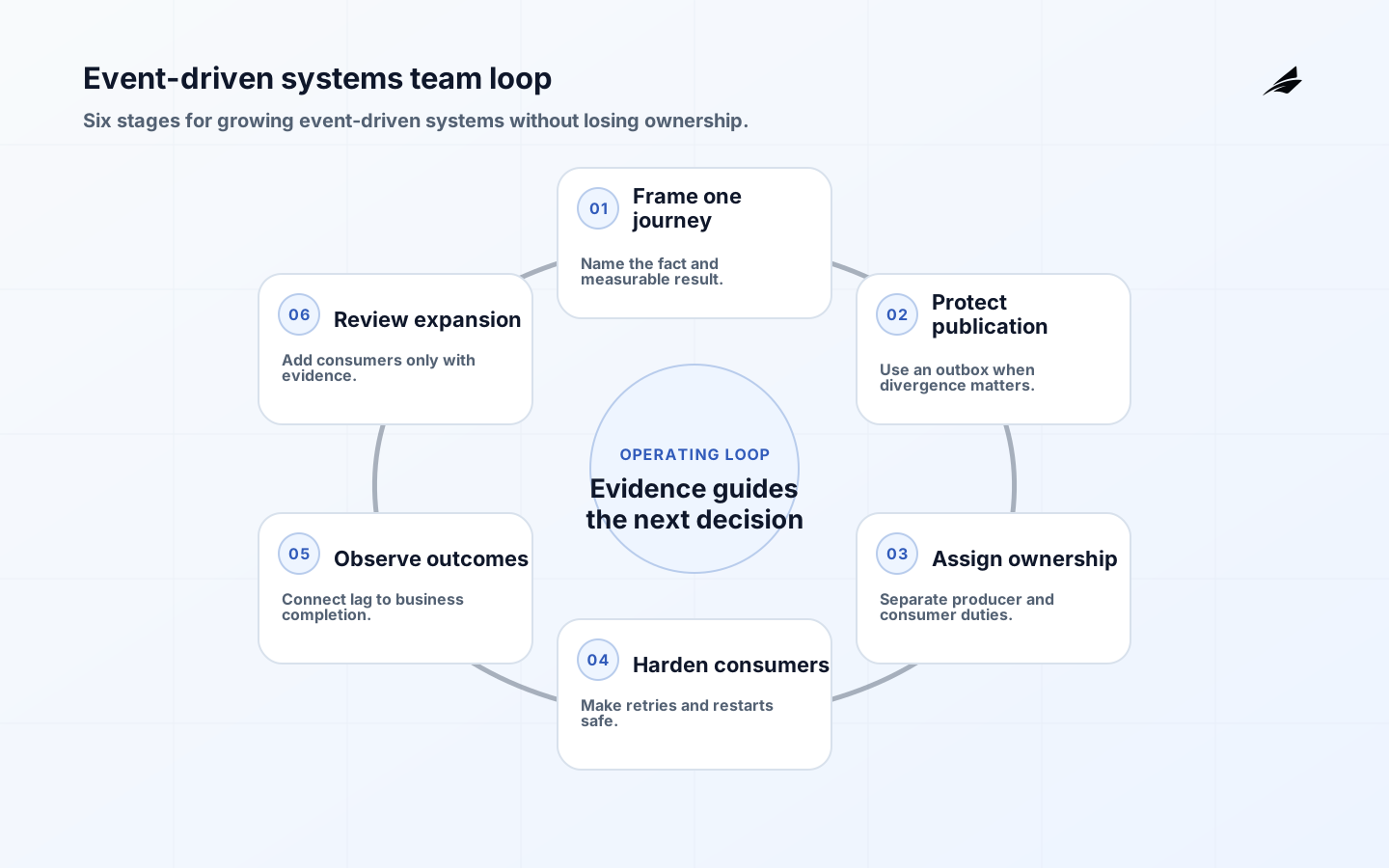
Growing teams usually meet event-driven systems through a practical pain: a new capability needs the same business fact as an existing one, a background job is slowing a user request, or a service should react without importing another team’s deployment schedule. The first event often works. The second and third introduce questions about ownership, duplicate processing, schema changes, retries, and who will answer a support ticket when one consumer is behind. This field guide treats event-driven systems as a team practice rather than a platform purchase. It shows how to start with one journey, keep the event contract small, assign the work to people who can operate it, and expand only when the evidence justifies more moving parts.
Define the event-driven systems decision around one journey
Pick one journey with a visible outcome: a customer submits a document, an order is accepted, a ticket is assigned, or a report is generated. Write the synchronous part, the asynchronous part, and the point at which the user can safely leave the screen. Then name the fact that will travel, the consumer that will react, the acceptable delay, and the consequence of a repeated reaction. This keeps a growing team from debating architecture in the abstract. The CloudEvents specification is useful for common metadata such as source, type, subject, and time, but the team still needs to state which local fields are authoritative and which are only context.
| Field-guide question | Good first answer | Owner to name |
|---|---|---|
| What changed? | One durable business fact with a stable subject. | Producer or domain owner. |
| Who reacts? | One consumer that produces a measurable result. | Consumer team. |
| How long may it take? | An explicit user or operational delay window. | Product and operations. |
| What if it repeats? | A stable idempotency or reconciliation rule. | Consumer owner. |
| Who repairs it? | A named operator with a safe action. | Support or on-call owner. |
Build a narrow path with an outbox or a clear source
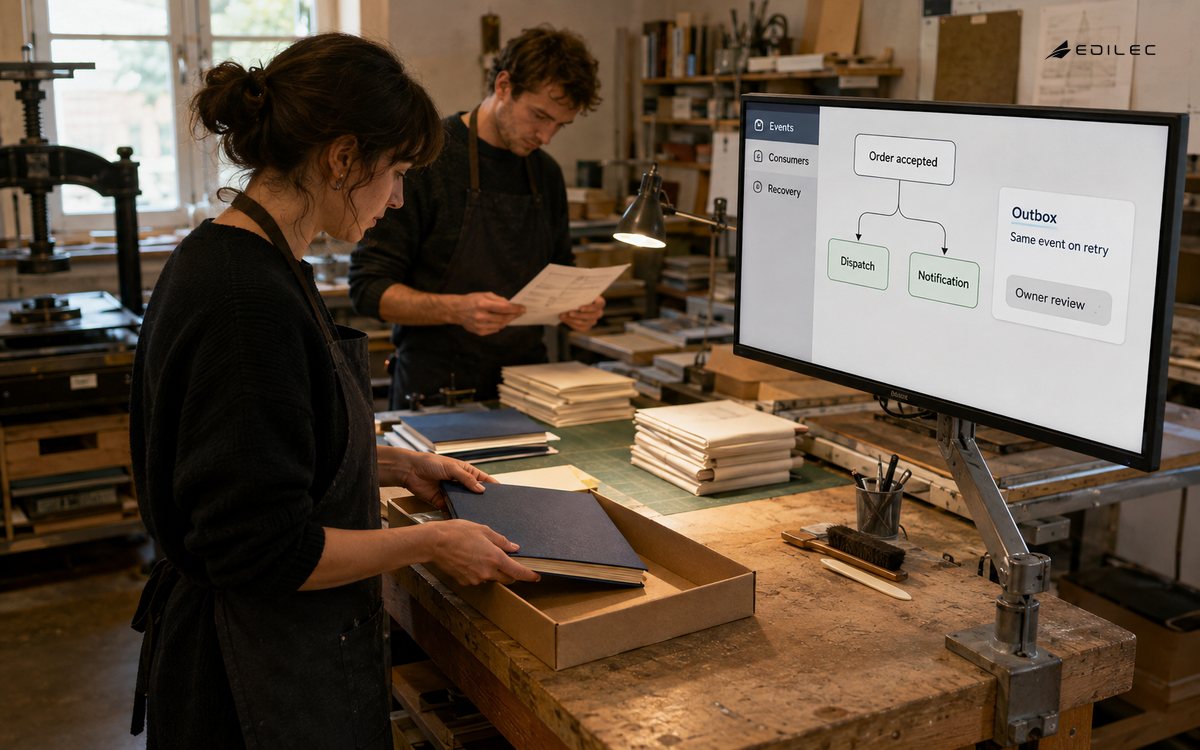
The dual-write problem appears when a service commits its database change and then tries to publish an event separately. A process crash can leave the record updated while consumers never learn about it. For a business fact that cannot be silently lost, store an outbox entry in the same local transaction as the change, publish it with a separate worker, and keep the event identity stable through retries. The AWS transactional outbox pattern describes this boundary and its tradeoffs, while the Debezium Outbox Event Router is one implementation reference for translating outbox rows into routed events. A growing team should not add an outbox everywhere by reflex; use it when the consequence of divergence is material and the source record cannot be polled or rebuilt safely.
Make producer and consumer ownership visible
Assign the producer the responsibility for event meaning and the consumer the responsibility for reaction safety. The producer owns required fields, event identity, compatibility, and publication evidence. The consumer owns validation, idempotency, side effects, retries, and its derived view. A shared platform team may provide the channel, but it should not become the hidden owner of every business outcome. Keep a small inventory with event type, schema version, producer, consumers, sensitive data, retention, and escalation route. This inventory becomes especially valuable when people move teams or a service is rewritten.
Keep the event contract small enough to evolve
Include the stable identity and business context a consumer needs, not a dump of the producer’s database row. Prefer immutable facts and explicit versions. If a consumer needs the latest customer address, it may be safer to carry a customer identifier and let the consumer request the current authority than to embed a value that will be stale when processed. If the event must preserve history, say so and define retention. Write fixtures for current, missing, duplicate, delayed, and unknown fields. A contract that only shows the happy payload gives a new team no guidance when a deployment meets an older consumer or a partial record.
| Contract decision | Starting rule | Why it helps a growing team |
|---|---|---|
| Identity | Use a stable event ID and business reference. | Support can find duplicates and outcomes. |
| Versioning | Add fields compatibly and document meaning changes. | Independent deploys remain possible. |
| Sensitive data | Publish the minimum needed for the reaction. | Reduces access and retention burden. |
| Retention | Choose a period tied to replay and audit needs. | Storage cost and recovery expectations stay explicit. |
| Unknown input | Reject, quarantine, or translate by a named rule. | Bad data does not disappear silently. |
Make every consumer safe under retries and restarts
Assume the consumer will restart after completing an external side effect but before acknowledging the message. Store the event or business identifier before the side effect, use a durable uniqueness check, or use the downstream system’s idempotency facility. The Kafka delivery semantics documentation is a useful reminder that the guarantee depends on producer, broker, consumer, and side-effect behavior together. A consumer should also distinguish transient dependency failure from invalid input, permission denial, and a stale version. Retry only what may become correct; route the rest to a searchable exception path with its original context.
- Make duplicate processing safe by using a durable event or business identity.
- Bound retries and backoff so one poison message cannot starve unrelated work.
- Keep the original payload, failure category, attempts, and next action visible to support.
- Make replay and re-drive permissions explicit when a repeated side effect could harm a customer.
- Test a restart after side effect and before acknowledgement, not only a clean success.
Instrument outcomes that a growing team can own
A dashboard that says the broker is healthy does not prove that the product result is healthy. Track publish success, event age, consumer lag, processing duration, retry count, dead-letter age, duplicate rate, and the time from event to durable outcome. Google Cloud Pub/Sub documentation illustrates the decoupled producer and consumer model; your local runbook must add the business join key and the action for a stalled subscription. Use OpenTelemetry messaging conventions where they fit so traces, metrics, and logs remain comparable across languages and message systems.
Decide which signal changes behavior. A small increase in lag may be harmless for a nightly report but dangerous for an entitlement or fraud control. Set thresholds from the accepted delay and consequence, then name the response: scale a consumer, pause publication, fail over, re-drive a bounded range, or start reconciliation. Avoid alerting on every retry if the retry is expected; alert on aged work, rising permanent failures, and a gap between authoritative records and projections. Review those signals with product and operations so the team does not optimize a queue while users wait for a result.
Evolve consumers without freezing the producer
Growing teams need independent delivery, but independence requires a compatibility habit. Keep old event fixtures, validate consumer assumptions in continuous integration, and publish a deprecation window before removing a field or changing its meaning. A new consumer should start in a non-side-effecting or audit mode when possible, then move to an active mode after its output is compared with an authority. A producer should know which consumers are active before making an incompatible change. Connect this work to A Field Guide to API Versioning for Growing Teams, Event-Driven Systems Before the First Build: A Decision Framework, and Event-Driven Systems for Custom Software for the decision record behind the boundary.
Review the operating cost before expanding the graph
Every consumer adds deployment, telemetry, access, retention, retry, and incident-response work. Before adding another reaction, ask whether a projection, scheduled job, direct API call, or existing consumer could meet the same need with less coordination. If the new consumer handles sensitive data or creates a side effect, involve the security and operations owners before subscribing. If a topic has no clear producer, no current consumer, or no retention reason, retire it. A clean event inventory is a product of active maintenance, not a sign that the team has stopped innovating.
Turn incidents into a changed control
When an event-driven failure occurs, record more than the message that failed. Capture the business outcome, authority, event ID, schema version, consumer attempt, side effect, and recovery decision. Then change the control that would have made the failure safer: add an idempotency key, narrow a payload, improve a status, set a lag threshold, or write a reconciliation query. Do not treat a manual repair as the permanent design. A team that repeatedly fixes the same class of message by hand is carrying an unpriced reliability feature.
Growing team takeaways
- Start with one journey, one fact, one measurable consumer result, and one accountable recovery owner.
- Use an outbox when a local database change and its event must remain consistent, but do not install the pattern without a consequence to justify it.
- Keep contracts small, versioned, privacy-aware, and tested against duplicates, delays, missing fields, and old consumers.
- Make retry, replay, lag, and reconciliation operations part of ownership from the first release.
- Expand only when a new consumer creates more product value than operational surface.
Growing team event-driven systems FAQ
Who should own an event-driven system?
The producer team should own event meaning and publication evidence, while each consumer team owns its reaction, retries, side effects, and derived state. A platform team can own shared transport and tooling, but business outcome ownership must remain with the team that can change or repair the result.
When should a growing team add an outbox?
Add an outbox when losing the event after a committed database change would create a material business or audit gap and the change cannot be rebuilt safely. Keep it local to the authority, publish with stable identity, and pair it with idempotent consumers and a visible backlog.
How do we keep a shared event platform from becoming a bottleneck?
Keep transport standards and tooling shared, but keep event contracts, consumer decisions, and business recovery with the owning teams. Publish self-service examples, enforce minimum observability and access rules, and review platform work by the reduction in repeated operational effort rather than by the number of topics created.
Conclusion: grow event-driven systems through ownership and evidence
A growing team can use event-driven systems successfully when the first path is narrow and the operating model grows with it. Define the fact, contract, owner, delay, retry behavior, and recovery route; protect the transaction boundary when necessary; and measure the business result rather than only message traffic. Each new consumer should earn its place through a real user or operational benefit. That discipline keeps decoupling useful, keeps incidents explainable, and lets the architecture evolve without turning the message layer into an unowned second application.