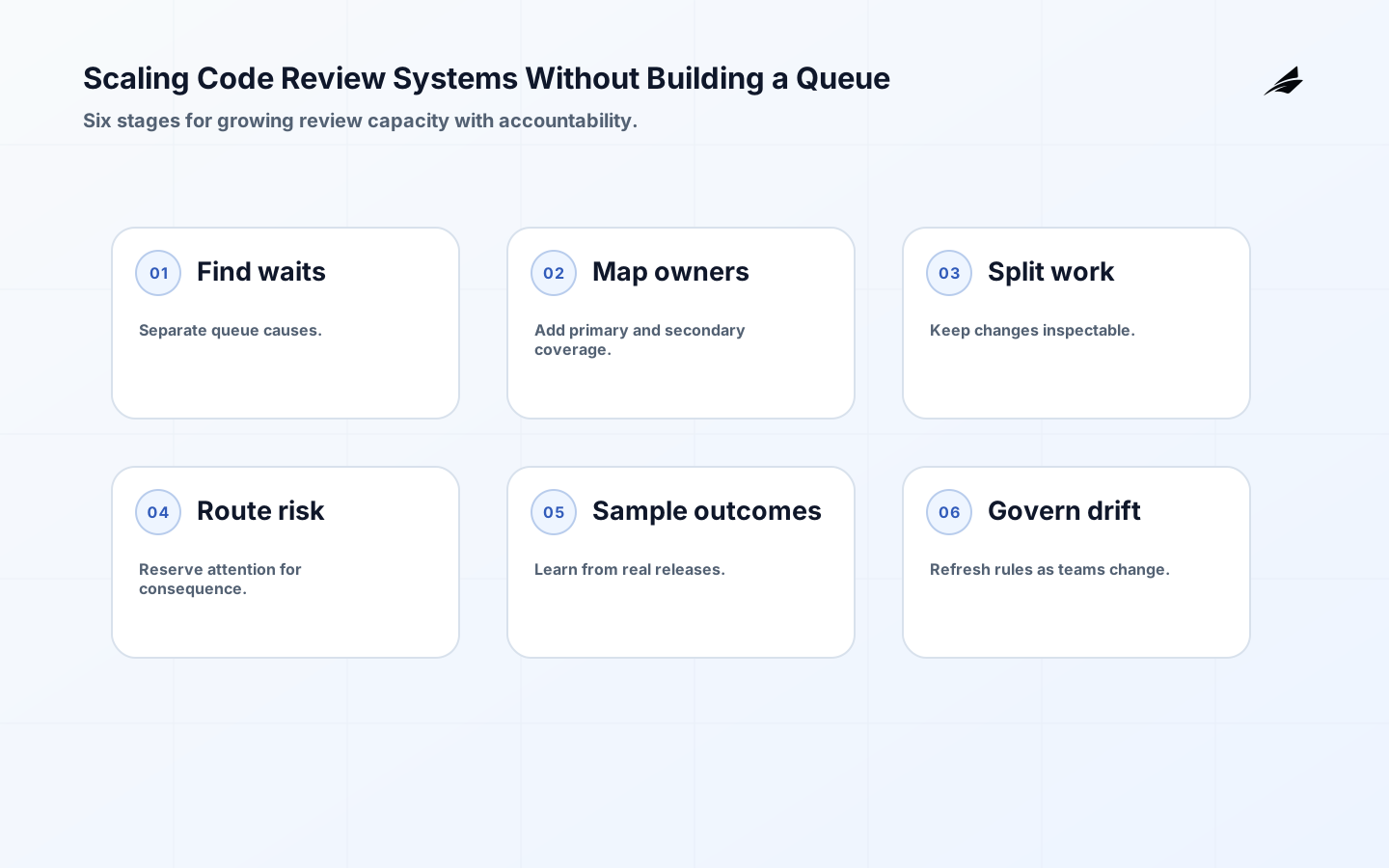
Code review systems often work well at ten engineers and feel painfully slow at fifty. The change is not just volume. More teams create more ownership boundaries, more specialized reviewers, more dependent services, and more opportunities for a pull request to wait in the wrong queue. A growing team needs a review practice that preserves fast feedback without flattening every change into the same approval ritual. The goal is a dependable path from author context to accountable decision, with enough shared knowledge that no critical area depends on one person’s availability.
Find the queue hidden inside the ownership model
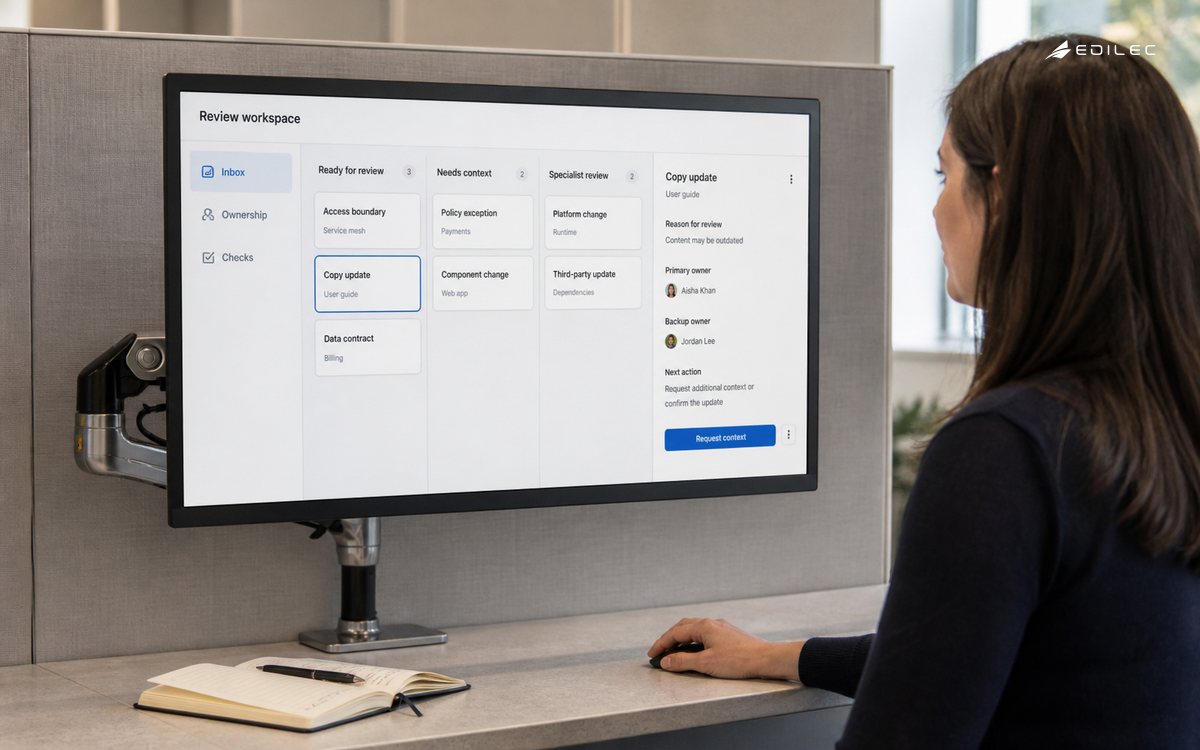
Measure where work waits. A review may be blocked by an unavailable owner, an oversized diff, a flaky check, an unclear product decision, or a dependency team that was invited too late. The median time to merge cannot distinguish those causes. Track first response, time in each state, change size, number of reviewers, rework, check delay, and the age of the oldest high-consequence change. Google’s speed guidance treats timely review as part of engineering health because delayed feedback makes both authors and reviewers less effective.
| Observed symptom | Likely system cause | First response |
|---|---|---|
| One reviewer approves everything | Ownership is concentrated or invisible. | Add secondary owners and route by domain. |
| Reviewers ask basic context repeatedly | Change descriptions and examples are weak. | Improve author template and split changes. |
| High review rework | Checks or design review arrive late. | Move evidence and design questions earlier. |
| Old urgent changes wait | Queue lacks consequence-based priority. | Set an escalation and aging policy. |
| Many approvals, escaped defects | Approval count substitutes for useful scrutiny. | Sample failures and strengthen evidence. |
Make ownership discoverable and resilient
A growing team needs to answer “who can decide?” without asking the founder or searching a chat history. Use a code-owner file, service catalog, repository metadata, or another maintained map to identify primary and secondary owners. GitHub’s code-owner documentation explains automatic reviewer requests and required approval for owned paths. Keep the map close to the code, review it when a team changes, and make missing or invalid owners visible.
Ownership should include more than merge approval. Name who explains the business meaning, who maintains automated checks, who can pause a rollout, who responds to an incident, and who accepts an exception. A team can share work while retaining accountability for a boundary. Add secondary owners and a rotation so the primary owner is not a permanent single point of failure. Review the ownership map alongside the monorepo structure guide when repository boundaries change.
Scale by making changes easier to inspect
As the organization grows, large changes create more cross-team coordination and more hidden review paths. Use staged changes that preserve a working state: introduce a compatible field, update consumers, migrate data, then remove the bridge. A reviewer can understand each step and an owner can stop the rollout with less ambiguity. The GitHub guidance on helping others review changes emphasizes focused pull requests and clear context; those habits become more valuable as reviewer pools widen.
Do not optimize for the smallest diff if it hides a required invariant. A permissions change may need its policy, negative tests, and rollout evidence together. Explain why the change is shaped as it is, what is deliberately out of scope, and which follow-up carries the remaining work. Leaders should reward understandable units, not only raw throughput.
Route review by consequence, not hierarchy
A growing team can use tiers without creating bureaucracy. Routine changes need a focused peer review and reliable checks. Changes to data, authorization, external contracts, or critical operations require the accountable owner. Cross-cutting changes may need a design review before implementation, but not every file owner needs to inspect every line. GitLab approval rules show how required reviewers can be grouped by category; apply the same idea to your actual risk boundaries.
| Change category | Review route | Signal to improve the route |
|---|---|---|
| Routine feature | Peer review plus automated checks. | Rework and escaped defects. |
| Shared library | Maintainer and representative consumer. | Downstream breakage and migration age. |
| Security boundary | Security or domain owner required. | Denied-path failures and review delay. |
| Data movement | Data owner plus operational verifier. | Reconciliation and rollback outcomes. |
| Emergency fix | Fast accountable decision, later full review. | Exception age and repeat emergencies. |
Do not let a hierarchy become a substitute for context. A senior reviewer who cannot explain the affected user journey may be less useful than a domain maintainer who can. Rotate review opportunities so newer engineers learn how decisions are made, while keeping required ownership for consequential paths. This is how code review becomes a knowledge system rather than a gate owned by a small group.
Improve feedback quality as the team diversifies
Different teams will bring different conventions, languages, and levels of context. Make comments specific about behavior, risk, or evidence, and distinguish a required change from a preference. Use a shared vocabulary for blocking, optional, question, and follow-up. Google’s navigation guidance recommends examining the broad change and major design first, then reviewing the remaining files in a logical sequence. That sequence reduces wasted effort when a foundational assumption is wrong.
Create an escalation path that is faster than a silent queue. If the author and reviewer disagree about a product or architecture choice, name the decision owner, discuss it with the smallest useful group, and record the outcome. Avoid turning review comments into a permanent design document; move enduring decisions into the repository’s appropriate record and link them back. Teams grow when the reasoning is available without requiring the original people.
Use automation to protect reviewer attention
A growing repository needs machines to catch repeatable faults: formatting, types, unit behavior, dependency risk, contract compatibility, migration checks, and deployment configuration. Make the checks fast enough to support normal work and reliable enough to carry trust. When a check is flaky, assign an owner and measure its failure rate. Do not ask reviewers to compensate indefinitely for a pipeline that cannot distinguish code failure from environment failure.
Reviewers should then focus on choices automation cannot settle: whether the feature solves the stated problem, whether the boundary is owned, whether the state model handles a retry, whether the user can recover, and whether the change makes the system more understandable. Keep the evidence close to the change so someone outside the author’s team can verify it without a private handoff.
Measure the practice without punishing the people in it
Use review data to find system constraints, not to rank individuals. Compare response time, queue age, change size, review cycles, check duration, escaped defects, rollback rate, and owner concentration by change class. A team with more high-risk work may appropriately have longer reviews. A team with unusually few comments may have excellent automation or may be rubber-stamping; pair metrics with samples and production outcomes.
Run a monthly review sample with engineers from different teams. Select an ordinary change, a delayed change, an escaped defect, and a successful high-consequence rollout. Ask what context was available, which owner could decide, what signal indicated success, and whether recovery was known. Convert repeated gaps into a template prompt, test, ownership correction, or a change to the routing policy. The TypeScript architecture checklist is a useful adjacent example of making ownership and boundaries reviewable.
Govern the practice as the organization changes
Review ownership, approval rules, and repository boundaries whenever teams reorganize, services split, or a critical capability changes hands. Remove stale owners and update secondary coverage. Watch for paths that have no accountable maintainer or paths where everyone is listed and no one feels responsible. Governance should make a timely decision easier, not freeze the repository in an old organizational shape.
Keep an exception ledger for bypasses, emergency approvals, and long-lived temporary owners. Each entry needs a reason, scope, responsible person, and expiry or review date. If the same exception repeats, fix the system instead of normalizing it. This is where code review connects to technical debt for growing teams: review friction is often evidence of a boundary that deserves investment. When the boundary is a shared product surface, the design systems decision guide offers a useful comparison for ownership and contribution rules.
Key takeaways
- Measure where review work waits and separate ownership, context, automation, and consequence as causes.
- Make primary and secondary ownership discoverable, current, and broader than merge approval.
- Use focused, staged changes to keep cross-team behavior inspectable.
- Route required attention by risk and domain, not by hierarchy or habit.
- Use review samples and production outcomes to evolve the system without blaming individuals.
Frequently asked questions
Why do code review systems slow down as teams grow?
More teams create more ownership boundaries, reviewers, dependencies, and specialized risks. Work waits when routing is unclear, changes are too large, checks are noisy, or a small group owns every decision. Measure those causes separately before adding more gates.
How should growing teams use code owners?
Use them to make responsibility discoverable and to route required review for defined paths. Keep secondary owners, review the file when teams change, and remember that an automatic request does not prove the reviewer has context or capacity.
How can leaders improve review speed without lowering quality?
Split oversized work, improve the author context, stabilize automated checks, rotate reviewers, set response expectations, and reserve required owner attention for consequential boundaries. Review escaped defects and queue age to see whether the change helped.
Conclusion: scale understanding, not ceremony
Growing code review systems stay healthy when ownership is visible, changes are inspectable, and feedback reaches the right person quickly. Use automation for repeatable facts, human attention for judgment, and production evidence for the next improvement. That combination lets a larger team move faster without turning every merge into a queue.