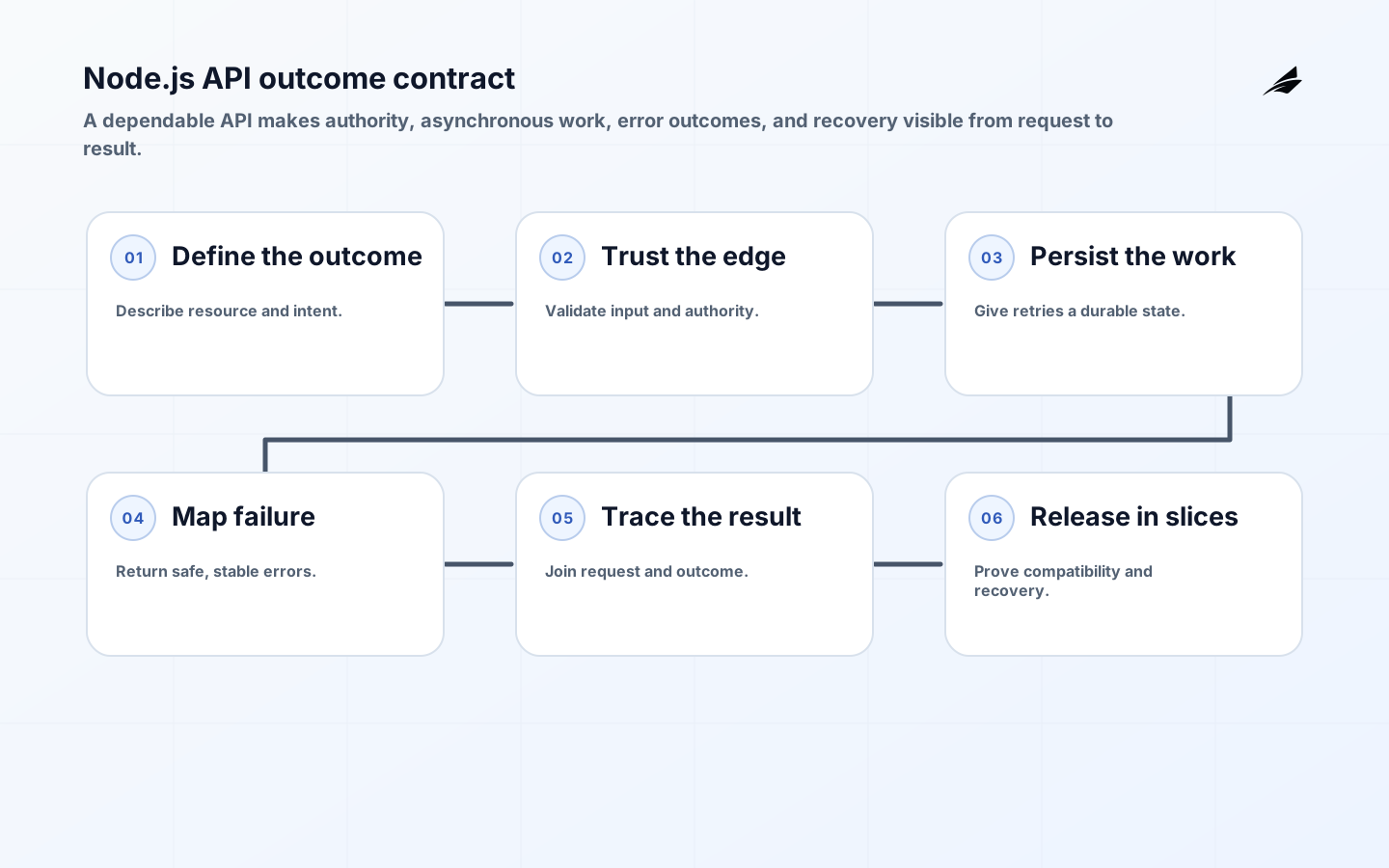
A Node.js API is not ready because routes return JSON on a developer laptop. It is ready when callers can understand the contract, the server can enforce authority, asynchronous work has a durable status, and an operator can explain what happened after a timeout or dependency failure. Node’s HTTP layer is intentionally low-level: it exposes streams, headers, sockets, and request handling without deciding your domain rules. That flexibility is useful only when the first build makes input, outcome, error, and recovery behavior explicit.
Define the user or system action before naming the endpoint. A create request may need idempotency, a search endpoint may need a stable pagination rule, and a report export may need a job resource rather than a long-held connection. Keep the surrounding decisions connected with REST API contracts, Node APIs in production, error handling, and test strategy before the first build.
Define the Node.js API around an outcome
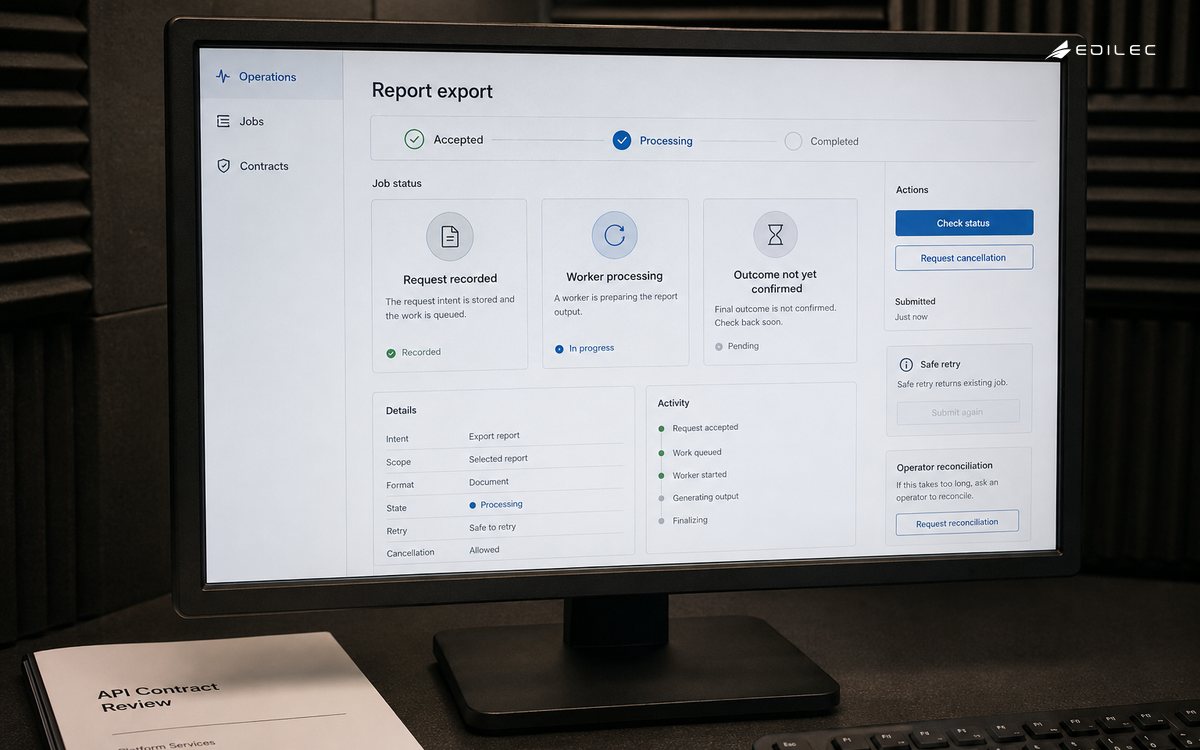
For each operation, write the resource or command, actor, preconditions, accepted input, authoritative write, response state, and retry behavior. An HTTP status code is part of the contract but does not describe every business outcome. A 202 response should point to a durable status that can become complete, failed, or cancelled; a 200 response should not imply that a downstream side effect has happened if the system only accepted work. OpenAPI gives teams a structured way to describe paths, schemas, responses, security, and servers. Keep examples for normal, invalid, unauthorized, delayed, and repeated requests.
| Boundary decision | Implementation intent | Caller benefit |
|---|---|---|
| Input | Parse and validate before domain work. | Actionable rejection at the edge. |
| Authority | Check subject, tenant, resource, and action on the server. | No reliance on hidden client controls. |
| Idempotency | Persist a stable request or business key. | Safe retry after timeout. |
| Asynchrony | Return a durable status reference. | Truthful visibility into pending work. |
| Error | Use safe problem details and a correlation ID. | A repairable failure without secret leakage. |
Node.js APIs also need a clear boundary between transport mechanics and business authority. The Node.js HTTP documentation describes the low-level request, response, header, and stream primitives that the application must wrap deliberately. The HTTP layer can parse a request and report a status, but it should not invent ownership, permission, or completion semantics. Put those decisions in a testable application boundary, then expose enough durable context for a caller or operator to distinguish accepted work, rejected work, and work whose outcome still needs reconciliation. That separation prevents a framework default from becoming an accidental contract.
Validate and authorize at the trusted edge
Treat every request body, query parameter, header, file, and path segment as untrusted. Validate type, length, range, format, content type, and relationships before invoking domain logic. Then make an authorization decision against current server-side facts, not a role or resource identifier supplied by the caller. OWASP’s REST Security Cheat Sheet recommends endpoint-level access control, HTTPS, input validation, content-type checks, safe errors, and audit records. Put these decisions close enough to the protected action that a new route cannot accidentally skip them.
Make asynchronous work durable and honest
A Node process can accept a request quickly while a database, message broker, file store, or external provider continues the work. That is useful only when the state is durable and owned. Persist a work identifier, requested intent, actor, input version, current state, attempt count, and last error. Define whether retries are safe and how a worker reconciles an outcome that may have completed just before its connection failed. Do not hold an HTTP request open to hide an asynchronous workflow. Give callers a status resource and give operators an exception route with an age threshold.
- What durable record proves the request was accepted?
- Can the same business intent be recognized if a caller retries?
- Which dependency is authoritative when the worker times out?
- What state is safe while the outcome is unknown?
- Who owns work that exceeds its normal age?
- How can an operator reconcile or cancel it without editing tables by hand?
Protect data authority and concurrent change
Define which system owns each consequential fact and how the API handles a stale read. Use optimistic concurrency, version fields, conditional updates, or a domain command when two callers can change the same record. Return a conflict that explains the next safe action instead of overwriting the newer value. Keep pagination stable under concurrent inserts and updates, and make filtering semantics explicit. A Node API can be stateless at the HTTP layer while still needing a careful model of resource state, transaction boundaries, and retry behavior.
Turn Node.js errors into safe API outcomes
Node distinguishes ordinary JavaScript errors, system errors, assertion errors, and event-emitter failures. The Node.js Errors documentation notes that error messages can change and that error codes are more stable for programmatic handling; it also warns that an unhandled error event can crash a process. Install handlers where streams and event emitters require them, classify dependency failures, and map internal detail to a safe public response. Preserve the original error and trace context in protected logs, but do not send stack traces, SQL fragments, provider secrets, or account existence clues to callers.
| Failure mode | Control | Signal to review |
|---|---|---|
| Client retry after timeout | Durable idempotency record and reused result. | Duplicate suppression count. |
| Downstream latency | Deadline, timeout, and bounded retry. | Dependency duration and exhausted attempts. |
| Worker failure | Persisted job and exception owner. | Age of unresolved work. |
| Unexpected exception | Safe problem response and trace ID. | Error code, route, and outcome. |
| Malformed request | Schema and size validation before domain work. | Rejected reason and source pattern. |
Make security part of the API contract
Document authentication schemes, required scopes or roles, tenant boundaries, resource-level checks, content types, size limits, rate limits, and audit events. Do not assume an API gateway has made endpoint authorization unnecessary; a direct internal caller or a new route may bypass it. Keep management endpoints separately protected and avoid exposing them on the public interface. Consider replay and out-of-order execution when an operation changes a financial, permission, or workflow record. A security contract is useful when it appears in examples and automated checks, not only as prose beside the route list.
Observe requests through durable outcomes
A request log is not an outcome record. Correlate the request, authorization decision, durable write, downstream call, worker attempt, and final state with a trace or business identifier. Measure latency by dependency, status and problem code, retry volume, queue age, idempotent replays, validation failures, authorization denials, and reconciliation outcomes. Redact secrets and sensitive payloads. Establish an operator view that can answer whether the system accepted the intent, whether an external effect may have happened, and what action is safe next. These signals keep a small Node service diagnosable as its dependencies grow.
Release the first API in bounded increments
Start with one resource or workflow that has a clear owner and a manual fallback. Publish the contract and examples, validate representative and adversarial inputs, exercise retries and timeouts, and test authorization with neighboring tenants and roles. Add a new response field before changing the meaning of an existing field; deprecate deliberately when a contract must move. Include database migration, worker versioning, idempotency, and rollback behavior in the release plan. A route that is easy to add but impossible to reconcile is not a small change.
Run a preflight review with a real scenario
Before the first build becomes a contract for other teams, walk one representative operation from request to durable outcome with product, engineering, security, and support. Use a scenario that can time out after the database write, repeat after a client retry, or lose the worker connection after an external call. Ask what the caller sees, which record decides the result, what is safe to repeat, and which operator can reconcile uncertainty. This exercise exposes missing ownership faster than another endpoint review because it forces the team to describe the moment when the network stops cooperating.
- An OpenAPI example for success, rejection, conflict, and pending work.
- A data or command record showing idempotency and outcome state.
- A timeout and dependency-failure test with the expected public response.
- An authorization case for a neighboring tenant or role.
- A runbook step that explains reconciliation without direct database editing.
- A compatibility note for the next consumer or schema change.
Key Node.js API takeaways
- Define resources and commands around user or system outcomes, not only routes.
- Validate input and authorize the current action on the server.
- Make retries, asynchronous work, idempotency, concurrency, and unknown completion explicit.
- Map Node errors and dependency failures to safe, stable public outcomes.
- Describe security, content, and compatibility rules in a reviewable contract.
- Observe the path from request to durable result and give operators a repairable next step.
Frequently asked questions
When should a Node.js API return asynchronous status?
Return an asynchronous status when the work can outlive a sensible request deadline, depends on a queue or external provider, or needs progress, retry, cancellation, or reconciliation. The status must be durable and tied to the accepted intent.
Does the web framework determine API reliability?
No. A framework can provide routing, parsing, and middleware, but reliability depends on contracts, authority, data boundaries, timeouts, idempotency, error handling, testing, and operations. Keep those decisions visible outside framework defaults.
How should a team version an API?
Version the compatibility promise that consumers depend on, not every internal refactor. Prefer additive change when possible, document deprecation and support windows, and test old and new consumers against the transition.
Conclusion
A Node.js API is dependable when its contract remains true under invalid input, retries, slow dependencies, concurrent change, and lost connections. Design the authority and outcome first, make the runtime’s error and streaming behavior part of the implementation, and ship only the evidence and recovery path that operators will need. The first build then creates an interface that can grow without making uncertainty someone else’s problem.