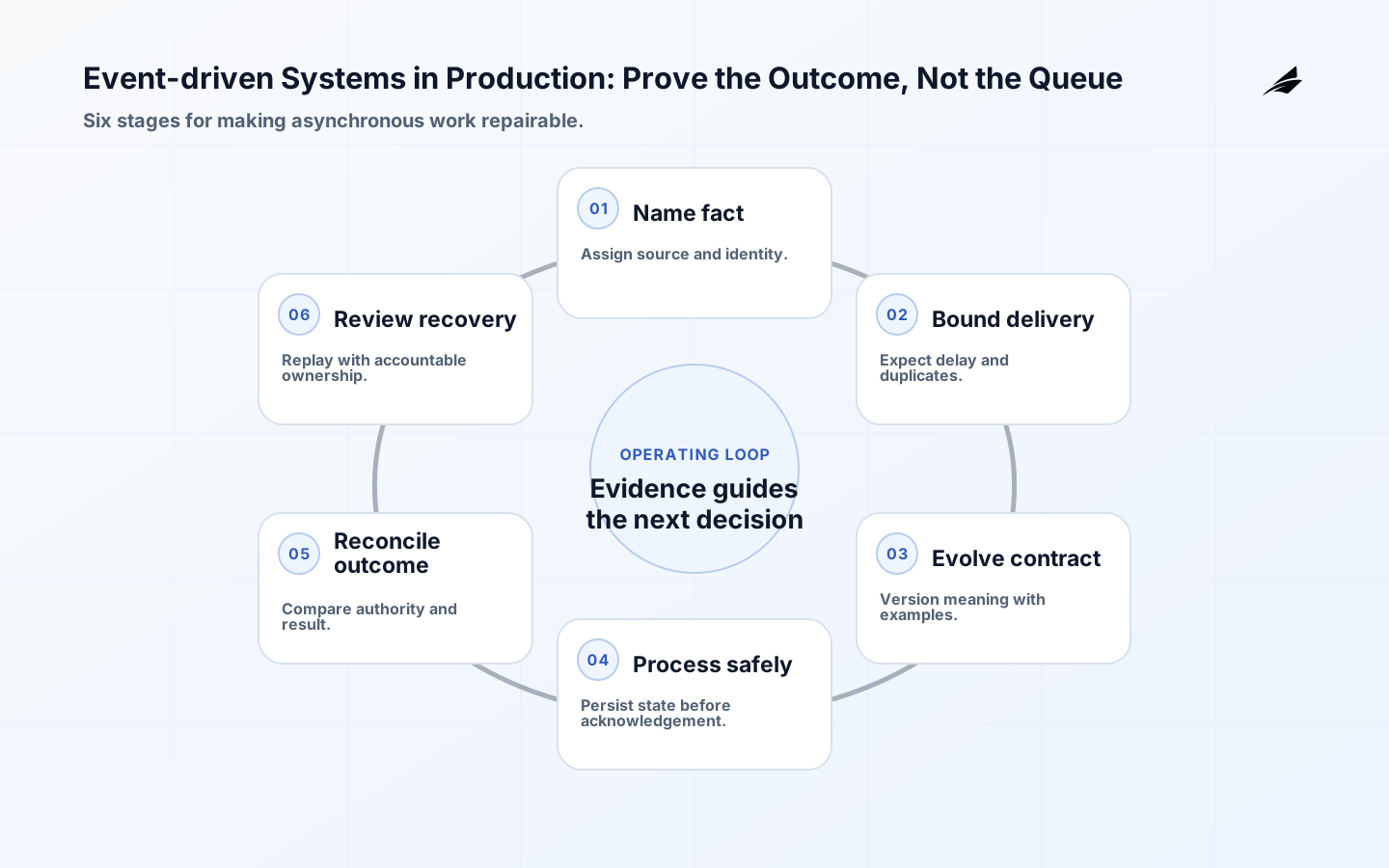
Event-driven systems become a production commitment when a message triggers work that customers, finance, compliance, or another service depends on. At that point, a healthy broker is necessary but not sufficient. The team must know which business fact the event represents, who owns that fact, what a duplicate means, how a consumer resumes after a crash, how a schema changes, and how someone discovers that the downstream outcome is missing. Production reliability comes from those decisions being explicit and repairable.
Name the business fact before naming the event
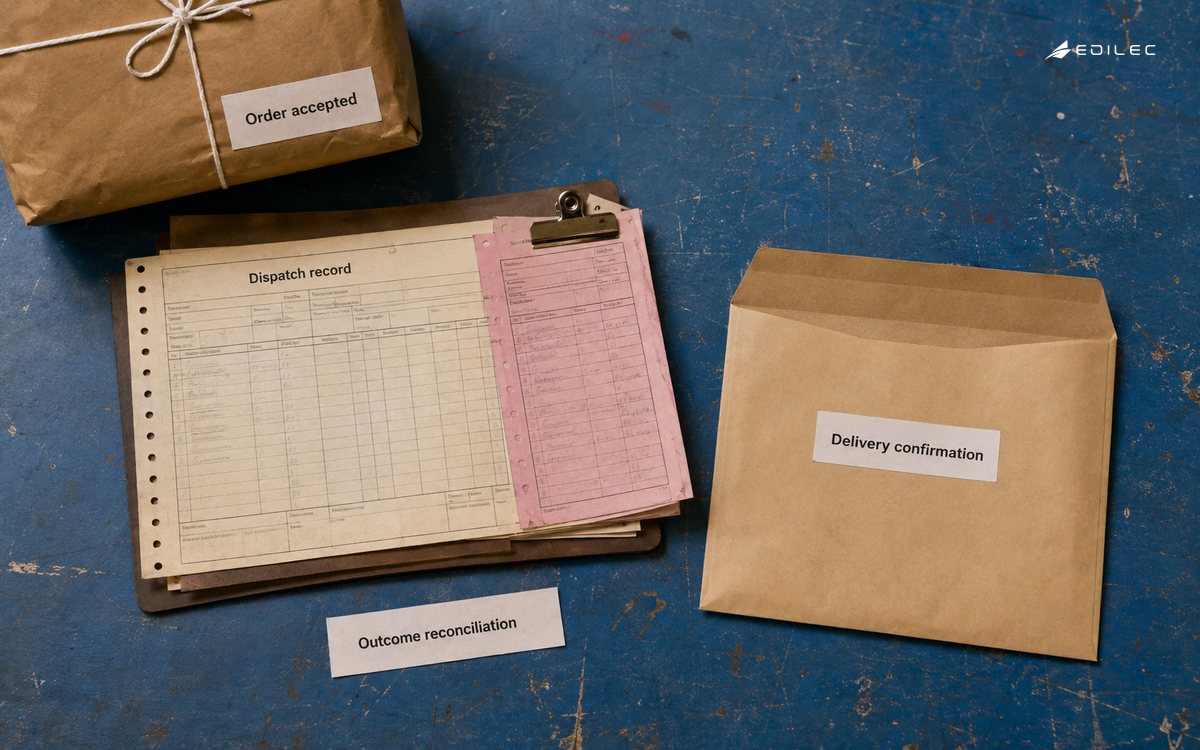
Start with a sentence that can remain true after the implementation changes: “Order 481 was accepted under policy P at time T,” not “the checkout service called a function.” Identify the source of truth, the subject, the producer, the event identifier, the moment the fact became durable, and the consumers that may act on it. CloudEvents defines an event as a record of an occurrence and its context, with required identity attributes such as source, id, specversion, and type. Its specification is a useful envelope reference, but it does not replace the domain meaning your team must document.
| Event element | Decision to record | Failure it helps investigate |
|---|---|---|
| Type | Which business fact occurred? | Wrong consumer or routing rule. |
| Source | Which owned context produced it? | Authority or producer ambiguity. |
| Id | How is one occurrence identified? | Duplicate delivery or replay. |
| Subject | Which aggregate or entity changed? | Cross-tenant or wrong-record action. |
| Time and version | When and under which contract? | Late event or schema mismatch. |
| Correlation | Which journey or command caused it? | Broken end-to-end diagnosis. |
Do not publish internal implementation activity as if it were a business fact. “Cache refreshed” may be useful telemetry, while “invoice issued” may be an event that another capability is allowed to consume. Keep commands and events distinct: a command asks a named owner to do something; an event records that something happened. The distinction prevents a new consumer from treating an instruction as proof that a transaction has completed.
Design for duplication, delay, and disorder
Assume a consumer can see the same event twice, receive it late, restart after writing part of its result, or observe related events out of order. Acknowledge delivery only after the consumer has reached a durable point from which it can safely resume. If a downstream write succeeds and the acknowledgement is lost, the broker may deliver again; the consumer must recognize the event identity or business idempotency key and return the same safe outcome. The Azure event-driven architecture guidance calls out guaranteed delivery, ordering, eventual consistency, and error handling as explicit challenges rather than automatic broker properties.
Set a retry budget based on the failure class. A transient dependency timeout may be retried with backoff. A validation error or incompatible schema should go to a repair path, not consume the same message repeatedly. Preserve the original payload reference, event id, attempt history, and reason for the move. A dead-letter queue is only useful when an owner can inspect the case, correct the underlying condition, and replay it at a safe rate. Amazon EventBridge illustrates the value of a managed routing boundary, but your application still owns the meaning of success and failure.
Make event contracts evolvable
An event schema is a public contract whenever another deployable unit reads it. Prefer additive changes that older consumers can ignore, preserve the meaning of existing fields, and document the versioning policy beside runnable examples. If an incompatible meaning is necessary, publish a new event type or schema identifier and give consumers a migration window. Do not assume that changing a field from optional to required is harmless because the producer and one consumer are deployed together; asynchronous systems deliberately allow independent release timing.
| Change | Usually safer approach | Test before release |
|---|---|---|
| Add optional field | Keep old meaning and let old consumers ignore it. | Old consumer reads the new payload. |
| Rename field | Publish a replacement and observe old-field use. | Both versions produce the same decision. |
| Change enum meaning | Create a new type or explicit version. | Unknown value reaches a safe path. |
| Remove payload detail | Move to a controlled lookup or new contract. | Consumer handles missing data without guesswork. |
| Change ordering rule | Document the aggregate and partition boundary. | Late and parallel messages are exercised. |
Keep events compact and purposeful. The CloudEvents guidance notes that smaller events reduce transport pressure and can allow differentiated access to linked data rather than distributing sensitive details to every consumer. Include enough information for a consumer to make a safe decision, but do not turn the event into a second uncontrolled system of record. If a consumer must fetch current details, record which version or authority it used so a later investigation can explain a difference.
Give every consumer an idempotent processing boundary
A consumer should have an explicit processing record: event identity, business key, attempt, decision, produced side effects, and completion state. The record may live in the same transaction as the side effect when the storage model permits it. For an external API, use an idempotency key or a durable result table so a retry cannot create two shipments, two refunds, or two access grants. If the consumer cannot know whether an external effect succeeded, represent the outcome as unknown and reconcile it rather than blindly repeating it.
Treat ordering as a scoped promise
Do not promise global ordering if the business only requires order within an aggregate. Define the key that determines serialization, the point at which events may be processed in parallel, and what a consumer does when a predecessor is missing. A shipping status might need order for one parcel while independent parcels can proceed together. An inventory projection may tolerate a late update if it compares versions before applying it. Make the rule part of the contract and test the exact interleavings that matter.
If the workload truly needs a synchronous answer, do not hide a request-response transaction inside a vague event subscription. Use an explicit command or query boundary and state where the user waits. Event-driven systems are most useful when decoupling, buffering, fan-out, replay, or independent scaling is valuable; a simple request-response path may be clearer for a decision that cannot continue without an immediate authoritative answer.
Reconcile the outcome, not just the queue
Build a check that compares the producer’s authoritative fact with the outcome each important consumer promises. A published payment-accepted fact should eventually produce a ledger entry, customer status, and fulfillment decision, each with a known state. The reconciliation can run continuously or on a schedule appropriate to the consequence. It should distinguish not yet due, delayed, failed, blocked, duplicated, and completed. A green broker dashboard does not tell you whether a customer received the email or whether the entitlement was granted.
A reconciliation result needs a repair owner and a safe action. If the consumer missed a message, replay from the original identity. If the consumer applied an outdated version, rebuild the projection from authority. If an external system produced an unknown result, investigate that system before retrying. Link the work to database schema design in production when a projection’s data model changes, and keep the business record separate from the event stream.
Operate the event path as a product capability
Give each producer, event type, consumer, and recovery queue a named owner. Monitor backlog age, delivery attempts, duplicate suppression, processing latency, failure categories, schema rejection, replay volume, and reconciliation exceptions. Add a correlation identifier to the event and carry it through logs and traces so an operator can connect a user action to the producer record and downstream work. The Kafka message delivery semantics guidance is a useful transport reference, but your operational dashboard should use business terms such as order, account, or entitlement rather than only partition and offset.
Define limits before load or backlog makes the decision urgent: maximum message age, retry attempts, retained payload size, replay rate, and the time at which a blocked business case reaches a person. Keep sensitive data out of broadly distributed events and restrict who can publish, subscribe, replay, or purge. Review the event surface as part of the error handling implementation checklist because an asynchronous failure needs a user or operator action just as much as an HTTP failure does. The software modernization guide is also useful when an event boundary is introduced to replace a synchronous legacy path.
Roll out with a replay and rollback story
A first production slice should use one event type, one consumer, and a bounded business scope. Capture the current authoritative state, run the consumer in shadow or projection mode when possible, compare outcomes, then enable side effects after the evidence is understood. Before release, exercise duplicate delivery, consumer restart, poison payload, broker delay, schema mismatch, and a replay that overlaps live traffic. The transactional outbox pattern is a practical option when a database change must reliably produce an outbound message.
Replays are production changes, not button clicks. Identify the business keys, current authority, expected side effects, rate limit, and stop condition. Make replay operations attributable and idempotent. If the old consumer is replaced, keep enough history to explain which contract version produced a result. This makes modernization of an event path safer because the team can compare old and new outcomes rather than trusting a cutover timestamp.
Key takeaways
- Define events as owned business facts with stable identity and a clear source of authority.
- Assume duplicate, late, and failed delivery; make consumer effects idempotent and bounded.
- Treat schemas as independent contracts with compatibility examples and version rules.
- Reconcile producer facts with downstream outcomes instead of treating a healthy queue as success.
- Give replay, failure queues, observability, and recovery to named owners before broad rollout.
Frequently asked questions
Do event-driven systems need exactly-once delivery?
Usually no. Design for at-least-once delivery and make the consumer idempotent, because a successful side effect can be followed by a lost acknowledgement. Exactly-once guarantees are narrow to a particular system boundary and do not remove cross-service reconciliation.
When should a service publish an event?
Publish after the owned business fact is durably recorded and another capability may act on it. Use an outbox or equivalent mechanism when the record and message must not diverge. Avoid publishing a transient implementation detail as though it were a business outcome.
What should happen to a message that keeps failing?
Stop unbounded retries, preserve identity and context, move the case to an inspectable failure path, and assign a repair owner. Replay only after the underlying condition is corrected and the side effect is known to be safe to repeat.
Conclusion: make event-driven systems repairable
Event-driven systems earn their complexity when decoupling, buffering, fan-out, or replay improves a real capability. Production reliability comes from naming the fact, bounding delivery and processing, evolving contracts deliberately, and reconciling the outcome. Keep the stream observable and the business record authoritative so the team can recover without guessing.