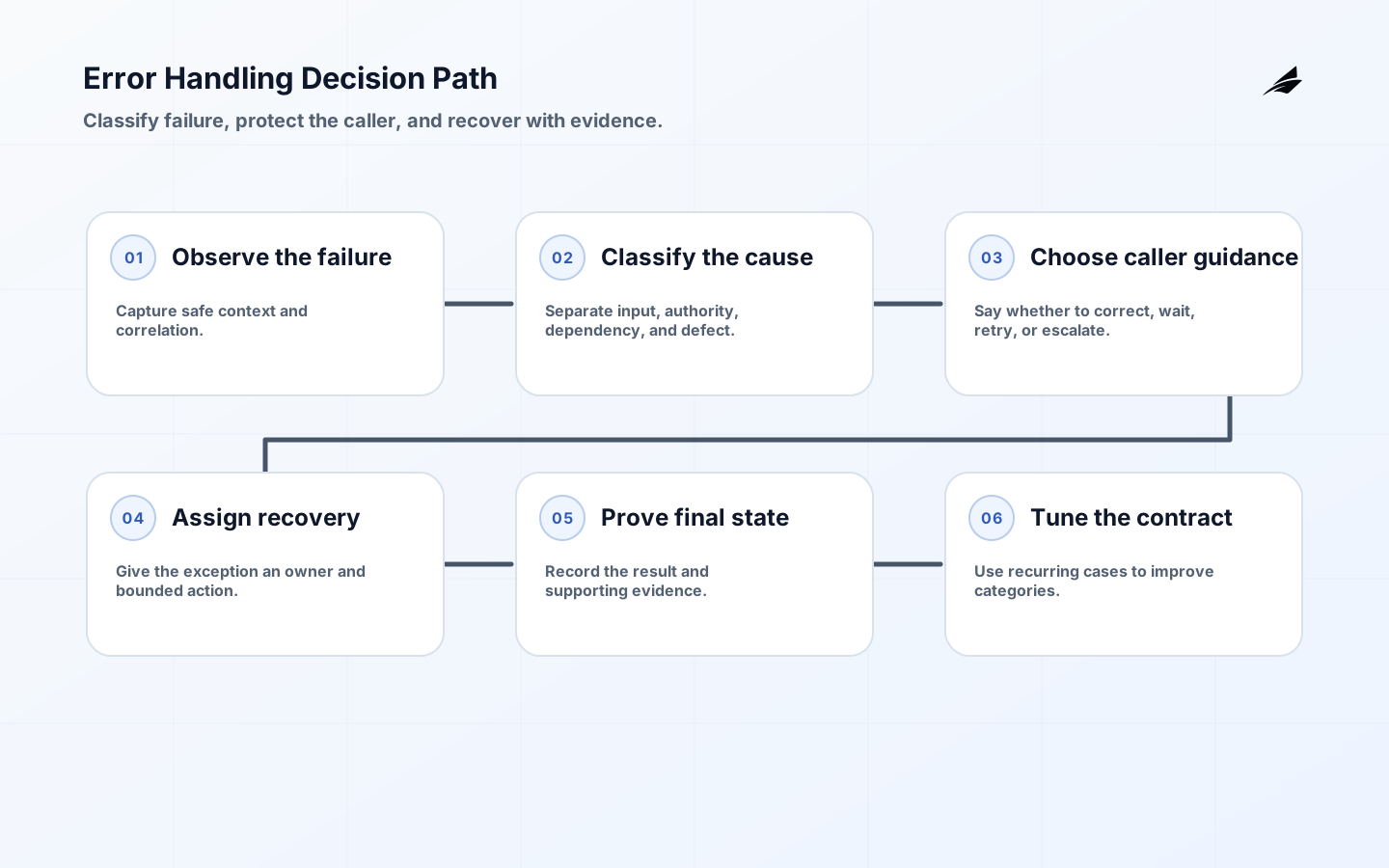
Error Handling: Implementation Checklist is a practical guide to error handling for teams that need a result they can operate, not a fashionable architecture diagram. In this context, error handling means the contract for classification, safe communication, retry behavior, logging, correlation, and recovery when a path cannot continue. The work is valuable only when a person can see the promised outcome, understand its limits, and recover when reality disagrees with the happy path.
For error handling, the planning move that changes the conversation is to begin with a decision boundary. For error handling, separate caller-correctable conditions from operator-repair conditions. Malformed requests, expired permission, unavailable dependency, invariant violation, and ambiguous external results each demand a different response. For error handling, that framing connects technical choices to the people who approve, perform, support, and audit the work.
Set the error handling decision boundary
Separate caller-correctable conditions from operator-repair conditions. Malformed input, expired permission, unavailable dependency, invariant violation, and ambiguous external result demand different actions. Write the promise in plain language: reader, desired outcome, authoritative record, timing, owner, and intervention threshold. This prevents a technical handoff from being mistaken for completion.

For error handling, a boundary also creates an honest non-goal. The first release does not need to solve every adjacent workflow. For error handling, it needs an observable path with real state, a known exception, and a person who can make the next safe decision.
| Question | Useful answer | Evidence to keep |
|---|---|---|
| What outcome matters? | A concrete completion or decision. | Business record and acceptance example. |
| What can fail? | Named conditions with recovery paths. | Classification and owner. |
| Who decides? | A role able to change rules or stop rollout. | Decision log. |
| What proves success? | Behavior in the relevant environment. | Trace, test, or workflow record. |
Classify failures before choosing the response
Define a taxonomy at service boundaries. HTTP problem details provide a standard public shape, but public responses must describe the interface rather than expose stack traces or internal topology. For error handling, draw the boundary between trusted state, side effects, and observability before implementation. For error handling, it reveals where inputs are validated, who can trigger an effect, and how a later reader can reconstruct the decision.
In error handling architecture, prefer interfaces that make safe behavior ordinary. For error handling, stable identifiers, explicit data ownership, reviewable change impact, and a modest first scope matter more than novelty. For error handling, an architecture that the current team cannot explain or operate is not ready for broad adoption.
Connect one error journey to evidence
Preserve cause, add a correlation identifier, translate once to the public contract, and record partial success. Store terminal failure categories beside the business record so support can explain state without hunting logs. For error handling, include authorization, real state, a representative error, and a visible outcome in the first vertical slice. A polished demonstration that skips those concerns can support a conversation, but it is not evidence that error handling can carry production work.
- Name accountable business and technical owners.
- Capture a stable identifier for material actions.
- Exercise normal, invalid, and interrupted cases.
- Show state and next action to the relevant reader.
- Document correction, rollback, and communication steps.
| Choice | Use it when | Trade-off |
|---|---|---|
| Small pilot | Workflow and ownership are still being learned. | Some manual handling remains. |
| Guarded rollout | Happy path is proven but scope needs control. | Support coordination increases. |
| Broad adoption | Recovery and measurement are routine. | Governance costs become visible. |
| Redesign | Core boundary no longer fits the task. | Short disruption prevents a larger false economy. |
Rehearse recovery before increasing volume
Swallowing exceptions turns defects into data loss; exposing all details turns errors into reconnaissance. Retrying invalid requests can also fill a queue and delay healthy work. Put failure states beside the happy path. For error handling, the team should know what is retried, reversible, or sent to human review, and how a user or support agent finds current state without needing raw infrastructure access.
- Could a timeout leave an ambiguous result?
- Can a repeated action cause a second effect?
- Does a public message reveal too much?
- What happens to late, missing, or unauthorized data?
- Who notices, and what can that person do?
Turn error signals into operating action
Track volume by stable type, unknown failures, retry exhaustion, customer-visible recovery time, and alert quality. Keep correlation keys through sampled traces. Review these with the people receiving the consequences, not solely maintainers. For error handling, combine technical timing, business completion, support evidence, and a small sample of real cases to determine whether the stated promise holds.
For error handling, establish a baseline before changes and annotate releases, policy changes, and unusual load. That turns “it got worse” into an investigation with evidence. The best error handling metrics connect a system event to the person or record affected.
Error handling needs a vocabulary that both engineers and support staff can use. “Dependency unavailable” communicates a different next step from “request conflict” or “operation requires review.” Stable categories also make alerting and incident analysis possible across services. Keep developer diagnostics in protected telemetry, while placing a safe correlation identifier and corrective guidance where the caller can use them.
A recovery design should state who is allowed to retry, cancel, compensate, or override a failed action. Those permissions are often more important than the exception class itself. For financial or approval workflows, test the moment after an ambiguous failure: what is shown, which record is authoritative, and how is duplicate action prevented? The answer belongs in a runbook and in the product state model.
Failure messages should be tested for both usefulness and restraint. Give a support agent a real correlation identifier and corrective status, but confirm that an unauthenticated caller cannot learn account existence, infrastructure names, or secret-bearing input. Include localization and partial-information cases where they affect the client action. This is not cosmetic copy review: vague or misleading messages create unsafe manual workarounds, while over-detailed ones expand the security boundary of an otherwise well-designed service.
Finally, keep recovery ownership visible during on-call handoff. An error category without a named resolver or deadline is only a more legible way to postpone the incident. Record the handoff condition, expected acknowledgement, and the escalation path when that acknowledgement does not arrive.
Assign error ownership and change triggers
Review new error types as API changes with support and security input. Test restricted error views as rigorously as success screens. For error handling, version decisions that affect consumers, retain enough history for audit and learning, and make current rules easy to find. For error handling, maturity means a new team member can understand a problem and take the next safe action without private memory.
The technical foundation for this approach is RFC 9457 problem details and OWASP error handling. For error handling, those references describe mechanisms and standards; applying them responsibly still requires a local decision about users, risk, and operating constraints. Additional implementation context appears in Google SRE monitoring and OpenTelemetry error recording.
Choose adjacent controls for failure recovery
Adjacent decisions often decide whether error handling succeeds in practice. Read API Versioning Without Breaking the Consumers You Need, Software Modernization Operations Playbook: Run the Transition Safely, How It Managers Should Think About Design Systems to connect this topic with testing, architecture, delivery, and operational ownership. For error handling, these are design context, not a substitute for observing the workflow in front of you.
Turn failure categories into operating decisions
A useful error taxonomy is small enough to teach and precise enough to trigger different actions. Start with invalid input, denied authority, missing dependency, conflict with current state, rate limit, timeout with unknown outcome, and internal defect. Do not force every failure into a single “server error” bucket: a caller can correct a validation error, while an operator must investigate an invariant violation. The distinction belongs in the interface, telemetry, runbook, and ownership map.
Consider a payment capture that times out after the provider may have accepted it. Retrying immediately can create a second charge; showing “failed” can send a customer into an unnecessary retry loop. The safe contract is to mark the result as pending, keep a correlation key, query the provider or reconciliation queue, and expose the next review time. This example is more valuable than a generic exception demo because it tests ambiguity, duplicate prevention, and communication together.
Use a decision table during implementation review. For every failure type, name the public status and safe message, whether an automatic retry is allowed, the evidence that proves final state, and the person or service that owns escalation. If a row has no owner or no authoritative record, the design is not complete. This also makes test cases concrete: each row can become a scenario with an expected state transition and a bounded recovery time.
Error handling changes should be reviewed as behavior changes, not merely logging changes. A new error code may alter client branching, support scripts, alert volume, and privacy exposure. Keep a compatibility note with the type, status, retry guidance, redaction rule, and first release that introduced it. In incidents, compare the observed response with that note; the gap is often the fastest route to a durable fix.
Key takeaways for error handling
- Error handling is a contract for a real outcome, not a tool configuration.
- Name ownership, authoritative state, recovery, and evidence before expanding scope.
- For error handling, use a complete pilot to learn the failure path as well as the happy path.
- Measure the promise in the workflow where people rely on it.
The durable test for error handling is straightforward: can the team describe the promised outcome, show current state, recover from a known failure, and explain the decision to the person affected? For error handling, begin with one accountable path, retain evidence that matters, and widen adoption only when that path behaves reliably. For error handling, it is a quieter form of progress, but it creates software that earns trust under ordinary pressure.
Frequently asked questions
Should every error have a unique code?
No. Use a stable type when a consumer must choose a different action; keep ordinary HTTP semantics for cases where the status already says enough. Stable types should be documented and should not expose implementation details.
How do we test an ambiguous timeout?
Run the operation against a controlled dependency that delays its response after accepting the request. Verify that the client sees a pending or reconciliating state, that a duplicate effect is prevented, and that an owner can find the final result from the correlation identifier.
When is retry appropriate?
Retry only when the failure is plausibly transient, the request is safe to repeat or has an idempotency key, and the retry budget is bounded. Never use retries to hide invalid input, authorization failure, or an unknown non-idempotent outcome.
Conclusion
A dependable error handling decision is visible in its boundaries, examples, ownership, failure behavior, and evidence. For error handling, start with one complete workflow, make the hard case observable, and expand only when the people responsible for the outcome can operate and recover it. For error handling, that discipline keeps the implementation useful after launch, when conditions are less tidy than the first demonstration.