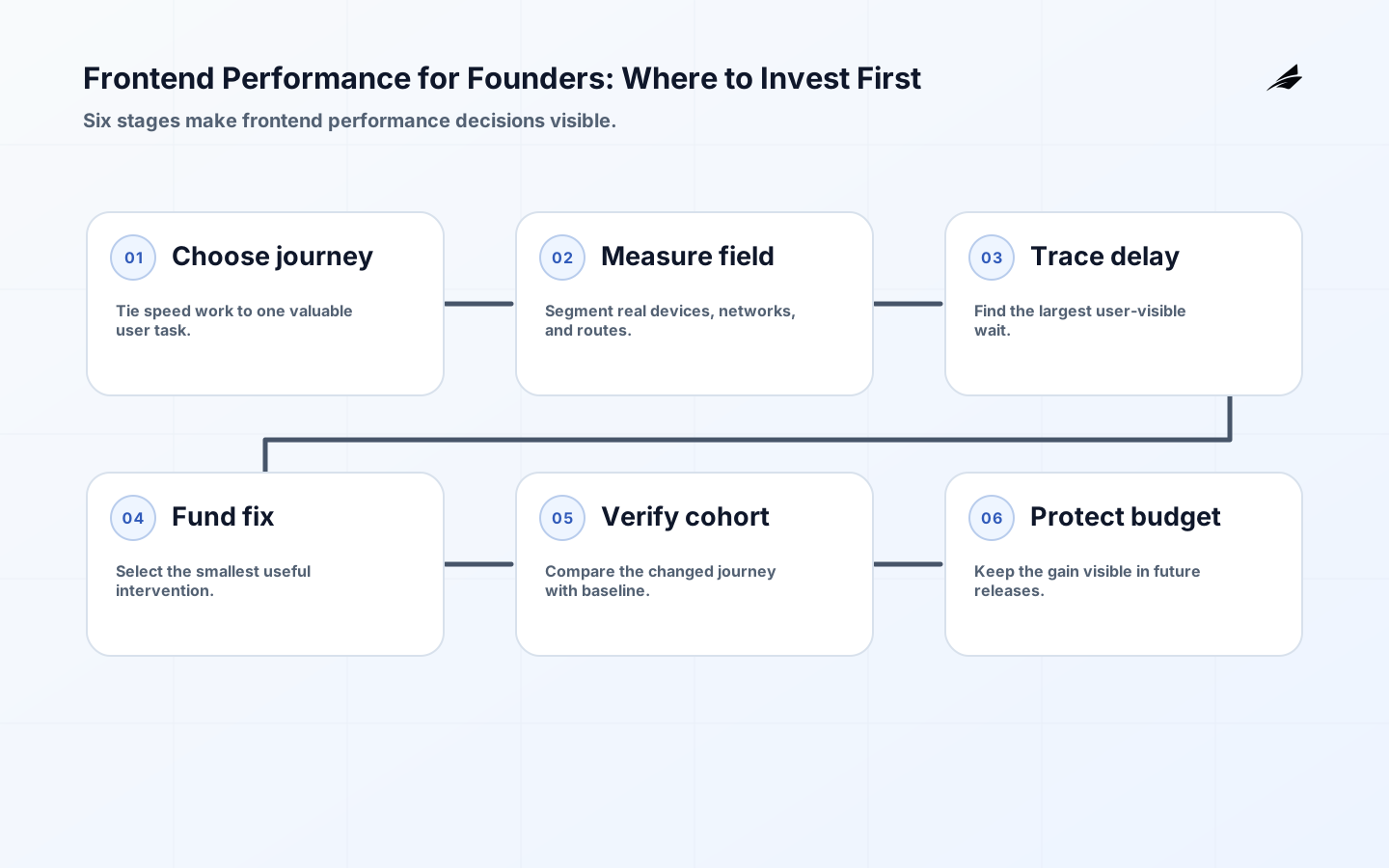
A useful founder decision is to choose one journey and one constraint before approving a speed project. For example, if mobile signup loses users while the account dashboard is already stable, fund the signup path first: record the device mix, first useful content, form interaction delay, completion rate, and the cost of the proposed change. A smaller image may be enough; replacing the rendering model is not automatically justified. This framing keeps performance investment attached to a customer decision rather than a scorecard.
Measure the experience before optimizing
Use both controlled tests and field data. A lab run is repeatable and useful for finding a problem during development; real-user measurements reveal actual networks, devices, and navigation paths. Core Web Vitals provide a shared vocabulary for loading, responsiveness, and visual stability, but they are indicators rather than the entire experience. The Web Vitals overview explains the measures and why they should be assessed at meaningful percentiles. Segment results by page type, device class, and release so an improvement for desktop does not hide a regression for lower-powered phones.

| User experience | Common cause | Useful first evidence |
|---|---|---|
| Slow initial view | Slow server response, render-blocking resource, large hero asset | Server timing and largest rendered element |
| Delayed interaction | Long main-thread JavaScript task | Interaction trace and task duration |
| Jumping layout | Late images, fonts, or injected UI | Layout-shift source and affected element |
| Slow repeat view | No effective cache or repeated data work | Navigation timing and cache headers |
Find the limiting step in the journey
Performance work becomes productive when a team traces one slow experience end to end. Is the HTML waiting on a database call? Is an oversized image delaying the largest visible element? Is a client bundle parsing code that the current screen will never use? Is a synchronous analytics or third-party script competing for the main thread? Examine network waterfall, server timing, JavaScript execution, rendering, and cache headers together. Changing a component before identifying the limiting step often moves work around without changing what the user feels. For main-thread diagnosis, the JavaScript performance guidance helps separate parsing, execution, and rendering work.
- Choose a journey tied to conversion, completion, or daily operational work.
- Compare a representative fast and slow real-user session.
- Identify the largest delay rather than collecting every possible issue.
- Estimate user impact and delivery cost for one focused change.
- Release behind a measurable boundary when risk is material.
- Confirm the field result, not only a local development measurement.
Prioritize assets, rendering, and data
High-value fixes are frequently mundane. Serve appropriately sized images, reserve image and ad space, defer work that is not needed for the first interaction, split code by route or feature, remove unused dependencies, and avoid serial data requests. Improve server response and cache predictable resources before attempting elaborate browser tricks. The Largest Contentful Paint guide offers a disciplined approach to the main visible content. Make the design resilient too: a visual that depends on a huge image or blocking custom font may be beautiful in a demo and frustrating on a real connection.
| Optimization | When it helps | Tradeoff to review |
|---|---|---|
| Responsive image delivery | Large imagery dominates load | Quality, cropping, and cache variation |
| Code splitting | Initial bundle includes unused features | Additional request and loading states |
| Server or edge cache | Responses are repeatable | Freshness and privacy boundaries |
| Deferred third party | Nonessential script blocks interaction | Business value and consent behavior |
Protect performance in delivery
Performance regresses when it is nobody's release concern. Establish budgets for the journeys and resources that matter, review bundle and image changes in pull requests, and make field measurements visible after each material release. A budget is not a promise that a product will never exceed a number; it is an early signal that prompts a tradeoff discussion. Treat third-party additions with the same scrutiny as internal code, since their availability and execution can affect the page. Caching is frequently part of the solution, but its freshness assumptions require the discipline described in the caching strategy guide. Use Lighthouse performance scoring as a repeatable diagnostic signal, not as the product outcome itself.
Connect speed to product learning
Pair performance changes with a user outcome. For a signup flow, observe completion and interaction delay. For an internal dashboard, observe time to usable data and support reports. For a content page, observe whether the primary content becomes visible before users abandon. Avoid claiming causation from a single before-and-after number when releases or campaigns also changed. Instead, use segmented trends and controlled rollouts where practical. This is how a founder can fund speed work as product quality, with evidence instead of a vague request to make the application faster. For adjacent delivery decisions, compare test strategy for custom software, caching strategy in production, and code review systems.
Use a frontend performance implementation checklist
Use the checklist when a team is tempted to optimize from intuition. It keeps an improvement tied to a measurable wait, a specific user population, and a release result. A performance decision should also explain what is deliberately not optimized yet, because that prevents a broad cleanup from obscuring the causal effect of the first change. Over time these records reveal repeated bottlenecks, such as a fragile image pipeline or excessive client work, that merit platform investment rather than another page-by-page patch.
- Choose a page and action where delay affects customer trust, conversion, or the ability of an employee to finish repeated daily work.
- Collect a field baseline by device, network, region, and page version, then compare it with a reproducible lab trace rather than relying on one measurement.
- Identify the largest user-visible wait and trace it through server response, network transfer, JavaScript execution, rendering, and any third-party work.
- Inspect the largest visible content element to see whether its image, font, data dependency, or render path is delaying the moment the page becomes useful.
- Measure interaction traces on lower-powered devices to find long main-thread tasks that a fast developer machine will not reveal.
- Reserve layout space for images, fonts, embeds, and dynamic modules so late resources do not move controls under a person's pointer.
- Review every added dependency for initial download, parse, execution, consent, and outage behavior before placing it on a critical route.
- Serve images in sizes and formats that match the rendered view, and verify responsive selection with real device dimensions rather than only desktop emulation.
- Set budgets for the resources and experience measures tied to the journey, then make a budget breach prompt an intentional product tradeoff discussion.
- Release a material change to a measured cohort where possible, so a separate campaign or backend event does not obscure its observed user impact.
- Watch completion, abandonment, error rate, and support feedback alongside performance measures to avoid optimizing a technical proxy while the journey remains confusing.
- Keep the before-and-after evidence with the change record, then revisit it when later features alter the same route, bundle, or source response.
A performance review should end with a short decision record: the journey measured, field baseline, limiting step, chosen change, expected tradeoff, release cohort, and result. This makes speed work cumulative. When a later feature introduces a large asset, a new third party, or an extra data call, the team can understand which earlier user experience it risks and decide intentionally whether the added value justifies the cost.
Key takeaways
- Measure field and lab experience for journeys users actually value.
- Find the limiting network, server, rendering, or JavaScript step before changing code.
- Prioritize simple improvements to assets, data, and rendering paths.
- Use budgets and release review to keep gains from disappearing.
- Connect performance metrics to completion, trust, and operational outcomes.
Frequently asked questions (FAQ)
When the evidence is mixed, separate cause from correlation. A campaign can change traffic quality while a release changes JavaScript weight, so compare cohorts and release windows rather than declaring victory from a single Lighthouse run. The decision record should name the baseline, the affected segment, the chosen intervention, the tradeoff, and the next measurement date. That short record becomes a practical guardrail when a later feature adds a widget, font, or analytics tag. What counts as good frontend performance? It depends on the journey and users, but loading, responsiveness, and stability should be measured from real devices and networks, not assumed from a developer laptop. Should we optimize every page first? Start with high-volume or high-value journeys and their largest observed delay. Do metrics replace usability research? No. Metrics identify friction, while observation explains why it matters. Can a framework solve performance? Framework choices influence defaults, but assets, data, rendering, and release discipline still determine the user experience.
A founder can make the investment decision more precise by separating reversible improvements from commitments that change the application’s shape. A responsive image, a deferred analytics tag, or a smaller bundle can be tested quickly and rolled back cleanly. A rendering-model change, a new edge layer, or a data-fetch redesign deserves a stronger case because it alters maintenance and failure behavior. Record the expected customer benefit, engineering cost, operational burden, and rollback path together. That comparison lets a small team choose a useful experiment without treating every performance concern as a platform rewrite.
Conclusion
Frontend performance becomes manageable when it is treated as a product experience with evidence. Choose a real journey, measure it in the field, identify its limiting step, and protect the improvement through delivery practices. That approach avoids a long, unfocused optimization campaign and gives customers a product that feels reliably ready when they need it.