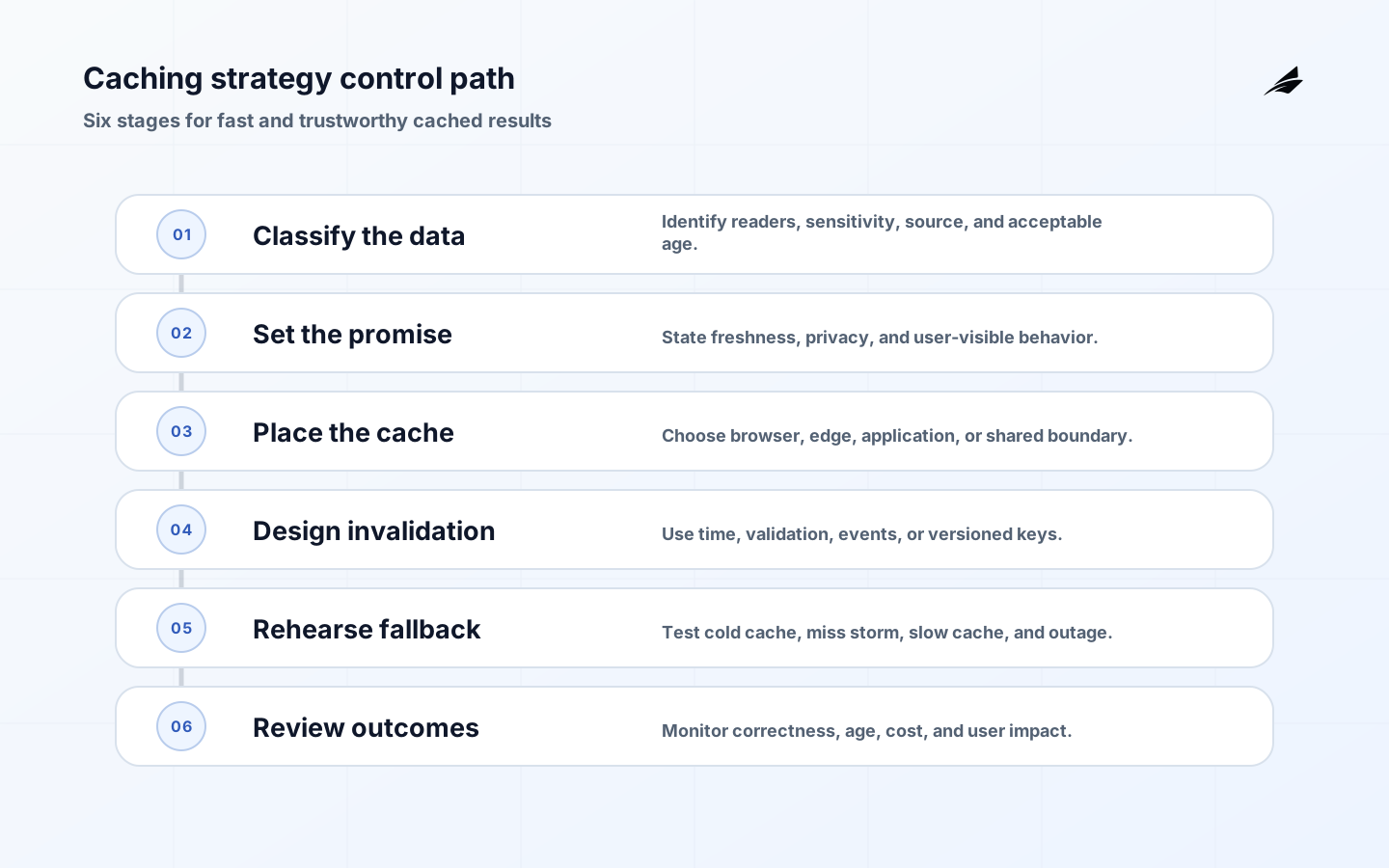
Caching strategy is an agreement about how stale a result may be, who can see it, and what the product does when the cache is missing or wrong. Faster pages are a welcome result, but speed alone is a poor reason to keep a copy of data. A product price, account balance, permission, delivery estimate, and public article all have different freshness and privacy requirements. Operations leaders should ask what decision the cached value supports, how incorrect data would harm a user, and whether the authoritative system can cope when cache traffic suddenly disappears.
Start with the decision and freshness promise
Classify data before selecting a cache. Public reference content may tolerate a long time-to-live and edge delivery. A user's account permissions should usually be evaluated close to the authoritative identity and policy systems. A product catalog might tolerate a brief delay, while inventory available for checkout needs a much tighter rule. State the maximum acceptable age, the invalidation event, the fallback behavior, and the owner in plain language. RFC 9111 defines HTTP caching semantics, including freshness and validation, which helps teams express web cache behavior consistently.

| Data class | Typical cache posture | Failure question |
|---|---|---|
| Public static content | Edge cache with validation | Can a user safely see an older revision? |
| Product catalog | Shared cache with bounded TTL | What price or availability delay is acceptable? |
| Per-user view | Private or session-scoped cache | Could one user see another user's data? |
| Authorization decision | Minimal, carefully invalidated cache | What happens after access is revoked? |
Select the cache boundary deliberately
Browser, CDN, gateway, application, and database-adjacent caches solve different problems. Put cache policy as close as practical to the consumer and source of truth without hiding ownership. HTTP responses can state cache control and validators that browsers and intermediaries understand; an application cache can combine expensive calculations; a distributed cache can protect a backend from repeated reads. Avoid storing a generic blob with an ambiguous key. Include tenant, locale, permission-sensitive variation, schema version, and query inputs in the key where they affect the result. Missing one dimension is a common route to data exposure.
- Write the data owner, acceptable staleness, and invalidation trigger.
- Choose a key that includes every dimension that changes the response.
- Define cache miss, timeout, and dependency-outage behavior.
- Protect stampedes with request coalescing, jitter, or controlled refresh.
- Set memory limits and eviction policy before capacity becomes an incident.
- Test a revoked permission and a changed source record through the full path.
Design invalidation and fallback together
Invalidation does not need to be instantaneous everywhere, but it must match the promise made to the user. Use a time-to-live when bounded staleness is acceptable, versioned keys when a representation changes, and event-driven invalidation when a source update must propagate promptly. Build a fallback for a cache outage: perhaps serve a bounded stale value, perhaps call the origin with rate protection, or perhaps fail closed for a protected action. Cache-aside is common because application code controls population, but it still requires a plan for races between an update and a read.
| Failure pattern | Mitigation | Signal |
|---|---|---|
| Cache stampede | Coalesced refresh and TTL jitter | Origin surge after expiry |
| Stale critical value | Event invalidation or short validation window | Age beyond service objective |
| Key collision | Explicit key dimensions and tests | Cross-tenant or wrong-context response |
| Memory pressure | Capacity budget and eviction review | Evictions, hit-rate drop, latency |
Operate capacity and security
A cache needs the same operational ownership as any dependency. Watch hit ratio alongside origin load, cache age, evictions, memory use, errors, and p95 latency. A high hit rate can still be bad when it serves incorrect data. Redis eviction behavior depends on configured policies and memory limits, so its key eviction guidance should inform capacity planning rather than being discovered under pressure. Treat cached data as sensitive data: restrict network access, encrypt where appropriate, avoid credentials in values, and include cache stores in incident and deletion procedures.
Measure user outcomes, not just hit ratio
Connect cache metrics to the journey they support. For an expensive search page, compare user-perceived response time, origin load, and error completion before and after a change. For checkout, compare stale inventory conflicts and successful purchases. Record cache policy changes with the same release evidence as application changes. Frontend performance improvements often involve a cache layer, but assets, rendering, and interaction work matter too; the frontend performance guide helps keep the system view intact.
Run a background job design review
Before coding a worker, write the business state machine it will move. Define the record that proves the request was accepted, the event that makes it eligible, the external effects it may create, and each terminal state. Then decide which actor can inspect, cancel, correct, or replay it. This keeps a job from becoming an untraceable function call buried behind a queue. It also exposes whether a user can safely make a second request while the first is pending and whether the product needs a deduplication or cancellation rule.
Design a failure injection exercise for each job type. Stop the worker before it starts, after it reads the message, after it performs a provider call, and before it records completion. Feed an invalid payload, an expired credential, and a provider response that arrives too late. The team should be able to predict the status, retry decision, audit evidence, and operator action for every case. This is especially important for financial or customer-notification work, where duplicate or missing effects are more damaging than a delayed result.
Make the job operational interface deliberately smaller than the payload. A support person usually needs a job ID, business record, state, attempt count, last failure category, timestamps, and an authorized repair action, not raw credentials or private content. Set an alert on age or failure rate only when a human has a documented response. Review recovery queues regularly; they are not a storage location for problems that have become too difficult to handle. A queue without a recovery routine is simply delayed data loss.
| Design checkpoint | Question | Evidence to retain |
|---|---|---|
| Intent | What durable record proves the request exists? | Committed business record before enqueue |
| Effect | What must happen no more than once? | Idempotency key and provider rule |
| Retry | Which failure could improve later? | Class, delay, cap, and terminal action |
| Status | What can the user or support team see? | State model and safe operator view |
| Recovery | Who handles exhausted jobs? | Queue owner and repair runbook |
| Capacity | What happens during a backlog? | Age objective and scaling or degradation rule |
Review jobs after the first week of real traffic. Compare expected volume and duration with observed work, inspect a sample of failures, and ask whether users understand the new asynchronous state. A job system is healthy when ordinary success is quiet, unusual failure is observable, and repair does not require a developer to reconstruct an opaque message. Those are practical criteria for deciding whether to add a new worker or first improve the one already carrying important operational work.
Use a caching strategy implementation checklist
- Name the authoritative source, the readers, the maximum acceptable age, and the product decision that the cached value is allowed to support.
- Include every response-changing dimension in the cache key, such as tenant, locale, role, feature state, schema version, and query input.
- Test an updated source record, revoked access, deleted content, cold cache, slow cache, and cache outage from the user's actual route.
- Choose time-to-live, validation, event invalidation, or versioned keys based on a stated freshness promise rather than implementation convenience.
- Protect the origin from synchronized expiry with request coalescing, jitter, bounded stale serving, or explicit load-shedding behavior.
- Set memory limits, eviction policy, and capacity thresholds before cache pressure forces a policy decision during an incident.
- Restrict network access and retention for cached data, particularly when it can contain personal, financial, or permission-sensitive records.
- Monitor age, hit ratio, evictions, memory, errors, origin load, and user outcome together so a fast but incorrect response is visible.
- Document fallback behavior for each route, including whether a user sees a bounded stale result, a wait state, or a protected failure.
- Review the policy after a privacy change, source-system change, traffic event, or incident, and remove cache layers that no longer earn their complexity.
Key takeaways
- Define acceptable staleness and harm before choosing a cache technology.
- Place cache boundaries and keys where ownership and privacy remain clear.
- Plan invalidation, misses, and cache outages as one design problem.
- Monitor freshness and correctness alongside speed and hit ratio.
- Treat cached records as production data with access and capacity controls.
Frequently asked questions
What is the best cache invalidation method? The best method is the one that meets the data's freshness promise with an understandable failure path; it may be TTL, validation, event invalidation, or a combination. Should sensitive data be cached? Only with a clear privacy boundary, key design, access control, and expiration policy. Is a high cache hit rate always good? No. A high hit rate serving stale or incorrectly scoped data is harmful. Can a cache replace database scaling? It can reduce repeated reads, but it does not remove the need to understand authoritative workload and write behavior.
Conclusion
A good caching strategy makes speed, freshness, and failure behavior explicit. Start with a product decision and the age of data it can safely tolerate, then design keys, invalidation, fallback, and observability around that promise. The cache becomes a dependable performance tool only when users, operators, and the source of truth all remain visible in the design.