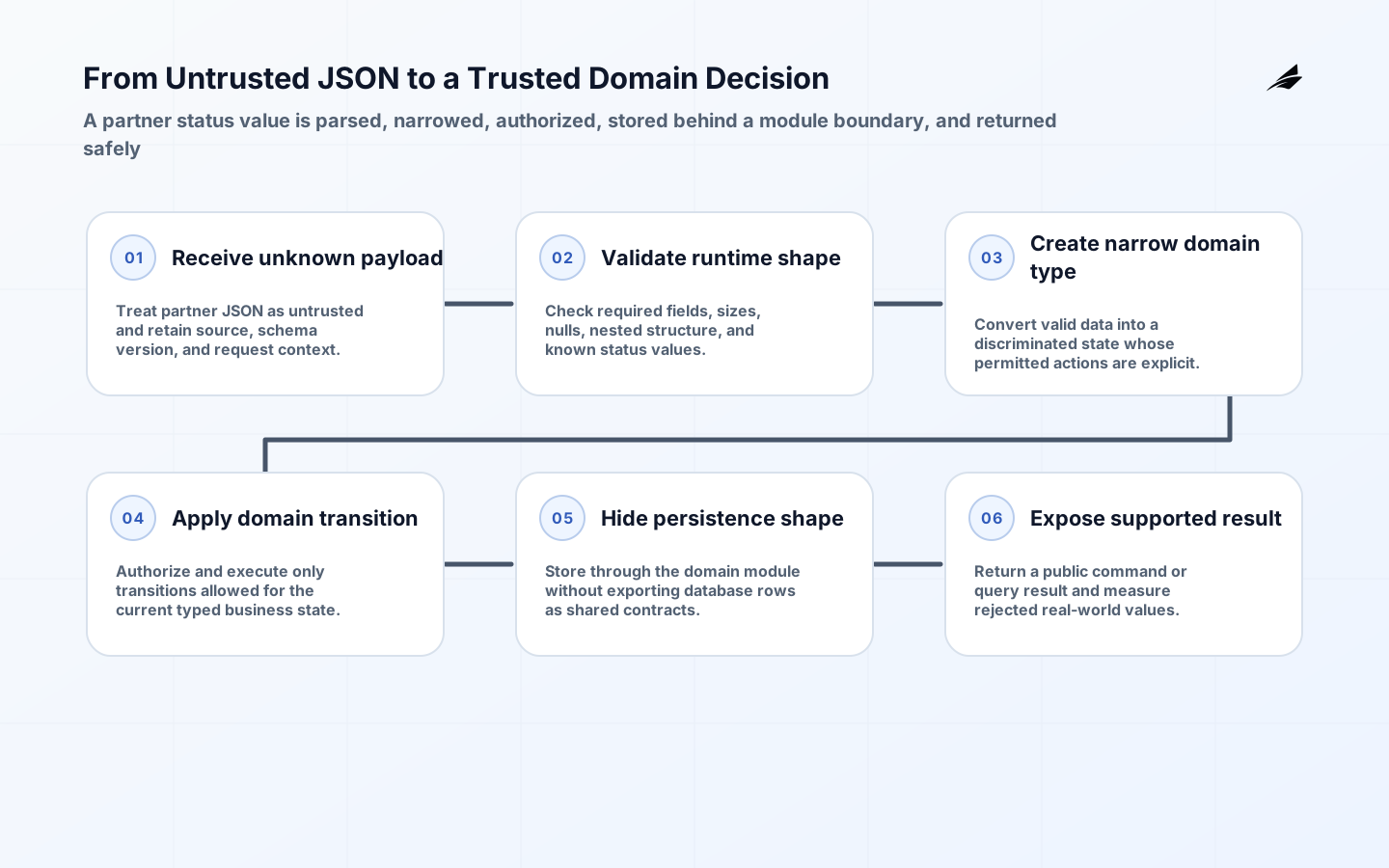
TypeScript architecture pays off when types describe the decisions a system is allowed to make. A type alias that mirrors a database row without capturing status, authority, or validation may provide autocomplete but little protection. A stronger model represents the difference between a draft invoice and an issued invoice, a verified user and an unauthenticated request, or a parsed external payload and a trusted domain object. The goal is not maximal type cleverness; it is making common mistakes hard to express.
Make TypeScript architecture an explicit operating decision
Keep types close to the boundary they protect. Validate untrusted input at the API, queue, file, or environment boundary, then turn it into a narrower internal representation. The TypeScript Handbook documents the language features, but architectural value comes from deciding where runtime validation is unavoidable and where static checks can safely enforce internal invariants.
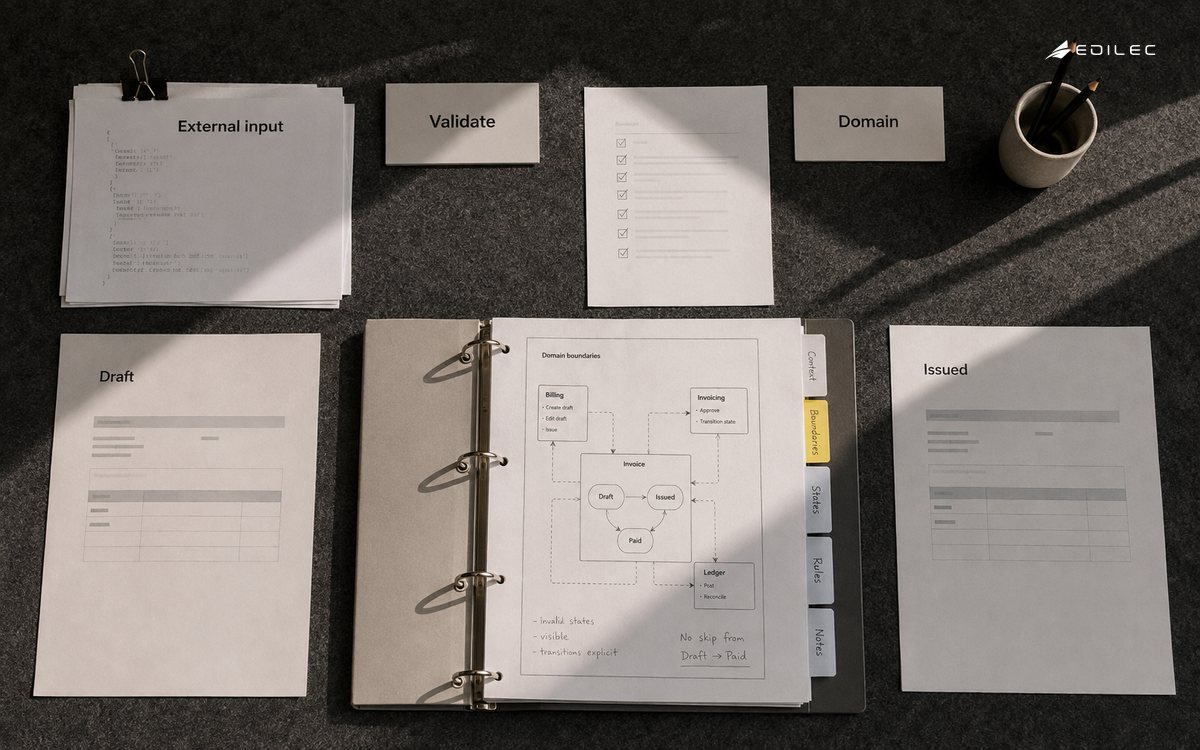
| Decision | Question to answer | Useful evidence |
|---|---|---|
| Boundary input | Where does untrusted data enter? | Parser and validation result |
| Domain model | Which states allow which actions? | Narrow state types |
| Module surface | What may another domain import? | Public command, query, or schema |
| Escape hatch | Where is unsound typing allowed? | Documented isolated conversion |
Define the TypeScript architecture contract and boundaries
Design modules around domain capabilities, not technical layers alone. A billing module can expose commands and queries while keeping persistence types private; an authentication module can return a verified principal rather than spreading raw token claims through the application. Use discriminated unions for meaningful states and exhaustiveness checks when every case needs a deliberate outcome. Do not pretend TypeScript validates JSON at runtime: parsed input is unknown until a validator accepts it.
- Identify external inputs and convert them from unknown data into validated domain values.
- Model states that change permitted actions with discriminated unions.
- Keep persistence and transport representations behind module boundaries.
- Use strict options and investigate new escapes rather than normalizing them.
- Add build references only where they reinforce real ownership and dependency rules.
- Test runtime validators, integration behavior, and state transitions alongside type checks.
Build and roll out TypeScript architecture in a bounded slice
Introduce boundaries during ordinary change. Start by wrapping one external API response in a parser, then make consumers depend on the validated result. Add project references or package boundaries when compilation and ownership need to follow the architecture. The project references documentation explains how to structure larger builds, but do not use references as a substitute for an understandable dependency direction.
| Failure mode | Guardrail | Signal to monitor |
|---|---|---|
| Typed fiction | JSON is cast without validation | Unknown input and runtime parser |
| Leaky persistence | Database shape becomes application contract | Private repository types |
| Global coupling | Shared types pull domains together | Narrow public contract |
| Suppression drift | Unsafe casts accumulate | Review of any and ignored errors |
Operate TypeScript architecture with evidence
Enable strict compiler options deliberately, track any escapes, suppressed errors, runtime validation failures, and dependency-cycle warnings. These signals should inform refactoring, not become a quota that encourages unsafe casts. Review compiler upgrades and type-definition updates as dependency changes with test evidence, because a changed declaration can reveal an assumption that production code has carried for years.
Make TypeScript architecture tradeoffs explicit
Shared types are useful for stable contracts, but a giant global types package can couple unrelated domains. Share a schema or narrow public type when two systems truly coordinate; otherwise translate at the boundary. This choice aligns with the monorepo structure guide, where package structure should make valid dependencies easier than accidental ones.
A concrete example keeps the design grounded. A customer import endpoint may receive JSON status values from several partners. Treating it as a TypeScript string lets unexpected values reach billing logic. Parsing at the boundary into a narrow union or rejected result forces a decision while the request still has context. Use the example to identify the authoritative record, expected outcome, failure that changes it, and operator who must choose the next action. That turns an architectural claim into a reviewable slice of production behavior.
Test parsers with omitted and extra fields, nulls, old enum values, maliciously large input, and real partner examples. Test state transitions with allowed and disallowed variants. During refactoring, compile from a clean checkout and run integration tests so type improvements do not conceal changed serialization or query behavior. Keep evidence with the change: a reproducible command, expected telemetry, and a note about the failure being exercised. Checks should state the capability being protected, not merely mirror implementation details.
Domain owners define vocabulary and transitions; API owners protect input boundaries; platform maintainers own compiler and build policy. A shared type becomes an organizational interface, so its changes need the same review and migration communication as any public contract. Agree on a review cadence and escalation route before the first exception arrives. The aim is a timely decision by someone with the right context, not a large committee or a static policy nobody can apply.
Strengthen typing one boundary at a time. Replace an unsafe cast with unknown data and a parser, expose a narrow result to one consumer, and use telemetry to learn about rejected real-world values. Avoid abstract type hierarchies before a concrete failure justifies their complexity. Publish entry and exit criteria for each step, including the condition that stops expansion. A narrow rollout gives a better learning loop because intended and observed behavior can be compared while scope remains correctable.
Watch validation failures by source, unsafe escapes, dependency cycles, and the duration and reliability of type checks. These indicators point to boundaries needing attention; they should not become a competition that drives developers to hide uncertainty behind a cast. Ask what action each signal would justify. A metric without an owner, threshold, or practical response is not useful observability; a smaller trusted set is stronger during a release or incident.
Review public type changes, compiler upgrades, and generated definitions with migration notes. Remove deprecated variants after consumers move, and keep examples near schemas. This record helps maintainers distinguish a deliberately broad input from an accidental loophole. Include this in dependency review, planning, and incident follow-up so it does not depend on one person's memory. Clear notes should cover normal operation, known limits, emergency authority, and recovery evidence.
Before treating a plan as ready, turn it into a small review exercise. Use an external payload with an unknown enum and a malformed nested field to verify that the parser rejects ambiguity before it reaches business logic. The exercise should name an owner, expected evidence, and a concrete result that would cause the team to pause. It is intentionally more demanding than a demo: demonstrations often assume ideal data and a cooperative dependency, while real confidence comes from showing that the boundary responds predictably when assumptions fail. Store the result with the relevant change record so the next engineer can repeat the check rather than reconstruct its purpose from an old ticket.
Failure rehearsals are a practical way to protect operational knowledge. Ask a maintainer to trace a domain value from API input to storage and back without reading private implementation details from another module. The person running the rehearsal should use ordinary documentation and permitted tools, not private memory or administrator shortcuts. Note the time needed to detect the condition, make a decision, and verify recovery. Those observations often reveal a missing identifier, unclear authority, or unsafe default before an incident turns the same omission into customer harm. Feed the learning back into tests, runbooks, and the next release rather than treating the exercise as a one-time audit.
Change needs a decision record as well as code or configuration. Record type-contract changes beside API or package release notes so consumers understand whether a new variant is additive, deprecated, or breaking. Include the scope, assumption, approval authority, observable success condition, rollback or correction route, and date for reconsideration. This discipline keeps temporary controls from becoming invisible permanent architecture. It also gives product, operations, security, and engineering a common artifact for resolving tradeoffs, which is far more useful than asking each group to infer intent from dashboards, implementation details, or an incomplete support history.
Prefer a short, readable type model over a universal abstraction that only its author can modify. The review question is simple: can a teammate see which values are trusted, which transitions are allowed, and where uncertainty is handled? When the answer is no, a smaller boundary or a clearer runtime parser often delivers more safety than another generic utility type.
The best boundary is also explainable in a review. A reader should be able to identify the incoming uncertainty, the validator, the trusted value, and the decision enabled by that conversion.
Key TypeScript architecture takeaways
- Types are most valuable when they encode business-relevant distinctions.
- Runtime validation is required at untrusted boundaries.
- Modules should expose capabilities, not internal storage shapes.
- Discriminated states make missing cases reviewable.
- Shared types should follow stable contracts, not convenience.
- Compiler evidence complements rather than replaces behavioral tests.
TypeScript architecture FAQ
Can TypeScript replace tests? No. It cannot verify runtime input, integration behavior, or business outcomes. Should every value have a branded type? No; use stronger types where confusing values would cause a meaningful defect. Is `any` always forbidden? It is an escape hatch that should be isolated, justified, and converted to a safer type quickly.
Conclusion: make TypeScript architecture dependable
Good TypeScript architecture turns important assumptions into visible, reviewable boundaries. Validate at the edge, model meaningful states, and use the compiler as one layer of evidence in a broader quality system.