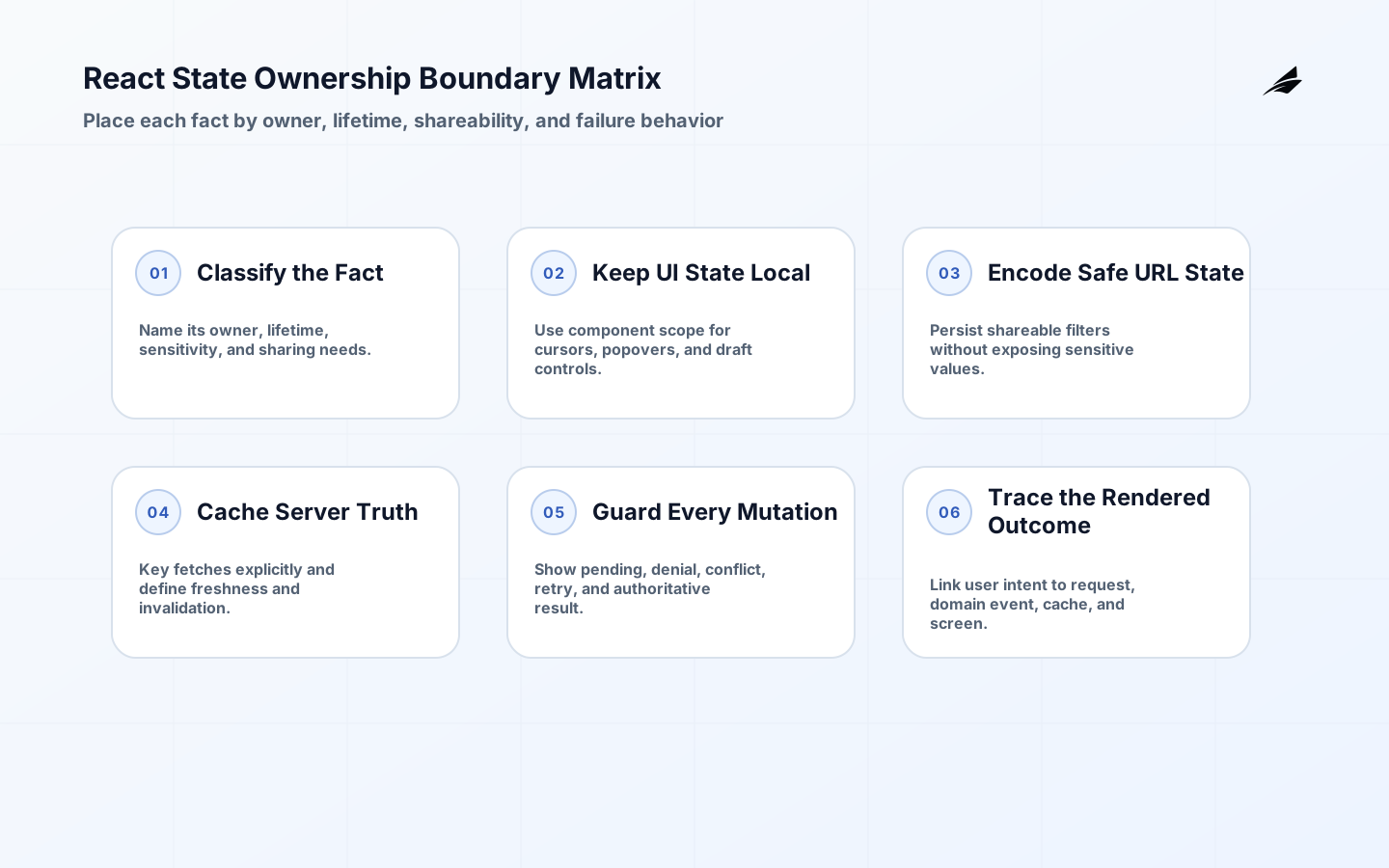
React state design is visible to operations even when no one calls it that. It determines whether a filter survives a refresh, whether an operator sees a stale record after an update, whether two panels disagree about an approval, and whether a failed save leaves enough context to recover. The useful question is not which state library is fashionable. It is which system owns a fact, how fresh it must be, who may change it, and what a user should see while that answer is uncertain.
Make React state design an explicit operating decision
Separate state by source and lifetime. A text cursor or open popover is local UI state. A selected record in a shareable operational view may belong in the URL. A customer balance belongs to the server and needs a fetch, cache, invalidation, and error policy. The React documentation on managing state is a good foundation: lift state only when multiple components genuinely need a coordinated source of truth.

| Decision | Question to answer | Useful evidence |
|---|---|---|
| State owner | Which system defines this fact? | Local, URL, server, or shared classification |
| Freshness | When must data be refetched? | Cache and invalidation rule |
| Mutation behavior | What appears before confirmation? | Pending and conflict design |
| Recovery | How does a user resume after failure? | Preserved context and retry path |
Define the React state design contract and boundaries
Write the state contract for consequential screens. Define the server resource, query parameters, freshness expectation, mutation authority, optimistic behavior, conflict handling, and fallback UI. When an operator changes a case status, decide whether the interface applies an optimistic transition, waits for the server, or shows a pending state. Include a version or updated timestamp when conflicting edits are possible; otherwise the last writer may silently erase a teammate's work.
- Classify each state value as local UI, URL, server, or shared client state.
- Document freshness and invalidation rules for server-backed views.
- Define pending, error, success, and conflict states for each consequential mutation.
- Keep sensitive or oversized filters out of shareable URLs.
- Test multiple tabs, slow requests, failed writes, and changed permissions.
- Instrument actions from user intent through the rendered authoritative result.
Build and roll out React state design in a bounded slice
Keep server state out of a generic global store unless it truly represents client-owned state. Use a query layer or a disciplined fetch abstraction that caches by explicit keys, invalidates after mutations, and exposes loading and error states. Make mutations return the authoritative result where possible. Exercise slow networks, failed writes, expired permissions, and a second browser tab during testing. The user experience must make uncertainty visible without turning every interaction into a modal dialog.
| Failure mode | Guardrail | Signal to monitor |
|---|---|---|
| Stale display | Cache hides a changed server record | Freshness indicator and invalidation |
| Silent overwrite | Two users edit the same record | Version check and conflict flow |
| Duplicate action | Slow response invites another click | Pending state and idempotent API |
| Global-store drift | Client copy outlives server truth | Narrow cache ownership |
Operate React state design with evidence
Monitor failed mutations, stale-data complaints, time spent in pending states, duplicate submissions, and conflict-resolution frequency. Trace a UI action to the request, domain event, and rendered result so support can tell whether a problem is data, permission, cache, or presentation. The internal tool UX guide is useful companion reading because state decisions determine whether the operator can understand and recover from an exception.
Make React state design tradeoffs explicit
Local state is simple and fast but disappears across navigation. Global client state can coordinate shared interactions but becomes a hidden database if it mirrors the server indefinitely. URL state improves reproducibility and support handoff but should not expose sensitive values. Choose the smallest scope that preserves the user's task, then promote state only when evidence requires it.
A concrete example keeps the design grounded. An operations lead filters a case list to urgent accounts, opens a record, approves a change, and returns. If a filter is only component-local state, refresh loses context; if a list cache is never invalidated, it can show an approval another user superseded. Both failures are visible state-design failures. Use the example to identify the authoritative record, expected outcome, failure that changes it, and operator who must choose the next action. That turns an architectural claim into a reviewable slice of production behavior.
Test slow servers, rejected mutations, a second tab changing the same record, session expiry mid-action, browser back and forward, and reload from a copied URL. Assert pending, conflict, and error states so visual recovery remains part of the regression suite. Keep evidence with the change: a reproducible command, expected telemetry, and a note about the failure being exercised. Checks should state the capability being protected, not merely mirror implementation details.
The service owns the record, product owns the visible freshness promise, and frontend owns how uncertainty is communicated. Support needs a trace path across them. Naming those responsibilities prevents stale views from becoming a vague frontend issue when the cache rule was a product choice. Agree on a review cadence and escalation route before the first exception arrives. The aim is a timely decision by someone with the right context, not a large committee or a static policy nobody can apply.
Introduce a query or state-management change behind one workflow, logging cache hits, invalidations, failed mutations, and fallback actions. Do not migrate every local component to global state at once. Prove filters, recovery, and accessibility before applying the pattern elsewhere. Publish entry and exit criteria for each step, including the condition that stops expansion. A narrow rollout gives a better learning loop because intended and observed behavior can be compared while scope remains correctable.
Monitor displayed-data age, rejected or retried mutations, duplicate submissions, conflict frequency, and time pending. Pair metrics with tickets and observation; a low error rate may hide users who refresh repeatedly because the interface does not explain when it will become current. Ask what action each signal would justify. A metric without an owner, threshold, or practical response is not useful observability; a smaller trusted set is stronger during a release or incident.
Document query keys, invalidation rules, URL parameters, and ownership beside the feature. When the backend changes a field or state, update the frontend contract and test failure views. State behavior is product behavior and deserves release notes when it changes materially. Include this in dependency review, planning, and incident follow-up so it does not depend on one person's memory. Clear notes should cover normal operation, known limits, emergency authority, and recovery evidence.
Before treating a plan as ready, turn it into a small review exercise. Use concurrent edits and a delayed response to verify that the view shows the authoritative result or a resolvable conflict instead of a silent overwrite. The exercise should name an owner, expected evidence, and a concrete result that would cause the team to pause. It is intentionally more demanding than a demo: demonstrations often assume ideal data and a cooperative dependency, while real confidence comes from showing that the boundary responds predictably when assumptions fail. Store the result with the relevant change record so the next engineer can repeat the check rather than reconstruct its purpose from an old ticket.
Failure rehearsals are a practical way to protect operational knowledge. Ask support to reproduce a user report from a shared URL and request ID; this tests whether state and trace context survive the handoff. The person running the rehearsal should use ordinary documentation and permitted tools, not private memory or administrator shortcuts. Note the time needed to detect the condition, make a decision, and verify recovery. Those observations often reveal a missing identifier, unclear authority, or unsafe default before an incident turns the same omission into customer harm. Feed the learning back into tests, runbooks, and the next release rather than treating the exercise as a one-time audit.
Change needs a decision record as well as code or configuration. Record freshness and invalidation decisions with the feature so a later optimization does not unknowingly change what users are entitled to see. Include the scope, assumption, approval authority, observable success condition, rollback or correction route, and date for reconsideration. This discipline keeps temporary controls from becoming invisible permanent architecture. It also gives product, operations, security, and engineering a common artifact for resolving tradeoffs, which is far more useful than asking each group to infer intent from dashboards, implementation details, or an incomplete support history.
Key React state design takeaways
- State location should follow ownership and lifetime.
- Server state needs explicit freshness and mutation behavior.
- URL state can improve reproducibility when it is safe to share.
- Optimism requires a visible correction path.
- Global stores should not become unbounded mirrors of the backend.
- Support improves when a UI action can be traced across layers.
React state design FAQ
Should all state live in one store? No. State should live with the system that owns it and the scope that needs it. When is optimistic UI appropriate? When the action is likely to succeed, reversal is clear, and conflict behavior is understood. Do caches cause stale data? They can; freshness and invalidation policies are product decisions that need explicit tests.
Conclusion: make React state design dependable
React state design is operational design. When ownership, lifetime, freshness, and failure behavior are explicit, the interface can remain trustworthy even as users, records, and network conditions become messy.