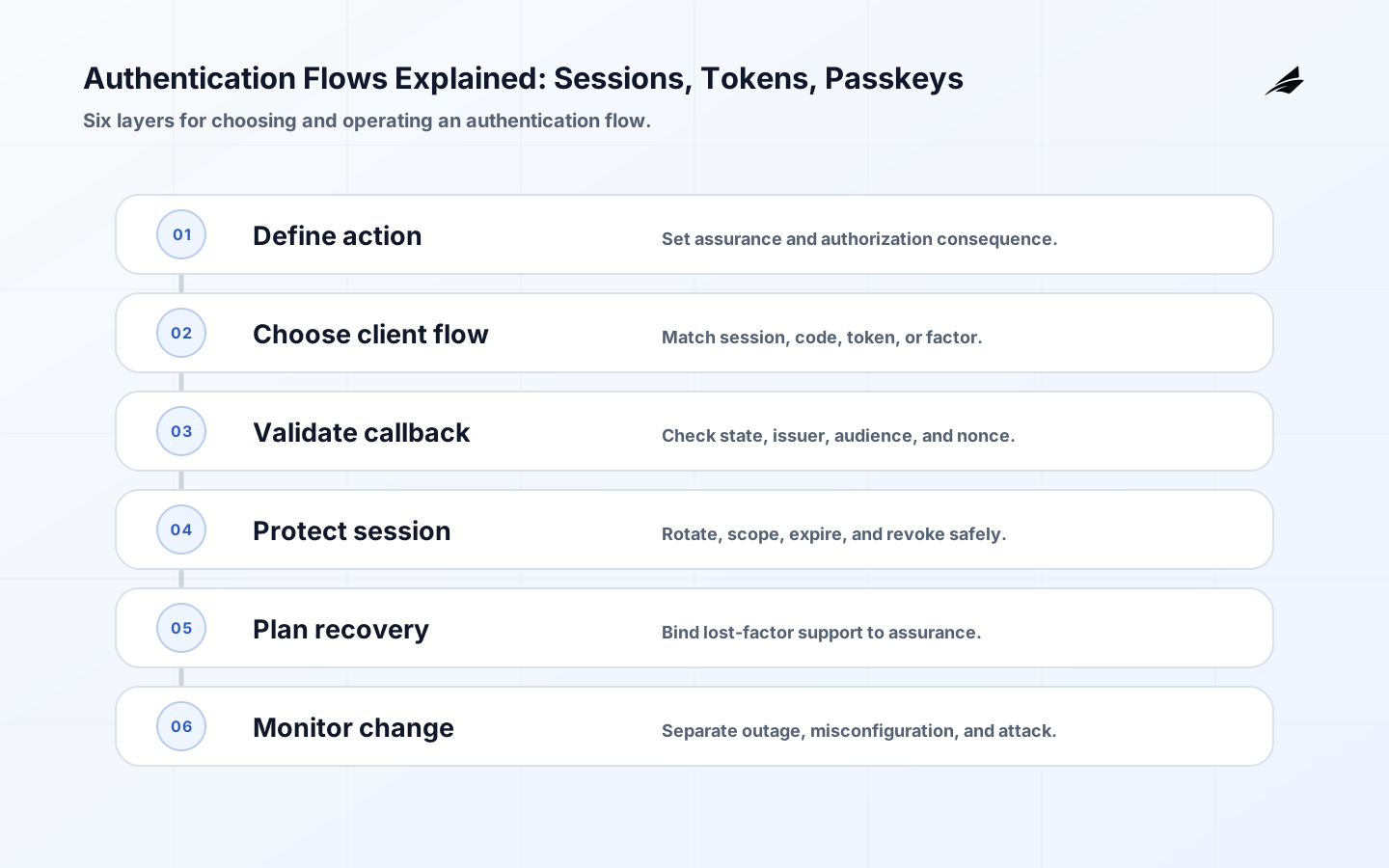
Authentication flows are easier to choose when their parts are named plainly. Authentication establishes who is attempting to act. Authorization decides what that identity may do. A browser redirect, a server session, an OAuth access token, an OpenID Connect ID token, a passkey, and an account-recovery process solve related but different problems. The right design depends on client type, assurance needed for the action, data sensitivity, provider relationship, session lifetime, and what happens when a person loses a device. This guide compares the choices and puts recovery beside enrollment instead of treating it as an afterthought.
Start with the action the identity must protect
Write the protected outcome before selecting a protocol. Reading a public page, viewing another employee's records, approving a payment, changing an authenticator, and exporting a customer dataset do not need the same assurance or reauthentication rule. Identify the relying application, user population, account authority, resource server, session expectation, and recovery owner. Successful sign-in does not prove that the user may perform the next action. Keep the authentication decision and the authorization decision visible in design, tests, support tools, and audit events.
Separate identity, authorization, and session
OAuth 2.0 defines a way for a client to obtain limited access to a protected resource; it is not, by itself, a user-login protocol. RFC 6749 names the resource owner, client, authorization server, and resource server. OpenID Connect Core adds an identity layer and ID token so a client can verify an authentication event and receive claims. The application still needs a local authorization policy and a session model. Do not treat an ID token as an API access token or a decoded token as a validated token.
Choose a flow for the client and risk
A confidential server-side application can maintain a secure session after a provider exchange. A browser or native public client cannot keep a durable secret, so it needs a flow designed for that constraint. The current OAuth security best practice recommends authorization-code use over flows that expose access tokens in the authorization response and rejects the resource-owner password-credentials grant. Choose the flow from client capability and threat model, then document redirect URIs, scopes, token audience, lifetimes, refresh behavior, and revocation.
| Pattern | Fits when | Important control |
|---|---|---|
| Server session | Server-rendered or backend-owned web app | Secure cookie, rotation, expiry, and CSRF defense |
| Authorization code with PKCE | Browser or native public client | Exact redirect, state, code verifier, and token validation |
| OpenID Connect login | Application needs federated identity claims | Issuer, audience, nonce, signature, and claim policy |
| Passkey | User authentication with public-key credentials | Origin binding, enrollment, revocation, and recovery |
| Service credential | Machine-to-machine access | Scoped identity, secret or key custody, rotation, and audience |
Treat redirects and callbacks as security boundaries
Register exact redirect URIs and keep the authorization request tied to the browser session that initiated it. Validate state, use PKCE for public clients, and validate issuer, audience, signature, expiration, nonce, and required claims before establishing a session or accepting an API token. Do not put long-lived secrets or access tokens in URLs, logs, or browser history. RFC 9700 is a primary reference for redirect, code-injection, mix-up, replay, and token-leakage concerns. When a provider returns denial, cancellation, or an unexpected issuer, make that outcome explicit rather than retrying it as if the user had entered a wrong password.
Make session state short, scoped, and observable
Rotate a session identifier after authentication and privilege changes. Set idle and absolute lifetimes from the sensitivity of the work, protect cookies, avoid putting session material in client-readable storage when a safer server session fits, and invalidate sessions after account recovery or high-risk changes. Keep token scopes and audiences narrow. Monitor refresh failures, unexpected geography or device changes, session revocation, and repeated login failures without treating every anomaly as proof of compromise. The related authentication flows guide for custom software is useful when a bespoke application owns both the session and the recovery workflow.
Understand what passkeys change and what they do not
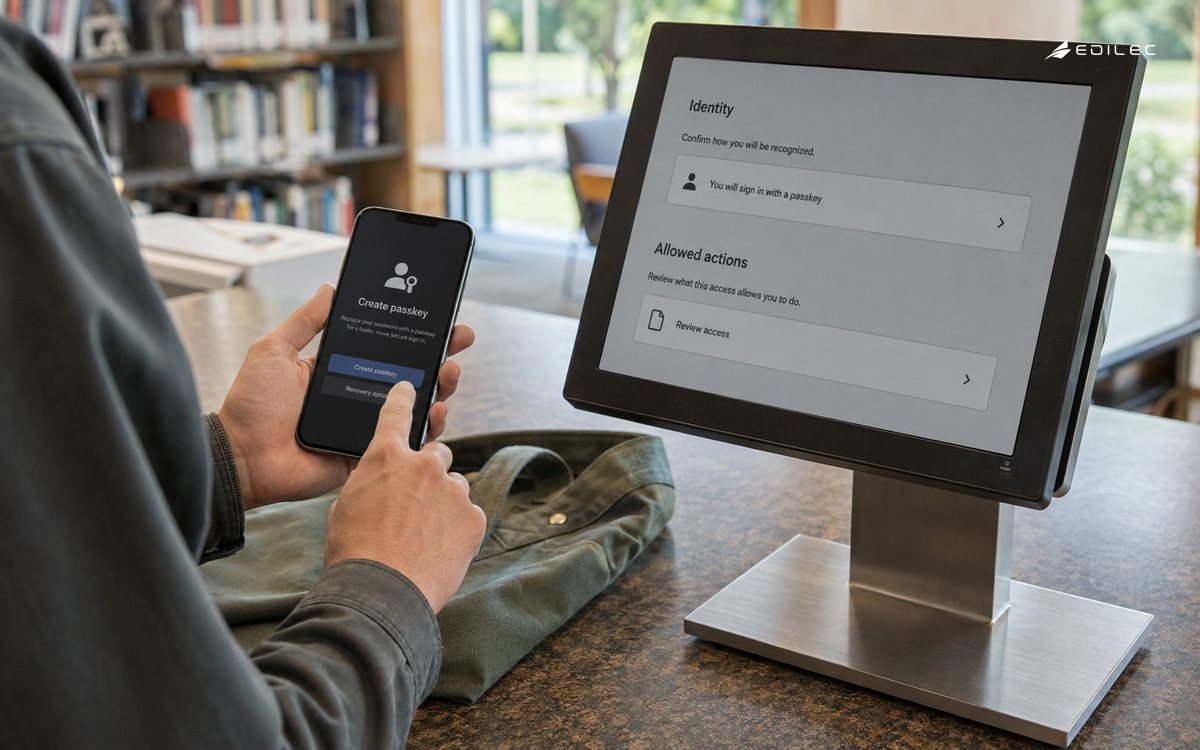
WebAuthn uses public-key credentials associated with a relying-party origin, so the server verifies an assertion rather than receiving a shared password. Web Authentication Level 3 is the authoritative browser API reference. Passkeys can reduce password reuse and phishing exposure, but the product still needs enrollment policy, authenticator naming, removal, device loss, account recovery, and support controls. Do not describe a passkey as a complete identity lifecycle. It is one authenticator choice inside a broader flow.
Design account recovery before requiring a factor
Recovery is a new authentication path and should be held to an appropriate assurance level. Identify which factor is lost, what evidence can establish control, who may approve an exception, how long a recovery link or code remains valid, and which existing sessions or authenticators are revoked. NIST Digital Identity Guidelines provide an authoritative framework for authenticator lifecycle and assurance; OWASP's Authentication Cheat Sheet adds practical checks for login, session, password, and recovery behavior. A support agent should not be able to bypass the designed assurance with a persuasive phone call and no audit trail.
| Event | Record | Response to review |
|---|---|---|
| Factor enrolled | User, factor type, time, and policy | Confirm intended enrollment |
| Factor removed | Actor, reason, and remaining factors | Check for takeover or support abuse |
| Recovery started | Evidence, channel, and expiry | Rate-limit and review risk |
| Recovery completed | New authenticator and revoked sessions | Notify and inspect unusual context |
| Provider failure | Flow, issuer, and error state | Use an approved continuity path |
Monitor signals that distinguish a bad release from an attack
Track successful and failed attempts by reason, callback mismatches, code-exchange failures, token-validation failures, refresh errors, recovery volume, factor enrollment and removal, provider latency, and lockout or support intervention. Segment by client, issuer, release, and flow. A provider outage, a bad redirect configuration, and credential stuffing can produce different shapes and require different responses. Keep runbooks for key rotation, provider degradation, emergency revocation, and a compromised session. The related REST API contracts guide is a useful adjacent read when token audiences and resource permissions cross API boundaries.
Roll out a new flow in bounded stages
Start with a controlled enrollment or optional path, then test provider denial, cancelled consent, clock skew, callback mismatch, lost device, concurrent sessions, refresh rotation, and support escalation. Compare safe completion, lockouts, recovery time, and unresolved cases rather than measuring adoption alone. Require stronger assurance only after the recovery and operations teams can handle the new path. Keep a disable or containment action that does not strand enrolled users, and communicate any change in session or factor behavior clearly.
Document the threat and support boundary
Write down what the provider is trusted to assert, what the application verifies itself, and which local records control access after the exchange. Include issuer and audience allowlists, scope-to-action mapping, factor enrollment policy, session lifetime, recovery assurance, and the support actions that require approval. This record helps teams distinguish a provider configuration problem from a local authorization bug or a suspected account takeover. It also gives a customer-facing team language for explaining a denial or required reauthentication without revealing detection logic.
Review the boundary when a new device class, issuer, mobile SDK, or partner client is added. A flow that was safe for a server-rendered site may be wrong for a native app, and a token that is valid for one resource should not silently work at another. Put those distinctions in client registration, tests, and monitoring. The team should be able to revoke one client, factor, session, or issuer without disabling every user or relying on an undocumented emergency change.
Treat the support channel as part of the threat model. Rate-limit recovery, require evidence appropriate to the protected action, notify the user about factor changes, and log every privileged intervention. A temporary continuity route should have a narrow scope and expiry rather than becoming an informal bypass. When a factor or provider changes, review connected sessions, tokens, API permissions, and downstream records. Authentication is complete only when the organization can operate the whole lifecycle, including the uncomfortable path.
For the neighboring controls, compare plain-language error handling when login and recovery failures need safe messages, and supply chain security when provider SDKs, authenticators, or client libraries become part of the trust boundary. Keep the dependency inventory and revocation plan with the flow decision.
Authentication flow decisions worth explaining plainly
- Separate authentication, authorization, session management, and recovery.
- Choose the protocol and flow for the client type, assurance, and threat model.
- Validate redirect, state, PKCE, issuer, audience, nonce, signature, lifetime, and scope as applicable.
- Treat passkey enrollment, removal, device loss, and recovery as one lifecycle.
- Roll out in stages and measure safe completion, not just sign-in success.
Questions teams ask about authentication flows
Is OAuth 2.0 the same as user authentication?
No. OAuth is primarily a delegated authorization framework. OpenID Connect adds an identity layer for login and claims. An application still needs local authorization and session policy after a successful exchange.
Do passkeys eliminate account recovery?
No. They change the authenticator and can reduce password exposure, but users can lose devices, remove credentials, or need help. Recovery must be designed and protected as a separate authentication path.
Can a public client safely store a client secret?
A distributed browser or native app cannot keep a durable secret confidential. Use a flow and proof mechanism designed for a public client, such as authorization code with PKCE, and protect tokens through scope, audience, lifetime, and storage choices.
Conclusion: make authentication flows dependable
Good authentication flows make identity, authorization, session, and recovery boundaries visible. Choose for the client and risk, validate every callback and token claim, protect the session, and rehearse lost-factor and provider-failure paths before making a new method mandatory. The best flow is not the most fashionable one; it is the one an organization can operate honestly when a user, dependency, or credential behaves unexpectedly.