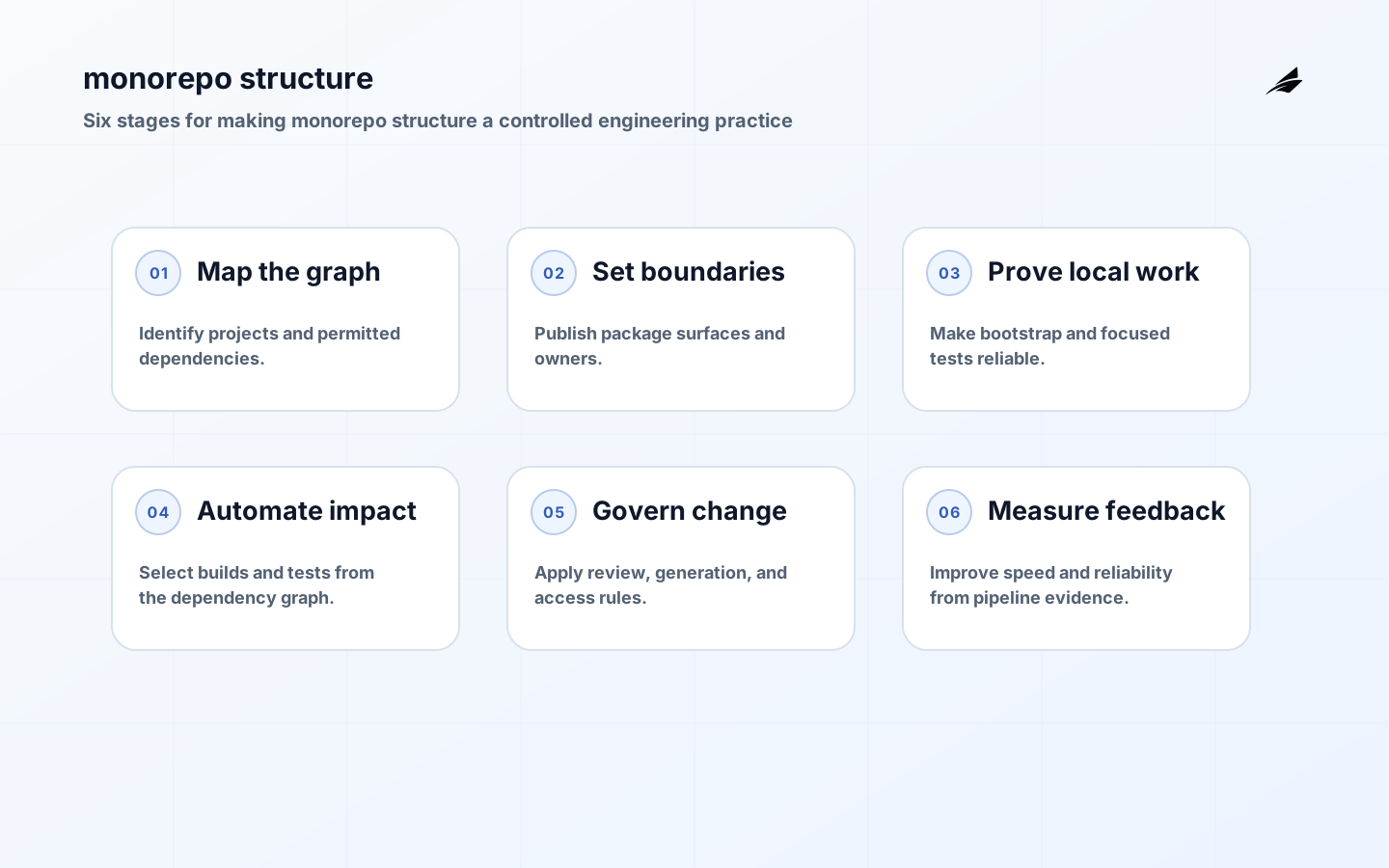
A monorepo is one version-controlled repository containing multiple projects. It is neither a shortcut to architectural simplicity nor a requirement for every team. Its practical value appears when a change crosses a shared library, service, deployment configuration, and test suite, and the team needs one reviewable unit of change. Its cost appears when every developer action triggers too much work, ownership is vague, or a repository exposes code that a contributor should not see.
Make monorepo structure an explicit operating decision
Begin with the dependency graph, not folder aesthetics. A repository can contain applications, packages, generated clients, infrastructure definitions, and documentation, but each relationship needs a direction. A UI package should not import a service's private database module merely because both are nearby. Tools such as npm workspaces make package grouping convenient; they do not decide whether a dependency is healthy.
| Decision | Question to answer | Useful evidence |
|---|---|---|
| Repository scope | Which systems change together often? | Observed cross-project change history |
| Package boundary | What may consumers import? | Public entry point and owner |
| Build selection | Which tests prove a change? | Affected graph and integration rule |
| Access model | Who may read sensitive projects? | Repository and CI permission review |
Define the monorepo structure contract and boundaries
Document the public surface of each package: runtime support, import paths, configuration requirements, owner, and change policy. Use semantic versions internally when packages have independent release consequences, even if a single commit updates them together. For TypeScript, project references can make boundaries explicit and support incremental builds, provided the project graph reflects real dependencies rather than convenience imports.
- Map applications, packages, generated artifacts, and their allowed dependencies.
- Name an owner and support expectation for every shared package.
- Make local bootstrap and one focused test a documented developer journey.
- Run affected-project checks while retaining release-level integration coverage.
- Treat generated code as an output with a reproducible source and command.
- Review access rules before consolidating repositories with different sensitivities.
Build and roll out monorepo structure in a bounded slice
Adopt the repository in slices. First make one cross-project change build and test locally and in continuous integration. Then add affected-project detection, remote caching if justified, generated-code rules, and ownership checks. A check should run the smallest trustworthy test set for a pull request, while scheduled or release pipelines retain broader integration coverage. Do not declare the migration complete until a new engineer can clone, bootstrap, change one package, and understand why a pipeline selected its tests.
| Failure mode | Guardrail | Signal to monitor |
|---|---|---|
| Hidden coupling | Private module becomes a de facto public API | Boundary linting and review ownership |
| Broad CI | Every pull request runs the world | Affected targets and test tiers |
| Unreproducible generation | Generated client differs by machine | Pinned toolchain and verification |
| Access sprawl | Consolidation expands source visibility | Access assessment before migration |
Operate monorepo structure with evidence
Measure time to a reliable local feedback result, cache hit rate, queue time, flaky test rate, and the number of unrelated projects touched by ordinary changes. A slow monorepo is often a graph or test-isolation problem, not proof that one repository is inherently wrong. Bazel's dependency guidance is useful for the discipline of declaring dependencies instead of relying on transitive accidents.
Make monorepo structure tradeoffs explicit
Use a monorepo when coordinated change and shared tooling outweigh the cost of central governance. Separate repositories may be better for independently operated products, sharply different access requirements, or teams that do not share a release rhythm. The TypeScript architecture guide complements this choice: repository layout should reinforce code boundaries rather than disguise them.
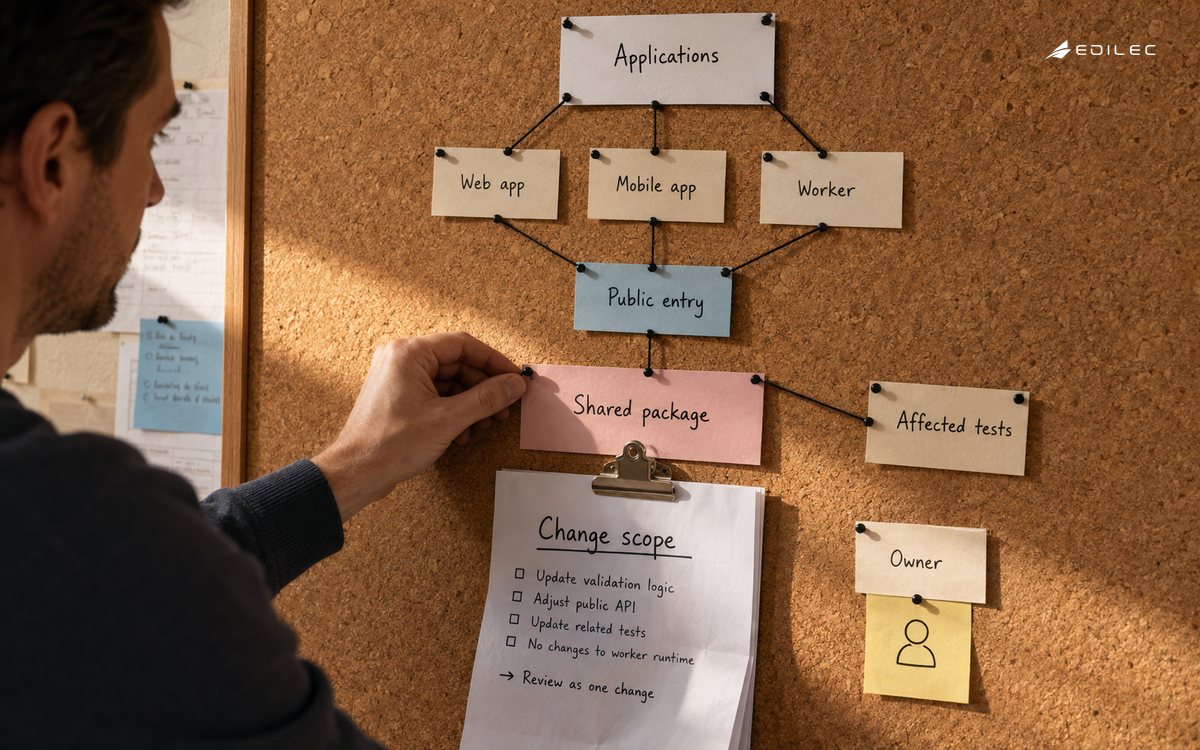
A concrete example keeps the design grounded. Imagine a web application, a shared pricing package, and a reporting job in one repository. A pricing change should compile the package, test the importing web app, and run the reporting contract test, but not rebuild an unrelated mobile application. That outcome requires declared dependencies and verified task inputs. Use the example to identify the authoritative record, expected outcome, failure that changes it, and operator who must choose the next action. That turns an architectural claim into a reviewable slice of production behavior.
Prove the graph with clean and warm-cache builds, changed shared packages, changed application-only files, deleted generated output, and failing tests in affected projects. Compare local and CI selection results; a fast local command that chooses different work from CI creates confidence only until a release incident. Keep evidence with the change: a reproducible command, expected telemetry, and a note about the failure being exercised. Checks should state the capability being protected, not merely mirror implementation details.
Repository administrators own access and baseline tooling; package owners own public interfaces and migration notes; service teams own test quality and release requirements. Code ownership should route review without making routine maintenance impossible when a named person is unavailable. Agree on a review cadence and escalation route before the first exception arrives. The aim is a timely decision by someone with the right context, not a large committee or a static policy nobody can apply.
Migrate one project family first and preserve an escape path while tooling stabilizes. Publish bootstrap instructions, pin the runtime and package manager, and make cache behavior observable. Only then bring in generated clients or infrastructure definitions that increase graph sensitivity. Publish entry and exit criteria for each step, including the condition that stops expansion. A narrow rollout gives a better learning loop because intended and observed behavior can be compared while scope remains correctable.
Use median and tail feedback time, affected-target accuracy, cache-hit rate, flaky-test retries, CI queue time, and onboarding time as separate signals. A cache can make repeated work look healthy while a clean build remains too expensive for a new contributor or incident responder. Ask what action each signal would justify. A metric without an owner, threshold, or practical response is not useful observability; a smaller trusted set is stronger during a release or incident.
Prune abandoned packages, stale owners, unused task targets, and implicit dependencies. Repository scale becomes manageable when the graph remains a maintained product with visible users and consequences rather than an archive nobody is comfortable changing. Include this in dependency review, planning, and incident follow-up so it does not depend on one person's memory. Clear notes should cover normal operation, known limits, emergency authority, and recovery evidence.
Before treating a plan as ready, turn it into a small review exercise. Use a deliberately changed shared package to verify that task selection includes every consumer and excludes projects with no declared relationship. The exercise should name an owner, expected evidence, and a concrete result that would cause the team to pause. It is intentionally more demanding than a demo: demonstrations often assume ideal data and a cooperative dependency, while real confidence comes from showing that the boundary responds predictably when assumptions fail. Store the result with the relevant change record so the next engineer can repeat the check rather than reconstruct its purpose from an old ticket.
Failure rehearsals are a practical way to protect operational knowledge. Ask a new developer to reproduce an affected build and explain why each target was selected; this is a practical test of graph legibility. The person running the rehearsal should use ordinary documentation and permitted tools, not private memory or administrator shortcuts. Note the time needed to detect the condition, make a decision, and verify recovery. Those observations often reveal a missing identifier, unclear authority, or unsafe default before an incident turns the same omission into customer harm. Feed the learning back into tests, runbooks, and the next release rather than treating the exercise as a one-time audit.
Change needs a decision record as well as code or configuration. Record toolchain upgrades and repository-wide migrations as owned change programs, with a fallback path for contributors blocked by new local requirements. Include the scope, assumption, approval authority, observable success condition, rollback or correction route, and date for reconsideration. This discipline keeps temporary controls from becoming invisible permanent architecture. It also gives product, operations, security, and engineering a common artifact for resolving tradeoffs, which is far more useful than asking each group to infer intent from dashboards, implementation details, or an incomplete support history.
A monorepo decision should also include a cost boundary. Estimate the compute and maintenance cost of broad checks, then compare it with the coordination cost of cross-repository releases. This prevents a tooling migration from being judged only by developer enthusiasm or only by CI spend. The relevant outcome is reliable shared change at a cost the team can sustain.
Treat this as a continuous architecture decision. As projects, access needs, and release rhythms change, revisit whether the repository still improves coordination more than it increases the cost of safe independent work.
Key monorepo structure takeaways
- A repository is a coordination tool, not an architecture by itself.
- Dependency direction matters more than directory names.
- Shared packages need owners and public surfaces.
- Fast feedback requires trustworthy affected-project analysis.
- Caching cannot repair flaky or overly coupled tests.
- Deployment independence can coexist with shared source control.
Monorepo structure FAQ
Does a monorepo mean one deployment? No. Source control topology and deployment topology are separate choices. Can teams keep ownership? Yes, with code owners, package maintainers, and clear review paths. Will caching fix poor tests? No. Caching improves repeated work; it cannot make nondeterministic or over-broad tests trustworthy.
Conclusion: make monorepo structure dependable
A good monorepo structure makes dependencies, ownership, and change impact visible. Start with a graph that matches the business systems, then earn scale through reproducible builds and narrow, reliable feedback.