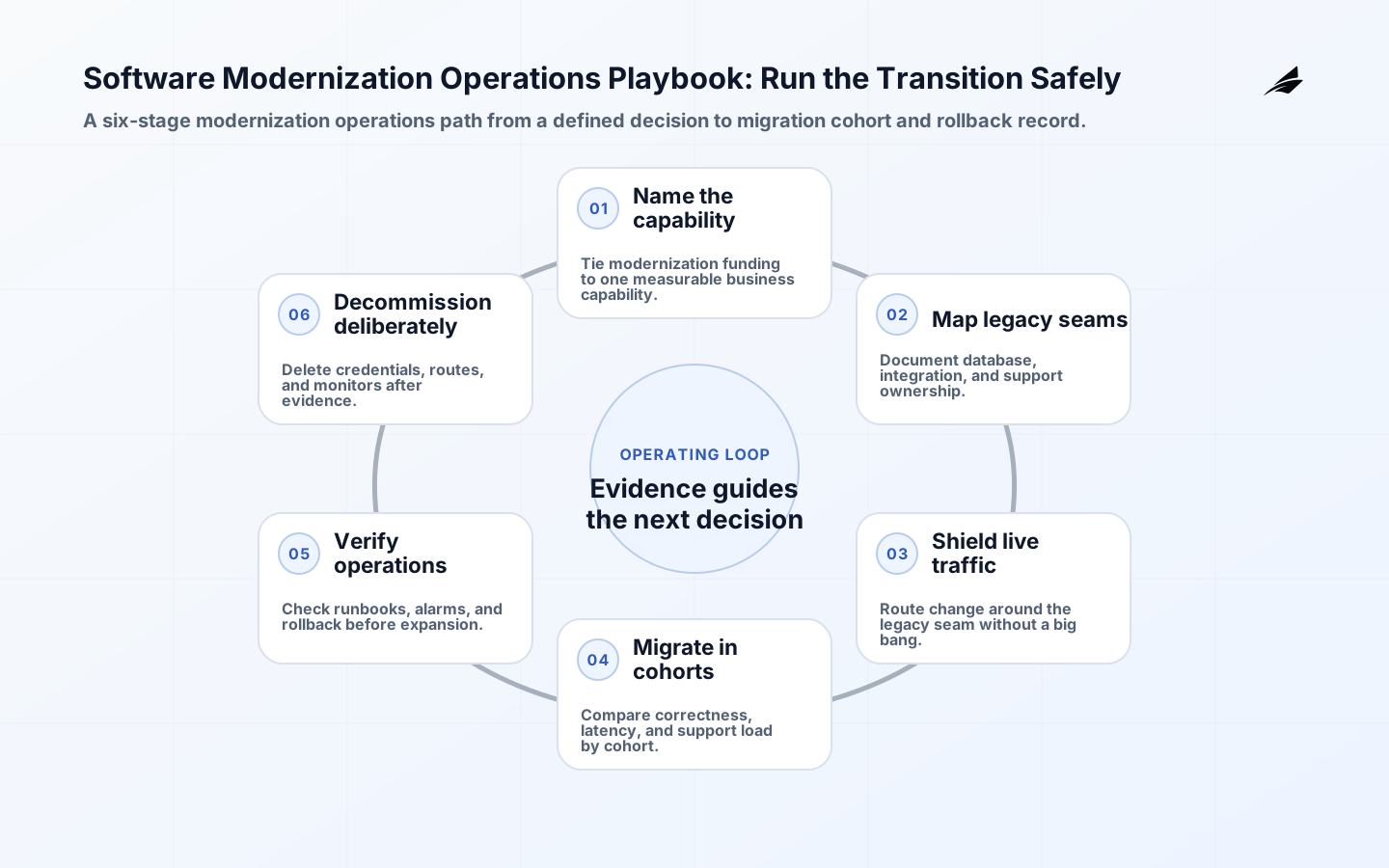
Software modernization matters when a legacy order-management application works for routine days but its release process requires a maintenance window, manual database steps, and the one administrator who understands the batch jobs. This guide is for IT managers who need to modernize a business capability while protecting the operational facts and controls that keep it running. The planning unit is a service journey, including its data ownership, users, dependencies, service target, and recovery procedure. That framing keeps the work tied to a decision people can inspect, rather than to a tool purchase or a collection of isolated tickets during a modernization transition.
Start with the operating decision — modernization operations
Software modernization is an operating change, not a synonym for moving code to a new platform. The starting point is the business journey that must become safer, faster, or easier to support. Follow that journey through screens, overnight jobs, spreadsheets, permissions, reports, and vendor interfaces. The apparently outdated component may contain rules that people rely on but have never written down. A useful programme makes those rules visible before it changes the runtime around them.
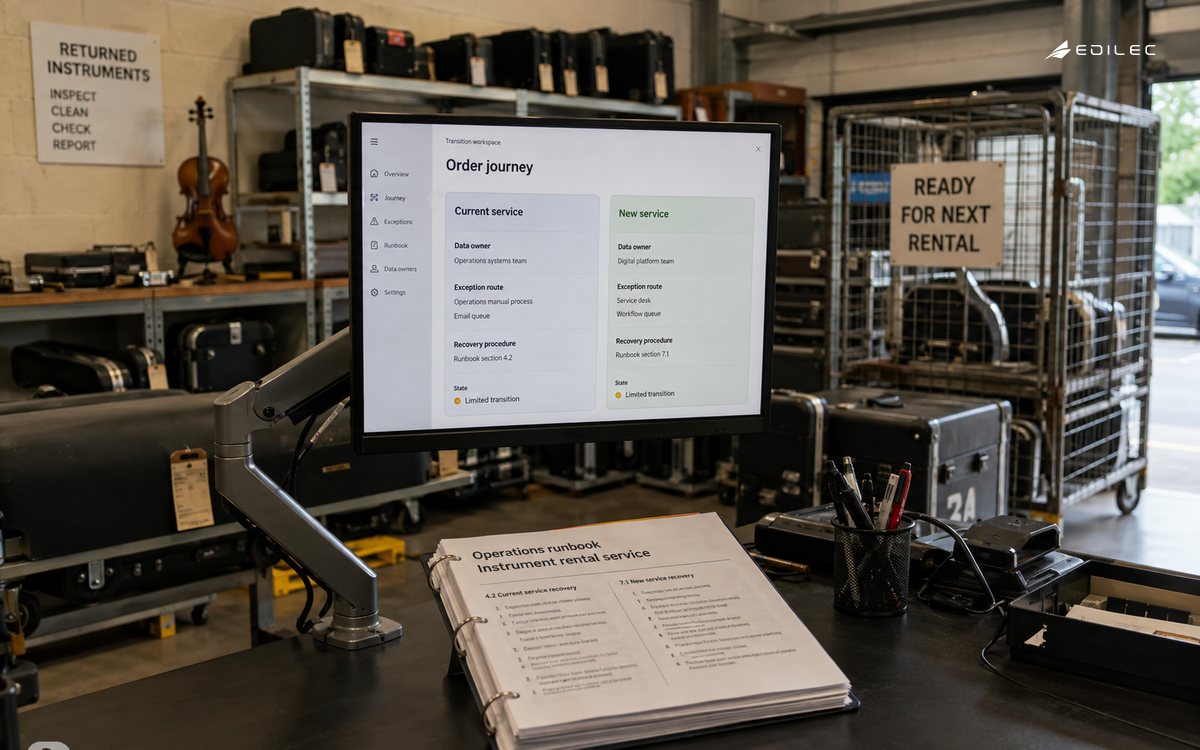
| Question | Working rule | Evidence to collect |
|---|---|---|
| Outcome | Name the decision or task that must improve. | a legacy order-management application works for routine days but its release process requires a maintenance window, manual database steps, and the one administrator who understands the batch jobs |
| Authority | Identify who owns the fact and who may change it. | a service journey, including its data ownership, users, dependencies, service target, and recovery procedure |
| Risk | Describe the costly failure before selecting technology. | replacing technology first and discovering late that a critical exception, report, or authorization rule was never modelled |
| Measure | Choose a signal that can change the next investment decision. | successful cutovers, reconciliation differences, recovery time, failed release steps, support volume, and adoption of the new workflow |
Map boundaries and ownership — modernization operations
Choose a unit of modernization that can be observed end to end. For an order process, that may be order capture through fulfilment confirmation, not “the monolith.” Name the records of authority, the reconciliation point, the customer or operator outcome, and the safe way to fall back. This boundary helps leaders decide between encapsulating, replacing, rehosting, or retiring a component based on risk and value rather than fashion.
Map the path from request to outcome with the people who operate it. Include entry points, systems of record, permissions, dependencies, handoffs, and the place where a person can correct an exception during a modernization transition. For adjacent implementation concerns, read What Changes When Software Modernization Moves into Production, What Changes When Event-Driven Systems Move into Production, and What Changes When Database Schema Design Moves into Production. These related guides help distinguish a local implementation choice from the wider delivery practices that keep a service understandable.
| Boundary | Decision to make | Operational check |
|---|---|---|
| Input | Define identity, required fields, and validation responsibility. | Can an invalid software modernization request be rejected with a useful reason? |
| Authority | State the source of truth and who can override it. | Can a reviewer explain which record or rule produced the software modernization result? |
| Change | Version behavior that clients, users, or operators rely on. | Can the team deploy a compatible change and observe its effect? |
| Recovery | Give failures an owner, reference, and safe next action. | Can support resolve a disputed case without an unsafe workaround? |
Design the first observable slice — modernization operations
Discovery needs production evidence. Review logs, operational runbooks, database jobs, access reviews, incident tickets, and the people who correct failures. Architecture diagrams are useful hypotheses, but they often omit seasonal work, manual approvals, and integrations that run under shared credentials. A discovery backlog should record uncertainty as plainly as known facts. Unknown ownership or an undocumented file exchange is a delivery risk that deserves a test before a cutover date is promised.
Coexistence is frequently the safest path. Introduce an anti-corruption boundary or adapter, publish events with durable identifiers, and reconcile outputs while the old path remains authoritative. Parallel operation has a cost, so use it to answer particular questions: do totals agree, are authorization decisions identical, can support resolve a disputed case, and does the new service meet its latency target? Stop running in parallel when the evidence supports a decision, not because the calendar is tired of it.
- Write one software modernization decision record with owner, boundary, and success condition.
- Collect ordinary, invalid, delayed, and contradictory examples before estimating broad scope.
- Assign an accountable operator for exceptions and a named escalation path.
- Add correlation references that connect the user-visible outcome to supporting records.
- Test the recovery path as deliberately as the successful path.
- Review successful cutovers, reconciliation differences, recovery time, failed release steps, support volume, and adoption of the new workflow after the first release before expanding the design.
Control risk without blocking work — modernization operations
Release planning should make rollback specific. A database rollback may be impossible after new writes, so a compensating action or read-only mode may be the real contingency. Prepare owned runbooks for monitoring, communication, access changes, and data reconciliation. Google’s canary guidance is a helpful reminder to increase exposure in measured steps; the right step size is determined by the blast radius of the journey.
Use authoritative guidance with local evidence — modernization operations
The design choices above should be checked against primary guidance and then tested against local constraints. Useful references include Microsoft Azure architecture guide, Microsoft cloud migration framework, Google SRE workbook: canarying releases, NIST Cybersecurity Framework 2.0. These sources explain standards and supported behavior; they do not replace the organization’s own decision about owners, legal obligations, service targets, and user impact during a modernization transition. In this software modernization context, turn the guidance into concrete configuration, review evidence, and runbooks that a team can use during a release or incident.
Measure the service and improve it — modernization operations
Modernization can increase risk when identity and secrets are copied into a new environment without a new ownership model. Inventory service accounts, rotate credentials where possible, apply least privilege, and remove access paths that the retired component no longer needs. The NIST Cybersecurity Framework supports organizing this work, but control evidence must remain close to the actual systems and operators.
Retirement is a planned deliverable. Confirm retention obligations, archive evidence required for support and audit, revoke integrations, delete scheduled work, and monitor for callers that still depend on the old endpoint. A system is not modernized merely because new code is live; the old risk and cost must be deliberately removed. Capture what the programme learned so the next capability begins with sharper assumptions.
Key takeaways — modernization operations
- Software modernization should begin with a real operational decision, not an abstract technology preference.
- Use a service journey, including its data ownership, users, dependencies, service target, and recovery procedure as the unit of planning and review.
- Make authority, change behavior, and recovery visible before scaling a design.
- Use authoritative guidance as an input, then validate the result with representative local cases.
- Let successful cutovers, reconciliation differences, recovery time, failed release steps, support volume, and adoption of the new workflow determine whether the next increment is justified.
Frequently asked questions — modernization operations
What is the smallest useful scope for software modernization? Start with one consequential path that has a clear user or operator outcome, a bounded set of records, and a way to recover from failure. The first release should prove ownership and behavior under normal and uncomfortable cases. It does not need to centralize every adjacent process.
When should a person intervene? A named business owner should decide when a migration uncovers a rule that no one can explain, a reconciliation difference, or a cutover risk beyond the service target. Their choice should be captured with the data and operational consequence, not resolved through an undocumented configuration change.
How do we know the design is ready to expand? Move to another modernization journey after parallel results reconcile, operators have practiced the cutover and recovery runbooks, and obsolete access or jobs have an approved retirement plan. A successful demo is weaker evidence than a controlled operating period.
Conclusion — modernization operations
Software modernization becomes a durable advantage when the team designs the decision, authority, evidence, and recovery path together. Begin with the legacy order-management application: its routine-day release requires a maintenance window, manual database steps, and the one administrator who understands the batch jobs. Keep the first change narrow enough to observe, and use real operating signals to guide the next investment during a modernization transition. That is how a technical choice becomes a service people can trust during a modernization transition.
A modernization operations review should leave a usable handoff: the next cohort, its rollback trigger, the owner on call, and the record that proves the change is safe to continue. Keeping those details beside the migration decision prevents a successful deployment from becoming an unsupported service. It should also name the evidence that remains valid after a rollback, the support view used to explain partial completion, and the review date for retiring compatibility steps. Before the next cohort starts, rehearse one failed migration and one reconciliation mismatch with the on-call owner. Record what operators can decide without engineering help and which conditions require a stop. This turns the handoff into an operating control rather than a status note.
The final handoff should show who owns the next cohort, which signal triggers rollback, and where operators can verify the change before extending it.