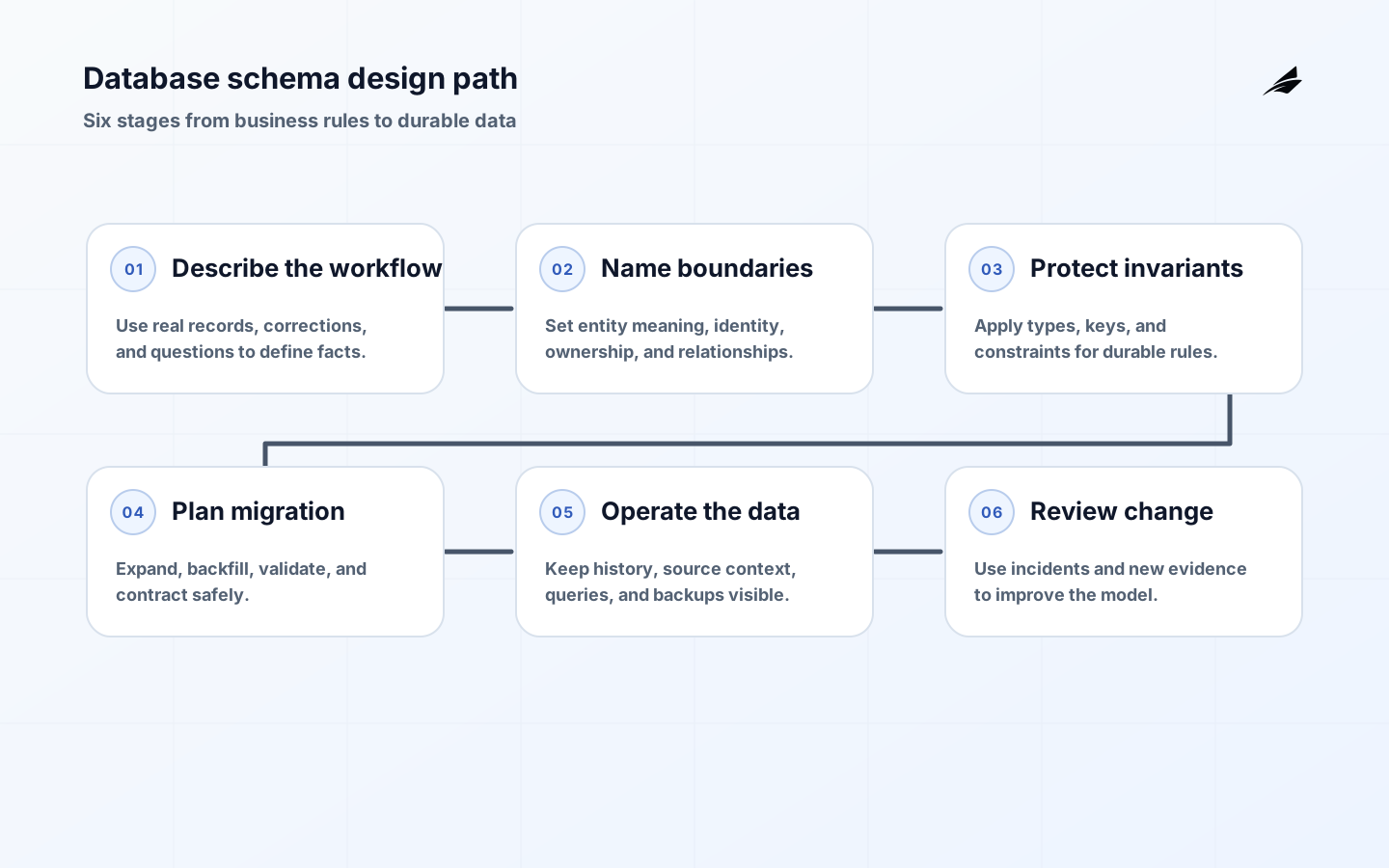
Database schema design is where a product's business vocabulary becomes durable and enforceable. A weak schema does not merely make queries unattractive; it allows impossible states, ambiguous ownership, and expensive repairs to accumulate. A strong one makes important distinctions explicit: an order is not a payment, a cancellation has a reason and time, an account can have many members, and a ledger entry must not silently change. Engineering teams should design from the decisions the data must support, then use tables, types, keys, and constraints to preserve the facts that those decisions depend on.
Model a business boundary before tables
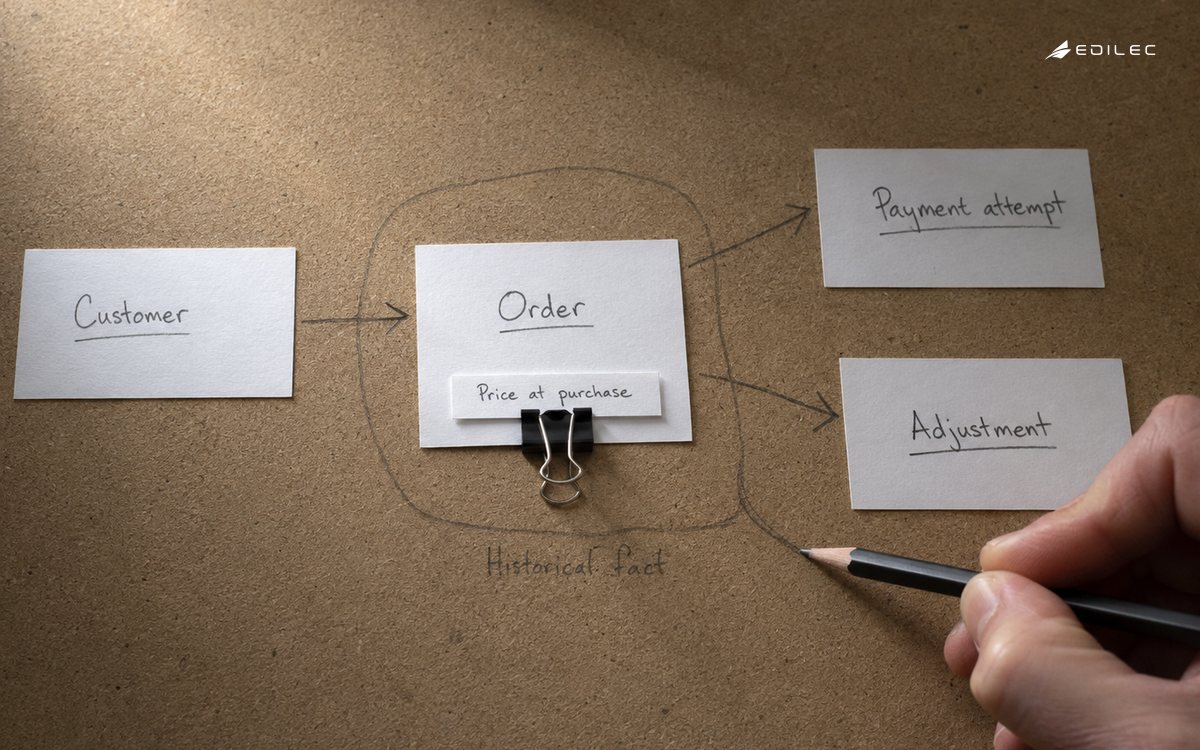
Start with a narrative of one real workflow. For subscription billing, identify the customer, plan, price agreed at purchase, billing period, invoice, payment attempt, and adjustment. Ask which facts can change, which must be historical, and which system is authoritative. Do not begin by copying a screen or an API payload into columns; those are views of a model and often change faster than the underlying business terms. A concise glossary and ownership map will expose where two teams use the same word for different things, which is a far cheaper problem to solve before data is populated.
| Model decision | Question | Useful outcome |
|---|---|---|
| Identity | What makes this record the same thing over time? | Stable primary key and clear natural-key policy |
| Relationship | How many can relate and who owns the link? | Foreign keys and explicit join records |
| History | Must prior state remain knowable? | Time-bound or append-only representation |
| Authority | Which service may change this fact? | Write boundary and reconciliation rule |
Put essential rules near the data
Application validation improves user feedback, but it cannot be the only defender of a shared database. Use a primary key to establish identity, foreign keys to preserve relationships, unique constraints to prevent duplicate facts, check constraints for bounded values, and not-null constraints where absence would be misleading. The PostgreSQL constraints documentation explains the capabilities and tradeoffs of these controls. A constraint should express a durable invariant, such as a quantity never being negative, rather than a temporary UI workflow that will become obsolete with the next feature.
- Name entities and fields after business concepts, not current screen labels.
- Choose types that preserve meaning, especially for money, time, and identifiers.
- Define which relationships must be enforced by the database.
- Add constraints for invariants that must survive every write path.
- Record ownership and source-of-truth boundaries for shared facts.
- Review indexes against real access patterns and explain their maintenance cost.
Make schema migrations boring
Production migration safety comes from separating compatible expansion from destructive cleanup. Add a new nullable column or table, deploy code that writes both representations if needed, backfill with an observable job, validate results, switch reads, and remove the old form only after evidence supports it. Changing a large table in one lock-heavy step can create an outage even when the final schema is correct. Give each migration a rollback or forward-repair plan and test it against a representative data copy. Defaults and generated values deserve the same review because they can silently shape future records.
| Migration phase | Purpose | Check before moving on |
|---|---|---|
| Expand | Introduce compatible storage | Current application version still works |
| Backfill | Populate historical records | Counts, samples, and error handling agree |
| Dual read or write | Compare behavior safely | Mismatch rate is understood |
| Contract | Remove old structure | No supported reader depends on it |
Design for operations and investigation
A schema is also an investigation tool. Include timestamps with clear semantics, actor or source identifiers where justified, and status changes that let an operator explain what happened. Avoid using a mutable updated_at field as a complete audit trail when regulatory or business needs require event history. Examine query plans, lock behavior, storage growth, and replication or backup requirements as the system evolves. Data quality work begins here: the data quality for analytics guide offers a useful companion view of ownership and evidence once data leaves the transactional boundary.
Review schema change risk
Review a schema change with a domain owner, application maintainer, and operator when its blast radius is meaningful. Test normal writes, invalid writes, concurrent updates, import paths, backup restore, and a rollback scenario. Watch for application code that assumes a database default it never reads back, or for an identifier that is unique only within one tenant but constrained globally. Numeric and time choices are business choices too: use representations that avoid rounding surprises and state which timezone or clock event a timestamp represents. Good reviews turn future ambiguity into present evidence.
Run a cache policy review
For every cacheable response or value, create a one-page policy that a product owner and operator can read. State the authoritative source, readers, key dimensions, acceptable age, refresh method, invalidation event, maximum retention, fallback during origin trouble, and the person accountable for changing the policy. This prevents the common situation where caching has been added in several layers and nobody can say which copy will be served. It also gives security reviewers a concrete way to inspect whether a value crosses a tenant or permission boundary.
Exercise the policy with an intentionally awkward scenario. Change a price, revoke a user's role, delete a document, or publish a corrected article, then observe every relevant cache layer. Repeat while the origin is slow and while the cache is empty. The goal is not necessarily instant propagation; it is behavior that matches the stated promise and does not leak data. Include invalidation messages, refresh errors, and cache key versions in protected telemetry so an operator can distinguish a stale-data incident from an application defect.
Capacity planning should model a miss storm, not only average memory use. Estimate what happens after a deploy, regional event, TTL alignment, or cold start causes many clients to request the same expensive data. Set load-shedding or degraded-mode behavior at the origin, and make cache warming deliberate rather than assuming a normal traffic pattern will rebuild everything safely. Review cost too: a cache with high network transfer, replication, or eviction churn may be masking an inefficient query that deserves a direct fix.
| Policy checkpoint | Decision | Evidence to inspect |
|---|---|---|
| Data classification | May this value be shared or stored? | Privacy and permission analysis |
| Freshness | How old may it be for this decision? | User promise and time-to-live |
| Keying | What changes the returned value? | Tenant, locale, role, and input tests |
| Invalidation | What source event makes it stale? | Event path or validation rule |
| Fallback | What occurs during miss or outage? | Load test and user-facing behavior |
| Capacity | Can the origin survive mass expiry? | Miss-storm estimate and guardrail |
A cache policy should have a review date because products change their privacy model, data sources, traffic shape, and user expectations. Revisit policies after a permission redesign, a major source-system change, an incident, or a significant growth event. Remove caches whose value has disappeared as readily as adding new ones. The simplest performant path is frequently better than a layered arrangement that delivers fast but unexplainable data to a user who needs to make a decision.
Use a database schema implementation checklist
- Write representative records that show normal creation, correction, cancellation, import, and reporting before choosing table or field names.
- Confirm every identifier, relationship, required value, uniqueness rule, and constrained value has a clear business meaning and owner.
- Test invalid writes through every known path, including application code, imports, administration tools, and concurrent requests.
- Use numeric and time types that preserve the relevant business meaning, including currency precision and the timezone or event a timestamp represents.
- Plan expansion, backfill, validation, read switch, and cleanup so supported application versions can coexist throughout the deployment.
- Estimate locks, table size, index work, and replication effects before running a migration against busy production data.
- Make long-running backfills restartable, observable, throttled, and safe when a record has changed since the work began.
- Record source ownership and reconciliation behavior when facts arrive from another service, vendor, or user-managed import.
- Check representative query plans after adding indexes or changing data shape, then keep the rationale with the migration.
- Preserve enough event or history context for an operator to explain a disputed business record without inventing a story from a mutable row.
Key takeaways
- Model stable business facts and ownership before choosing tables.
- Use database constraints for invariants that every writer must respect.
- Expand, backfill, validate, and contract instead of betting on one destructive release.
- Store enough history and source context to investigate real outcomes.
- Review types, keys, and indexes as product decisions with operational cost.
Frequently asked questions
Should every rule be a database constraint? No. Put durable data invariants in the database; keep temporary workflow and presentation rules in the appropriate application layer. When should a schema be normalized? Normalize when separate facts have independent meaning and update paths; selectively denormalize only for a measured read need with a clear consistency plan. Are UUIDs always better than integers? They solve different identity and distribution needs, so choose based on the system rather than fashion. Can migrations run automatically? Yes, when they are reviewed, observable, and designed for the production data and locks they will encounter.
Conclusion
Good database schema design gives software a truthful memory. It captures business facts with clear identities and relationships, blocks impossible data, and changes through an evidence-led migration path. Start with one real workflow and the invariants it cannot violate. That foundation makes application code simpler, reporting more trustworthy, and later product decisions much less mysterious.