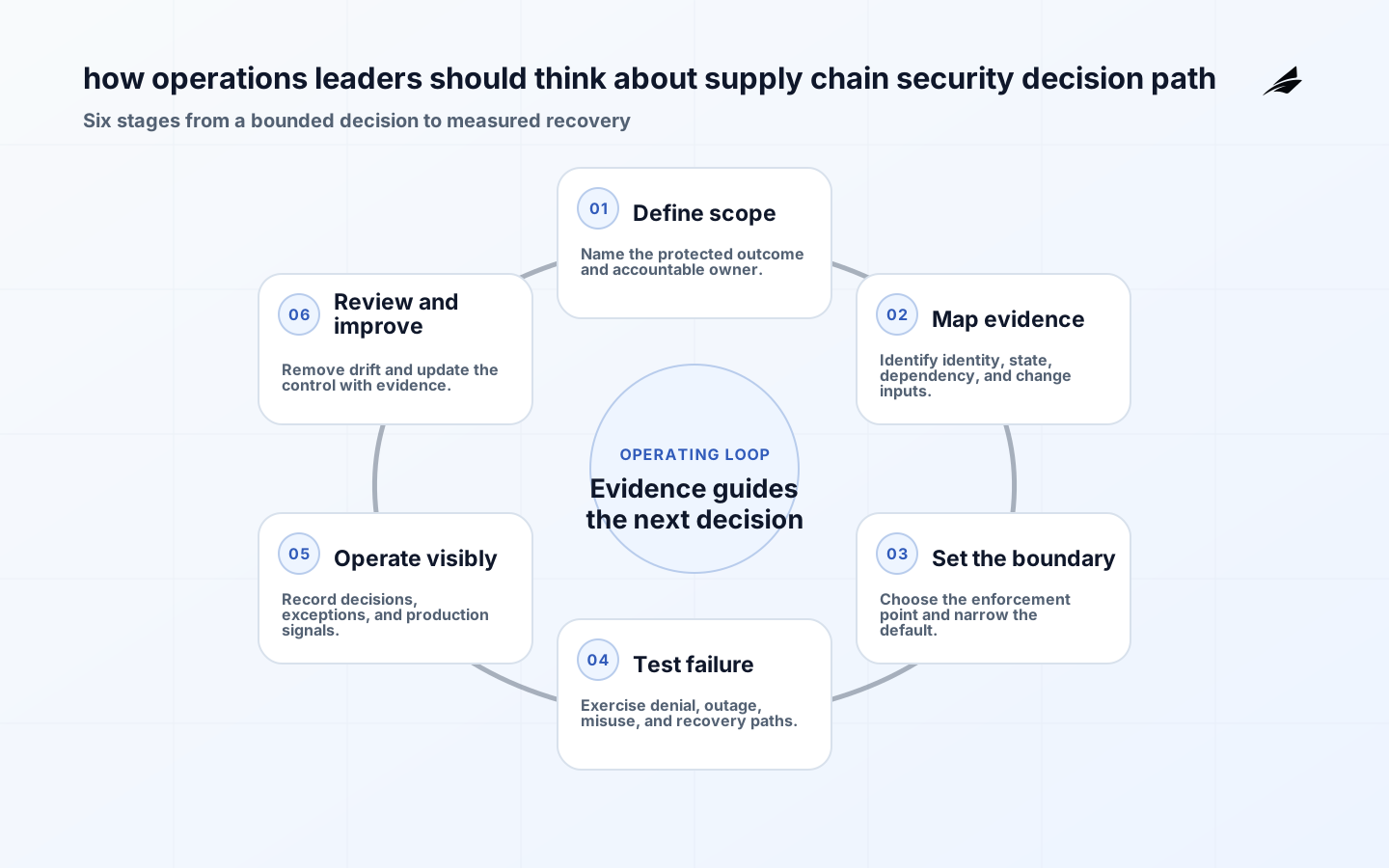
Supply chain security is the discipline of knowing how source code, third-party components, build tools, credentials, and delivery systems combine into the software that reaches users. Operations leaders should see it as a continuity and change-control concern as well as a security concern. A compromised dependency, a modified build runner, or an exposed publishing credential can alter a release even when application code review is strong. The first objective is not an inventory for its own sake; it is a traceable path from approved input to deployed artifact.
Set the supply chain security scope
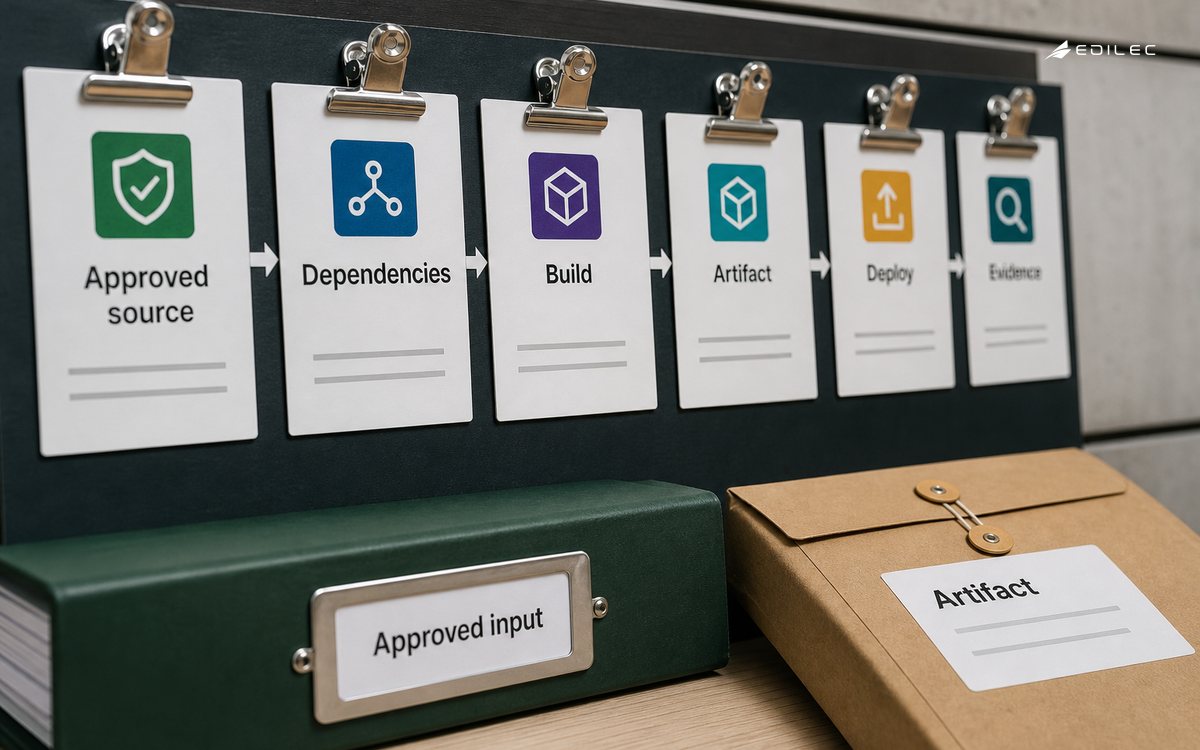
Map the chain in the order work actually happens: source repository, dependency resolution, build environment, artifact storage, deployment automation, and runtime configuration. Include hosted services and staff-operated steps, because a manual signing key or a vendor integration may be the narrowest point of control. OWASP describes the supply chain as the systems and processes that create, transform, and assess software artifacts. That framing helps operations teams assign owners to the transformations, not only to the finished application.
| Decision area | Question to answer | Accountable evidence |
|---|---|---|
| Chain point | Control question | Evidence |
| Source | Who may change code and workflows? | Protected-branch and review record |
| Build | What identity and inputs produced it? | Build log and provenance data |
| Artifact | Can promotion be traced? | Digest, signature, and repository record |
Translate supply-chain risk into routines
Create a release policy that says which sources are allowed, how versions are pinned or reviewed, what evidence proves the build ran in the expected environment, and who can promote an artifact. Prefer short-lived credentials for pipelines, protect branch and build-definition changes, and separate the ability to approve code from the ability to alter a production release. An SBOM can support investigation, but it does not prove an artifact was built from the recorded components. Pair inventory with provenance and signature verification where the toolchain supports it.
Rehearse supplier and release failures
Pilot the controls on one service with an active release cadence. Capture its dependencies, restrict the CI identity, preserve build logs, and record artifact digest and promotion history. Then rehearse a component advisory: identify affected artifacts, locate deployed versions, decide whether the issue is reachable, and document the remediation choice. This exercise reveals whether the chain is useful under pressure. It also keeps teams from confusing a scanner result with a complete risk assessment.
| Scenario | Expected response | Review evidence |
|---|---|---|
| Failure mode | Containment move | Follow-up |
| Compromised dependency | Stop promotion and identify affected artifacts | Pin or replace component |
| CI credential exposure | Rotate credential and inspect jobs | Adopt short-lived scoped identity |
| Registry outage | Use approved cached artifact process | Review emergency exception |
Give procurement evidence an owner
Operations teams need a clear exception route for urgent patches, unavailable registries, and legacy tools that cannot yet emit provenance. Each exception should state the compensating control, owner, expiry date, and evidence required to close it. Tie this work to incident playbooks so the people who respond to compromise know where artifact and deployment evidence lives, and to least privilege so pipeline credentials stay proportionate.
Use supply-chain guidance with procurement evidence
Use primary guidance to anchor technical choices: NIST Cybersecurity Framework 2.0 describes a governance-oriented risk framework; CISA Cybersecurity Performance Goals supplies practical baseline outcomes; the OWASP Cheat Sheet Series offers implementation-oriented guidance; and RFC 9700 records current OAuth security practice. These references inform the controls here, but the accountable owner must still apply them to supply chain security in the organization’s actual architecture and threat model.
Track traceability and recovery speed
Useful metrics include the percentage of releases with traceable source and artifact records, time to identify deployments affected by a critical advisory, number of long-lived pipeline credentials, and unresolved exception age. A dependency count alone is misleading: a small unmanaged dependency can be more dangerous than many reviewed packages. Use measurements to improve evidence and recovery speed rather than to create an arbitrary compliance score.
Address supplier architecture and dependency tradeoffs
Reproducibility is a useful aim even when a fully hermetic build is not yet practical. Capture the source revision, dependency lock data, build configuration revision, builder identity, timestamp, and artifact digest. Store that record where it can be retrieved during an incident, not only in ephemeral build output. The record lets responders distinguish a vulnerable source dependency from an affected released artifact, and it lets release managers verify that a promotion did not substitute an unreviewed binary after testing completed.
Dependency governance should match the way engineers choose components. Define which registries and package sources are approved, when a new maintainer or license needs review, how version updates are proposed, and who owns removal of abandoned libraries. Automated updates can reduce delay, but they still need tests and an accountable route for changes that affect production. Avoid a rule that forces teams to hide dependencies because approval is too slow; a transparent exception process gives security a better picture of actual exposure.
Review supply-chain change without losing operations
Build isolation is often the highest-return improvement. A runner that can read every secret, access every repository, and deploy every environment becomes an attractive pivot point. Segment jobs, scope secrets to the exact step and environment, protect build-definition changes, and log administrative modifications to the delivery platform. When a vendor-hosted runner or registry is used, document its trust boundary and outage plan. Operations should know which releases can pause safely and which require an approved alternate path.
Turn supply-chain design into durable governance
Procurement and vendor management are part of the software supply chain even when no source package is installed. A hosted build service, code-signing provider, managed registry, or deployment integration can influence the integrity or availability of releases. Maintain contacts, service commitments, access roles, and exit assumptions for those dependencies. During selection, ask how the provider isolates customers, reports security changes, supports credential rotation, and supplies audit evidence; after selection, review integration permissions as carefully as internal service accounts. Incident contracts should say how evidence is requested and who can authorize a temporary workaround. The same discipline applies to open-source components: popularity is not a guarantee of maintenance, and a component’s transitive dependencies may change without a conscious product decision. Set an update cadence, identify ownership for critical libraries, and monitor changes in maintainer or distribution behavior. This does not eliminate external trust, but it turns implicit reliance into a known operational decision that can be reassessed before a crisis.
Run a procurement and release evidence review
During a release review, choose one deployed artifact and reconstruct its path without asking the original builder to remember it. Locate the approved source revision, dependency record, build job, digest, promotion event, and environment. Any missing step becomes a prioritized improvement because it will also be missing when a security advisory lands at night. This exercise gives operations a concrete definition of supply chain traceability and reveals where a tool integration needs stronger ownership.
Keep supply-chain verification close to release work
Keep the release evidence usable. A record that requires specialist access or a manual export during an incident will not support fast containment. Give responders read access to artifact history and preserve it beyond the lifetime of an individual build job. Test retrieval during an exercise, including a release made several months earlier.
For each critical release path, retain an owner who can explain the current controls and an alternate who can operate them. This avoids an evidence gap when a build system changes hands or a supplier incident occurs.
Key takeaways
- Define supply chain security around a real high-consequence workflow, not a generic tool setting.
- Give every exception an owner, compensating control, and expiry date.
- Test the denial, change, recovery, and evidence paths before calling the control complete (supply-chain-operations-context).
- Use measurement to remove operational blockers and revise the control deliberately.
Frequently asked questions
Does a software bill of materials solve supply chain risk? No. It helps identify components, but control of source, build, artifact, and deployment paths is still required. Must every dependency be built internally? No. The decision should reflect criticality, maintainership, update practice, and the ability to verify what is consumed. What comes first? Protect source-control and CI privileges, then establish a reliable artifact record for a pilot service.
Conclusion
Supply chain security is operationally credible when a team can answer what entered a release, how it changed, who authorized it, and where it runs. Start with one release path, make exceptions visible, and build evidence that helps both prevention and response.
Supply-chain decisions for operations leaders
Operations leaders own the conditions under which software becomes a production dependency. Set risk appetite for unverified artifacts, exception authority, supplier ownership, release authority, and recovery time. Ask for evidence in operational language: what changed, what is affected, who can stop promotion, and how will service be restored? A monthly review can sample one release, dependency change, and exception. Trace source to artifact to deployment, review aged exceptions, and remove friction from the approved path. Reward timely disclosure of suspicious dependencies rather than creating incentives to hide them.
| Decision | Release authority | Supplier tier | Exception | Recovery |
|---|---|---|---|---|
| Question | Who may publish or promote? | What if it is compromised or unavailable? | Owner, expiry, compensating control? | Can we rebuild and verify? |
| Evidence | Approval record and signer | Incident timeline and containment | Exception record and review | Rebuild output and verified digest |
Frequently asked questions
These questions focus on the decisions operators need when the control moves into a live service.
A leadership question worth repeating
Ask, “What would we need to know by tomorrow morning if this supplier were compromised tonight?” The answer should include affected products, live digests, release owners, customer impact, credential rotation, and communication authority. If the organization cannot answer, invest in inventory and provenance before buying another dashboard. Leaders can accelerate this work by funding a bounded exercise, removing approval ambiguity, and making recovery evidence part of the normal operating review.
Conclusion
A durable implementation is a bounded decision with an owner, evidence, a tested denial path, and a safe way to recover. For a production supply chain, start with the highest-value workflow and expand from what the team can explain and repair.
Related Edilec guidance for supply chain operations: session security decisions, OAuth security for growing teams, and zero trust for growing teams. Operations leaders can compare the model with NIST software supply-chain guidance, CISA customer guidance, NIST SSCA, and CISA procurement guidance.