Founders should treat incident playbooks as a company operating capability, not a compliance artefact delegated to whoever owns alerting. One person may be incident lead, but decisions still need separate ownership: technical containment, customer communication, evidence, legal or privacy review, and executive tradeoffs. For continuity and response governance, consult NIST SP 800-34, CISA’s NCIRP 2024 Fact Sheet, the NIST Cybersecurity Event Recovery guide, and NIST’s incident response topic. The governance emphasis in NIST CSF 2.0 is practical. If nobody can authorize credential revocation or a customer notice, the company has an availability problem even when technology is sound.
Set the incident playbooks scope
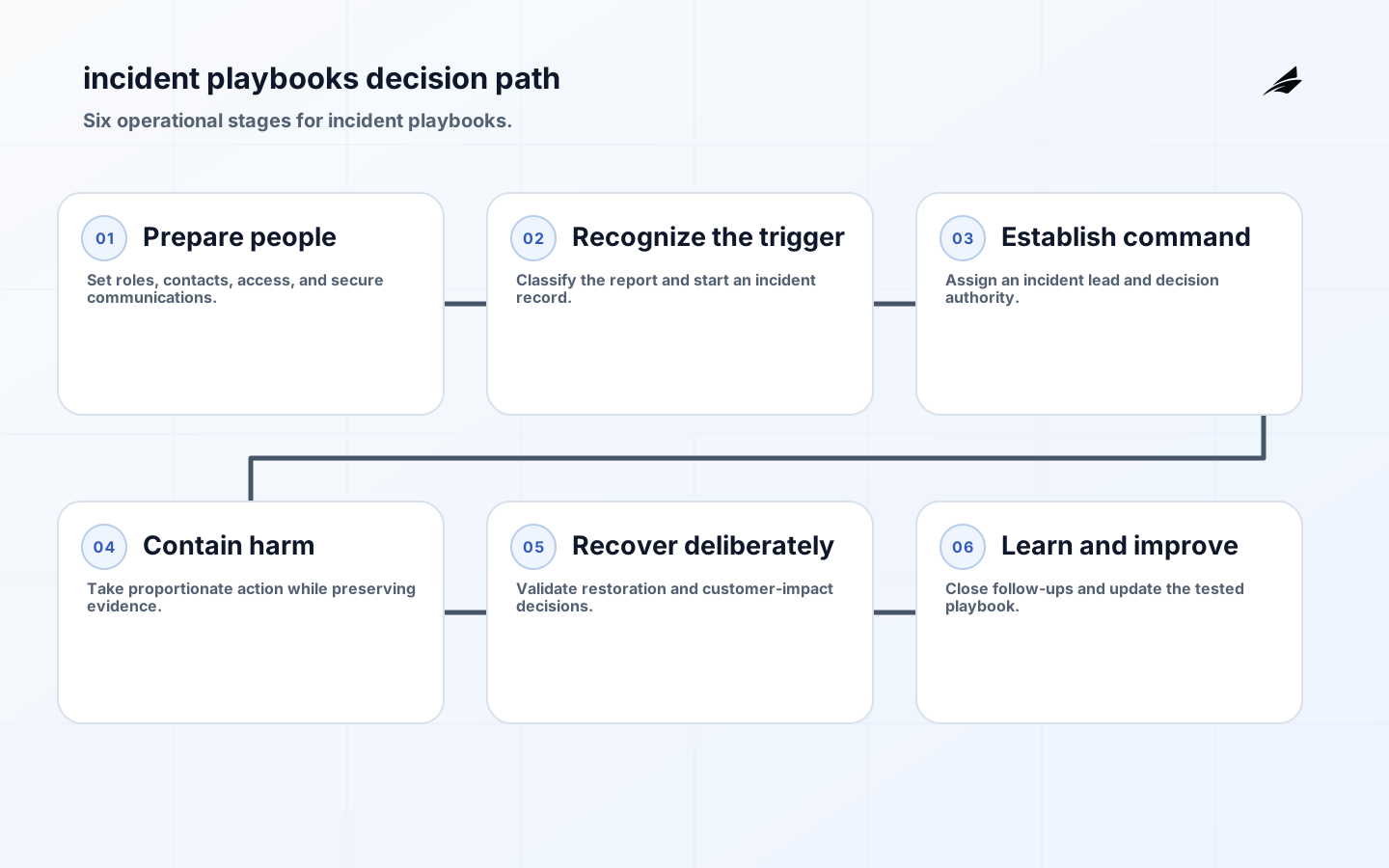
Separate a playbook from a generic policy. A policy says the organization responds to incidents; a playbook tells an on-call person how to classify a report, preserve evidence, appoint an incident lead, engage specialists, and decide on containment. CISA and NIST incident-response materials organize work around preparation, detection and analysis, containment, eradication, recovery, and post-incident learning. That sequence is useful, but a small company should adapt it to its actual systems, contracts, and people rather than copying federal terminology.

| Decision area | Question to answer | Accountable evidence |
|---|---|---|
| Scenario | First decision | Core roles |
| Exposed credential | Revoke, rotate, and scope exposure | Incident lead and identity owner |
| Suspected exfiltration | Contain path and preserve evidence | Technical lead and privacy counsel |
| Ransomware | Isolate systems and assess restoration | Operations lead and executive sponsor |
Design controls that fit the workflow
For each scenario, define a trigger, initial severity criteria, decision authority, communication owner, technical lead, legal or privacy escalation, and a secure place to keep notes. Include customer support and public communication thresholds, but avoid prewriting promises before facts are known. A good playbook specifies evidence to collect before systems are changed, yet it also identifies actions that must happen immediately to limit harm. This balance prevents both destructive panic and slow committee response.
Build and test the failure paths
Run a tabletop with the people who will actually answer the phone: engineering, operations, product, support, and leadership. Introduce realistic constraints, such as missing logs, an unavailable identity provider, or a customer report arriving through social media. Note where people do not know who can approve an outage, access backups, or notify a partner. Turn those gaps into owners and dates. Then perform a narrow technical exercise, such as revoking an exposed token or restoring a test dataset, to ensure the instructions reflect the systems in use.
| Scenario | Expected response | Review evidence |
|---|---|---|
| Phase | Output | Failure to avoid |
| Detection | Recorded report and initial scope | Changing systems before preserving key evidence |
| Containment | Approved harm-reduction action | Waiting for perfect certainty |
| Recovery | Validated service restoration | Declaring success without monitoring |
Make operations accountable
Keep the playbook versioned, accessible during an identity outage, and reviewed after material architecture changes. It should link to vulnerability management for confirmed exploitation and supply chain security when a build or dependency is implicated. Do not rely on a single executive to remember every contact; maintain alternates and test the notification path.
Use authoritative guidance with local evidence
In the founder readiness context, use primary guidance to anchor technical choices: NIST Cybersecurity Framework 2.0 describes a governance-oriented risk framework; CISA Cybersecurity Performance Goals supplies practical baseline outcomes; the OWASP Cheat Sheet Series offers implementation-oriented guidance; and RFC 9700 records current OAuth security practice. In the founder readiness context, these references inform the controls here, but the accountable owner must still apply them to incident playbooks in the organization’s actual architecture and threat model.
Measure the operating outcome
Track time to acknowledge, time to assign an incident lead, time to contain the affected capability, exercise participation, and closure of follow-up actions. These are learning signals, not a scorecard for blaming responders. Review whether evidence was sufficient to explain the decision trail, whether communications matched facts, and whether the same detection gap reappears. The goal is a response organization that becomes calmer and more capable over time.
Address architecture and dependency tradeoffs
Communication needs its own prepared workflow. Decide who can make factual updates, where customer support gets approved language, when counsel or a regulator must be involved, and how the team distinguishes confirmed facts from working hypotheses. Keep an incident timeline with timestamps, decision owners, and source evidence. Do not make responders choose between technical investigation and stakeholder communication; assign both tracks and synchronize them through the incident lead. A calm, truthful update is usually more valuable than a premature explanation that must be corrected later.
Containment choices should be rehearsed with their business cost visible. Disabling an integration, rotating a root credential, pausing a release, or taking a tenant offline may protect customers but also interrupt revenue and support operations. A playbook should identify which role can accept that tradeoff and what information they need. Pre-approved thresholds reduce delay, while an escalation rule covers cases outside the expected scenario. This is governance in the service of speed, not bureaucracy added after the fact.
Review change without losing the operating model
Post-incident work should separate root cause, control gap, and contributing condition. A single exposed credential may reveal missing secret scanning, unclear ownership, excessive authorization, and weak detection at once. Create follow-up actions that are specific enough to verify, assign them owners, and review closure with the same seriousness as the original event. Publishing an internal learning summary, with appropriate care for sensitive facts, helps prevent the organization from rediscovering the same failure through another team.
Turn the design into durable governance
The incident record should preserve decisions as well as technical events. Record when a report arrived, what was known at each stage, which containment options were considered, who approved an action, and what customer impact was assessed. This makes later review fairer because it evaluates responders against the information available at the time rather than against facts discovered afterward. Maintain a protected evidence location with access controls and a naming convention before an incident occurs; scattered chat messages and personal notebooks are fragile sources for a legal, regulatory, or customer review. Founders should also pre-agree the boundary between transparent communication and speculation. A response can say that an investigation is under way, explain an immediate protective action, and give a next update time without asserting a root cause prematurely. Afterward, compare the playbook to the actual timeline. Remove steps that created delay, retain decisions that helped, and update contact lists and access procedures while the experience is still fresh. This keeps the playbook a living operational tool rather than an artifact created only to satisfy a questionnaire.
Run a practical review
At the end of an exercise, ask each participant what information they needed but could not find quickly. The answer may be a system diagram, a customer contact list, an access procedure, a logging query, or an authority decision. Turn it into a specific improvement and retest it in the next scenario. This loop is how a playbook becomes reliable under pressure: not through more prose, but through fewer unanswered questions at the moment a response begins.
Keep verification close to the work
Keep responder welfare in the operating plan. Prolonged incidents require rotations, clear handoffs, and a record that prevents each new person from repeating the same investigation. Calm coordination protects decision quality, particularly when technical uncertainty and customer pressure arrive together.
Set a cadence for contact verification between exercises. A phone number, escalation channel, or vendor contract that worked last year is not a reliable incident dependency today.
Founder incident-readiness takeaways
- Define incident playbooks around a real high-consequence workflow, not a generic tool setting.
- Give every exception an owner, compensating control, and expiry date.
- Test the denial, change, recovery, and evidence paths before calling the control complete.
- Use measurement to remove operational blockers and revise the control deliberately.
Founder incident-readiness FAQ
How many playbooks does a startup need? Begin with the few scenarios that could stop the business or harm customers, then expand from exercises and incidents. Should a founder lead every incident? The founder may own business decisions, but an assigned incident lead should run the response rhythm. Is a tabletop enough? It is a strong start; pair it with technical drills that validate access, backups, and containment actions.
Founder incident-readiness conclusion
Incident playbooks give a company a practiced way to make consequential decisions under pressure. Define authority, evidence, and communication before the event, rehearse them with the real team, and improve the playbook after every exercise. That preparation protects both customers and the people responding.
Founder readiness: turn tradeoffs into an operating decision
Founder readiness: rehearse a business-critical incident
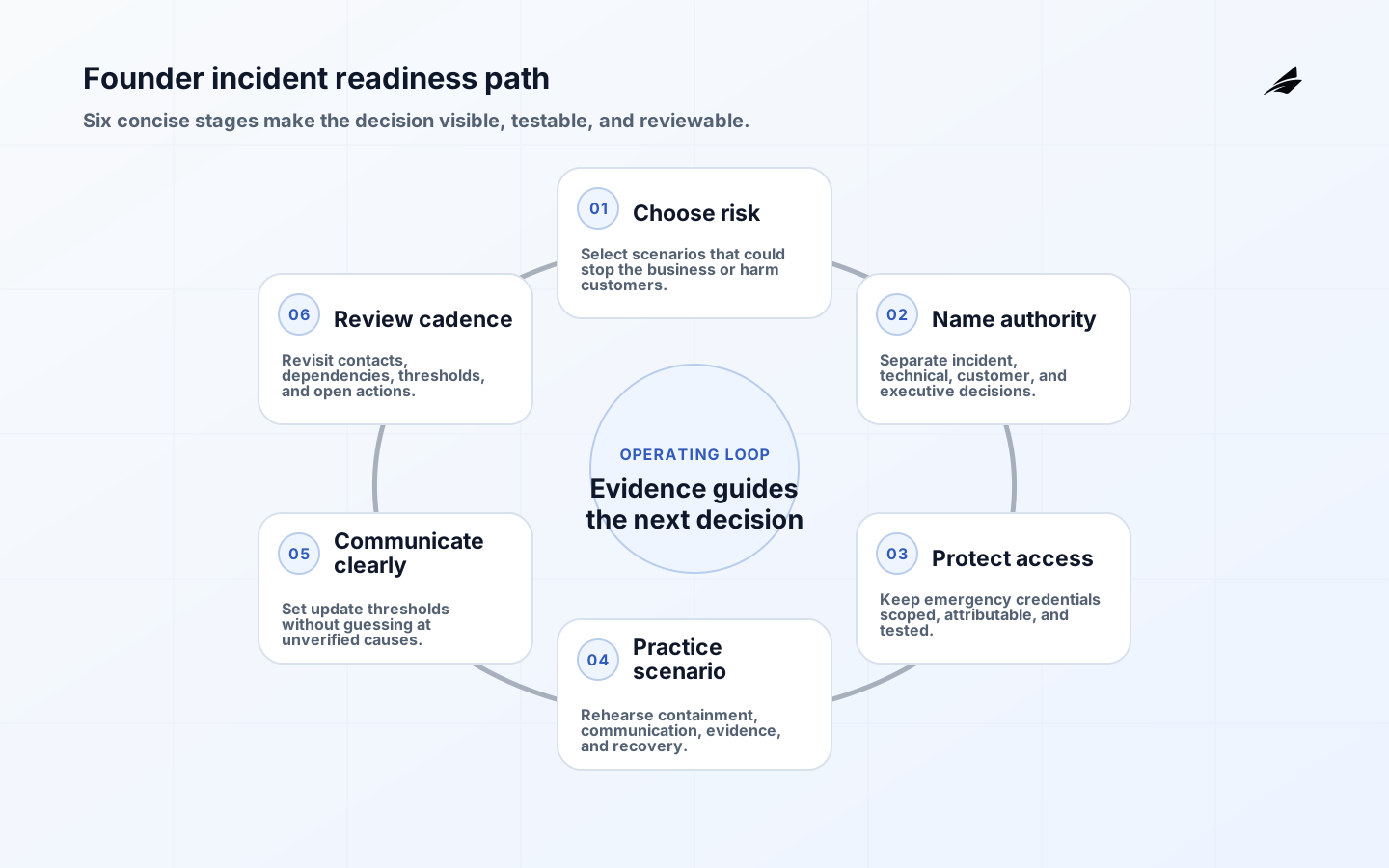
Choose scenarios based on business concentration. A SaaS company whose largest risk is privileged account compromise should rehearse identity recovery, token revocation, support verification, and tenant impact analysis before writing a broad malware plan. A marketplace may prioritize payment manipulation, data exposure, and supplier outage. For each scenario identify the signal, protected asset, decision authority, safe containment action, and recovery evidence.
Invest in contact and access resilience. Keep a separately hosted contact list, confirm alternates, and test that responders can reach logs, cloud consoles, backups, and customer context during an identity-provider outage. Emergency access should be rare, scoped, attributable, and reviewed after use. RFC 9700 reinforces why token issuance, redirect handling, and client credentials need explicit scrutiny; a founder should require ownership of those failure modes.
Make review light enough to survive growth. Run a short quarterly scenario, review open actions monthly, and revisit the playbook after major vendor, product, staffing, or architecture changes. Track time to decision, containment, accurate customer update, and verified recovery rather than document counts. Safe escalation and honest uncertainty are leadership responsibilities.
Founder readiness: connect response to continuity
In the founder readiness context, for a broader view, compare incident playbooks access and operations, evidence and review practice, and recovery planning. In the founder readiness context, these Edilec guides add the human and operational context around this article’s technical decision.
Founder readiness: preserve authority and review evidence
A founder-level playbook should expose tradeoffs in business language. Temporarily disabling a feature may protect data but reduce revenue; rotating a credential may interrupt a partner; notifying customers may create support demand before scope is known. Pre-agree the authority and escalation threshold for those choices. The purpose is not to make every decision in advance, but to ensure that the person on call is not alone with an ambiguous mandate. Review these thresholds with technical and customer-facing leaders as the company’s concentration, contracts, and obligations change.
Measure readiness with a small evidence set: reachable responders, current asset and dependency map, tested emergency access, usable logs, a restore rehearsal, and a completed scenario exercise. A founder can ask for those artifacts without dictating implementation. If one is missing, the risk is visible and can be assigned rather than hidden behind a mature-looking policy document.