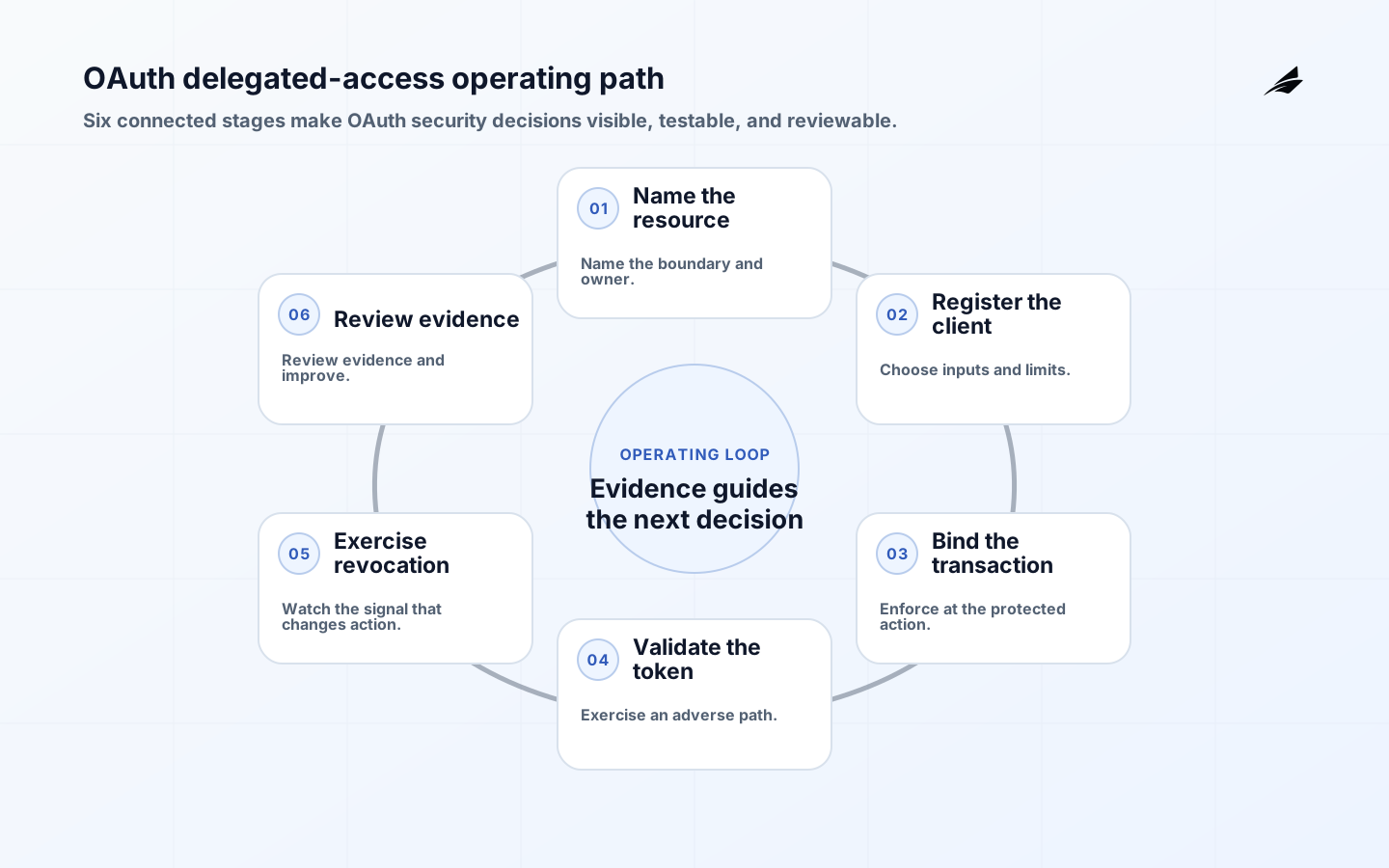
OAuth security is useful only when it changes a concrete engineering decision. For IT managers, that means defining delegated API access between a client, authorization server, resource server, and resource owner before choosing a product or publishing a policy. Start with the protected outcome, the person accountable for it, and the evidence an operator will need when access is denied or a dependency fails The NIST zero trust architecture frames security around protecting resources rather than assuming a network location grants safety That perspective is practical even when the program is small: make the requested action explicit, keep authority close to the resource, and leave a trace that explains the result OAuth security should reduce a known failure path without making ordinary work depend on a secret exception.
Set the OAuth security boundary
The boundary for OAuth security is delegated API access between a client, authorization server, resource server, and resource owner. A team should be able to point to the request, the resource, the decision point, and the owner who can change the rule In this setting, the central design decision is to treat redirect URIs, authorization codes, tokens, and client registration as security boundaries rather than routine plumbing. Write down the normal path and the awkward path: a new employee, an automated workload, a support escalation, a revoked account, and a partial outage This avoids a familiar pattern where a control exists but nobody can say what it protects NIST SP 800-53 is useful as a control catalogue because it connects access, configuration, monitoring, and recovery instead of treating them as unrelated checkboxes
| Boundary question | Practical answer for this design | Evidence to keep |
|---|---|---|
| Protected outcome | State what OAuth security must allow, prevent, or prove. | Scope statement, owner, and impact of failure. |
| Decision inputs | Use registered redirect URI, client type, grant, scopes, proof-of-possession capability, and token audience. | Source, freshness expectation, and steward for each input. |
| Exception path | Make deviation time-bounded and approved. | Reason, compensating measure, expiry, and review record. |
Design an explainable OAuth security decision
Good OAuth security design is intentionally specific. The key inputs are registered redirect URI, client type, grant, scopes, proof-of-possession capability, and token audience; the implementation needs exact redirect matching, authorization code flow with PKCE, constrained scopes, and token validation at the resource server. Those pieces should agree on vocabulary and ownership. A policy that says “trusted” without identifying a subject, an action, a scope, and a time limit cannot be tested properly Keep the rule narrow enough that engineers can predict its outcome, then test the opposite outcome on purpose The OWASP Authorization Cheat Sheet reinforces two durable habits: deny by default and verify authorization on the server side Those habits matter because a polished interface, a network control, or a client-side check cannot establish authority by itself
- Name one accountable owner for each OAuth security policy and one reviewer for high-impact exceptions.
- Record which source supplies each decision input and what happens when it is unavailable — for OAuth security.
- Keep administrative changes versioned, attributable, and reversible through a tested path.
- Test an expected success, an expected denial, and a recovery action before widening the scope — for OAuth security.
Avoid the failure modes that weaken OAuth security
The most damaging shortcut in OAuth security is accepting a redirect or token merely because it looks syntactically plausible. It usually begins as a reasonable response to delivery pressure, then becomes invisible infrastructure Counter it with an explicit inventory, a narrow policy, and an expiry date for every workaround Do not confuse activity volume with assurance: large logs or a dashboard of green checks do not prove that the right resource was protected The OAuth security best current practice is a good reminder that interfaces exposed through browsers and APIs need exact, transaction-bound validation rather than permissive matching Apply the same discipline here: identify what is bound to the request, what can be replayed or altered, and where the system must reject ambiguity
Implement OAuth security in a narrow slice
A credible first release for OAuth security is one client integration, a locked client registry, and negative tests for redirect, state, PKCE, scope, and audience failures. Instrument it before broad adoption. Capture a stable actor or workload identifier, the protected target, the policy or configuration version, the outcome, and a correlation identifier Avoid collecting sensitive material just because it is available; observability should help an operator reconstruct a decision without creating another sensitive store Treat configuration changes as production changes with peer review and a rollback plan This approach gives product and security teams a shared way to decide whether the control is helping: they can see the expected traffic, the expected denials, and the support work created by the new boundary
| Release check | Pass condition | What a miss means |
|---|---|---|
| Expected path | A legitimate OAuth security request succeeds with attributable evidence. | The policy or integration is not ready to expand. |
| Negative path | An intentionally invalid request is rejected at the enforcement point. | A bypass or incomplete validation may remain. |
| Recovery path | The designated owner can restore approved access without a shared secret. | Operations will invent an unsafe workaround under pressure. |
Operate OAuth security as a living control
After release, measure whether OAuth security is still protecting the intended outcome. Watch for changes in request patterns, stale owners, recurring exceptions, policy edits, and dependencies that no longer supply trustworthy information Review a small sample of both successful and denied decisions with the team that owns the workflow That investigation should answer who requested what, why the rule reached its result, and how a correction would be made Use those findings to simplify the policy where possible. The strongest operating signal is not a perfect metric; it is the ability to explain a real event and make a safe correction before a temporary exception turns into permanent access — for OAuth security.
Connect OAuth security to adjacent practices
OAuth security does not stand alone. It relies on dependable identity, careful authorization, change control, and evidence that can be investigated The most relevant companion reading is A Field Guide to Zero Trust for Growing Teams, A Field Guide to OpenID Connect for Growing Teams, and session security decisions. Use these guides to align the handoffs: an identity claim should not silently become a broad authorization grant, and a monitoring alert should lead to an accountable response When the controls share an asset inventory and a consistent owner model, teams can make security improvements without repeatedly rediscovering the same dependencies
Review one OAuth transaction end to end
A practical review follows one authorization-code transaction from browser start to resource-server enforcement. Confirm that the client uses an exact registered redirect URI, creates a transaction-specific state value, sends a PKCE S256 challenge, and redeems the code once. RFC 9700, published by the IETF in 2025, makes exact redirect matching and PKCE central best practices and warns against open redirectors. The reviewer should also inspect the token’s issuer, audience, expiry, and scope at the resource server; successful login is not proof that the requested API action is authorized.
Questions to answer before expanding OAuth security
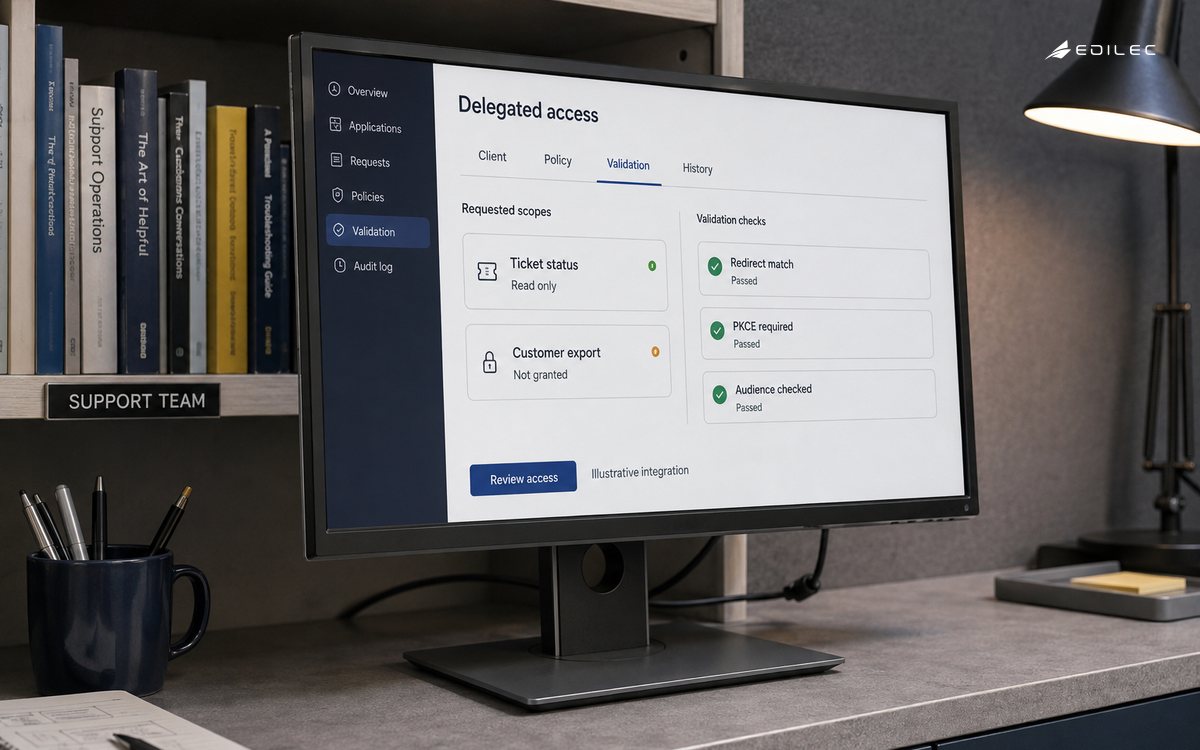
Consider a support integration that needs to read ticket status but not export customer records. Give it a narrow audience and scope, rotate its credentials through a recorded owner, and test what happens when the integration is disabled while a refresh token is still present. The negative test should show a clear denial and a correlation identifier, not a generic success from an upstream gateway. If an exception is required for a migration, set a removal date and make the migration itself the owner’s work item. This keeps delegated access bounded when teams, vendors, and endpoints change.
| Review point | Pass condition | Evidence |
|---|---|---|
| Redirect | The requested URI exactly matches a registered value. | Client registration, request trace, and failed variant. |
| Code exchange | PKCE is transaction-bound and the code cannot be reused. | Challenge, redemption result, and replay test. |
| Resource call | Issuer, audience, expiry, and scope are checked at the API. | Decision log with policy version and target. |
OAuth security takeaways
- Scope OAuth security around a protected outcome and a named resource, not a generic security objective.
- Make the decision inputs, enforcement point, owner, and exception expiry visible to operators — for OAuth security.
- Start with one measurable workflow, test rejection and recovery, then extend coverage from evidence — for OAuth security.
- Review changes and exceptions often enough to remove obsolete access before it becomes institutional memory — for OAuth security.
Review OAuth security evidence
An OAuth security review is most useful when it follows a concrete authorization transaction. Verify that the client’s registered redirect URI is exact, state and PKCE are tied to that browser session, the code is redeemed once, and the resource server evaluates the intended issuer, audience, expiry, and scope. Also inspect the less visible inventory: inactive clients, old redirect domains, refresh-token policy, and who owns each integration. A client integration can look healthy while retaining access nobody remembers granting. Make removal and credential rotation routine operations, then test the incident path for a suspected redirect leak or revoked client. That discipline turns protocol compliance into dependable delegated access.
OAuth security FAQ
Where should a team begin with OAuth security? Begin with one high-value workflow, its resource owner, its normal request path, and the most plausible failure or abuse path (OAuth security boundary). How much documentation is enough? Keep a short decision record with scope, inputs, owner, enforcement point, exception process, and tests; update it when the workflow changes — for OAuth security. How do we know the control works? Reproduce a normal request, an invalid request, and an approved recovery while tracing each result to a policy or configuration version — for OAuth security. Can a small team do this? Yes. Small teams benefit from a narrower first boundary because it makes ownership and operational evidence realistic rather than aspirational — for OAuth security.
For protocol detail, consult RFC 8252 on OAuth for native apps, RFC 8628 on the device authorization grant, RFC 9068 on JWT access tokens, and RFC 9449 on DPoP. These references help validate client binding, token semantics, and replay resistance.
Conclusion: make OAuth security operable
OAuth security becomes durable when it is a clear decision made at the right boundary, backed by owned inputs and a recoverable operating path. Begin with the workflow that would hurt most to get wrong, make the allow and deny conditions explainable, and expand only after the team can observe and repair the result That is steady security engineering, with fewer heroic exceptions and more useful evidence