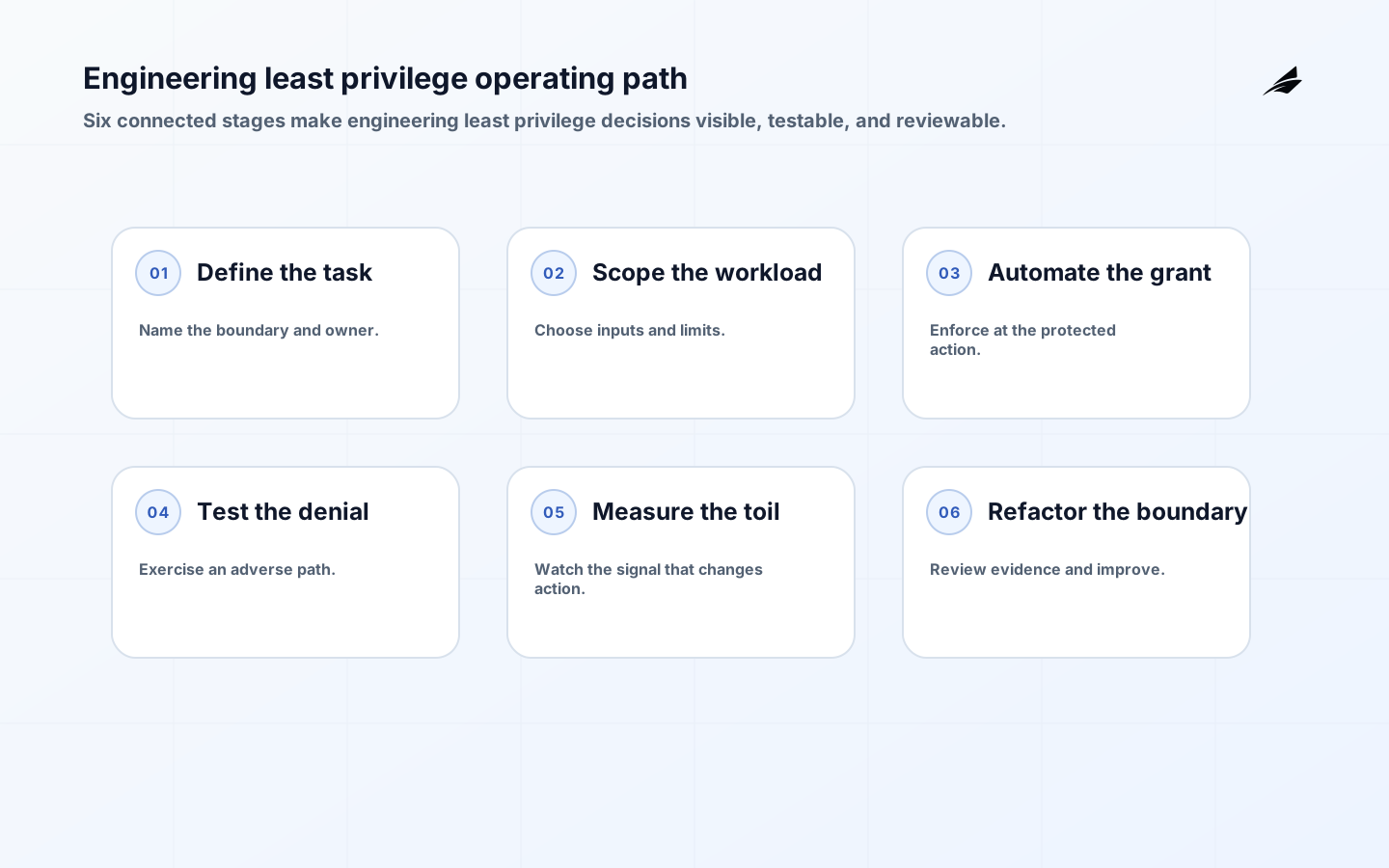
Least privilege means granting a person, workload, or automation only the access needed for a defined task, for no longer than it is needed. Engineering teams often reduce it to roles in an identity provider, then discover that repositories, CI runners, cloud accounts, feature flags, databases, and observability tools each carry their own permission model. The work is to join those models to real engineering jobs. A broad permission is not made safe by good intentions; it must be justified by a bounded operation and revisited when the job or system changes.
Set the least privilege scope
The fastest way to find material exposure is to trace a change from a developer laptop to production. Note who can merge, who can alter a build definition, which pipeline identity can deploy, who can read secrets, and what the running service can invoke. OWASP recommends deny-by-default authorization and validation on every request. That principle exposes a useful distinction: authentication identifies a caller, while authorization decides whether that caller may perform this operation on this resource now.
| Decision area | Question to answer | Accountable evidence |
|---|---|---|
| Identity | Needed capability | Boundary |
| Developer | Merge reviewed change | Named repository and branch rules |
| CI runner | Build and publish artifact | Single project and protected secrets |
| Runtime service | Read its configuration | Specific namespace and audience |
Match authority to the engineering task
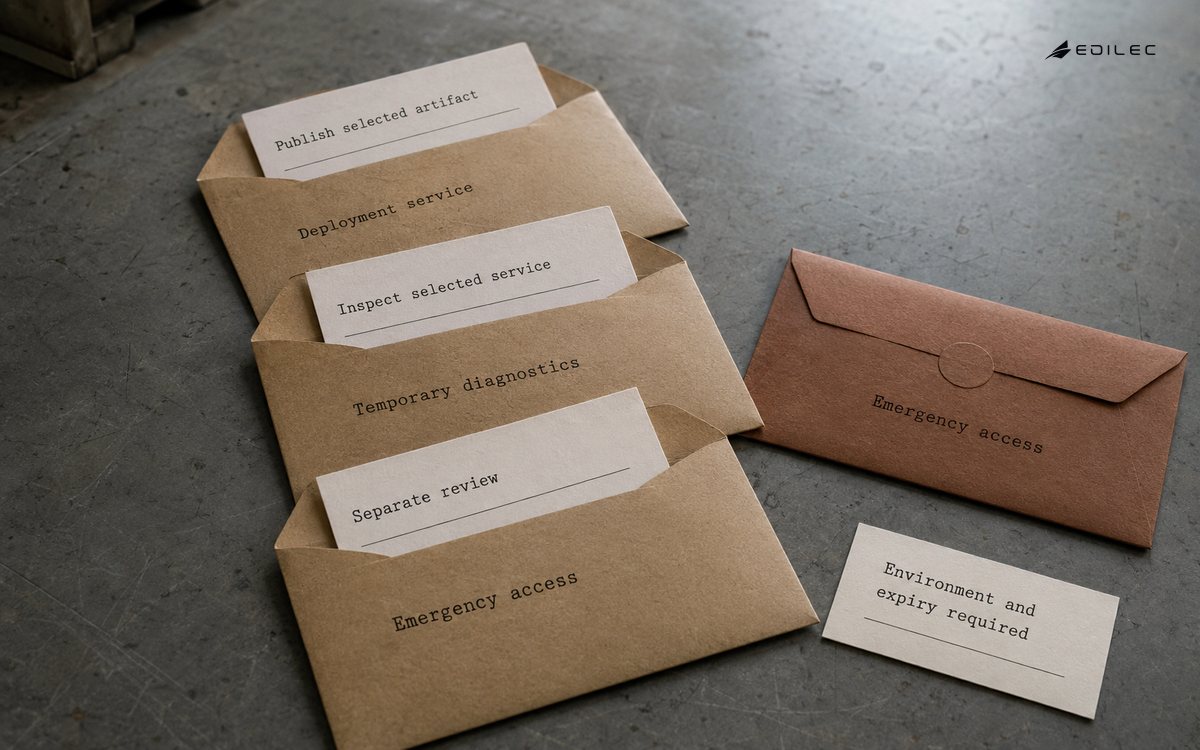
Design permissions around capabilities, not job-title folklore. A deployment service might need permission to publish one signed artifact to one environment, but not to read customer data. A developer might request temporary production diagnostics but not an evergreen administrator role. Keep human elevation, machine identities, and emergency access separate so their reviews do not blur. Where a platform supports conditions, use environment, resource, or time limits carefully and test their actual evaluation order before relying on them.
Probe pipeline, workload, and emergency failures
Treat access changes as code-reviewed production changes where feasible. Store role definitions and policies in version control, test expected allows and expected denies, and require an owner for every high-impact entitlement. When an engineer leaves a project, remove project-specific paths before assuming the central directory update catches everything. For service accounts, replace shared credentials with distinct identities so an audit trail can distinguish a build, a deployer, and a runtime workload.
| Scenario | Expected response | Review evidence |
|---|---|---|
| Signal | Why it matters | Response |
| Wildcard permission | Scope cannot be explained | Replace with resource-specific grant |
| Dormant administrator | Unused power can be hijacked | Remove or reapprove |
| Shared service account | Actions lack attribution | Split into workload identities |
Give every grant an operator and expiry
A quarterly recertification can find drift, but it cannot be the only feedback loop. Alert on newly created administrators, wildcard permissions, dormant privileged identities, and policy edits outside the approved path. Ask managers to review access in the language of tasks: can this person still deploy this service, approve this payment, or inspect this dataset? The approach reinforces supply chain security because build authority is production authority in another form.
Use authoritative guidance with local evidence for engineering least privilege
Use primary guidance to anchor technical choices: NIST Cybersecurity Framework 2.0 describes a governance-oriented risk framework; CISA Cybersecurity Performance Goals supplies practical baseline outcomes; the OWASP Cheat Sheet Series offers implementation-oriented guidance; and RFC 9700 records current OAuth security practice These references inform the controls here, but the accountable owner must still apply them to least privilege in the organization’s actual architecture and threat model.
Measure permission friction and useful change
Track the number of permanent privileged grants, time from request to removal, age of unused service identities, and the share of policies covered by automated allow-and-deny tests. Do not reward teams simply for reducing the number of roles; an elegant but opaque role hierarchy can conceal more risk than a small explicit policy. The useful outcome is an authorization decision a reviewer can understand and reproduce.
Address architecture and dependency tradeoffs for engineering least privilege
Permission design has to cover non-human work as carefully as employee accounts. Build agents, infrastructure automation, scheduled jobs, integration connectors, and runtime services often have wider and longer-lived authority than a developer. Give each workload a distinct identity, an owner, and a defined execution context. Constrain it to a specific resource path where the platform allows, and remove the identity when the service is retired. Shared operational accounts make emergency recovery feel easy in the moment, but they erase attribution and make later reduction of privilege much harder.
Use a permission review to challenge accumulated assumptions, not to ask managers to click approve on a long list. Present the requested capability, the resource it reaches, recent evidence of use, the owner who can explain it, and the expiry if it is temporary. When access is denied, give engineers a safe route to request the missing capability with enough detail to improve the policy. That keeps teams from responding to friction by creating side channels or adding unrestricted administrator credentials to automation.
Review change without losing the operating model for engineering least privilege
Access control tests deserve the same attention as functional tests. For a representative resource, assert that the correct subject succeeds and that adjacent subjects fail: another tenant, a lower privilege role, a terminated project member, and an expired elevation. Test server-side authorization rather than trusting that a user interface hides a button. These tests catch horizontal access mistakes that role names cannot reveal, and they create a regression signal when new endpoints or data models are introduced. Compare ABAC in production when attribute context changes the grant.
Turn the design into durable governance for engineering least privilege
Engineering leadership should distinguish permission reduction from responsibility avoidance. A restrictive policy that lacks a fast, reviewed elevation path can block an urgent repair and encourage teams to bypass the intended controls. Design the request flow around the information a reviewer needs: task, target resource, time limit, change ticket or incident reference, and the identity that will exercise the access. Make the result visible to the requester, then automatically remove the grant at the agreed end time. For platforms without mature just-in-time access, a documented temporary group with periodic cleanup is still better than silently assigning a permanent administrator role. Track ownership changes in repositories and services so policy review follows the work, not only the organization chart. Finally, use separation of duties where it changes risk materially: the same person need not be prevented from every adjacent task, but a production approver, a build-policy editor, and a secrets administrator should not accidentally collapse into one unchecked identity. The goal is understandable accountability under normal delivery pressure.
Run a practical review for engineering least privilege
Before approving an access model, ask a new engineer to explain how they would obtain, use, and relinquish the capability needed for one production task. If the answer is a shared password, an unspecified administrator group, or a message to a person with informal authority, the control needs work. A good path is discoverable, time-bound, auditable, and quick enough that it is preferred over improvisation. That is the practical test of least privilege in a delivery organization.
Keep verification close to the work for engineering least privilege
Make removal measurable too. When a repository is archived, a service is retired, or an employee changes teams, trigger an access review from that operational event. Compare the intended removal date with the actual directory, cloud, and application policy changes. This turns least privilege from a periodic cleanup project into part of the engineering lifecycle.
A final control is transparency: engineers should see what access they hold and why. Self-service visibility reduces stale requests, speeds correction, and gives reviewers a practical starting point when permissions no longer match a task.
For engineering controls, consult AWS Access Analyzer, Kubernetes service accounts, Google Cloud audit logs, and Microsoft role-based access control. Compare the resulting workflow with the supply chain security guide and least privilege review before expanding it.
Make least privilege an engineering feedback loop
Engineering teams make least privilege practical when they treat access as part of the workflow contract. For a deployment service, define which repository, environment, artifact, and command the job needs, then issue that authority for the job’s lifetime rather than giving the runner a standing administrator role. The NIST Cybersecurity Framework is a useful organizing reference, but the team still needs a local test: a normal deployment, an altered artifact, a different environment, a cancelled job, and a revoked credential.
Questions to answer before expanding engineering least privilege
Use denial data as engineering input. If developers frequently request the same exception, inspect whether the service boundary is wrong, the task is under-automated, or the policy lacks a stable resource identifier. Pair exception count with time to approve, time to remove, and affected customer work. A mature team can then choose a smaller permission, a dedicated workflow, or a better resource model instead of arguing from intuition. Keep changes close to code review and deployment evidence so the permission model evolves with the software rather than months after it.
| Engineering moment | Least privilege question | Useful signal |
|---|---|---|
| Design | What exact resource and action does this component need? | Declared scope and owner. |
| Delivery | Can the pipeline prove denied and cancelled behavior? | Negative test and rollback result. |
| Operations | Which grant or exception is creating repeated toil? | Age, frequency, and removal time. |
Key takeaways
- Define least privilege around a real high-consequence workflow, not a generic tool setting.
- Give every exception an owner, compensating control, and expiry date.
- Test the denial, change, recovery, and evidence paths before calling the control complete — for engineering least privilege.
- Use measurement to remove operational blockers and revise the control deliberately.
Frequently asked questions
Is least privilege the same as role-based access control? No. Roles are one mechanism; least privilege is the outcome that may also use attributes, relationships, time bounds, or approval workflows. Does it slow incident response? It should improve it when break-glass access is pre-authorized, short-lived, logged, and reviewed. Where should a team begin? Start with identities that can change production code, secrets, money, or customer data.
Conclusion
Least privilege becomes practical when permissions map to work that can be named, tested, and retired. Build for narrow capability, temporary elevation, and visible review. That lets engineering move quickly without leaving permanent authority behind every release.