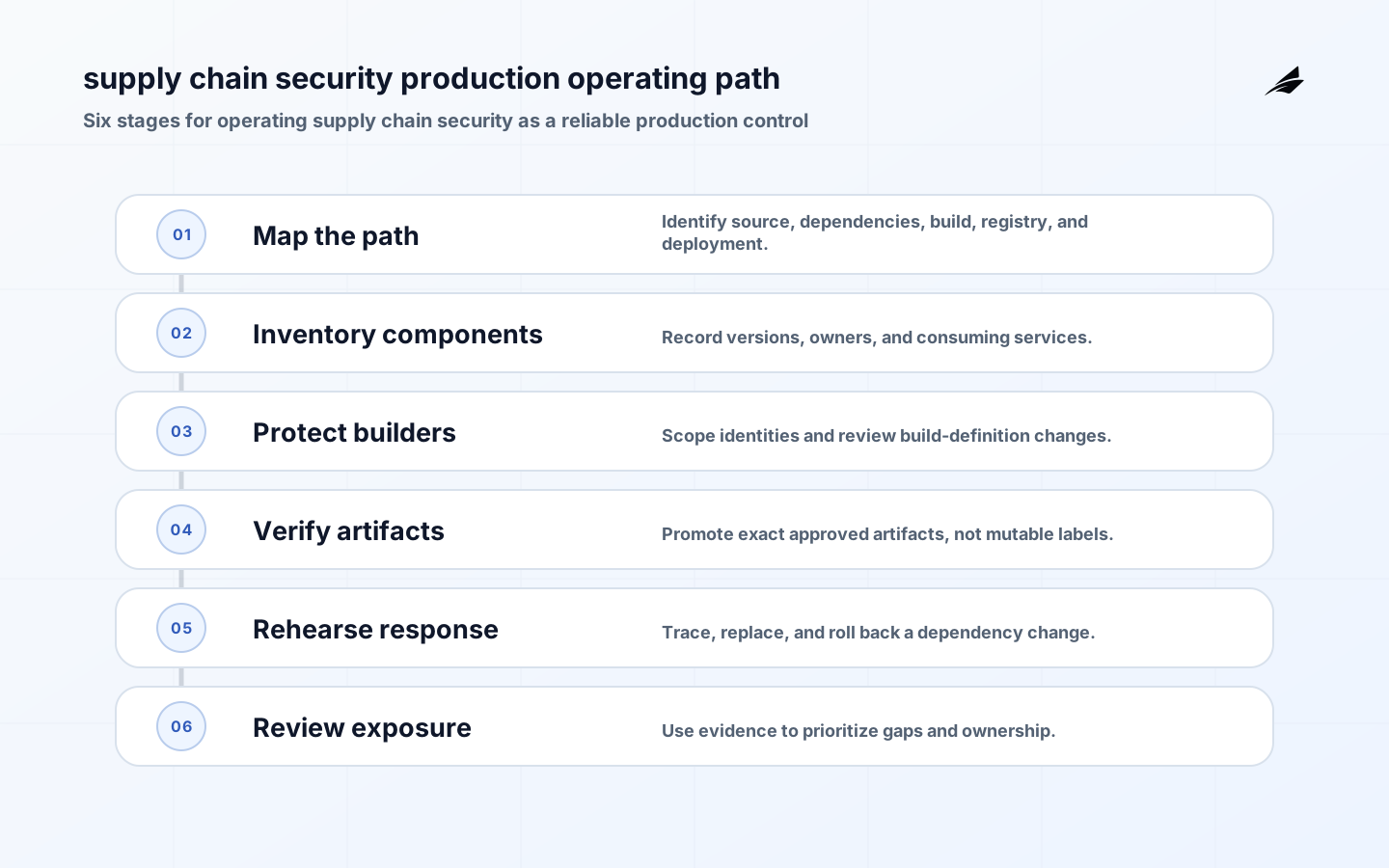
Supply chain security changes in production because it must work during ordinary releases, partial failures, and the occasional urgent request. For operations leaders, the practical problem is that a dependency, build action, artifact registry, or external service enters production without a reliable record of its origin, version, or owner. A useful implementation begins with one important workflow and a named owner, then makes the control visible in the way the system actually operates. This guide focuses on decisions a team can test: what is protected, who or what may act, where the decision is enforced, how exceptions are handled, and what evidence remains after the event. The relevant guidance in NIST SP 800-161 Rev. 1: Cybersecurity Supply Chain Risk Management is a useful starting point, but the durable outcome is an operating habit rather than a document.
Define the supply chain security boundary
The first boundary is the outcome, not the tool. State the asset or action at stake, the identities and systems involved, the trust assumptions, and the person who can accept a temporary exception. For this topic, the central production decision is to treat the build-to-deployment path as a chain of accountable handoffs and retain enough evidence to identify affected releases quickly. That statement should be specific enough that engineering, operations, and security can recognize whether it happened. It also exposes dependencies early: identity providers, queues, caches, deployment tooling, customer tenants, or third-party services can all influence the result. NIST SP 800-218: Secure Software Development Framework reinforces the value of designing controls that are explicit and verifiable rather than relying on convention.
| Handoff | Control to establish | Evidence |
|---|---|---|
| Dependency resolution | Pinned versions and reviewed change path | Lockfile change and review record. |
| Build and artifact creation | Scoped build identity and protected registry | Build ID, artifact digest, signer or runner. |
| Deployment | Approved artifact promoted by automation | Environment, release ID, and deployment outcome. |
Assign ownership and evidence before rollout
Production controls fail quietly when ownership is implied. Assign a service owner for the workflow, an operational owner for the change path, and a reviewer for exceptions or high-impact events. Decide what must be retained to demonstrate the decision later: inventories of dependencies and artifacts, protected build identities, provenance or attestation where available, and tested rollback or replacement procedures. Keep the evidence focused on actor, target, time, configuration or version, result, and correlation. Do not collect sensitive values merely because they are available. NIST SP 800-53 Rev. 5: Security and Privacy Controls is especially clear that security evidence needs protection of its own; a record that exposes credentials, private data, or unrestricted system detail creates another risk surface.
Build supply chain security into the workflow
The implementation principle is straightforward: pin and review dependencies according to risk, restrict who can change build definitions, and verify that the deployed artifact is the approved artifact. Start with the path that produces a customer-facing release: source repository, dependency resolution, build runner, artifact registry, deployment automation, and runtime configuration. Each handoff needs an owner and a trust decision. Inventory should be useful during an incident, so record component name, version, source, license or contract context where relevant, consuming service, and deployment status. Supply chain security does not require an immediate perfect catalog; it requires a dependable way to answer which release contains a component and how it entered the environment. Put the policy or configuration under normal change control, with a clear owner and a way to compare the intended state to the deployed state. Avoid a big-bang conversion. Start with a bounded service, environment, action, or cohort whose operational behavior the team understands. That makes it possible to distinguish a genuine control failure from an undocumented dependency and to improve the rollout without turning every exception into a permanent bypass.
- Write the protected action and decision boundary in language an operator can use during an incident.
- Make the enforcement point and configuration source visible to the people who own the workflow.
- Provide a time-bounded, recorded path for legitimate urgent work instead of relying on informal access.
Test normal work, denial, and recovery
A configuration review cannot prove production behavior. Run a controlled change through the path and then answer operational questions without guessing: which build produced this image, which dependency version it contains, which environments received it, and how to stop or replace it. Test compromised or failed steps too: an unapproved build runner, a modified lockfile, a registry tag that moves, a dependency advisory, and a rollback to an earlier artifact. The goal is to expose where an operator would need tribal knowledge under time pressure. Test from the perspective of the caller and the protected resource, including the route that bypasses the preferred user interface. Capture the result in a repeatable check that can run after meaningful releases. When a test fails, resist the reflex to broaden access or silence a rule. First establish whether the workflow is missing a dependency, the policy is too broad or too narrow, or the enforcement point is not seeing the required context. This is where a small, well-instrumented rollout pays for itself.
| Response question | Required record | Useful action |
|---|---|---|
| Where is a component running? | Component version to artifact and environment | Target containment or upgrade. |
| Who can change it? | Repository, build, and registry access review | Remove excess write access. |
| Can we reverse it? | Known prior artifact and rollback test | Restore a verified release. |
Use signals to keep the control honest
After launch, supply chain security needs a review rhythm. Watch unreviewed dependency changes, builds from unexpected identities, artifacts without provenance information, direct production changes outside deployment automation, registry permissions that are too broad, and components whose owner is unknown. Rank work by reachability and exposure as well as severity. A theoretical issue in a development-only tool does not deserve the same response as a reachable component in an internet-facing service. Pair quantitative signals with a short human review of meaningful exceptions and recent changes. A good review asks whether the control still protects the intended boundary, whether it is creating avoidable friction, and whether the evidence would support a real investigation. Metrics should inform a decision, not become a reason to declare success. The most valuable trend is often a disappearing unknown: fewer unowned assets, fewer unexplained access paths, or faster verified recovery.
Connect the control to adjacent work
This topic is stronger when it is connected to the surrounding system instead of managed alone. The supply chain security guide explains a closely related production concern and is a useful companion when defining ownership and test evidence. Link operational records across identity, deployment, logging, and incident response so that the team can move from a symptom to a responsible system without guessing. The connection does not need a new platform: consistent identifiers, named owners, and a practiced review loop are often the decisive pieces. In supply chain security, that link helps prevent a policy from becoming isolated from the operational records that make it usable.
A practical first month for supply chain security
In the first week, draw the path for one release from source change through dependency resolution, build, registry, and deployment. In week two, record the component versions and artifact digest that reach one production environment. In week three, simulate a dependency concern and have the team identify affected artifacts, owner, replacement, and rollback route. In week four, review who can alter the build definition or promote a registry artifact. That focused exercise gives operations a credible response path before attempting to inventory every supplier and component at once. Before treating the inventory as complete, use the NIST secure software development framework to examine whether supplier and build practices support the assurance the release needs.
Key takeaways
- Supply chain security is a production decision with a protected boundary, not just a setting.
- Start with a narrow workflow, then expand only after normal, denial, and recovery paths are tested.
- Retain evidence that explains the actor, target, rule or version, outcome, and exception.
- Use recurring review to remove stale access, unknown dependencies, and fragile workarounds.
Frequently asked questions
What should the first supply chain security release include?
Choose one workflow with a clear owner and business boundary. The first release should include a named enforcement point, a minimal policy or configuration, a normal-path test, a denied-path test, a recovery path, and a record of the outcome. It should not attempt to solve every historical exception. The point is to produce evidence that the control works under real conditions before it reaches a wider audience. For supply chain security, first trace one deployed artifact back through its build and dependency inputs.
How should a team handle exceptions?
Make exceptions explicit, time bounded, and reviewable. Record the reason, affected scope, approving authority, compensating control, expiry, and next action. An exception should preserve the ability to deliver necessary work without pretending the risk disappeared. When the same exception recurs, treat it as design feedback: either the base policy is wrong, the workflow is incomplete, or an adjacent system needs a better interface. For a supply-chain exception, record the affected component, exposure, compensating control, and review date.
Conclusion
The production standard for supply chain security is not perfection on the first release. It is a control that has a clear boundary, accountable ownership, observable enforcement, a humane recovery path, and evidence that survives a difficult day. Build those pieces into one bounded workflow, test them together, and let the results determine the next expansion. That approach gives operations leaders a system they can operate, explain, and improve.