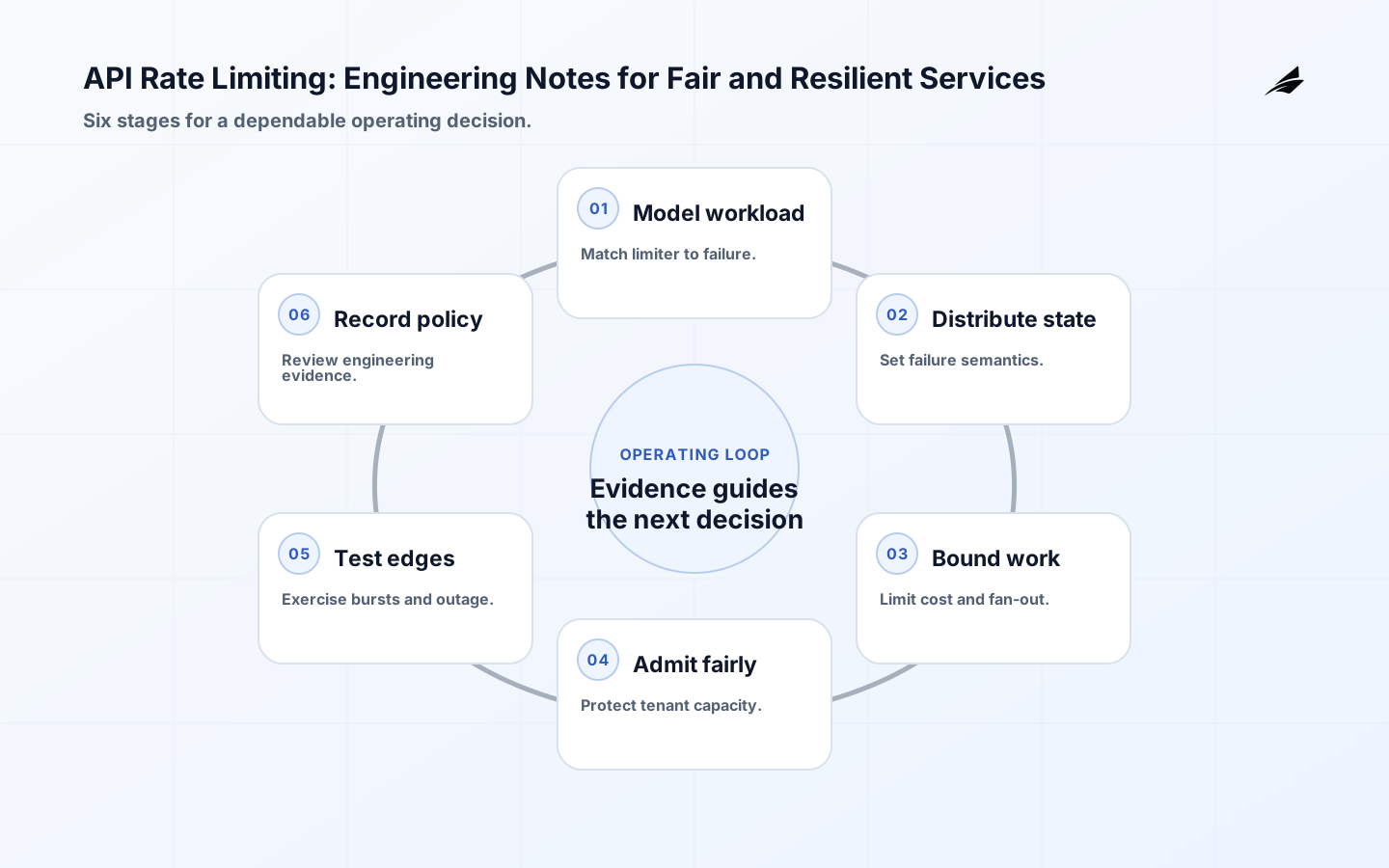
API rate limiting is a decision about API rate limiting, not a product setting to enable and forget. That matters for login and token endpoints, search, report generation, file conversion, bulk exports, webhook delivery, and partner integrations.
Start with an explicit limiter decision
Begin with the harm, not the tool. Make a short inventory of login and token endpoints, search, report generation, file conversion, bulk exports, webhook delivery, and partner integrations, then state the action, target, actor, and consequence of an incorrect result. This prevents policy language from becoming broad enough to mean anything.
Redis rate-limiting guidance defines HTTP 429 for too many requests; it does not choose the quota, identity key, or fairness policy for your service. In practical terms, document authenticated principal, tenant, route, request cost, concurrency, downstream dependency health, response status, and retry window.
| Decision area | Question to settle | Evidence to retain |
|---|---|---|
| Scope | Which API rate limiting decisions can materially harm the business? | Named actions, targets, and accountable owner |
| Trusted context | Which facts are evaluated: authenticated principal, tenant, route, request cost, concurrency, downstream dependency health, response status, and retry window? | Source, freshness expectation, and missing-data behavior |
| Exception | When may a normal rule be bypassed? | Approver, duration, reason, and expiry |
| Verification | How will the team know the rule behaved as intended? | Test result, decision record, and review date |
Define the resource to protect
The enforcement path must be as specific as the business decision. One global limit for unlike operations, limits keyed only to an easy-to-spoof address, and 429 responses with no usable recovery guidance are common because teams optimize for the ordinary path and assume that a directory, screen, storage setting, or proxy is the enforcement point. It rarely is.
Design for change as well as correctness. The Istio rate-limit task is a useful technical baseline, but the local implementation still needs a small, readable contract: input fields, default behavior, error handling, and the route for temporary exceptions.
Stress the limiter before enabling enforcement
For this subject, burst a cheap read route, exhaust a costly report route, spread requests across credentials, respect Retry-After, and confirm one noisy tenant cannot starve another. Record expected and actual outcomes.
- Test the normal allowed action with the minimum required context.
- Test removal or revocation and confirm old access cannot silently persist.
Instrument the limit and its failure modes
Track limited requests by principal and route, queue depth, saturation, latency, retry success, client errors, and limit-policy changes. Kong rate-limiting plugin provides useful framing for treating security as a managed capability rather than a one-time deployment.
| Signal | What it can reveal | Review response |
|---|---|---|
| Unexpected denial | Stale facts, incorrect policy, or hostile probing | Compare the request context with the current approved state |
| Exception volume | A design gap or a normal workflow that is not modeled | Review the exception owner, expiry, and redesign decision |
| Failed dependency | A route that may be falling back insecurely | Verify fail-closed behavior and repair the dependency contract |
| Evidence gap | An action cannot be reconstructed later | Add the missing field or correlation before expanding the workflow |
Release limits with owners and rollback
Measure normal and abusive-looking traffic first, deploy observability-only counters, then enforce route-specific limits with a tested backoff contract. GitHub REST API rate-limit documentation is a useful reminder that mature security includes governance and measurement, not merely technical configuration.
Takeaways
- Start API rate limiting with the sensitive decision and its likely harm.
- Exercise denial, recovery, revocation, and direct-call paths before broad rollout.
- Retain focused evidence that lets an accountable reviewer explain the result.
Frequently asked questions
Is API rate limiting only a security-team responsibility? No.
**How much detail is enough for a first release? Add breadth after this path has survived real operations. The related guides The Plain-language Guide to API Rate Limiting, Audit Logs Architecture: Evidence That Can Answer What Happened, Secure Admin Panels: A Practical Implementation Checklist provide useful adjacent reading when that first control touches identity, evidence, or a privileged interface.
Distributed limiting deserves explicit capacity math. Estimate the cost of a request, the burst a legitimate tenant can produce, the storage or coordination overhead of the limiter, and the capacity reserved for recovery. Then choose whether the budget is enforced per request, per concurrent operation, per byte, or by a weighted cost score. A shared store should expose latency and availability signals so the team can distinguish a rejected customer action from a limiter dependency failure. If the store is unreachable, the endpoint-specific policy should define a bounded response rather than inheriting a global fail-open default. Test clock skew, counter expiry, retry storms, and a rolling deployment with old and new policy versions active together. Capture the policy version and key class in the decision record without logging credentials or raw identifiers. This level of detail helps an engineer tune a fair limiter without accidentally shifting cost to a downstream database or creating a recovery bypass that no one can later remove.
A limiter should expose enough state to explain a denial without revealing its internal keys. Return a stable correlation reference, a truthful retry signal, and a response class that support can map to the protected budget. Internally, retain the policy version, cost class, tenant scope, and dependency result. Do not place raw credentials or user-controlled identifiers in logs. When a new route is added, require an explicit cost estimate and a negative test before it inherits a shared limit. This keeps the engineering model aligned with the service’s actual resource constraints.
Conclusion
For API rate limiting, distinguish a customer-facing quota from a protective circuit breaker. A fair published allowance can coexist with a stricter temporary guard when a downstream dependency is failing. Document the difference so support teams do not promise a quota that the platform cannot safely honor during an incident.
API rate limiting succeeds when it makes a consequential decision both harder to abuse and easier to explain.
For a second implementation perspective, the HAProxy configuration reference is useful when checking where counters, windows, and response behavior live at the serving boundary.
Choose a limiter model that matches the failure you need to prevent
A fixed window is easy to explain but can allow a burst at the boundary. A sliding window smooths that edge at more storage cost. A token bucket permits controlled bursts while preserving an average rate; a concurrency limit protects work that remains expensive until it completes. These are not interchangeable tuning knobs. Start with the resource that fails first and the user-visible harm of denial. If a report endpoint holds database connections, concurrency may matter more than requests per second. If a webhook sender can overwhelm a downstream API, a token bucket plus queue may be the better fit. Record the selected model, scope, refill or reset behavior, and reason in the design decision.

| Decision | Practical test | Evidence |
|---|---|---|
| Boundary | Name the protected resource and owner | Scope record |
| Failure | Rehearse denial, retry, and recovery | Observed result |
| Change | Version the policy and expiry | Review decision |
Make distributed state and failure semantics explicit
A limiter distributed across gateway nodes needs a decision about shared state, clock behavior, network partitions, and fail-open or fail-closed behavior. A local limiter can preserve availability during a store outage but may admit more traffic than intended; a centralized store can enforce a tighter budget but adds latency and a new dependency. Use monotonic time where the implementation allows it, bound counter expiry, and test retries after a node transition. For authenticated requests, derive keys from trusted identity and tenant context, not from a user-editable header. For public endpoints, combine coarse IP controls with endpoint-specific cost limits and abuse signals. The implementation is only correct when its failure mode is also designed.
Pair throttling with bounded work and idempotency
Rate limits cannot repair an unbounded query or a non-idempotent retry. Cap page size, upload size, batch count, execution time, and fan-out. Give state-changing commands an idempotency key and persist the result for the period in which a client may retry. Separate admission from execution: accept a request into a bounded queue only when the queue’s age and capacity are visible. Return a status the client can poll instead of holding a connection through expensive work. OWASP’s resource-consumption guidance explicitly includes payload size, page size, timeouts, and process limits; treat the limiter as one layer in that envelope.
Verify fairness with load shapes, not one throughput number
Test steady traffic, synchronized bursts, one noisy tenant, many small tenants, a slow downstream, a limiter-store failure, and a rolling deploy. Inspect p95 and p99 latency, rejected work, queue age, downstream errors, and the share of capacity each tenant receives. Confirm that health checks and operational recovery have a protected path without becoming an undocumented bypass. The final runbook should say who can change the policy, what evidence is required, and how to return to the previous version. Engineering notes become durable when another engineer can explain why a limit exists, reproduce its edge cases, and change it without guessing.
Key takeaways
- Define the boundary and the owner before choosing implementation details.
- Test denial, delay, duplication, and recovery as first-class paths.
- Measure the customer or operator outcome, not only the control signal.
- Keep exceptions narrow, time-bound, and easy to investigate.
- Review the policy when dependencies, traffic, or business rules change.
Frequently asked questions
Which limiter model fits expensive work? Use concurrency or queue controls when work remains costly after admission, and token or sliding windows when burst and average rate matter. What is a distributed limiter risk? Node clocks, shared-state outages, and fail-open behavior can change the effective budget. What should engineering retain? The chosen model, failure semantics, test shapes, and policy owner.
Conclusion
API Rate Limiting: Engineering Notes for Fair and Resilient Services becomes dependable when the rule is understandable, the failure path is rehearsed, and the evidence survives a busy day.
For adjacent decisions, compare Security headers engineering notes, Product teams and security headers, Production API rate limiting.