API rate limiting protects finite resources from accidental overload and deliberate abuse. It works best as one layer in a service design that also includes authentication, authorization, payload limits, timeouts, queueing, and capacity planning. A fixed number chosen because it sounds cautious can still block a legitimate integration or leave an expensive endpoint open to exhaustion.
Define the resource you are protecting
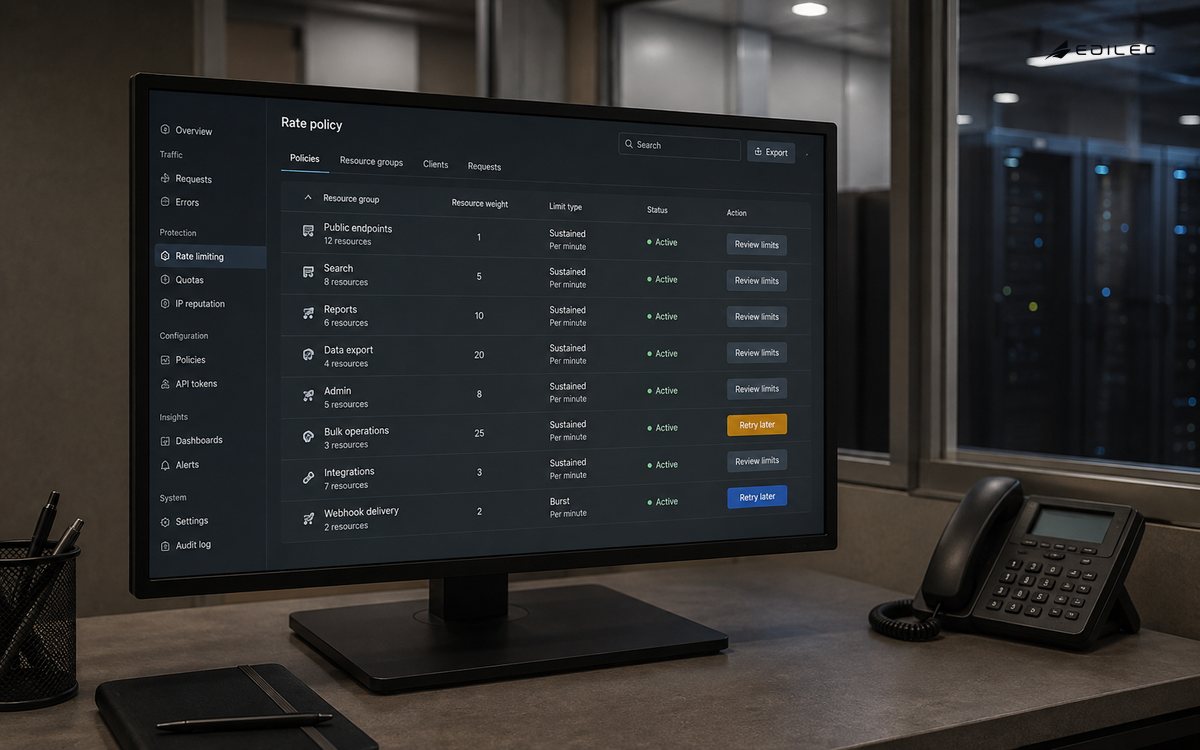
Begin by identifying what each request consumes. A search endpoint may consume CPU and index capacity; an export may consume database, storage, and worker time; a login endpoint may consume risk checks and notifications. The OWASP API Security Top 10 guidance warns that unbounded resource use can make an API unavailable. Weight expensive operations differently instead of assuming requests are equivalent.
Select the limiting key carefully. An API key, authenticated account, tenant, IP address, client application, route, or combination can be appropriate, but each has failure modes. IP-only limits can penalize users behind a shared network, while account-only limits may not slow unauthenticated abuse. Apply a layered policy: coarse edge protection, a per-principal control for fair use, and tighter route-specific limits around costly or security-sensitive actions.
| Design decision | Question to answer | Evidence |
|---|---|---|
| Request class | Useful key | Control |
| Unauthenticated sign-in | IP plus account identifier | Short window and abuse detection |
| Tenant API traffic | Tenant plus API credential | Fair-use quota with burst allowance |
| Expensive export | Account and route | Low concurrency and asynchronous job option |
Choose a key and limit model
Clients need a predictable contract. Return a clear status and retry information, and make idempotent retry behavior safe for write operations. Do not reveal internal capacity or make the response a side channel for user enumeration. The IETF HTTP semantics specification defines 429 as Too Many Requests; that response should tell a legitimate client what to do next while alerts tell operators that a pattern deserves investigation.
- Avoid: Applying one global counter to cheap reads and expensive exports.
- Test for: Keying only on IP address and punishing legitimate shared networks.
- Do not accept: Returning a generic error that encourages clients to retry immediately.
Make limits visible to clients
The practical standard for API capacity and abuse control is not a perfect diagram or a successful demonstration. Use focused tests for denial, stale state, unusual volume, and recovery.
| Operating signal | What it may reveal | First investigation |
|---|---|---|
| Signal | Likely cause | Response |
| 429 spike after release | Client retry loop or changed traffic | Inspect retry headers and client version |
| Worker saturation with few requests | Costly endpoint bypasses weighting | Add route-specific cost control |
| One tenant consumes capacity | Quota mismatch or abuse | Contact owner and apply scoped limit |
Tune limits with operational evidence
Review both protection and fairness. Plot accepted, limited, and failed requests by endpoint, tenant, and authentication state. Compare the intended limit with actual downstream saturation. A sudden rise in 429 responses may be a scraper, a client retry bug, a product launch, or an overly low quota. Test the limit layer under outage conditions too: a rate limiter that fails open or becomes a single point of failure changes the incident story.
Use a short review cadence for the parts of API capacity and abuse control that can cause material harm: privileged access, exception paths, high-value data, and emergency changes.
Translate fairness into client contracts
Rate-limit algorithms should be chosen for the traffic pattern, not for their names. A token bucket can accommodate a controlled burst while maintaining an average rate; a concurrency limit is more direct when a small number of expensive operations exhaust workers; a queue can smooth work only when the request can be made asynchronous. State the expected client behavior and downstream constraint before configuring the algorithm. Test distributed behavior too, because per-instance counters can multiply the effective allowance after a scale-out event.
Authentication also changes the fairness model. An anonymous traffic limit protects the edge but cannot distinguish customers. Once a request is authenticated, apply a durable tenant or credential quota that aligns with the product agreement and operational capacity. Keep a separate limit for account recovery and login attempts because those flows face credential stuffing and enumeration risks. Do not let a successful login grant unlimited access to expensive endpoints; authorization and consumption are separate decisions.
Limits need a client experience that avoids making an incident worse. Document quotas, headers, backoff expectations, pagination, and asynchronous alternatives for long-running operations. Ensure software development kits respect retry hints and do not synchronize retries across a fleet. For internal clients, test failure handling in staging with injected 429 responses. A client that treats every refusal as a reason to retry faster can turn a protective limit into a source of sustained load.
Capacity work and abuse work should meet in the same review. Compare rate-limit events with database pools, cache misses, queue depth, CPU, and business events such as a migration or campaign. This helps teams distinguish an attack from a legitimate surge and decide whether to expand capacity, adjust a quota, or block a pattern. Preserve enough request classification to investigate but avoid logging secrets or whole payloads. A rate limit is more trustworthy when its policy, operational evidence, and customer communication agree.
Rate-limit lessons worth carrying forward
- Tie API rate limiting decisions to a bounded action and a named owner.
API rate limiting FAQ
Is API rate limiting a one-time implementation? No.
What should be measured first for API rate limiting? Those signals reveal whether API rate limiting is supporting the intended workflow or simply moving risk to a less visible path.
How should a small team start with API rate limiting? That bounded work creates evidence for the next API rate limiting decision without claiming the entire estate can be redesigned at once.
API rate limiting should also be exercised against bypass attempts. Check whether a caller can evade a counter by changing request headers, cycling credentials, distributing traffic, using alternate hostnames, or shifting from an API endpoint to an equivalent bulk job. Make sure shared caches and proxies do not serve a successful response beyond the authorization or quota context that produced it. For paid or contracted integrations, establish a process for approved quota changes with an expiry and owner; ad hoc permanent increases make capacity planning impossible. Finally, make the protection observable to customer-facing teams so they can explain a legitimate limit and identify a client bug without exposing detection rules or sensitive operational thresholds.
For high-value endpoints, pair rate limits with an explicit product alternative. An asynchronous export, a paginated result, or a scheduled report may serve legitimate demand better than increasing a synchronous limit. The alternative also gives operations a controlled way to preserve service when a customer’s task is real but its immediate resource cost is not sustainable.
Conclusion
API rate limiting is dependable when it maps to real work, uses authoritative inputs, makes a defensible decision at the point of action, and leaves an evidence trail for review.
Implementation choices can be checked against the NGINX limit request module, Envoy rate limit filter, Google Cloud quotas, and Azure flexible throttling example. Together they illustrate different places to enforce a client-visible budget and the tradeoffs that follow.
Think of a rate limit as a queue with a fair turn
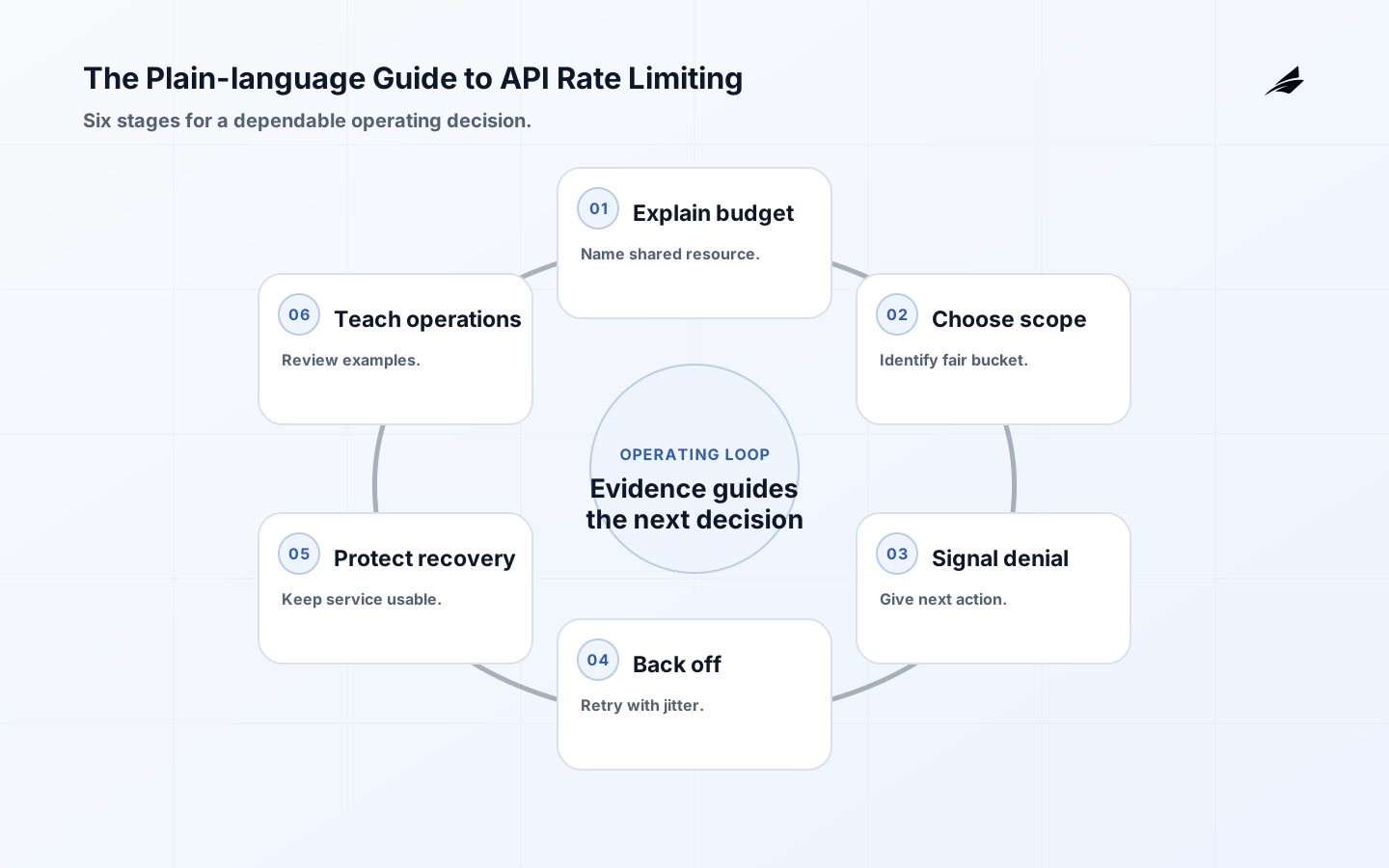
When an API says “too many requests,” it is protecting a shared resource: CPU, memory, a database connection, a vendor quota, or a business action. The number is meaningful only when you know who shares the bucket and what a request costs. Ten requests that read a cached profile are not equivalent to ten report exports. A service may therefore use different limits for different routes and different customers. The IETF definition of 429 Too Many Requests does not prescribe how a server identifies users or counts requests, so that explanation belongs in the API contract. Put the limit’s purpose into plain language: wait, reduce the batch, ask for a higher quota, or correct the client.
| Decision | Practical test | Evidence |
|---|---|---|
| Boundary | Name the protected resource and owner | Scope record |
| Failure | Rehearse denial, retry, and recovery | Observed result |
| Change | Version the policy and expiry | Review decision |
Explain the response a person or program can act on
A useful rejection includes the status, a stable error code, the scope that was exhausted, and a safe next step. Retry-After can tell a client when to try again, but a client should still apply exponential backoff and jitter because many clients may wake together. For an interactive screen, show that work is paused and preserve the user’s input. For a job queue, reschedule rather than failing every item at once. Distinguish a temporary budget exhaustion from a permission denial, invalid input, or a blocked business action. Clear categories reduce support tickets and help engineers find the real cause when an integration behaves badly.
Separate protection from punishment
A limit should protect service quality, not silently punish a customer for a legitimate change in usage. Combine per-tenant fairness with a global safety ceiling, and let customers see their budget or quota when that information is safe to expose. If a plan includes a higher allowance, model that as a policy decision with an owner and effective date rather than a hard-coded exception in a gateway. Watch for a shared NAT or proxy that makes many legitimate users appear as one IP. Conversely, do not trust an arbitrary client-supplied identity header. Authentication and authorization establish who may act; rate limiting decides how much shared capacity that identity may consume.
Teach recovery through examples
Show one example of an immediate retry that should not happen, one example of backoff, and one example of a queued operation. Explain whether a successful retry is idempotent and how the client supplies an idempotency key for a state-changing request. A support team should be able to ask: which route, which identity, which budget, what response, and when does it reset? That small vocabulary is more useful than promising that limits are invisible. Rehearse a dependency outage and a burst at the boundary of a time window. The customer experience is reliable when the service stays available for other callers and the affected caller gets a predictable way forward.
Key takeaways
- Define the boundary and the owner before choosing implementation details.
- Test denial, delay, duplication, and recovery as first-class paths.
- Measure the customer or operator outcome, not only the control signal.
- Keep exceptions narrow, time-bound, and easy to investigate.
- Review the policy when dependencies, traffic, or business rules change.
Frequently asked questions
What does a rate-limit rejection mean? A shared resource or business action has reached its allowed budget; it is not automatically an authorization failure. How can a caller recover? Preserve input, wait as instructed, back off, or move expensive work to a queue. Why expose the scope? The client can correct its behavior when it knows whether the exhausted budget belongs to a route, tenant, credential, or shared service.
Conclusion
The Plain-language Guide to API Rate Limiting becomes dependable when the rule is understandable, the failure path is rehearsed, and the evidence survives a busy day.
For adjacent decisions, compare API rate limiting engineering notes, Security headers engineering notes, Product teams and security headers.