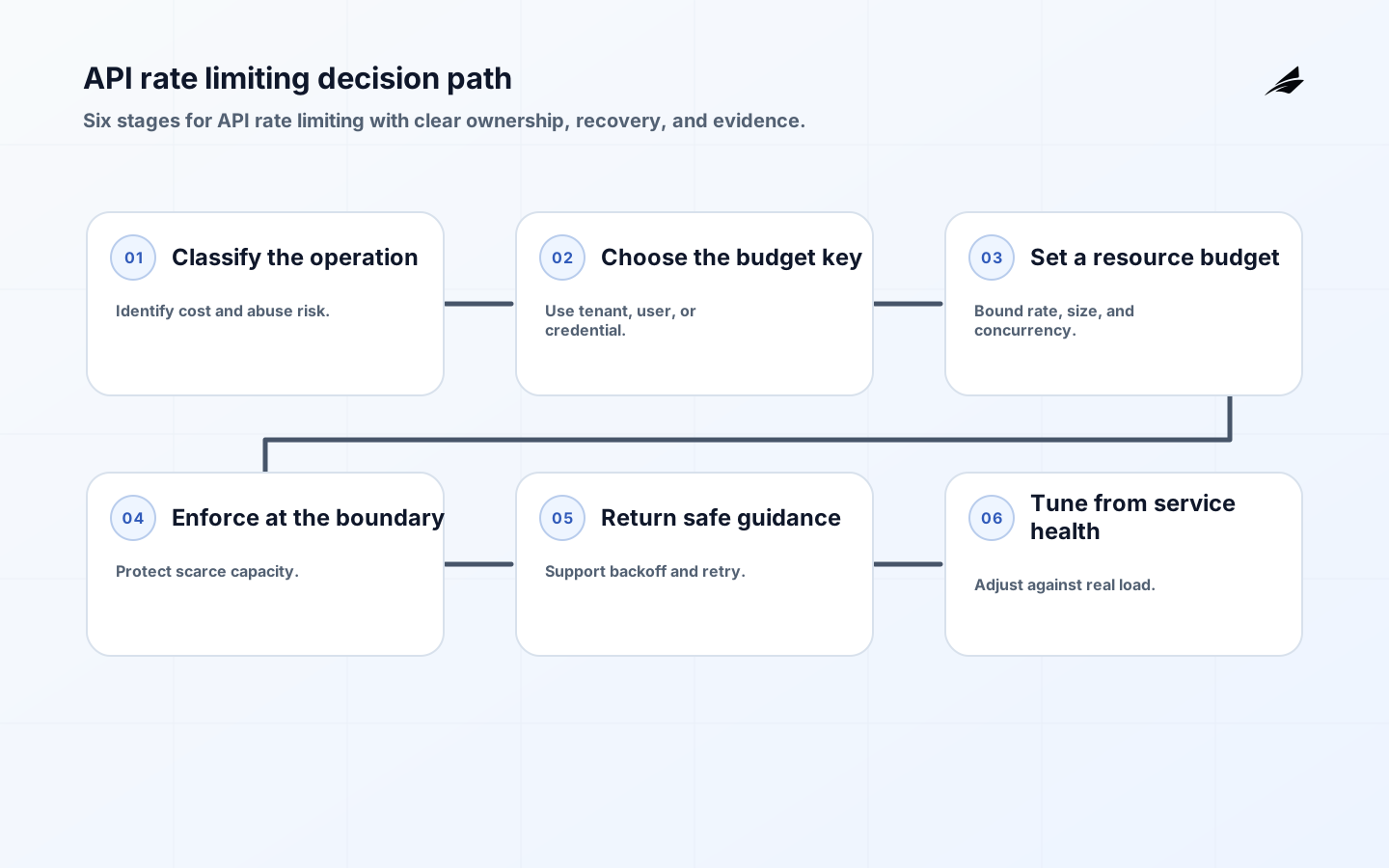
API rate limiting is a reliability and security control for work that consumes shared resources. An endpoint can be abused without being technically unauthorized: repeated password-reset requests, expensive search queries, large exports, login attempts, webhook retries, and transaction creation can exhaust capacity, inflate cost, or disrupt downstream services. Good limits are not a single requests-per-minute number attached to every route. They reflect the resource being consumed, the caller identity, the business flow, expected burst behavior, and the consequence of rejecting work. Pair rate limiting with authentication, authorization, input limits, queues, and capacity controls; it cannot correct every abuse path alone.
Find expensive and abusable work — API rate limiting
Inventory endpoints and asynchronous jobs that create cost, contention, or customer harm. Look beyond public APIs: internal administration endpoints, report generation, token issuance, webhook delivery, and message ingestion can be overloaded too. Estimate work using observed latency, database load, third-party calls, payload size, fan-out, and business effect. A simple read may be cheap until it accepts an unbounded filter; an export may be legitimate but must be paced; a login attempt is small but security-sensitive. Define a budget for each class of work, then decide whether a limit should apply per account, user, tenant, credential, IP address, device signal, or global service.
| Work type | Useful limiter key | Complementary control |
|---|---|---|
| Authenticated tenant API | Tenant and client identity. | Per-object authorization, pagination, payload and query limits. |
| Login or recovery | Account signal plus network and abuse context. | Credential protections, safe error messages, and recovery safeguards. |
| Expensive export | User, tenant, and concurrent job budget. | Asynchronous job, approval where needed, scope limit, and audit record. |
| Webhook or ingestion | Credential, sender, queue, and global capacity. | Signature validation, idempotency, backpressure, and dead-letter handling. |
Design limits around a real unit of work — API rate limiting
Choose algorithms and windows after defining the desired behavior. A token bucket can permit short legitimate bursts while constraining average rate. A fixed window is simple but can create boundary spikes. Concurrency limits protect scarce workers and downstream calls even when request rate is modest. Cost-weighted budgets can make a heavy query consume more than a lightweight lookup. Document the decision so an operator can explain why one customer is constrained and another is not. Be cautious with IP-only keys: shared networks and proxies make them weak identity signals, while ignoring them entirely can leave public endpoints exposed.

- Limit authenticated, anonymous, and privileged paths separately because their identities and risks differ.
- Cap request size, pagination, query complexity, and concurrent jobs in addition to request count.
- Place enforcement near the scarce resource and keep distributed state behavior consistent across instances.
- Return clear, documented retry information without exposing sensitive capacity details.
- Provide an approved, observable path for legitimate high-volume integrations rather than encouraging retries and workarounds.
Make rejection safe and useful — API rate limiting
A rejected request should not create a secondary incident. Return the appropriate response, include a retry signal when it is safe to do so, and ensure clients back off rather than synchronize retries. For asynchronous work, queue or defer within a bounded budget when that preserves correctness; do not silently drop a material business event. Make idempotency explicit for create operations so a client retry does not duplicate a payment, order, or notification. Operations teams need dashboards that distinguish normal throttling, client bugs, abusive patterns, limit misconfiguration, and downstream failure. A rising limit count is a prompt to investigate context, not automatic proof of attack.
Test under realistic pressure — API rate limiting
Test a legitimate burst, a sustained client loop, a distributed attempt across identities, oversized inputs, concurrent exports, downstream slowness, and a limiter-store failure. Verify that limits are keyed as intended, that an attacker cannot obtain a fresh budget by changing a trivial identifier, and that one tenant cannot starve another. Confirm metrics, logs, and alerts carry route, identity class, decision, limit policy, and correlation context without exposing secrets. Exercise client behavior too: a perfect server response is not useful if the official SDK retries immediately forever.
| Observed pattern | Possible cause | Engineering response |
|---|---|---|
| Many 429 responses after a release | A new client loop or incorrectly low policy. | Inspect route and client version; adjust or fix with a controlled change. |
| Queue depth grows despite low request rate | Work per request or downstream latency increased. | Use concurrency and cost budgets; investigate the dependency. |
| One tenant dominates capacity | Limits are keyed too broadly or lack tenant fairness. | Introduce tenant budgets and protect shared pools. |
| Retries multiply failures | Clients ignore backoff or operations are non-idempotent. | Document retry behavior and add idempotency controls. |
Tune with production evidence — API rate limiting
Begin conservatively, publish limits for intended integrations, and revise them using observed workload rather than a static industry number. Review high-cost routes after product changes, new clients, pricing changes, or incidents. Capacity planning should include rate-limit behavior: an increased threshold may be reasonable only if the downstream system can absorb the resulting concurrency. Connect the limit owner to the service owner so exceptions are deliberate. Security monitoring for software helps turn those signals into operational action.
Run a practical operating exercise — API rate limiting
These API rate limiting engineering notes are most useful when tested with a realistic client and dependency profile. Build a controlled load test that mixes ordinary reads, authenticated bursts, expensive searches, retries after timeouts, a concurrent export, and a downstream service that becomes slow. Observe not only how many requests are rejected, but which tenant or credential spends the budget, whether jobs queue fairly, whether clients respect backoff, and whether a retry can duplicate a business action. Then run the same test through an internal service path to find bypasses that an edge gateway cannot see. Record the policy version and the capacity assumption behind it. This gives the team a reasoned threshold and a safe tuning process instead of a number copied from another API with different traffic and cost.
Add a short review session whenever a high-volume integration that begins retrying after latency changes the assumptions behind API rate limiting. Bring service owners, client developers, and database operators together and start with the actual request rather than a control label. Trace the request from the authoritative record through identity, configuration, policy, implementation, and the evidence an investigator would use in the API rate limiting context. Ask whether shared capacity is protected without silently losing valid work. Then introduce one realistic failure: a delayed directory update, unavailable dependency, stale configuration, unexpected retry, or departure of the person who normally knows the workaround for this API rate limiting context. The group should choose a safe response before the next urgent event forces improvisation within API rate limiting context. Capture only concrete outcomes: a missing owner, an unclear approval limit, a test that does not reach the enforcement point, a recovery step that is too broad, or an evidence record that cannot be retrieved during API rate limiting context. Assign each outcome to a person and date, and rerun the same scenario after the change lands across API rate limiting context. This practice keeps API rate limiting connected to daily operations. It also reveals when a process appears complete because a document exists, while the service itself still depends on unwritten knowledge or standing privilege after API rate limiting context. Over time, retain a small decision history so new team members can understand why the boundary exists and which assumptions must be revisited as the product, vendors, and workforce change in the API rate limiting context.
Key takeaways
- API rate limiting starts with the resource and business flow being protected, not a universal number.
- Use meaningful identities and combine rate, concurrency, size, and complexity limits.
- Design rejections, retries, queues, and idempotency so limits do not create a new failure mode.
- Enforce where capacity is scarce and test internal as well as edge entry paths.
- Tune policies from observed load, client behavior, and downstream capacity.
Frequently asked questions
Conclusion
API rate limiting is most effective when it models real work and protects the resource that matters. Choose sound identity keys, constrain several dimensions of consumption, make rejections recoverable, and learn from production behavior. That gives customers predictable service while making abusive or accidental load much harder to turn into an outage.
Budget the scarce operation — API rate limiting
For API rate limiting, start with the operation that consumes capacity rather than with a convenient endpoint count. A search query, bulk export, password reset, and write may need different budgets even when they share a route.
Return a response a client can act on — API rate limiting
When a limit is reached, the response should identify the boundary, provide a safe retry signal where appropriate, and avoid leaking whether a sensitive record exists. Idempotency keys and bounded queues keep retries from multiplying the original work.
Tune limits against service health — API rate limiting
Review accepted work, rejected work, queue age, downstream saturation, and customer-visible latency together. Adjust tenant, credential, and shared-service budgets only after testing burst behavior and confirming that the change will not move pressure to an unprotected dependency.
Questions for the API rate limiting review — API rate limiting
Which workload deserves the first budget? — API rate limiting
Retain the inputs, decision, owner, outcome, and recovery record that matter for API rate limiting. Make the record useful to the next operator, not just to the person who designed the control in the API rate limiting context.
How should rejection affect clients? — API rate limiting
Choose one outcome measure for API rate limiting and pair it with failure, exception, and recovery measures. Review segments that expose a blocked role, dependency, or workload.
When should a limit be retuned? — API rate limiting
For rate limiting, change the policy when saturation, abuse, or client behavior shifts; record the capacity tradeoff and replay representative traffic.
Conclusion: operate API rate limiting with evidence
Reliable API rate limiting is a maintained operating practice. Keep the boundary explicit, make the difficult path recoverable, and give every material exception an owner and a review date in the API rate limiting context.
For adjacent Edilec guidance on API rate limiting, compare API rate limiting engineering notes, the zero-trust operations checklist, and the production secrets-rotation guide. This comparison is selected for API Rate Limiting: Engineering Notes for Reliable Services.
Source context: OWASP API Security Top 10: Unrestricted Resource Consumption; OWASP API Security Top 10: Unrestricted Access to Sensitive Business Flows; NIST SP 800-204A: Building Secure Microservices-based Applications; NIST Secure Software Development Framework (SSDF); Additional HTTP Status Codes.