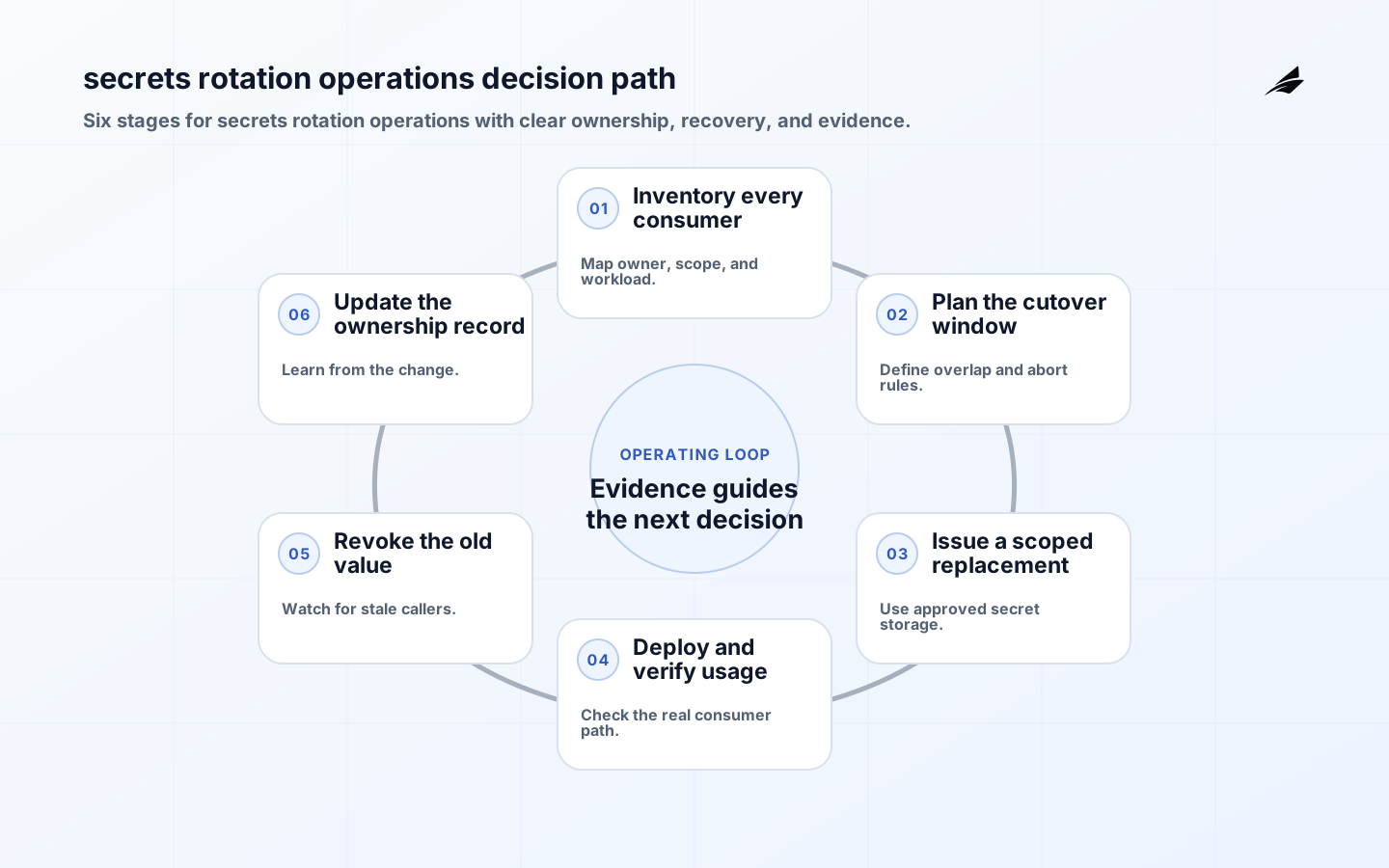
Secrets rotation is a production capability with consequences for people, software, and recovery. Secrets rotation work should begin with the decision that must remain true when a request, change, or failure reaches the sensitive boundary. Secrets rotation is not improved by a larger checklist alone; it improves when ownership, enforcement, evidence, and repair are explicit. Secrets rotation decisions below draw on OWASP Secrets Management Cheat Sheet and NIST Recommendation for Key Management. Secrets rotation designs benefit from that source-backed framing because it makes a later investigation possible without relying on the memory of the person who made the original configuration.
Set the secrets rotation operating decision — secrets rotation operations
Secrets rotation begins with the risk the system must control, not a product setting. Inventory API keys, database passwords, signing keys, service tokens, webhook secrets, and recovery codes. Classify each by blast radius and rotation method. Some support two active values while others require coordinated issuer and consumer changes. Secrets rotation reduces risk only when every consumer can move from old material to new material without a blind interval or a permanent exception. Credentials copied into code, CI variables, or shared across services make a simple expiry policy an outage risk. Write the expected outcome, accountable owner, approved exception route, and stop condition before rollout in the secrets rotation operations context. That record makes a technical choice reviewable and gives responders a basis for deciding whether observed behavior is intended or harmful for this secrets rotation operations context.
Map secrets rotation boundaries and dependencies — secrets rotation operations
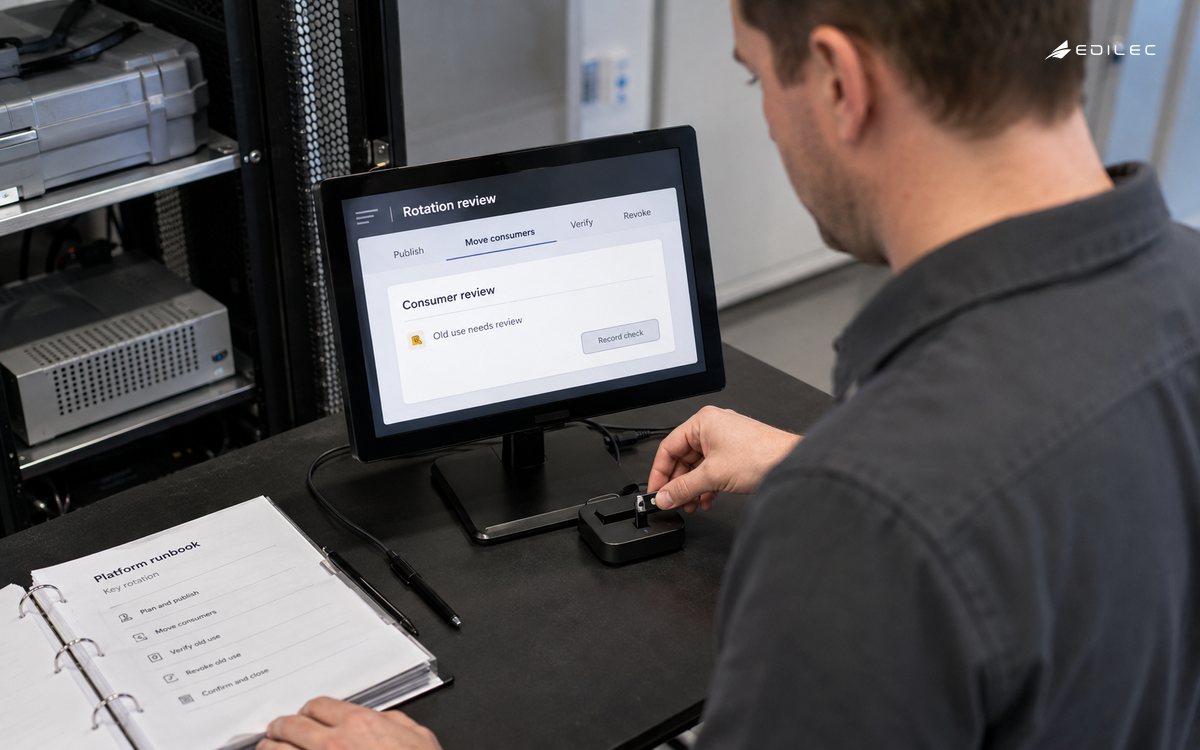
Separate the issuer or store from applications that consume a secret. Give each workload its own credential where practical, and locate all copies in deployment manifests, local tooling, backup configurations, and vendor consoles. The validation service is the boundary where overlap and revocation become enforceable. A useful boundary is specific enough that a reviewer can identify the actor, protected resource or connection, enforcing component, and behavior when a dependency is slow or unavailable in the secrets rotation operations context. State the irreversible moment too: an action may be technically reversible yet operationally irreversible once a customer, vendor, or downstream system has received the effect for this secrets rotation operations context.
| Design element | Question to answer | Evidence to retain |
|---|---|---|
| Secret record | What credential and blast radius? | Owner, issuer, and classification |
| Consumers | Which workloads use it? | Dependency inventory |
| Cutover | How do both versions coexist? | Migration and validation plan |
| Retirement | When is old material invalid? | Revocation and confirmation |
Use proportionate secrets rotation controls — secrets rotation operations
Deliver secrets into controlled runtime memory or mounts, never logs or source control. Use short-lived credentials where available; otherwise use two-version rotation: publish, migrate consumers, validate, then revoke. Keep overlap short and visible, and test the same dependency pattern before production. Match each safeguard to a credible failure mode. Preventive checks constrain known bad states; runtime signals detect conditions that escaped them; recovery procedures return the system to a safe state in the secrets rotation operations context. Keeping those functions separate prevents a team from declaring success merely because a request or deployment completed without an immediate error for this secrets rotation operations context.
OWASP Authentication Cheat Sheet is useful for making enforcement and verification concrete. The nearby guides on Secrets Rotation: Explained from First Principles, Encryption at Rest: Hands-on Planning Guide, Least Privilege: Security Review cover adjacent choices that commonly affect this design. Do not convert an emergency accommodation into a permanent privilege or configuration simply because it was needed once in the secrets rotation operations context. Give it a reason, owner, expiration, and a record visible to the people responsible for risk for this secrets rotation operations context.
Operate secrets rotation with evidence — secrets rotation operations
Measure inventory coverage, age beyond policy, migration progress, failed authentication after rotation, emergency static credentials, and revocation completion. A dashboard should show which consumers still use an old version, not merely that a new credential exists. Decide before implementation which movement triggers investigation, pause, or rollback. Link dashboards, change records, and runbooks with stable identities or revisions so an operator can trace cause, effect, and decision across boundaries in the secrets rotation operations context. Evidence close to the work also makes handoffs and audit practical without turning every engineer into a historian for this secrets rotation operations context.
| Signal | What it can reveal | Review action |
|---|---|---|
| Secret age | Policy drift or forgotten inventory | Alert owner before deadline |
| Old-version use | Consumers not migrated | Track by workload |
| Auth failures | Broken cutover or hostile use | Correlate with window |
| Static exceptions | Temporary material becomes permanent | Review expiry and rationale |
Roll out secrets rotation in six controlled stages — secrets rotation operations
- Name the owner, protected boundary, and unacceptable outcome for secrets rotation.
- Capture a baseline for secret age before changing enforcement.
- Implement the smallest scope that can provide real production evidence.
- Exercise one normal path and one harmful failure path with the operating team in the secrets rotation operations context.
- Review customer impact, support load, and recovery evidence before widening exposure.
- Convert observed gaps into a policy, test, alert, or runbook improvement.
Implementation details for secrets rotation — secrets rotation operations
Implementation requires a concrete test of the production path, not an assertion that a configuration exists in the secrets rotation operations context. Dual-secret rotation depends on a clear overlap contract. Confirm whether consumers can prefer the new value then try the old, whether the issuer exposes a key identifier, and how revocation propagates. Controlled overlap avoids a plan that demands every production deployment occur at the same minute. Keep the test result with the change record so that later maintainers can see the conditions under which the control was verified for this secrets rotation operations context.
Operating discipline keeps a sound design from drifting after the initial rollout in the secrets rotation operations context. Secret scanning and access review complement rotation. Scanning finds material that escaped to repositories or build logs, while access review finds people or workloads that can retrieve more than needed. Neither replaces rotation after a disclosure, but both reduce unknown audiences for the next credential. Assign the review cadence to the people who understand the affected work, and use actual events and access patterns to refine the model rather than adding blanket privilege or silent exceptions for this secrets rotation operations context.
Recovery planning is part of the security design. For exposed material, locate the issuer and consumers, revoke or disable the secret, deploy replacements, investigate use during the exposure window, and document cause. The response must be fast without breaking unrelated systems. A practical exercise should confirm both that the harmful state can be stopped and that legitimate work can resume with a recorded decision trail in the secrets rotation operations context.
Before expanding secrets rotation, review the design with the owner of secret record and the operator who will respond when retirement fails. Ask them to demonstrate the evidence described in the table, including the current decision, the last approved change, and the recovery authority in the secrets rotation operations context. This review has a practical purpose: it exposes whether permissions, policies, certificates, secrets, events, or workflows are only described in documentation or are actually usable under production conditions for this secrets rotation operations context. Record the gaps as owned work, then repeat the exercise after the change rather than treating the first walkthrough as final proof within secrets rotation operations context.
Set a review date and a measurable completion condition for this secrets rotation change. Evidence should show that the intended boundary is enforced, the exception route is controlled, and the responsible team can recover from the most likely failure without creating a wider security exposure in the secrets rotation operations context.
Secrets rotation takeaways
- Secrets rotation works when the boundary and owner are explicit.
- Use controls because they interrupt a specific credible harm.
- Keep exceptions narrow, expiring, and reviewable.
- Measure the customer or system outcome as well as control health.
- Practice recovery, preserve evidence, and revise the operating record.
Checklist questions for secrets rotation
What is the first implementation step? Start by identifying the credential and its blast radius; retain the owner, issuer, and classification. A narrow owned boundary produces better evidence than an organization-wide conversion with unclear enforcement in the secrets rotation operations context. How should an exception be handled? Treat it as a temporary decision with a named approver, limited scope, expiry, and audit record for this secrets rotation operations context. It must be easier to review than an informal bypass and must not silently become the default path within secrets rotation operations context. What proves the design is working? Look for the operating signals above, a successful adverse-path exercise, and evidence that the relevant owner can explain which workloads use it without undocumented behavior. NIST Zero Trust Architecture provides a useful verification reference for that final test.
Conclusion: make secrets rotation an operating capability
The durable version of secrets rotation is neither a one-time configuration nor a document completed in isolation. It is an owned decision with a defined boundary, proportionate controls, observable outcomes, and a practiced way to recover in the secrets rotation operations context. Begin with one high-value path, retain the evidence it produces, and expand only after the people responsible can explain and operate the result confidently for this secrets rotation operations context.
Inventory consumers before the cutover — secrets rotation operations
An operational secrets-rotation checklist starts with consumers, not with the secret store. List every workload, deployment path, owner, privilege, expiry expectation, and emergency contact before scheduling a change.
Coordinate overlap with verification — secrets rotation operations
Use a bounded overlap window when consumers cannot switch atomically. Verify the replacement through the real application path, monitor old-version use, and define the abort condition before revoking anything.
Close the loop after revocation — secrets rotation operations
After revocation, inspect failed calls, stale configuration, and support tickets. Update the inventory with the observed consumer set and the reason for any exception; otherwise the next rotation will repeat the same uncertainty.
Questions for the secrets rotation review — secrets rotation operations
Which consumers must be inventoried? — secrets rotation operations
Retain the inputs, decision, owner, outcome, and recovery record that matter for secrets rotation. Make the record useful to the next operator, not just to the person who designed the control in the secrets rotation operations context.
How should a cutover be verified? — secrets rotation operations
Choose one outcome measure for secrets rotation and pair it with failure, exception, and recovery measures. Review segments that expose a blocked role, dependency, or workload.
When should rotation automation change? — secrets rotation operations
For rotation, change the method when inventory or cutover evidence exposes an unowned consumer; record the exception and verify the next replacement.
Conclusion: operate secrets rotation with evidence
Reliable secrets rotation is a maintained operating practice. Keep the boundary explicit, make the difficult path recoverable, and give every material exception an owner and a review date in the secrets rotation operations context.
For adjacent Edilec guidance on secrets rotation operations, compare API rate limiting engineering notes, the zero-trust operations checklist, and the production secrets-rotation guide. This comparison is selected for Secrets Rotation Checklist for Reliable Digital Operations.
Source context: OWASP Secrets Management Cheat Sheet; NIST Recommendation for Key Management; OWASP Authentication Cheat Sheet; NIST Zero Trust Architecture; AWS Secrets Manager Rotation.