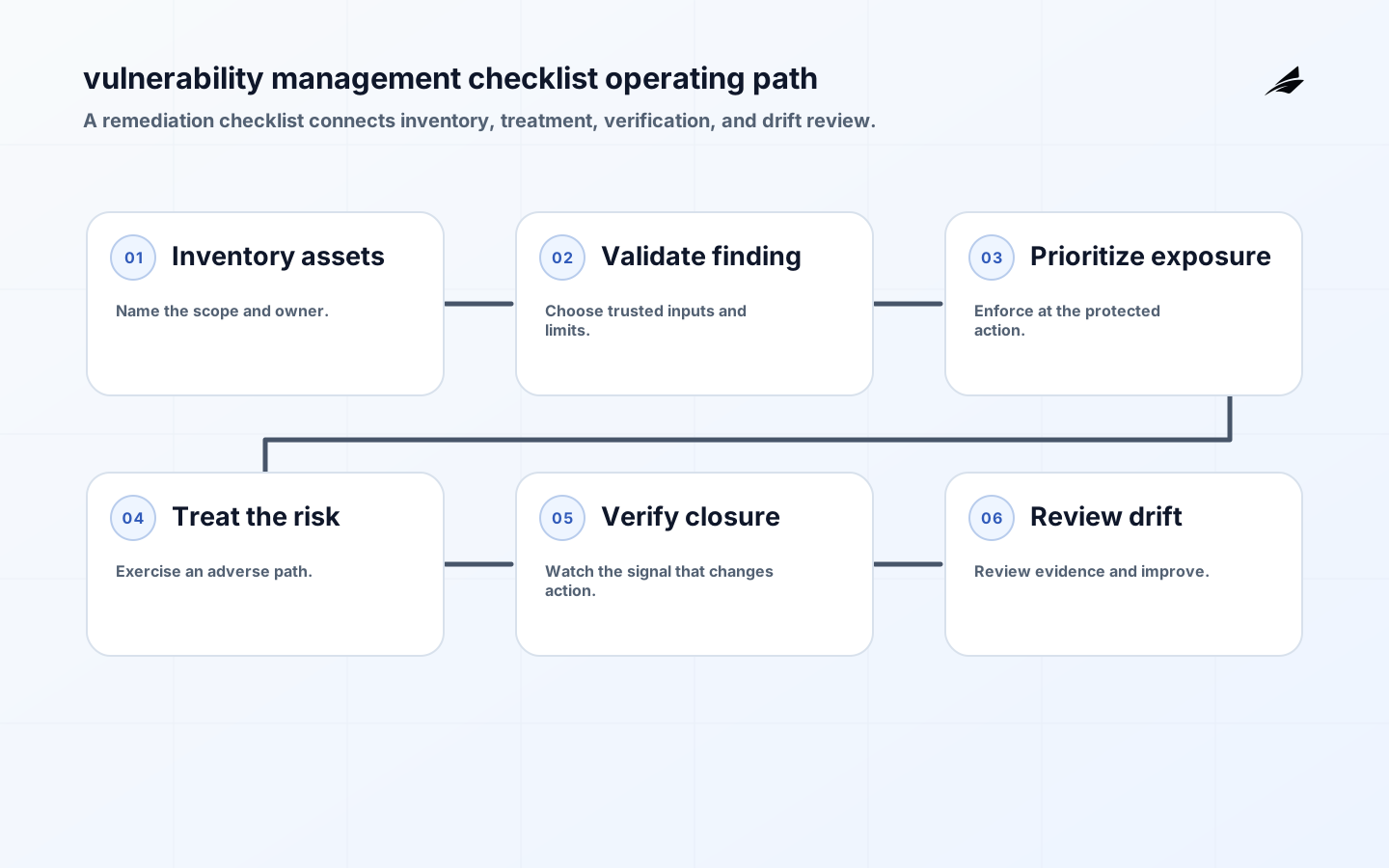
Vulnerability management practice: Vulnerability Management Checklist for Reliable Digital Operations is a practical guide for IT managers. Vulnerability management is credible only when a team can name the protected action, the accountable owner, the decision inputs, and the evidence left behind. Start with one high-value workflow, from asset inventory to remediation ticket, instead of trying to secure every system at once. Vulnerability management is the discipline of turning findings into verified risk decisions. A severity label is only one input. Exposure, exploitability, asset criticality, compensating controls, and owner capacity determine urgency. CISA performance goals make asset inventory, patch management, and recovery capability practical starting points for teams that need a defensible baseline. NIST SP 800-207 provides useful architectural language for putting policy decisions near protected resources.
Define the vulnerability management boundary — vulnerability-management checklist
Vulnerability management practice: Create a small request map before choosing products. For every finding record, list the initiator, target, action, sensitivity, dependency, owner, and expected lifetime. Include support access, background jobs, administrators, and emergency procedures. A boundary is testable when it says what is permitted, what is denied, what requires review, and what should happen if the authoritative asset inventory is unavailable or stale. That record gives implementation and incident response the same vocabulary.

| Decision | Question | Evidence |
|---|---|---|
| Scope | Which finding record is protected first? | Named workflow and owner |
| Authority | Who can change remediation ticket? | Reviewed change record |
| Failure | How is a failed asset inventory handled? | Tested fallback and escalation |
| Review | When is risk acceptance review revisited? | Scheduled review result |
Put remediation authority beside the real change — vulnerability-management checklist
Vulnerability management practice: Controls fail when they exist only in a user interface while another route reaches the same action. Enforce remediation ticket at the service, gateway, workflow engine, or other point that actually permits the outcome. Keep authoritative identity and configuration sources distinct from cached convenience data. Record a decision identifier, actor, target, policy version, outcome, and reason without logging secrets In the vulnerability-management checklist workflow, the owner records that result. That is enough to investigate a surprising result without turning logs into a second sensitive database In the vulnerability-management checklist workflow, the owner records that result.
- Inventory every finding record and the systems that create, alter, or consume it.
- Document which asset inventory is authoritative and how freshness is assessed.
- Apply remediation ticket before the protected operation, not after it appears in a screen.
- Give emergency access a separate identity, short expiry, named approver, and review record In the vulnerability-management checklist workflow, the owner records that result.
- Exercise an allowed request, a denied request, and a failed dependency.
- Remove or renew exceptions before they become unexamined permanent access.
Turn findings into closure evidence — vulnerability-management checklist
Vulnerability management practice: Pilot one cohort and keep a rollback boundary. Measure ordinary activity, denied outcomes, exception volume, support contacts, and time to complete work before changing policy In the vulnerability-management checklist workflow, the owner records that result. Release one control adjustment, compare the result, and retain the decision record In the vulnerability-management checklist workflow, the owner records that result. This is less dramatic than a whole-program migration, but it separates security defects from usability problems and release defects In the vulnerability-management checklist workflow, the owner records that result. Put remediation ticket configuration under reviewed change management; production behavior should be traceable to an approver and a verification result.
| Stage | Deliverable | Exit condition |
|---|---|---|
| Model | Request and dependency map | Owners agree on scope |
| Configure | Reviewed remediation ticket rule | Representative tests pass |
| Pilot | Bounded cohort and support path | Rollback owner is available |
| Operate | Signals and exception queue | Observed behavior matches intent |
Exercise stale and hostile inputs — vulnerability-management checklist
Vulnerability management practice: Test more than a successful request. Include stale input, a changed privilege, an unexpected principal, a cross-tenant or cross-environment target, replayed input where relevant, and an unavailable dependency In the vulnerability-management checklist workflow, the owner records that result. Confirm that alerts are actionable and that troubleshooting does not disclose credentials or unnecessary personal data In the vulnerability-management checklist workflow, the owner records that result. OWASP ASVS is a useful verification catalog, but the most persuasive test is one that exercises the exact vulnerability-management path users and integrations take in production.
Use signals that set repair priority — vulnerability-management checklist
Vulnerability management practice: Choose a few signals with owners: denied outcomes by reason, time-limited exceptions, policy changes, configuration drift, alert quality, and unresolved review items. A spike prompts investigation; it does not prove misuse. Pair each signal with a threshold or cadence and a stated next action In the vulnerability-management checklist workflow, the owner records that result. The CISA Cybersecurity Performance Goals can help prioritize foundational operational practices while the vulnerability-management team develops more context-specific measures.
Make remediation burden reviewable — vulnerability-management checklist
Vulnerability management practice: Vulnerability management can add friction, latency, recovery work, and administrative overhead. When those costs are hidden, people route around controls during urgent work In the vulnerability-management checklist workflow, the owner records that result. Document the burden, offer a supported exception path, and revisit rules after changes in people, software, suppliers, or data In the vulnerability-management checklist workflow, the owner records that result. The aim is not maximum denials. It is a clear allowed path that is easier to use and audit than the workaround, with a recovery path that does not depend on a single unavailable administrator In the vulnerability-management checklist workflow, the owner records that result.
Vulnerability Management Checklist: make the decision record useful — vulnerability-management checklist
A concrete decision example — vulnerability-management checklist
For vulnerability management, make one remediation case reviewable: name the asset, exploitable condition, trusted severity signal, failure state, owner, and evidence that proves risk was reduced. Keep the case small enough to verify in tooling and specific enough to guide support when remediation stalls In the vulnerability-management checklist workflow, the owner records that result.
NIST SP 800-40 Rev. 4 treats patching as preventive maintenance: inventory, prioritization, deployment, and verification belong to one program. A scanner result without an asset owner is an observation, not a remediation plan.
Move every finding through validated, prioritized, assigned, treated, verified, and closed states. Exceptions need an approver, compensating control, expiry, and residual-risk statement. Verify both the intended asset state and the exposed condition; a successful deployment alone is not proof.
| Decision point | Minimum record | Proof |
|---|---|---|
| Scope | Protected action and owner | Named boundary |
| Failure | Safe fallback and escalation | Adverse-path test |
| Change | Review trigger and expiry | Versioned evidence |
| Outcome | Signal and next action | Owner review |
For operations, prioritization should also consider changeability. A fix that can be deployed safely today may reduce more risk than a theoretically higher-scored issue that requires a long redesign, provided the treatment is recorded and does not conceal the original exposure. Use maintenance windows, canary groups, backups, and rollback criteria where they reduce deployment risk. If a workaround blocks the vulnerable path, prove that it blocks the path customers and attackers actually use. When a finding is closed, retain the asset identifier, old and new state, validation date, and reviewer. That record makes trend analysis possible: teams can see whether risk is declining or whether the same package, image, or configuration keeps returning.
Key takeaways
- Vulnerability management should protect a named resource or action, not an abstract compliance goal.
- Enforce remediation ticket where the protected outcome occurs.
- Keep exceptions short-lived, owned, and reviewable.
- Pilot with observable signals and a tested rollback path.
- Revisit risk acceptance review after material changes or incidents.
Frequently asked questions
For implementation context, use the CVSS v4.0 specification, GitHub’s Dependabot security update guidance, its code scanning introduction, and NIST configuration management guidance. Apply them to prioritization, remediation evidence, closure verification, and drift review.
Vulnerability management practice: Does vulnerability management require a new platform? Often no. Begin with the identities, systems, policy points, and audit events already present, then correct unclear ownership and unsafe defaults In the vulnerability-management checklist workflow, the owner records that result. A new product may be useful after the first workflow is understood In the vulnerability-management checklist workflow, the owner records that result. How often should it be reviewed? Review after material changes to code, identity, suppliers, data, or incident findings, plus a regular cadence proportionate to the consequence of failure In the vulnerability-management checklist workflow, the owner records that result.
Vulnerability management practice: What proves that the control works? A combination of representative tests, production telemetry, sampled decision records, and evidence that a trained operator can handle a denied request or dependency outage In the vulnerability-management checklist workflow, the owner records that result. A static policy document does not prove enforcement. Can a small team start? Yes: choose one consequential workflow, identify its owner, and make the allowed, denied, and emergency paths explicit before expanding coverage In the vulnerability-management checklist workflow, the owner records that result.
Field review for vulnerability management — vulnerability-management checklist
For vulnerability management, normalize scanner output into one finding record tied to an asset, software version, exposure, owner, due date, and disposition. A compensating control or accepted risk needs an expiry and a reviewer; it is not a permanent way to close inconvenient work. Verify remediation using the same evidence that established the finding where feasible, then watch for reintroduction through images, templates, dependencies, or configuration drift. Coverage metrics should reveal unknown assets and overdue decisions, not merely closed tickets.
- Assign one accountable owner for the vulnerability management decision and a reachable backup.
- Keep a dated record of the current vulnerability management rule, its exception path, and its next review.
- Sample real vulnerability management outcomes each month; compare the evidence with the stated policy.
- Treat failed checks as operational work with a due date, not as an alert that can be ignored In the vulnerability-management checklist workflow, the owner records that result.
- Use production changes, new integrations, and incident findings to trigger a focused vulnerability management reassessment.
- Make the supported path fast enough that users do not need undocumented bypasses to finish legitimate work In the vulnerability-management checklist workflow, the owner records that result.
Evidence review for vulnerability management — vulnerability-management checklist
Evidence review for vulnerability management should be brief enough to happen and concrete enough to challenge assumptions. Bring one recent allowed case, one denied or failed case, one exception, and the current configuration or decision record In the vulnerability-management checklist workflow, the owner records that result. Ask whether the right owner approved the outcome, whether the signals were fresh, and whether a responder could explain the result without relying on memory In the vulnerability-management checklist workflow, the owner records that result. Compare the desired control with the path actually taken through services, queues, browsers, and support tools In the vulnerability-management checklist workflow, the owner records that result. When the evidence is incomplete, record a bounded follow-up with a due date rather than declaring the control adequate In the vulnerability-management checklist workflow, the owner records that result. This habit turns vulnerability management from a document into an operational practice.
A useful review also tests the human side of vulnerability management. Confirm that the primary operator knows when to escalate, that the backup can locate the necessary record, and that an urgent business request has a documented route instead of a private message to an administrator In the vulnerability-management checklist workflow, the owner records that result. Look for controls that create repetitive manual work, because repetition is where unsafe exceptions become normalized In the vulnerability-management checklist workflow, the owner records that result. Preserve only the telemetry needed to diagnose decisions, protect it with appropriate access, and periodically test whether it remains available during an outage In the vulnerability-management checklist workflow, the owner records that result. The review is successful when the next change is smaller, clearer, and supported by evidence specific to vulnerability management.
Conclusion
Vulnerability management practice: Reliable vulnerability management is a maintained capability, not a one-time configuration. Map the path, place controls at the protected action, test information that is missing or misleading, and keep evidence useful for the next reviewer In the vulnerability-management checklist workflow, the owner records that result. Continue with Vulnerability Management: Buyer and CTO Guide, Vulnerability Management: From Findings to Verified Remediation, and What Changes When Vulnerability Management Moves into Production for related implementation context. The next move is modest and concrete: give one workflow a testable control plan with an owner and a review date In the vulnerability-management checklist workflow, the owner records that result.
For adjacent implementation context, see related Edilec guide 1, related Edilec guide 2, related Edilec guide 3 In the vulnerability-management checklist workflow, the owner records that result.
The remediation record should be useful after the ticket is closed. Keep the affected asset, vulnerable component, treatment, change identifier, validation result, and reviewer together. If the finding returns, compare the old and new evidence before assigning the same deadline again. Reappearance may signal an image rebuild, unmanaged dependency, inventory gap, or configuration drift. Solving that cause reduces future work more effectively than increasing the number of reminders sent to an already overloaded team.