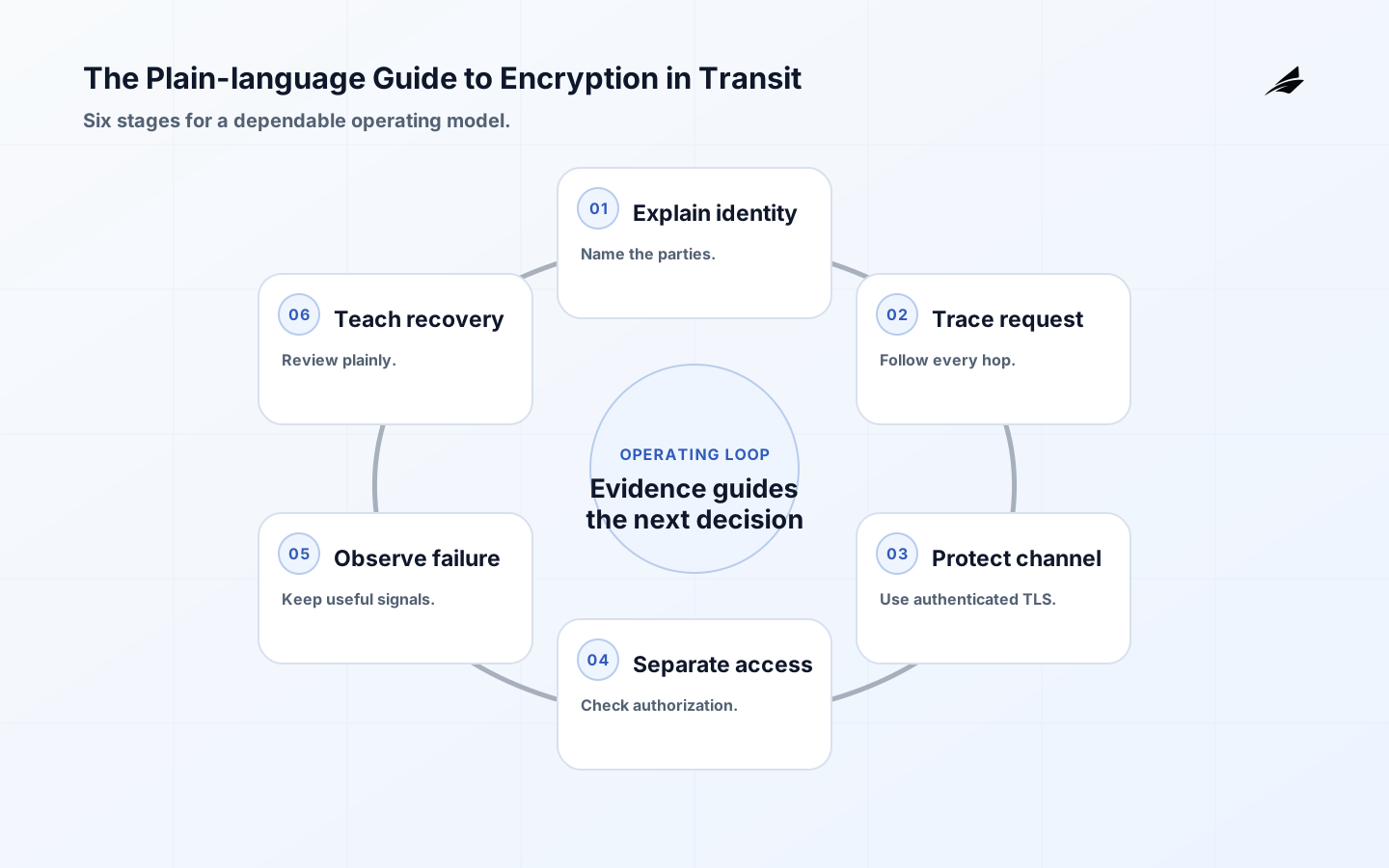
Encryption in transit protects data while it moves between clients, services, networks, and operational tools. A browser padlock is only one connection in a larger system. APIs, internal service calls, database links, message queues, telemetry collectors, administrative consoles, and build systems may all carry sensitive data or credentials and deserve an explicit transport decision.
Map every connection, not just the website

Build a connection inventory with source, destination, protocol, identity, data type, network boundary, and owner. Include east-west traffic inside a cloud account or data center; internal networks are not a security property. The OWASP TLS Cheat Sheet describes TLS as providing confidentiality, integrity, and server authentication when correctly implemented. Those properties must be verified for each hop that terminates and re-establishes TLS.
TLS remains not just encryption. Certificate validation establishes the server identity a client believes it is contacting, and mutual TLS can authenticate clients when the operating model supports certificate lifecycle management. RFC 8446 specifies TLS 1.3 for preventing eavesdropping, tampering, and message forgery. Do not compensate for an invalid certificate by disabling verification; fix the trust configuration or use a supported development arrangement.
| Design decision | Question to answer | Evidence |
|---|---|---|
| Connection | Identity question | Transport control |
| Browser to application | Is the hostname validated? | HTTPS with managed certificate |
| Service to service | Which workload is calling? | TLS or mutual TLS with lifecycle owner |
| Log shipper to collector | Can data be observed or altered? | Authenticated encrypted transport |
Use TLS as an authenticated channel
Certificate operations are the real maintenance work: issuance, private-key protection, deployment, renewal, revocation planning, inventory, and ownership. Prefer automation with alerting well ahead of expiry, but test renewal in the same topology clients use. A reverse proxy may be current while its upstream connection is plaintext; a service mesh may encrypt workloads while a debugging endpoint exposes data elsewhere. Map the termination points and make each remaining hop intentional.
- Avoid: Checking public HTTPS while ignoring internal APIs, queues, and observability links.
- Test for: Terminating TLS at an edge proxy and assuming every downstream hop is protected.
- Do not accept: Disabling certificate validation to make an environment work.
Manage certificates and trust deliberately
The practical standard for transport encryption is not a perfect diagram or a successful demonstration. It is whether the control still makes the intended decision when data is incomplete, a dependency is slow, an operator is rushed, or an attacker chooses the least protected path. Use focused tests for denial, stale state, unusual volume, and recovery. Keep the result with the change record so later reviewers can see what was expected and what was actually verified.
| Operating signal | What it may reveal | First investigation |
|---|---|---|
| Signal | Likely issue | Response |
| Certificate expiry alert | Renewal or ownership gap | Renew before the deployment window |
| Client validation failures | Trust-chain or hostname problem | Inspect certificate and client path |
| Plaintext listener found | Unmanaged legacy path | Remove, redirect, or isolate with deadline |
Verify production behavior continuously
Verify the deployed state with configuration review and synthetic checks. Confirm supported protocol versions and ciphers through current platform guidance, redirect plaintext entry points where applicable, use secure transport for logs and backups, and watch for certificate errors by client population. Treat a sudden validation error as an availability and security signal. It may be a renewal failure, an intercepted connection, a broken clock, or an unauthorized trust change.
Use a short review cadence for the parts of transport encryption that can cause material harm: privileged access, exception paths, high-value data, and emergency changes. The NIST Cybersecurity Framework 2.0 is helpful as an organizing model because it links governance, protection, detection, response, and recovery. The goal is a control that a named owner can explain, test, and improve rather than a setting no one revisits.
Implementation Details That Matter — plain-language TLS
Transport design should state where TLS terminates and why. A public load balancer may terminate a customer connection, then establish a new authenticated TLS connection to an application. That can be appropriate, but the intervening network and proxy must be part of the boundary. Preserve request identity securely across the hop, prevent clients from injecting trusted forwarding headers, and protect administrative access to the terminator. A diagram that stops at the edge hides exactly the place where many assumptions become ambiguous.
Certificate private keys deserve the same lifecycle care as other high-impact secrets. Restrict who and what can read them, choose automated issuance and renewal where the environment supports it, and alert on unexpected replacements or trust-store changes. For mutual TLS, avoid treating a certificate name as a complete authorization decision. First authenticate the workload, then apply an explicit policy for which resource and operation that workload may use. Identity is an input to authorization, not a substitute for it.
Test downgrade and failure behavior. Clients should reject invalid certificates, obsolete protocols, unexpected names, and untrusted chains; servers should have a deliberate policy for older clients rather than silently retaining weak configuration forever. In a controlled environment, exercise certificate expiry, a revoked or replaced trust anchor, an unavailable issuance service, and a misconfigured proxy. These tests reveal whether teams can restore secure connectivity without resorting to global verification bypasses that often remain long after the incident.
Observability needs privacy boundaries. Connection telemetry can show protocol version, certificate expiry, handshake errors, destination, and client population, but it should not turn encrypted traffic into a collection excuse. Decide what is needed for diagnosis, where it is stored, and who can read it. Pair monitoring with ownership: an expiry alert without a service owner is a calendar event, not a control. The best transport posture is visible enough to detect drift and narrow enough to preserve the confidentiality it was meant to provide.
Practical Takeaways
- Tie encryption in transit decisions to a bounded action and a named owner.
- Make enforcement happen in a trusted service or policy boundary, not in a browser or a document.
- Treat exceptions, recovery, and observability as part of the design from the start.
- Use representative negative tests and review evidence after changes, not only before launch.
Encryption in transit FAQ
Is encryption in transit a one-time implementation? No. The initial design establishes a baseline, but systems, identities, dependencies, and risks change. Review it whenever a high-impact workflow changes and use incidents or recurring exceptions as evidence that the operating model needs adjustment.
What should be measured first for encryption in transit? Start with the decision it protects, then measure successful and denied actions, exception volume, corrective work, and the time required to establish what happened. Those signals reveal whether encryption in transit is supporting the intended workflow or simply moving risk to a less visible path.
How should a small team start with encryption in transit? Choose one high-consequence workflow, map its current inputs and failure states, assign an owner, add the smallest dependable control, and test both normal and adverse cases. That bounded work creates evidence for the next encryption in transit decision without claiming the entire estate can be redesigned at once.
Encryption in transit needs an ownership map for trust stores as well as certificates. A client can be compromised by an unexpected root certificate, a proxy configuration, or a development override that broadens trust. Inventory where trust anchors are installed, who can change them, how managed devices receive updates, and how emergency removal would work. For services that call external APIs, verify hostname validation and certificate behavior in the real runtime, not only on a developer laptop. For message brokers and databases, confirm the client library does not silently downgrade or accept an unverified peer. These details ensure transport protection survives the diversity of runtimes that make up a production estate.
Include third-party integrations in certificate expiry and configuration reporting. A partner endpoint may change its chain, hostname, or accepted protocol on a schedule outside your release calendar. Named ownership and automated pre-expiry checks turn that external dependency into a planned maintenance event instead of a sudden failure or an unsafe verification bypass.
Conclusion
Encryption in transit is dependable when it maps to real work, uses authoritative inputs, makes a defensible decision at the point of action, and leaves an evidence trail for review. Start with one bounded workflow, make the recovery path real, and expand only after the team can explain what the control prevented, what it allowed, and who owns the next decision.
Use RFC 9325 for secure transport recommendations, HTTP semantics for request behavior, the MDN HTTP overview for browser-facing context, and W3C secure contexts for protected web features. Explain the implementation alongside the encryption checklist, transport operations playbook, and production transport guide.
Plain-language transport decisions
Explain transport protection as identity, confidentiality, and integrity across a real request path. Keep encryption distinct from authorization, and pair certificates with least privilege, route controls, and useful investigation evidence. Record the decision with its owner, acceptance evidence, exception rule, and review date so another team can operate it without private context.
| Decision | Evidence before release | Review signal |
|---|---|---|
| Scope and owner | Named boundary, accountable role, and expected outcome | Unowned or ambiguous work |
| Failure path | Rehearsed fallback, retry, and escalation | Aged or repeated exceptions |
| Change control | Versioned policy and rollback condition | Unexpected outcome after change |
| Recovery | Test result and correction authority | Time to restore and unresolved impact |
For implementation depth, compare the encryption in transit checklist with the encryption in transit operations playbook. The plain-language framing should remain consistent with the technical and operational records.
A useful explanation ends with a test someone can perform. Trace one request, name each hop, identify the party being authenticated, confirm the protected protocol, and ask what the operator would see if the certificate or route failed. If the answer is “the request just times out,” the system needs better telemetry and a clearer runbook. Plain language is not a simplification of the control; it is how the control becomes reviewable outside the specialist team.
Use the same vocabulary in architecture reviews, support guidance, and incident records: endpoint identity, protected hop, authorized action, failure signal, and recovery owner. Shared language reduces the chance that one team treats “encrypted” as a complete answer while another team is still responsible for an exposed or unauthenticated boundary.
Frequently asked questions
What should be decided first? Trace a real request and name each authenticated hop. Which failure deserves an early rehearsal? Invalid identity or a route that silently bypasses protection. What proves the explanation is useful? A non-specialist can identify the protected channel and the authorization decision.