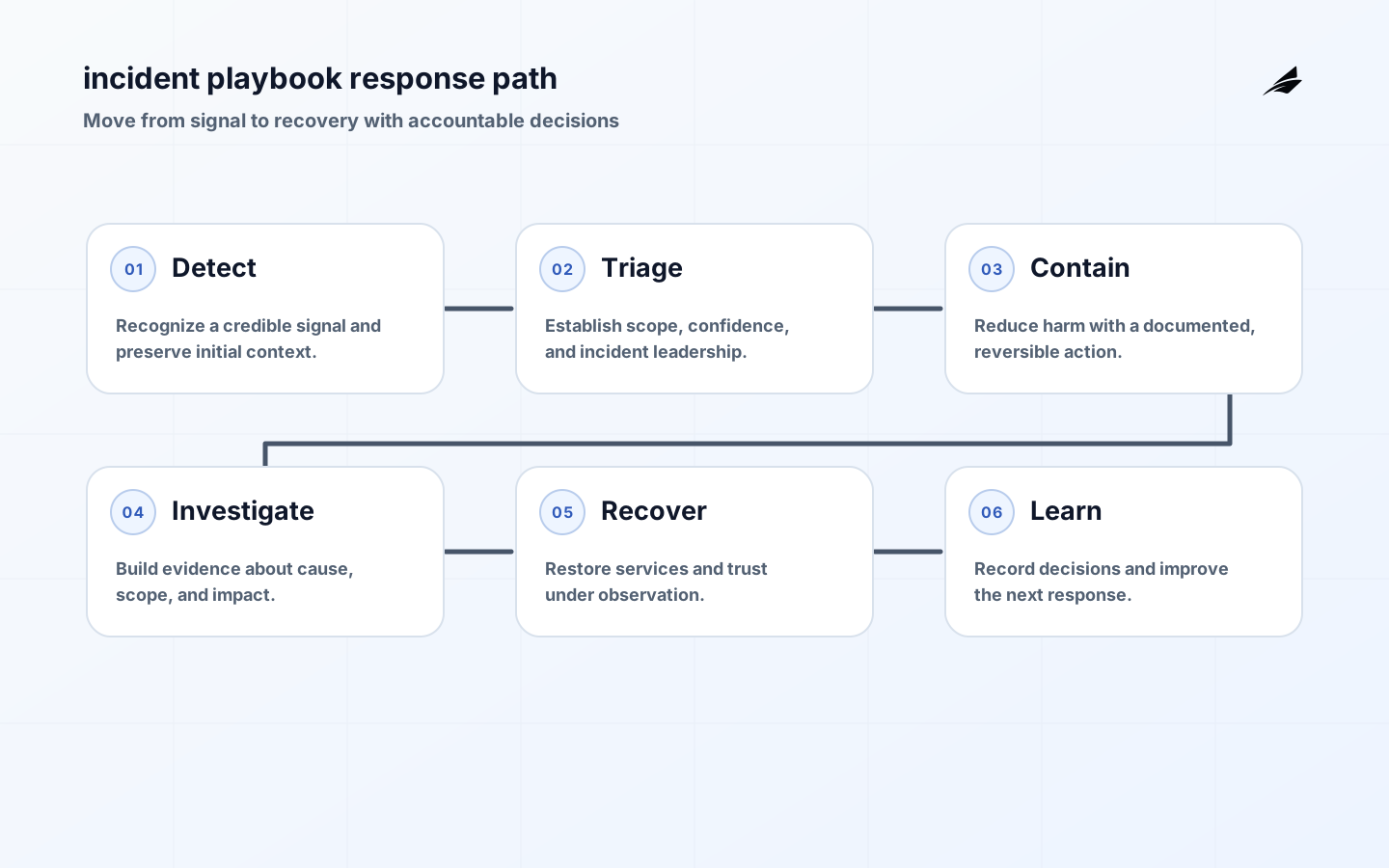
Incident playbooks is a practical discipline for reducing avoidable security risk while keeping a product operable. Teams usually discover the need after an urgent event: a customer asks for evidence, an engineer cannot explain an access decision, a release behaves unexpectedly, or a response depends on one person’s memory. The useful starting point is to make the risk boundary explicit. For credential compromise, suspicious administrative activity, data exposure, ransomware, service abuse, and third-party incidents, decide what must be true, who can make the decision, and what evidence would let another competent person verify it later. This article focuses on repeatable controls rather than a one-time configuration exercise.
Define the incident playbooks risk boundary
The boundary matters because an incident playbook is a prepared decision aid for a specific scenario; it gives people authority, evidence needs, containment choices, and communication triggers when time is short. Start with a short, owned inventory instead of an exhaustive catalogue. For each in-scope system or workflow, record the accountable business owner, technical owner, data or action affected, normal operating path, and failure consequence. That small record makes review conversations concrete. It also exposes hidden dependencies such as scheduled jobs, vendor portals, recovery routes, test environments, and emergency procedures that often sit outside the main product diagram.
| Situation | Why it matters | Practical response |
|---|---|---|
| Credential compromise | Suspected stolen password, token, or session | Preserve indicators; revoke or constrain the credential; review linked sessions and actions. |
| Data exposure | Unexpected disclosure, export, or public object | Stop ongoing exposure, identify data and audience, preserve records, involve required owners. |
| Service compromise | Host, container, or deployment may be controlled | Isolate safely, collect volatile evidence where possible, rebuild from trusted sources. |
| Third-party incident | Vendor reports or signals a compromise | Confirm integration scope, rotate trust material, and assess affected data or operations. |
Choose incident playbooks controls that fit the work
Build a small set of scenario playbooks around plausible high-impact events rather than a generic checklist. Name the incident lead, technical containment owner, communications owner, executive decision-maker, and alternates. Include activation criteria, immediate evidence preservation, safe containment options, dependencies, escalation channels, and conditions for recovery. Keep contact details and runbooks where they can be reached during an identity or collaboration outage.
- Name an accountable owner for each incident playbooks decision and its exceptions.
- Document the system boundary, current state, and evidence needed to verify operation.
- Make high-impact changes reviewable before they reach production.
- Use narrow scopes and expiry for temporary or emergency access where relevant.
- Test the control through a real workflow, not only a policy review.
Build a reliable incident playbooks path
Separate observation from action. Capture timestamps, affected services, account or artifact identifiers, relevant logs, and the source of each claim before changing systems where practical. Then select containment that is proportionate: revoke a credential, disable an integration, isolate a host, block a route, or pause a deployment. Every action should state who approved it, what it might disrupt, and how it will be reversed or verified.

Operate and measure incident playbooks
Exercise playbooks with a tabletop and, where safe, a technical drill. Measure time to assemble the right people, time to identify affected scope, quality of evidence handoff, and whether communications are timely and accurate. Update the playbook after changes and incidents; otherwise it becomes a historical description of an old system.
| Operating signal | What it demonstrates | Question to ask |
|---|---|---|
| Activation | Scenario meets defined trigger | Incident lead and record are established quickly. |
| Containment | Harm is reduced without needless destruction of evidence | Action, approver, expected impact, and result are captured. |
| Communication | Relevant audiences receive accurate, timely information | Facts, uncertainty, decision owner, and next update are clear. |
| Recovery | Service returns under monitored conditions | Root cause, residual risk, and follow-up owners are documented. |
Use change as a review trigger
Treat a material architecture change, a new critical vendor, an exercise finding, a legal or customer commitment, or an incident retrospective as a control trigger, not merely a project update. A change owner should ask whether the current policy, implementation, evidence, and recovery path still match the real system. This keeps the program tied to the product as it evolves. It is more effective than repeating a generic annual review because the people closest to the change can identify new scope, new failure modes, and outdated assumptions while the work is still understandable. For adjacent implementation detail, see incident response for web apps and audit logs for SaaS platforms.
Decide incident playbooks exceptions before pressure
Exceptions are sometimes necessary, particularly when a customer issue, outage, or legacy dependency makes the standard incident playbooks path temporarily impractical. They should not become undocumented permanent state. Record the exact scope, business reason, compensating control, approving owner, start time, and end date. Make the exception visible to the person who will next review the system, and ensure the control can be removed without a risky late-night reconstruction. A useful exception asks a narrow question: what minimal departure from the normal path is needed for this bounded situation? If the same exception keeps returning, treat that pattern as design evidence. It may reveal a missing role, unsuitable workflow, weak automation, or an ownership decision that has never been made.
Create an ownership rhythm for incident playbooks
Ownership becomes real when it appears in ordinary engineering and operational routines. Keep a short register for credential compromise, suspicious administrative activity, data exposure, ransomware, service abuse, and third-party incidents, including the current owner, next review trigger, open exceptions, and last successful test. In a weekly or release-focused review, resolve only the changes that affect the stated boundary: a new integration, role, asset, data flow, dependency, or high-impact action. Escalate decisions that cross technical and business authority instead of leaving them in a backlog without a decision-maker. This rhythm creates a compact history of why a control exists and who accepted any residual risk. It also means a new team member can take responsibility without discovering the critical details from a private chat or an old incident ticket. Publish a small set of owner-facing signals, such as overdue reviews, failed tests, unexpected use, or unresolved exceptions. The point is not to create a score for its own sake; it is to give the responsible person a prompt early enough to make a considered correction.
Run a practical incident playbooks exercise
Choose one recent, ordinary workflow involving credential compromise, suspicious administrative activity, data exposure, ransomware, service abuse, and third-party incidents. Trace it from the initiating request through the authoritative identity or record, policy decision, implementation point, and retained evidence. Ask a business owner to describe the current need and a technical owner to show the enforcement point. Then introduce one realistic disruption: a stale configuration, unavailable dependency, unexpected retry, expired credential, or team-member absence. The group should select a safe response before an urgent event forces improvisation. Capture only concrete gaps, such as a missing owner, an unclear approval limit, a test that misses the enforcement point, or evidence that cannot be retrieved. Assign each gap a person and date, repeat the exercise after the fix, and retain the decision history so newcomers understand the operating assumptions.
Write incident playbooks decisions so the next person can act
A short decision record is often the difference between a control that survives change and one that becomes folklore. For each material incident playbooks choice, capture the problem being addressed, the selected approach, the alternatives considered, accountable owners, constraints, expected evidence, and the condition that will trigger reconsideration. Keep the record proportional: a routine low-impact setting may need only an owner and change reference, while a decision affecting credential compromise, suspicious administrative activity, data exposure, ransomware, service abuse, and third-party incidents may need approval, risk rationale, testing results, and recovery assumptions. Link the record to the system change and the evidence produced in operation. Avoid recording sensitive secrets or unnecessary customer information. The goal is to preserve reasoning, not to create a duplicate of the configuration. During a later review, ask whether the original assumptions still hold, whether the evidence is retrievable, and whether the owner can safely reverse or revise the choice.
Key takeaways
- Incident playbooks works best when the real scope, owner, and failure consequence are explicit.
- Controls should be enforced in the deployed system and tested through a normal operating workflow.
- Change events and exceptions deserve bounded review because they create most drift.
- Operational signals and retrievable evidence make it possible to improve decisions without relying on memory.
- Start with the highest-impact path, then widen coverage as ownership and evidence mature.
Frequently asked questions
Conclusion
Good incident playbooks practice turns an abstract security concern into a set of accountable operating decisions. Define the scope, use controls that match the actual system, test them under normal and disrupted conditions, and retain evidence that helps the next reviewer act. That is how a team gains resilience without creating a ritual that nobody can operate.