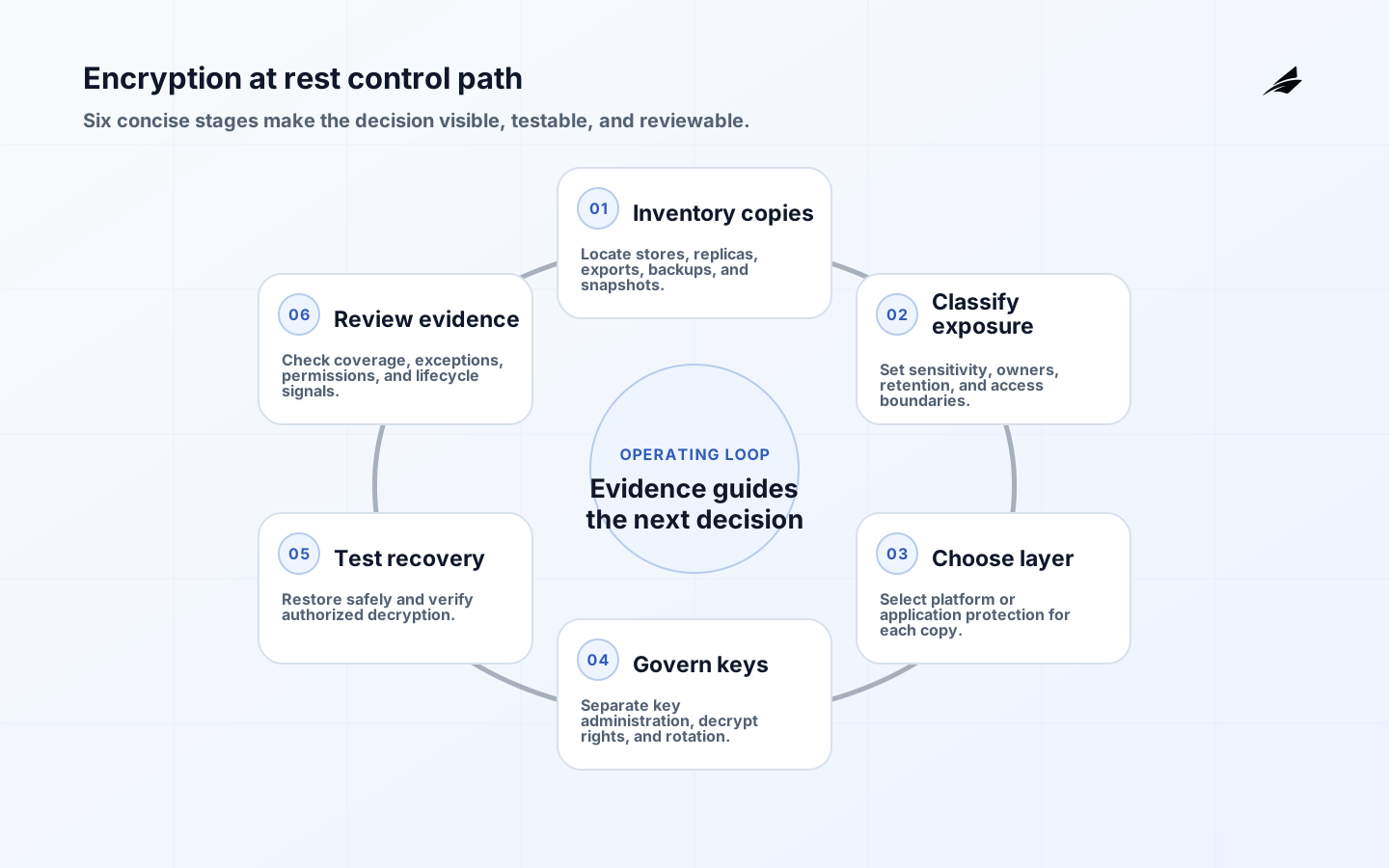
Encryption at rest is a property of a data path, not a checkbox attached to a database. Inventory primary storage, replicas, queues, search indexes, object storage, temporary files, backups, exports, analytics copies, and support downloads. For each location identify owner, mechanism, key boundary, access path, retention rule, and deletion behavior. OWASP’s cryptographic-storage guidance becomes useful when translated into this map. For the key-management boundary, use NIST SP 800-130, NIST SP 800-152, the NIST key-management topic, and RFC 8017 as specific reference points. A record protected in the primary table may still be exposed in an unencrypted export bucket or debug snapshot.
Set the encryption at rest operating decision
Encryption at rest begins with the risk the system must control, not a product setting. Inventory primary records, indexes, object storage, queues, analytics replicas, caches, exports, backups, and diagnostic snapshots. Decide whether platform-managed encryption is enough for each class or whether an application boundary is needed to separate tenants, services, or administrators. Encryption at rest protects stored data when the boundary, keys, and recovery path are designed together. A storage-provider setting may be appropriate, but it does not answer which copies are covered, who can decrypt, or whether encrypted backups can be restored. Write the expected outcome, accountable owner, approved exception route, and stop condition before rollout. That record makes a technical choice reviewable and gives responders a basis for deciding whether observed behavior is intended or harmful.
Map encryption at rest boundaries and dependencies
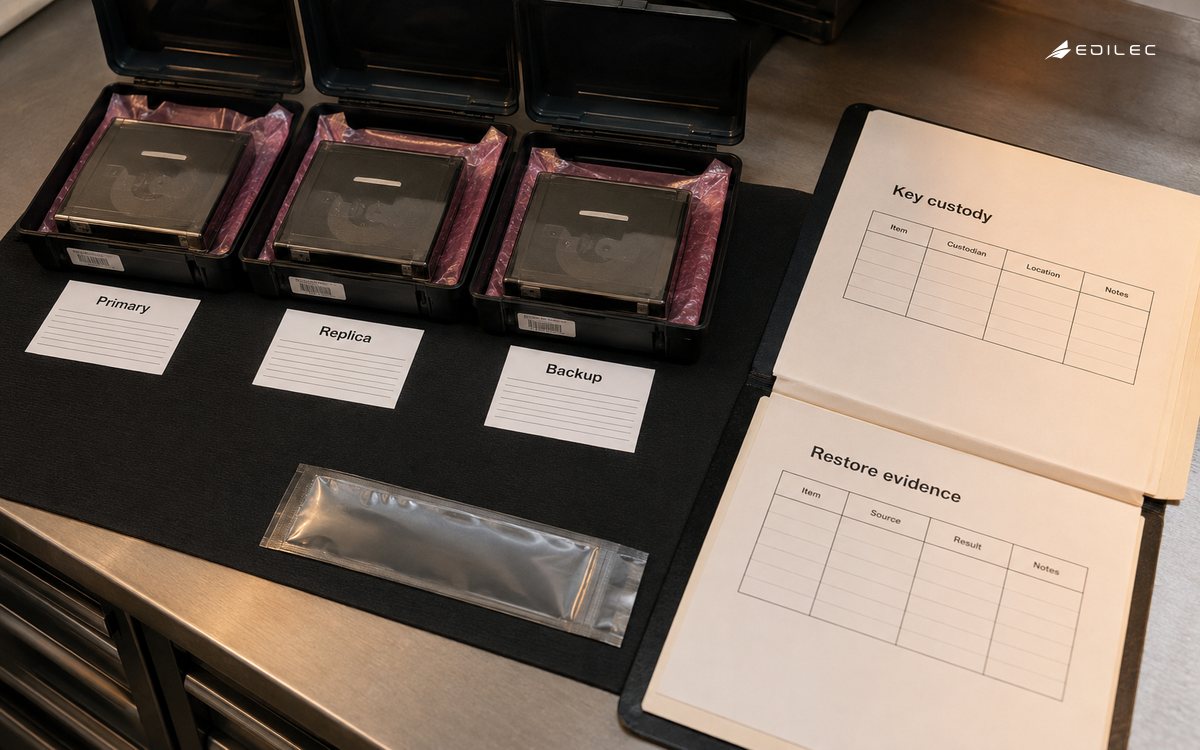
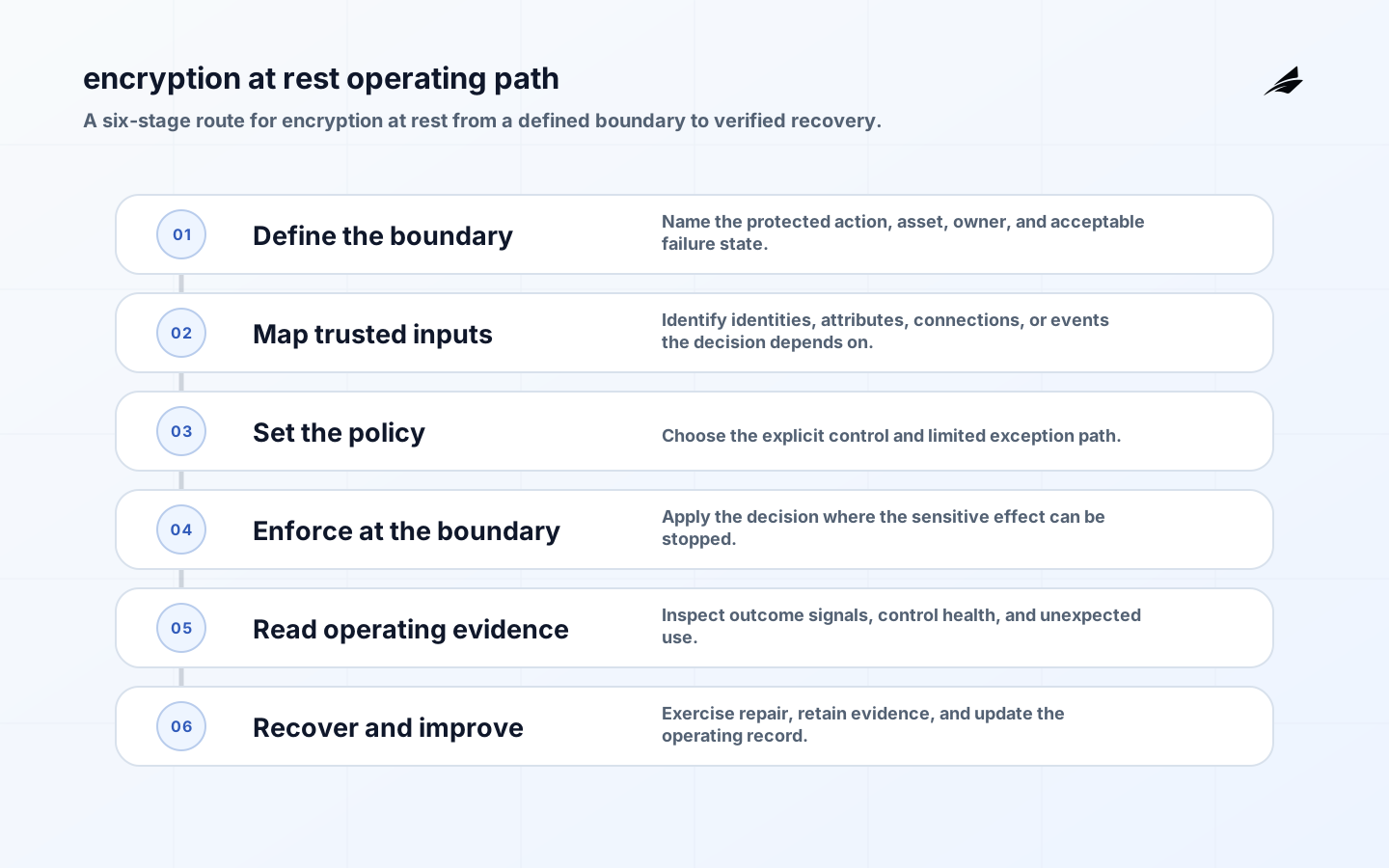
Separate data-plane access from key administration. A service that reads ciphertext should obtain decrypt permission only for the keys and context it needs, while a key administrator should not automatically gain customer-record access. Include backups and restores in the same boundary review. A useful boundary is specific enough that a reviewer can identify the actor, protected resource or connection, enforcing component, and behavior when a dependency is slow or unavailable. State the irreversible moment too: an action may be technically reversible yet operationally irreversible once a customer, vendor, or downstream system has received the effect.
| Design element | Question to answer | Evidence to retain |
|---|---|---|
| Data copy | Where is sensitive data persisted? | Classification and retention record |
| Key boundary | Which key protects which scope? | Key policy and encryption context |
| Access | Which service may decrypt? | Least-privilege identity grant |
| Recovery | How is encrypted data restored? | Practiced restore evidence |
Use proportionate encryption at rest controls
Use approved cryptographic services, protect key material from logs and repositories, and limit decrypt permissions to service identities. Document how new writes move to a new key, how older ciphertext remains readable for retention, and what compromise changes in the rotation plan. Match each safeguard to a credible failure mode. Preventive checks constrain known bad states; runtime signals detect conditions that escaped them; recovery procedures return the system to a safe state. Keeping those functions separate prevents a team from declaring success merely because a request or deployment completed without an immediate error.
NIST Guide to Computer Security Log Management is useful for making enforcement and verification concrete. The nearby guides on Encryption at Rest: Hands-on Planning Guide, Secrets Rotation: Explained from First Principles, Data Retention: Operations Playbook cover adjacent choices that commonly affect this design. Do not convert an emergency accommodation into a permanent privilege or configuration simply because it was needed once. Give it a reason, owner, expiration, and a record visible to the people responsible for risk.
Operate encryption at rest with evidence
Monitor key-policy changes, decrypt failures, unexpectedly broad decrypt activity, failed rotations, and restore tests. Link change records to key events so responders can distinguish planned migration from suspicious use. Test restoration through a role that is not normally privileged. Decide before implementation which movement triggers investigation, pause, or rollback. Link dashboards, change records, and runbooks with stable identities or revisions so an operator can trace cause, effect, and decision across boundaries. Evidence close to the work also makes handoffs and audit practical without turning every engineer into a historian.
| Signal | What it can reveal | Review action |
|---|---|---|
| Decrypt activity | Unexpected breadth or volume | Review by key and service |
| Key policy changes | Potential privilege expansion | Alert and require approval |
| Rotation status | New writes use retired material | Track encryption version |
| Restore tests | Recovery promise is unproven | Record outcome and gaps |
Roll out encryption at rest in six controlled stages
- Name the owner, protected boundary, and unacceptable outcome for encryption at rest.
- Capture a baseline for decrypt activity before changing enforcement.
- Implement the smallest scope that can provide real production evidence.
- Exercise one normal path and one harmful failure path with the operating team.
- Review customer impact, support load, and recovery evidence before widening exposure.
- Convert observed gaps into a policy, test, alert, or runbook improvement.
Implementation details for encryption at rest
Implementation requires a concrete test of the production path, not an assertion that a configuration exists. Distinguish data encryption keys from the keys that protect or authorize them, even when managed services handle cryptographic mechanics. The operational questions are who can request decryption, what context is required, how policy changes are approved, and how replicas remain inside the intended boundary. Keep the test result with the change record so that later maintainers can see the conditions under which the control was verified.
Operating discipline keeps a sound design from drifting after the initial rollout. Plan deletion and retention with encryption. Key deletion can make ciphertext inaccessible but is not complete data deletion when replicas, exports, or independent keys remain. Retention must describe each copy, while key retention must still allow lawful backups to be restored without a self-inflicted outage. Assign the review cadence to the people who understand the affected work, and use actual events and access patterns to refine the model rather than adding blanket privilege or silent exceptions.
Recovery planning is part of the security design. A suspected key compromise needs a rehearsed path: identify data scope, stop unauthorized access, replace material, migrate as appropriate, and preserve evidence. A routine rotation is not automatically containment and recovery. A practical exercise should confirm both that the harmful state can be stopped and that legitimate work can resume with a recorded decision trail.
Before expanding encryption at rest, review the design with the owner of data copy and the operator who will respond when recovery fails. Ask them to demonstrate the evidence described in the table, including the current decision, the last approved change, and the recovery authority. This review has a practical purpose: it exposes whether permissions, policies, certificates, secrets, events, or workflows are only described in documentation or are actually usable under production conditions. Record the gaps as owned work, then repeat the exercise after the change rather than treating the first walkthrough as final proof.
Set a review date and a measurable completion condition for this encryption at rest change. Evidence should show that the intended boundary is enforced, the exception route is controlled, and the responsible team can recover from the most likely failure without creating a wider security exposure.
Encryption at rest takeaways
- Encryption at rest works when the boundary and owner are explicit.
- Use controls because they interrupt a specific credible harm.
- Keep exceptions narrow, expiring, and reviewable.
- Measure the customer or system outcome as well as control health.
- Practice recovery, preserve evidence, and revise the operating record.
Encryption at rest FAQ
What is the first implementation step? Start by identifying where sensitive data is persisted, then retain a classification and retention record. In the encryption at rest context, a narrow owned boundary produces better evidence than an organization-wide conversion with unclear enforcement. How should an exception be handled? Treat it as a temporary decision with a named approver, limited scope, expiry, and audit record. In the encryption at rest context, it must be easier to review than an informal bypass and must not silently become the default path. What proves the design is working? Look for the operating signals above, a successful adverse-path exercise, and evidence that the relevant owner can explain which key protects which scope without undocumented behavior. OWASP Application Security Verification Standard provides a useful verification reference for that final test.
Conclusion: make encryption at rest an operating capability
The durable version of encryption at rest is neither a one-time configuration nor a document completed in isolation. It is an owned decision with a defined boundary, proportionate controls, observable outcomes, and a practiced way to recover. Begin with one high-value path, retain the evidence it produces, and expand only after the people responsible can explain and operate the result confidently.
Encryption checklist: turn scope into an operating decision
Encryption checklist: test a copy and restore path
Choose protection at the right layer. Full-disk encryption helps when media is lost, but it does not prevent an authorized host or compromised application from reading mounted data. Storage encryption may cover a managed database and its backups; application-level envelope encryption can narrow who may decrypt particular fields, at the cost of search, rotation, and recovery complexity. Classify data, define the threat being reduced, and check whether the design supports queries, deletion, legal hold, and investigation.
Key custody deserves the same attention as ciphertext. NIST SP 800-57 addresses key types, lifecycle, protection, backup, and compromise handling. Keep key-encryption keys in an appropriate managed or hardware-backed boundary, separate administration from use, and record important decrypt operations. Rotation needs a tested re-encryption or lazy-migration plan; changing a key identifier without proving old data is readable is a potential outage. Test disabled, unavailable, and compromised-key scenarios before production.
Add evidence to the checklist. Verify settings through the provider control plane, inspect backup and replica configuration, sample access logs, and compare the inventory with deployed resources. A useful exception has narrow scope, a reason, compensating control, owner, and expiry. Recheck after schema changes, vendor migrations, new pipelines, and support-tool changes.
Encryption checklist: connect keys to data operations
In the encryption at rest context, for a broader view, compare encryption at rest access and operations, evidence and review practice, and recovery planning. In the encryption at rest context, these Edilec guides add the human and operational context around this article’s technical decision.
Encryption checklist: preserve recovery evidence
Make the inventory operational by assigning a control owner to every copy. The owner should be able to answer which key or provider boundary protects the copy, which identities can read it, how access is logged, and how the copy is removed. Sample a row from the inventory during every material data-flow change. New reporting jobs, customer exports, vendor integrations, and incident snapshots are common places where coverage silently diverges. For non-production, require a decision about masking, synthetic data, or equivalent protection; “internal only” is not a cryptographic control.
The exception queue should distinguish risk acceptance from work in progress. A temporary provider limitation may have a compensating network and identity control, while an unreviewed legacy snapshot is simply a gap. Give each item a severity, owner, due date, affected copies, and closure evidence. Revisit exceptions after key rotation, restore testing, and architecture changes so the checklist remains a living map rather than an annual declaration.