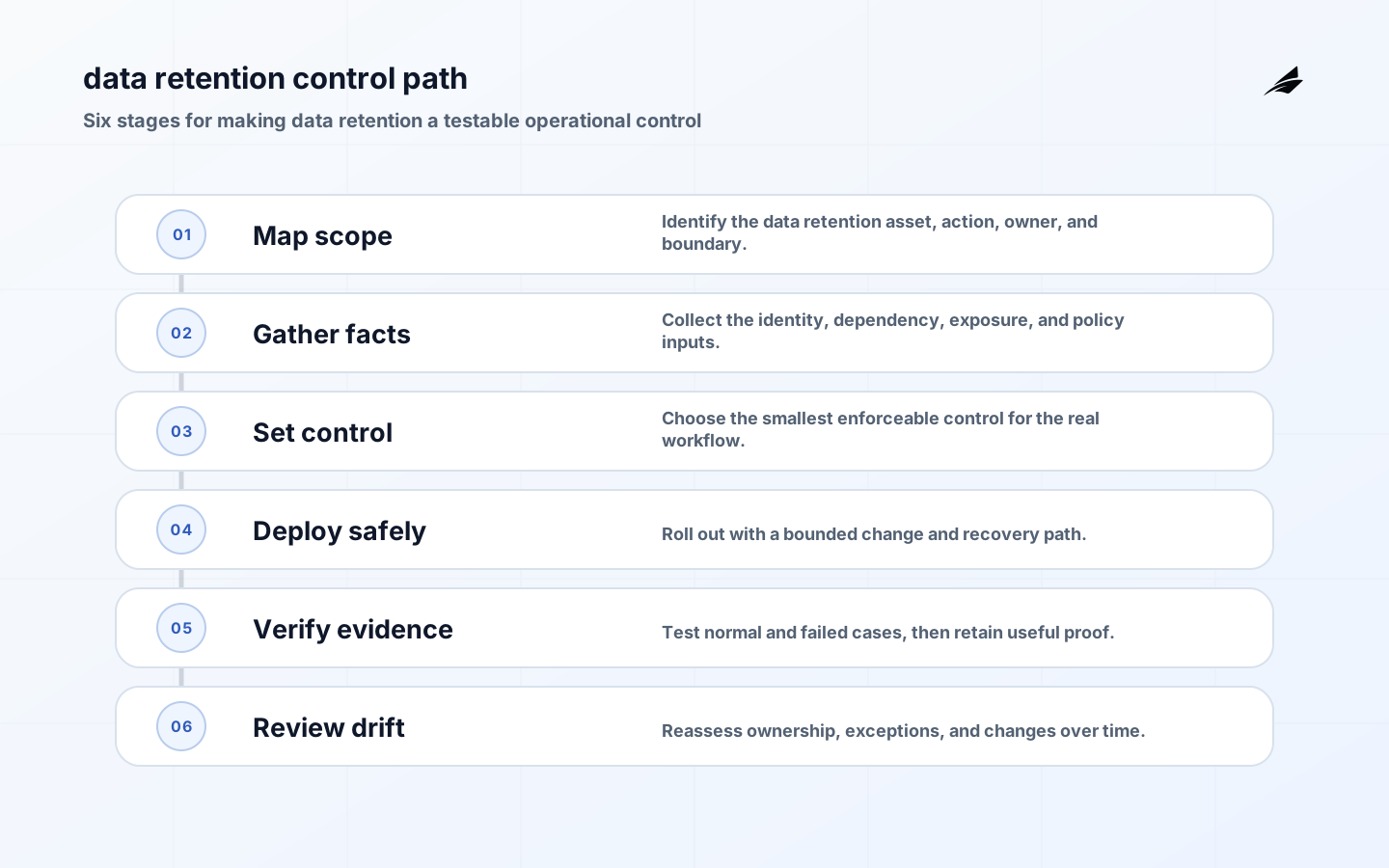
Data retention is a lifecycle decision, not a storage cleanup setting. Organizations keep data for operational continuity, customer support, security investigation, legal or contractual duties, and product improvement; each purpose can imply a different duration and access rule. The security failure is often keeping everything indefinitely because deletion feels risky, or deleting evidence without considering recovery and legal obligations. Begin with data classes and systems of record: customer records, authentication events, security evidence, backups, support attachments, analytics, source artifacts, and temporary processing data.
Classify data retention by purpose and system of record
For each class, document the collection purpose, business owner, sensitivity, authoritative location, active-use period, retention basis, deletion trigger, archive format, access restrictions, and legal hold process. A table of years without this context is difficult to enforce. Distinguish a production record from its backups, search indexes, exports, and replicas; a deletion request or policy change can fail if only the primary database is considered. The design should state when data becomes inaccessible, when it is securely deleted, and when proof of deletion is expected.
| Decision point | Practical choice | Evidence to retain |
|---|---|---|
| Data class | Typical decision needed | Control evidence |
| Authentication events | Investigation window and restricted access. | Retention rule, access record, deletion job. |
| Customer attachments | Active support need, archive conditions, and expiry. | Case policy and lifecycle execution result. |
| Backups | Recovery objective and separate expiry schedule. | Backup inventory and expiration record. |
| Decommissioned media | Sanitization method before disposal. | Disposal or cryptographic erasure evidence. |
Design data retention controls that can be enforced
Retention must balance investigation value with privacy and exposure. Security events and incident playbooks may need relevant logs available long enough to establish scope, while raw sensitive content may not need the same duration. Minimize fields at collection, pseudonymize or aggregate where the purpose allows, and restrict access to archives. Encryption helps protect retained data but does not eliminate the need for a deletion plan; keys, replicas, and recovery copies have their own lifecycle.
- Name the purpose, owner, and authoritative system for every data class.
- Model copies, backups, indexes, exports, and archives separately.
- Use minimum necessary retention and access restrictions for the stated purpose.
- Operate legal holds through a defined issuance and release workflow.
- Verify deletion and sanitization with evidence appropriate to the storage technology.
Operate data retention as a controlled change
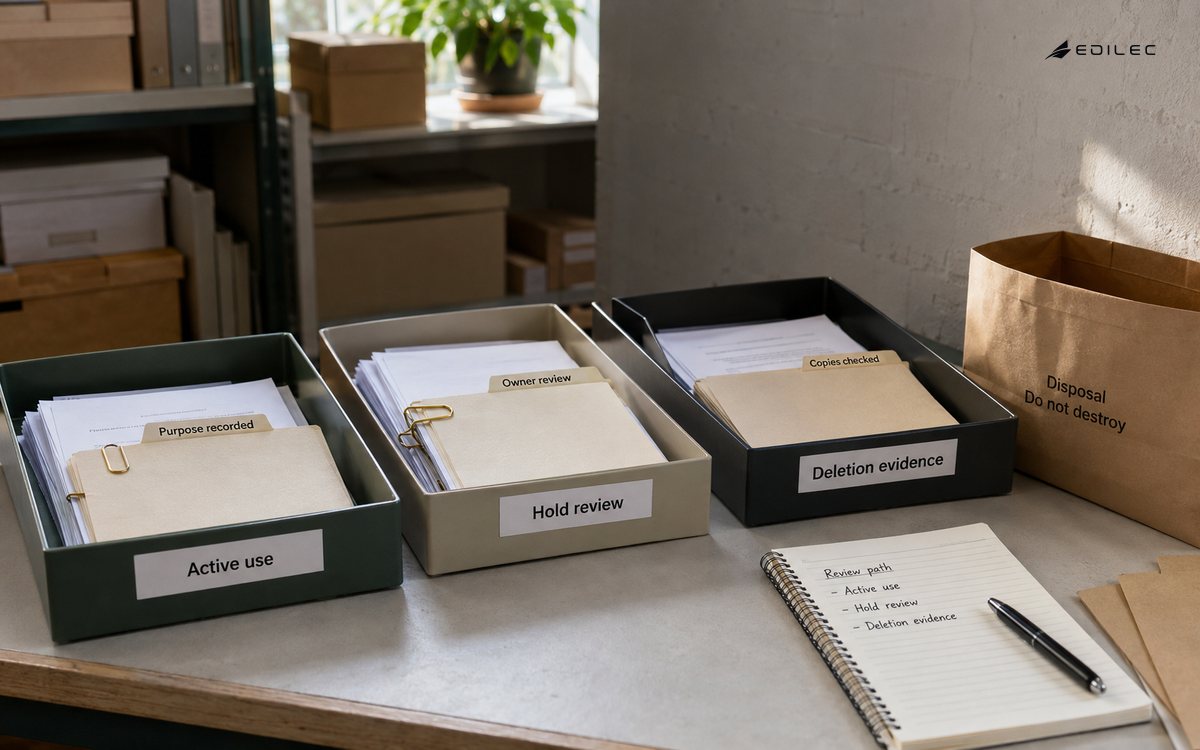
Legal hold is a controlled exception, not a reason to suspend every deletion rule. The organization should know who can issue a hold, what data and custodians it covers, how systems receive the instruction, how release is recorded, and how ordinary policy resumes afterward. Avoid asking engineers to interpret legal scope from an informal message. A defined hold workflow reduces the chance that evidence is destroyed or that unrelated personal data is retained without purpose.
Work through a data retention example
A practical example is customer support attachments. The active case system may need them for a defined period, a restricted archive may preserve selected evidence for disputes, and backups may expire on a different technical schedule. The policy should explain those layers in plain terms and ensure deletion jobs mark or remove the item across the intended stores. Test a sample attachment from creation through expiry, archive access, backup expiry, and legal hold release. This often exposes unowned exports or indexes.
Test and verify data retention
Deletion verification should match the storage technology and risk. Logical deletion may be appropriate where data is encrypted and inaccessible before a backup lifecycle expires; physical sanitization may be required for media disposal or decommissioned devices. Define the evidence required: job completion, object lifecycle record, cryptographic key destruction record, vendor certificate, or controlled disposal log. Test failure behavior too. A scheduled job that reports success while an archive permission error leaves records behind is a retention defect.
| Test or review | Expected behavior | Escalate when |
|---|---|---|
| Lifecycle test | Expected result | Failure to address |
| Expiry job | Record becomes inaccessible or deleted on schedule. | Only primary storage changes while copies remain. |
| Legal hold | Relevant data is preserved and release is recorded. | A broad informal hold stops all deletion. |
| Archive access | Only authorized staff can retrieve retained data. | Archive permissions are wider than production. |
| Media disposal | Chosen sanitization method matches media type and risk. | Device is discarded with recoverable content. |
Measure and govern data retention
Measure policy coverage, data classes without owners, overdue deletion jobs, legal holds past review, backup age, archive access, and exceptions. Treat unexpected growth as a governance signal: it may indicate a broken deletion workflow, a new data source, or a product feature that collects more than its documented purpose. Sampling should confirm that access restrictions and deletion outcomes agree with the written policy.
Govern retention through a cross-functional owner group involving data, security, legal, privacy, and system operators. Changes in jurisdiction, contract, product behavior, or incident requirements should trigger review. Publish clear internal guidance for teams creating a new store: they need a purpose, owner, lifecycle, and destruction method before collection begins. This avoids the common pattern where a convenient analytics or support export quietly becomes a permanent system of record.
A further operational consideration for data retention is that new collection should declare purpose, fields, owner, system of record, expected volume, retention basis, access, and deletion method before it reaches production. Give this boundary a named owner and a regular review point. The useful evidence is not a generic attestation; it is a record that identifies the system, decision, and observed result. When the expected control does not hold, the response should be visible and bounded so people do not improvise an unreviewed workaround. This detail is often where a policy becomes an operating practice.
Reliable data retention depends on recognizing that archives require separate retrieval, access, encryption, indexing, and restoration controls because they can be less visible yet more broadly available than production data. Put the rule near the system that can enforce it and make the supporting workflow accessible to legitimate users. Document the inputs, authority, failure response, and recovery owner before relying on automation. That level of specificity helps teams distinguish a true requirement from a historical convenience, and it leaves a reviewer with enough context to assess whether the control still fits the current service.
In a mature data retention program, lifecycle jobs need monitoring, safe retries, and escalation for permission or connectivity failures so a schedule is not mistaken for proof of deletion. Test the condition through the same path used in production, including an expected failure and a recovery step. Capture concise evidence, then review it when a dependency, team, or threat assumption changes. This keeps the design connected to actual behavior instead of allowing a diagram or written rule to stand in for a control that nobody has recently exercised.
The governance implication for data retention is that vendor storage, replica, backup, hold, export, and deletion behavior belongs in the system design rather than being assumed from a delete-account API. Establish an owner who can make the necessary tradeoff, a time limit for exceptions, and an escalation path for material risk. A short, well-maintained decision record is more useful than a broad policy document because it tells operators what to do when the normal path cannot be followed and how the organization will return to it.
Retention policy should be reflected in user-facing promises where customers can reasonably rely on them. If an export, account deletion, or support attachment follows a different lifecycle from the primary account, explain the distinction plainly and route questions to an accountable team. Clear communication reduces pressure to make ad hoc exceptions that undermine the technical policy.
Data lifecycle ownership should survive system retirement. Before shutting down a product, repository, or vendor integration, identify retained records, backups, encryption keys, access groups, and any legal or contractual holds. Decommissioning is a final lifecycle event, not merely a cost-saving change. A controlled shutdown proves that the organization can remove authority and data as intentionally as it created them.
Retention decisions need a technical owner who can translate policy into storage behavior. That owner should understand where replicas, archives, indexes, backups, and keys live, and be able to produce evidence for a representative deletion or hold. Bringing this knowledge into routine system reviews prevents lifecycle obligations from being discovered only during a customer request, audit, incident, or decommissioning project, when the cost of mapping old data is much higher.
Retention reviews should include data that appears operationally harmless, such as diagnostics, queue messages, analytics identifiers, and temporary files. These records can still reveal customer activity or security context when combined. Applying the same purpose, owner, and expiry discipline prevents small convenience stores from becoming permanent unmanaged datasets.
Key takeaways
- Name the purpose, owner, and authoritative system for every data class.
- Model copies, backups, indexes, exports, and archives separately.
- Use minimum necessary retention and access restrictions for the stated purpose.
- Operate legal holds through a defined issuance and release workflow.
- Verify deletion and sanitization with evidence appropriate to the storage technology.
Frequently asked questions
Can backups keep data after it is deleted from production? They may for a defined recovery period, but the policy must state that lifecycle and protect the backup. Backups should not become an unbounded retention loophole.
Is encryption the same as deletion? Encryption protects confidentiality, but deletion requires an approved method such as lifecycle removal, secure erase, or cryptographic erasure, depending on the storage design.
Conclusion
In conclusion, data retention makes storage accountable to purpose. Classify data and copies, set a defensible lifecycle, protect what must remain, honor controlled holds, and verify deletion at the technical layer. A policy is valuable only when systems can carry it out and provide evidence that they did.