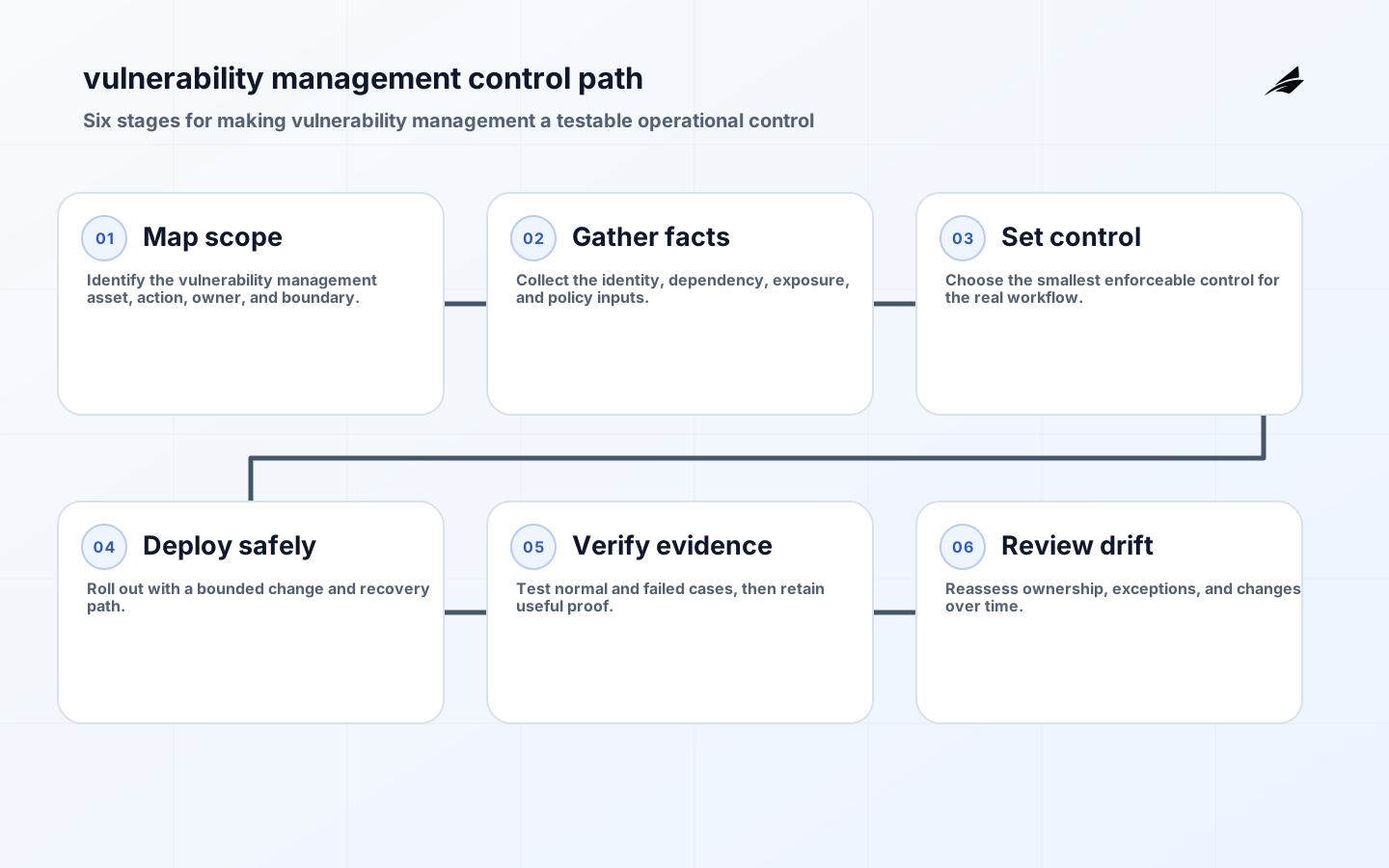
Vulnerability management is a decision system, not a list of scanner results. A finding matters when it intersects with an actual asset, reachable exposure, valuable data or function, credible exploit path, and a practical remediation choice. Teams lose time when they begin with severity alone and cannot answer whether the affected software is deployed, internet-facing, compensating-controlled, or owned by anyone who can change it. Start with asset facts: application, environment, owner, business function, data sensitivity, exposure, component version, and deployment location.
Establish asset facts before prioritizing vulnerabilities
Use severity as one input, not the final priority. CVSS communicates characteristics of a vulnerability but does not know whether your instance is exposed or whether a working exploit is being used. Add exploit intelligence, such as an authoritative known-exploited catalog, threat context, reachable attack paths, and the expected impact to the business service. A remotely exploitable authentication bypass on a public identity boundary warrants a different response from the same score in an isolated test system. Record why a priority was chosen so it can be revisited as facts change.
| Decision point | Practical choice | Evidence to retain |
|---|---|---|
| Priority input | Question | Example effect |
| Asset criticality | What business function or data is affected? | Raises urgency for identity or payment services. |
| Exposure | Can an attacker reach the vulnerable path? | Public reachability may outrank a higher isolated score. |
| Exploit evidence | Is exploitation known or plausible now? | Known exploitation accelerates action. |
| Compensating control | Does a tested control reduce the path? | May support a short, reviewable delay. |
Design vulnerability management controls that can be enforced
Build a reliable intake path from code, dependencies, infrastructure, cloud configuration, and external assessments. Normalize findings to assets and owners, deduplicate by root cause where appropriate, and preserve scanner evidence without treating it as ground truth. Validate important results, especially where version detection or reachability is uncertain. An unowned queue is not vulnerability management; every priority item needs a remediation owner, due date, status, and exception path. Link release and component data from supply chain security to make affected deployments easier to find.
- Map every priority finding to a live asset, owner, and environment.
- Combine severity with exposure, exploit evidence, and business impact.
- Choose remediation that breaks the actual attack path.
- Verify closure in the deployed environment, not only in source control.
- Give every exception an owner, compensating control, and expiry.
Operate vulnerability management as a controlled change
Remediation is more than patching. Options can include upgrading, changing configuration, disabling an exposed feature, removing a dependency, adding a temporary network or authorization boundary, or accepting risk with a defined expiry. Choose the option that actually breaks the exploit path and can be verified. A compensating control should be specific and testable, not a sentence that a firewall exists somewhere. If a patch could disrupt a critical system, use canary deployment, rollback planning, and monitoring rather than allowing that concern to create an indefinite exception.
Work through a vulnerability management example
Consider a critical library finding in an internet-facing API. First confirm the affected versions and deployment digests, then test whether the vulnerable function is reachable through the API's configured routes. Check known exploitation evidence, available mitigations, and the service owner. If patching requires a dependency upgrade, stage it in an environment that exercises real authentication and payload handling. If an urgent rule blocks only the exposed endpoint, document the rule, its owner, and the date it will be removed after the version is fixed.
Test and verify vulnerability management
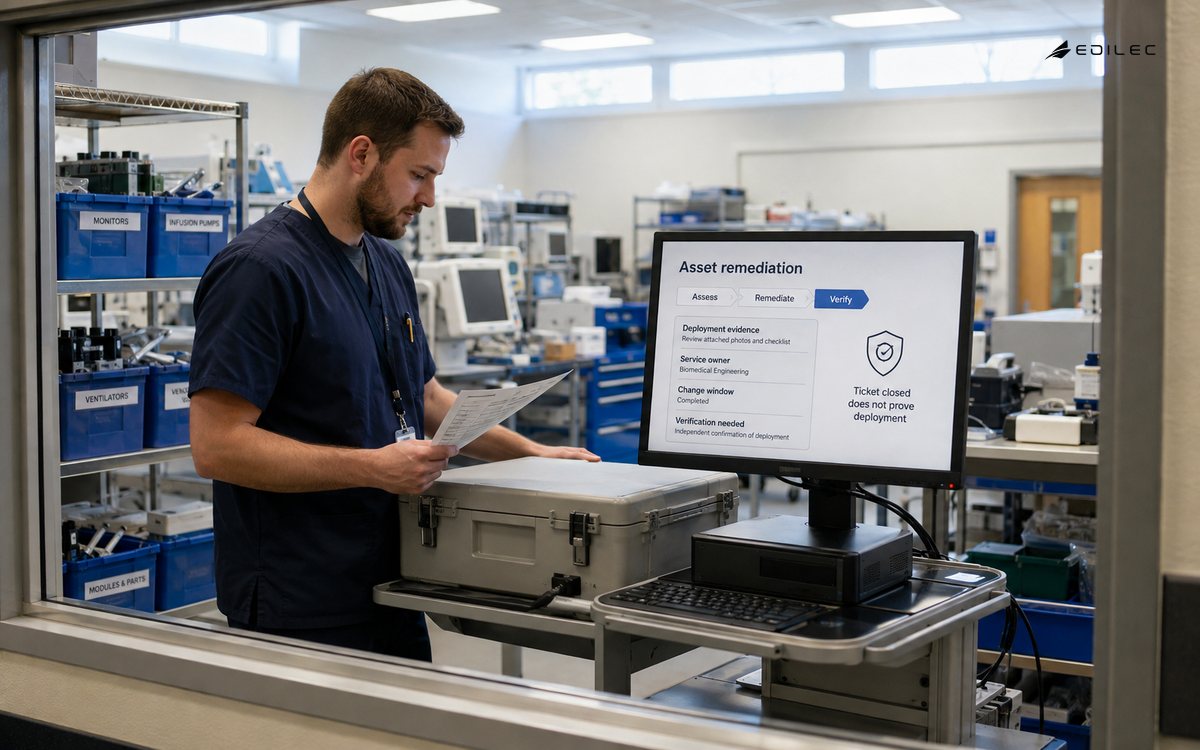
Verify closure independently of the ticket status. Rescan or inspect the deployed version, validate the configuration change, and retest the exploit path where safe. Confirm that the remediation reached every relevant environment and artifact, not only the repository branch. Capture the verification method and date. For high-risk issues, ask a second person or automated policy to check the result. This protects the team from 'fixed in code' claims when a long-lived image or manual deployment still runs the vulnerable component.
| Test or review | Expected behavior | Escalate when |
|---|---|---|
| Closure test | Expected evidence | Do not accept |
| Patch deployment | Deployed version no longer matches affected range. | A merged pull request alone. |
| Configuration change | Target setting is active on every relevant instance. | A screenshot from one environment. |
| Temporary mitigation | Exploit path is blocked and owner is named. | An untested statement that a firewall exists. |
| Exception expiry | Risk is renewed or remediated by the due date. | An open exception with no review. |
Measure and govern vulnerability management
Measure time to triage, time to verified remediation by risk class, proportion of findings mapped to a live asset, exception age, recurrence by root cause, and coverage gaps in inventory or scanning. Do not use a raw open-finding count as a proxy for safety; a falling count may reflect suppressed evidence. Look for systemic patterns such as unsupported runtime versions, weak ownership, or a release process that cannot update dependencies quickly.
Govern exceptions with the same seriousness as remediation. An exception should state the affected asset, exposure, reason patching is delayed, temporary control, owner, expiry, and review date. Escalate expired exceptions and changes in exploit evidence automatically where possible. Senior leaders need a concise view of material exposure and blocked remediation, not a spreadsheet with thousands of unranked technical entries.
A further operational consideration for vulnerability management is that asset inventory must be reconciled with cloud accounts, registries, endpoint management, and deployment reality so ownership and exposure are not merely inferred. Give this boundary a named owner and a regular review point. The useful evidence is not a generic attestation; it is a record that identifies the system, decision, and observed result. When the expected control does not hold, the response should be visible and bounded so people do not improvise an unreviewed workaround. This detail is often where a policy becomes an operating practice.
Reliable vulnerability management depends on recognizing that operators need a decision-ready summary with asset, exposure, exploit evidence, proposed action, deadline, and verification method rather than a raw scanner export. Put the rule near the system that can enforce it and make the supporting workflow accessible to legitimate users. Document the inputs, authority, failure response, and recovery owner before relying on automation. That level of specificity helps teams distinguish a true requirement from a historical convenience, and it leaves a reviewer with enough context to assess whether the control still fits the current service.
In a mature vulnerability management program, repeated findings may reveal unsupported runtimes, abandoned dependencies, or release friction that deserves root-cause investment beyond the immediate patch. Test the condition through the same path used in production, including an expected failure and a recovery step. Capture concise evidence, then review it when a dependency, team, or threat assumption changes. This keeps the design connected to actual behavior instead of allowing a diagram or written rule to stand in for a control that nobody has recently exercised.
The governance implication for vulnerability management is that new exploit information, exposure changes, and business changes should trigger a recorded priority review because intelligence informs but cannot replace local facts. Establish an owner who can make the necessary tradeoff, a time limit for exceptions, and an escalation path for material risk. A short, well-maintained decision record is more useful than a broad policy document because it tells operators what to do when the normal path cannot be followed and how the organization will return to it.
Remediation planning should account for the full deployment fleet. A fix tested in the main service can miss retired-but-running workers, regional clusters, customer-managed installations, or artifact caches. Use deployment records and asset inventory to enumerate the target set before declaring closure. This is particularly important when a vulnerability affects an image or library shared by several services.
Service owners need early visibility into remediation deadlines and dependencies. A priority issue that arrives only as an overdue ticket leaves no time for testing or coordinated maintenance. Establish escalation thresholds for blocked work, then involve product, operations, or vendor owners while options remain. That turns security urgency into a managed delivery decision rather than a last-minute conflict.
A useful remediation program preserves a small number of well-explained decisions rather than a large volume of unranked findings. For each material issue, keep the current asset facts, priority rationale, chosen action, verification result, and exception expiry together. This makes leadership reporting honest and gives a new owner a usable starting point. It also supports retrospective improvement: teams can see which assumptions repeatedly delayed response and where release engineering needs investment.
Key takeaways
- Map every priority finding to a live asset, owner, and environment.
- Combine severity with exposure, exploit evidence, and business impact.
- Choose remediation that breaks the actual attack path.
- Verify closure in the deployed environment, not only in source control.
- Give every exception an owner, compensating control, and expiry.
Frequently asked questions
Should teams patch every critical CVE immediately? Criticality matters, but the response should also consider deployment, exposure, exploit evidence, and available mitigation. Immediate action may be a patch or a verified control that blocks the path.
Are vulnerability scanners enough? They provide valuable evidence, but asset ownership, validation, prioritization, and verified remediation are human and process responsibilities.
Conclusion
In conclusion, vulnerability management turns vulnerability data into accountable action. Know the asset and exposure, prioritize with context, choose a remediation that breaks the real attack path, verify deployment, and force temporary exceptions back into review. That process is what makes scanning worthwhile.