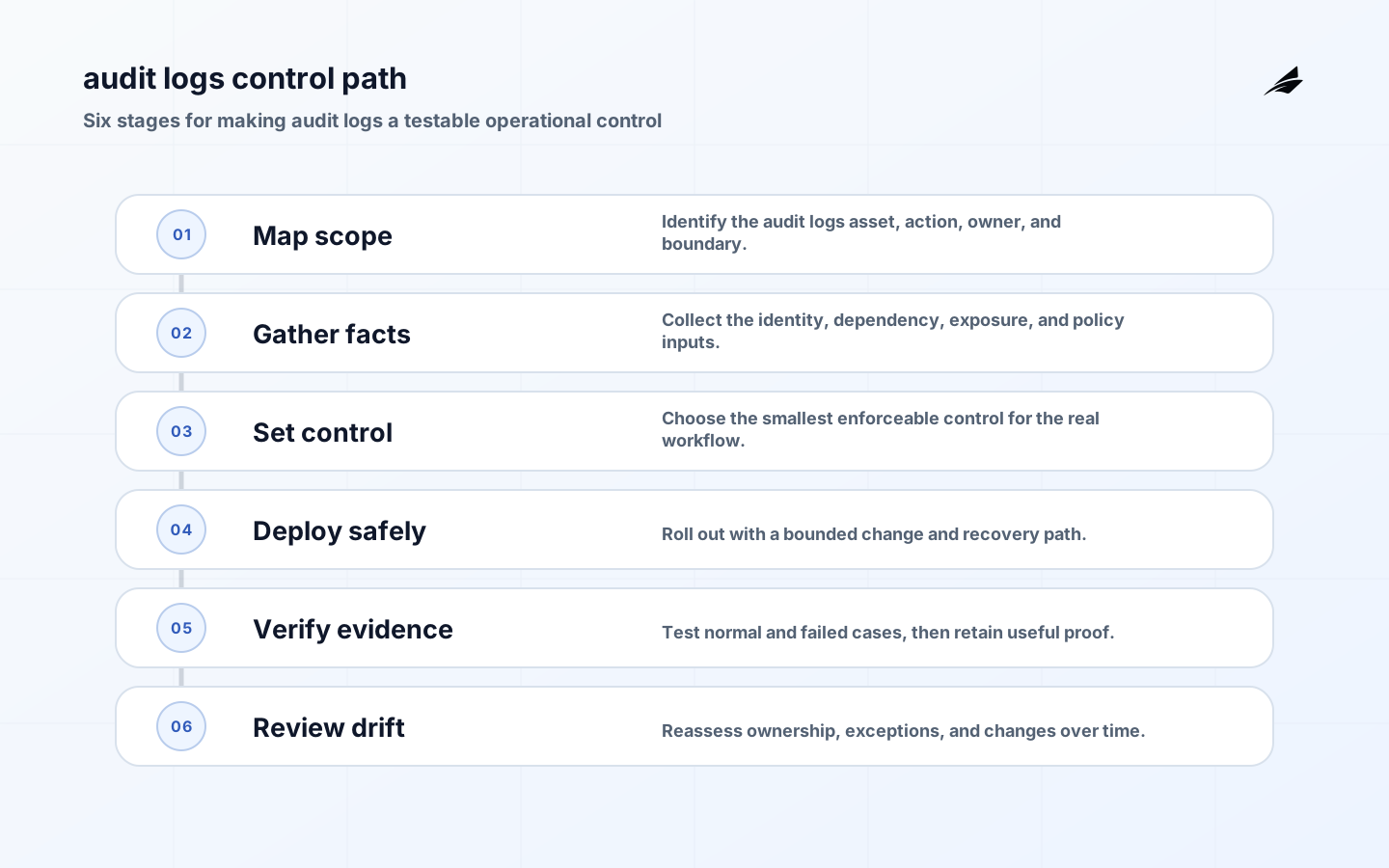
Audit logs are not a record of every technical noise signal. They are a durable account of meaningful actions and decisions: a privileged role was granted, an export was approved, a payment setting changed, a token was revoked, or an administrator viewed restricted data. A useful audit trail lets a reviewer connect an actor, action, target, time, result, request context, and policy or approval that authorized it. That is different from debug logging, which is optimized for diagnosing software behavior. Start by listing the decisions an investigator, compliance reviewer, or customer support lead would need to reconstruct after the fact.
Define audit events around consequential decisions
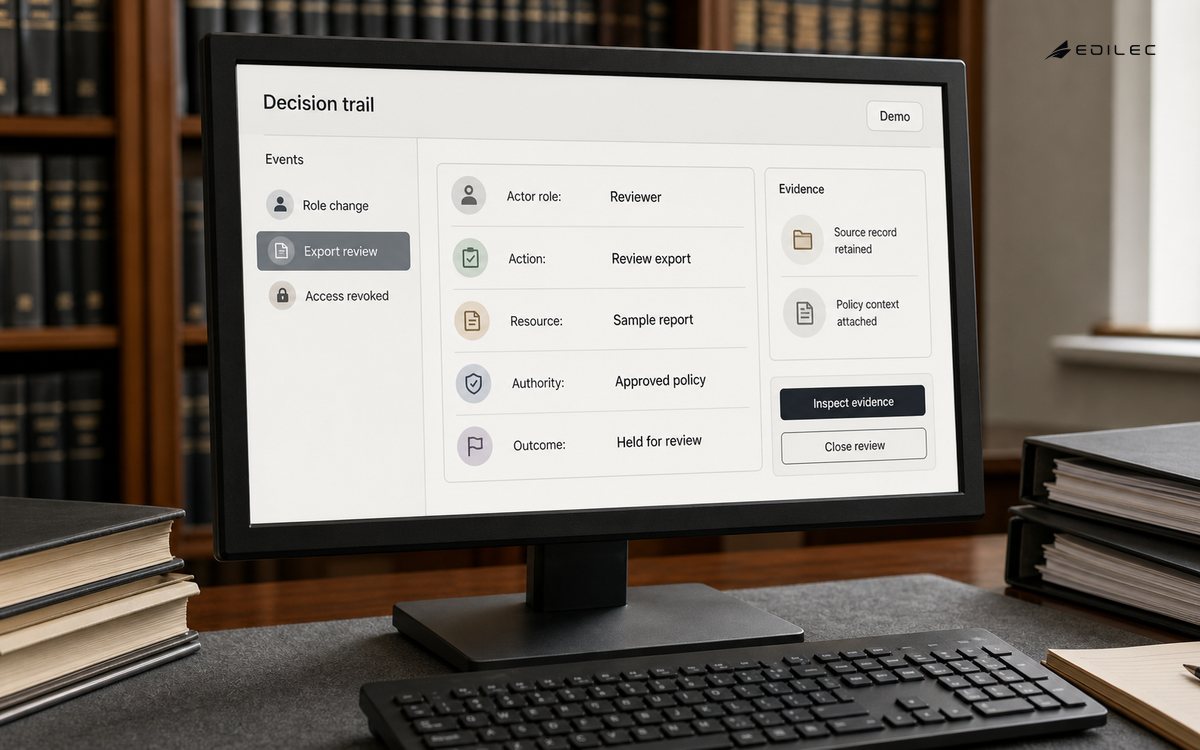
Define an event contract before choosing a log platform. Use stable event names and a documented schema with an event identifier, UTC timestamp, actor type and identifier, tenant or organizational scope, action, resource, outcome, and correlation identifier. Include the source of authority, such as role, policy version, approval reference, or service identity. Avoid logging secrets, full tokens, sensitive form values, or unrestricted personal data. The event should prove that a decision occurred without becoming another uncontrolled data store.
| Decision point | Practical choice | Evidence to retain |
|---|---|---|
| Question | Design answer | Reason |
| What happened? | Use an action name and outcome from a controlled vocabulary. | Reviewers can compare events across services. |
| Who acted? | Record human, workload, or delegated identity separately. | A client identifier is not always the decision maker. |
| What changed? | Use bounded before and after descriptors where justified. | The event can explain impact without copying records. |
| Why allowed? | Capture role, policy, or approval reference. | Authorization can be reviewed later. |
Design audit logs controls that can be enforced
Place collection at the system that makes or enforces the decision. A user interface can record intent, but the service or data boundary should record the resulting action. When a workflow crosses services, propagate a correlation identifier and retain each local decision rather than inventing one giant synthetic event. This preserves accountability when a queue retries or a backend service acts later. Clock synchronization and event ordering matter, but do not claim an ordering guarantee the architecture cannot provide; record ingestion time separately when it helps explain late arrival.
- Log the decision, not every internal implementation detail.
- Use stable actor, action, target, outcome, and correlation fields.
- Keep sensitive values out of events by design.
- Alert on missing sources and failed ingestion, not just suspicious activity.
- Version the event contract alongside the service that emits it.
Operate audit logs as a controlled change
Protect the pipeline as carefully as the application. Restrict writers, restrict readers, encrypt transport and storage, and retain an integrity signal appropriate to the risk. Centralization can improve review, yet it can also create a large target. Separate operational access from the ability to alter retention or delete events. Alert when logging stops, schema validation fails, or a high-value source goes quiet. An audit trail that appears only after an incident is not a trail; it is an untested assumption.
Work through a audit logs example
Consider a support administrator who changes a customer's account recovery method. The event should name the support identity, account scope, requested action, approval or case reference, before and after state in a privacy-preserving form, and whether the change succeeded. It should also identify the service that executed the change, not merely the browser session. This makes it possible to distinguish a legitimate support action from a stolen session, a broken automation, or an unauthorized direct API call.
Test and verify audit logs
Verification needs more than searching for a sample line. Run an allowed action, a denied action, a system failure, and a retry through the production-like path. Confirm that all events share the expected correlation data, arrive within the stated service objective, and can be read by the intended reviewers without granting them administrative mutation rights. Feed the result into incident playbooks so responders know what each field means and who owns missing evidence.
| Test or review | Expected behavior | Escalate when |
|---|---|---|
| Drill | Expected evidence | Failure signal |
| Denied request | Actor, target, deny result, and correlation identifier. | Only a frontend message exists. |
| Queue retry | Original and retried work remain traceable. | A duplicate looks like a separate action. |
| Collector outage | Source health alert and safe buffering behavior. | A silent gap in high-value events. |
| Privileged view | Read access itself is recorded and reviewable. | Log readers are invisible to the trail. |
Measure and govern audit logs
Retention should follow legal, contractual, investigation, and cost needs, not a default storage setting. Classify event types, identify the minimum searchable window, and define archival and deletion behavior. Revisit the decision when new jurisdictions, data categories, or customers change the evidence requirement. The most valuable measures are event completeness for priority workflows, source health, ingestion delay, unauthorized-read attempts, and time required to answer a representative investigation question.
Govern an audit logging program through change control. Event schema changes should be versioned, reviewed by the service owner and security stakeholders, and tested with downstream detection or reporting rules. Keep a small catalog that explains each critical event, sensitivity level, producer, consumer, and retention rule. This lets a new engineer add useful telemetry without breaking an existing investigation workflow or collecting data that nobody is permitted to use.
A further operational consideration for audit logs is that event names must represent business decisions and use stable actor, action, target, outcome, and correlation fields instead of controller names or unstructured prose. Give this boundary a named owner and a regular review point. The useful evidence is not a generic attestation; it is a record that identifies the system, decision, and observed result. When the expected control does not hold, the response should be visible and bounded so people do not improvise an unreviewed workaround. This detail is often where a policy becomes an operating practice.
Reliable audit logs depends on recognizing that the service needs an explicit choice between blocking an action, buffering evidence, or accepting a gap when a collector is unavailable, especially for privileged changes. Put the rule near the system that can enforce it and make the supporting workflow accessible to legitimate users. Document the inputs, authority, failure response, and recovery owner before relying on automation. That level of specificity helps teams distinguish a true requirement from a historical convenience, and it leaves a reviewer with enough context to assess whether the control still fits the current service.
In a mature audit logs program, read access, exports, and schema changes need their own authorization, evidence, and compatibility controls because the log platform is also a sensitive system. Test the condition through the same path used in production, including an expected failure and a recovery step. Capture concise evidence, then review it when a dependency, team, or threat assumption changes. This keeps the design connected to actual behavior instead of allowing a diagram or written rule to stand in for a control that nobody has recently exercised.
The governance implication for audit logs is that downstream alerts, reports, and investigators should receive a documented event contract so an apparently harmless producer change cannot create an invisible evidence gap. Establish an owner who can make the necessary tradeoff, a time limit for exceptions, and an escalation path for material risk. A short, well-maintained decision record is more useful than a broad policy document because it tells operators what to do when the normal path cannot be followed and how the organization will return to it.
Detection rules should be built from the same event contract used for review. A privilege grant followed by a data export, for example, may be meaningful only when the actor, tenant, and time relationship can be compared reliably. Validate the rule with representative events and retain the rationale so an alert change remains explainable.
Audit evidence is most useful when it supports a question with a known answer. Periodically ask a reviewer to determine who changed a sensitive setting, which policy allowed it, and whether the action was later reversed. Measure the time and ambiguity involved. The exercise reveals missing fields far more clearly than a generic log-volume target.
The strongest audit trail is one that can be understood outside the engineering team that produced it. Maintain field definitions, example events, ownership, and access rules beside the service documentation. During an investigation, a reviewer should be able to tell whether an event represents intent, authorization, execution, or a failed attempt. That precision avoids false conclusions and helps teams identify the real boundary that needs correction after an incident or customer dispute.
Key takeaways
- Log the decision, not every internal implementation detail.
- Use stable actor, action, target, outcome, and correlation fields.
- Keep sensitive values out of events by design.
- Alert on missing sources and failed ingestion, not just suspicious activity.
- Version the event contract alongside the service that emits it.
Frequently asked questions
Are audit logs the same as application logs? No. Application logs help engineers diagnose behavior; audit logs preserve accountable evidence about consequential actions and decisions.
Should every data read be audited? Audit reads that create meaningful privacy, security, or contractual risk. Define the scope and purpose so the volume remains reviewable.
Conclusion
In conclusion, audit logs are a product of deliberate decision modeling. Record consequential actions at their authoritative boundary, preserve enough context to explain authorization, protect the evidence pipeline, and test the trail under failure. A concise, reliable set of events is more defensible than a vast stream of unstructured noise.