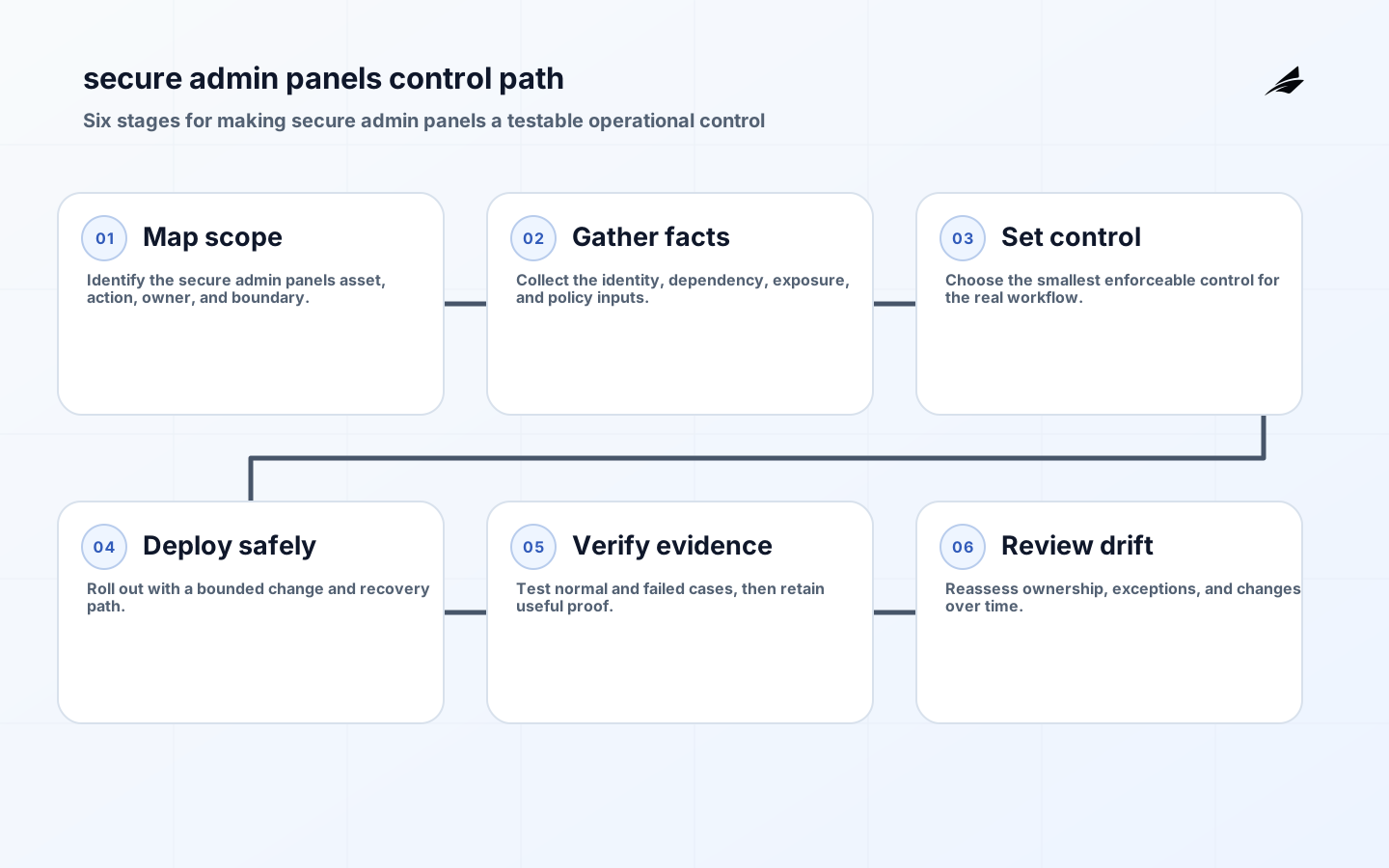
Secure admin panels deserve a different threat model from the customer-facing application because they can change identities, money movement, data visibility, configuration, and security controls at scale. The important boundary is not a route name such as /admin; it is the collection of actions that can materially affect another user or the system. Begin with an action inventory: account recovery, role assignment, impersonation, export, deletion, integration changes, feature overrides, and billing adjustments. For each one, name the approving authority, the required authentication strength, the allowed target scope, and the evidence that proves what happened.
Identify the privileged actions in the admin surface
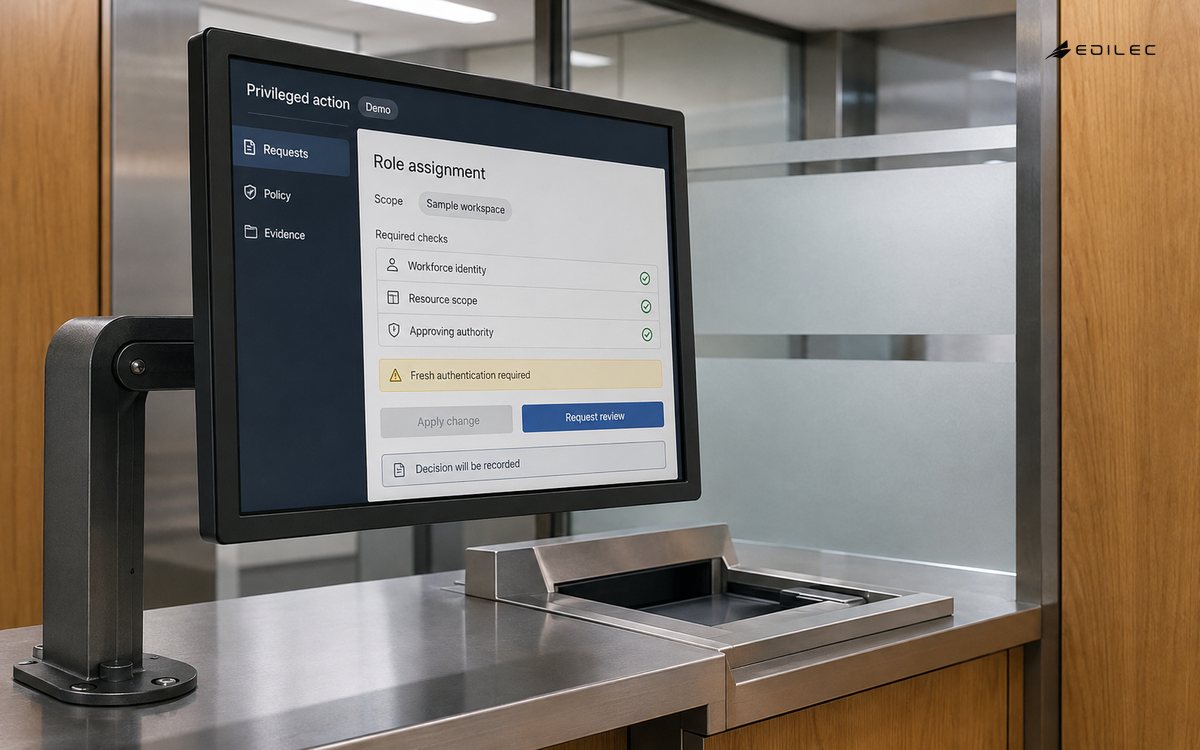
Separate administrative identity from ordinary product identity whenever practical. A staff member should not obtain a powerful console simply because they have a standard account and know a URL. Use a dedicated administrative application or clearly isolated privilege boundary, a managed workforce identity provider, phishing-resistant multifactor authentication, and session controls appropriate to the action. Reauthenticate or step up before a sensitive operation, particularly after a long idle interval, a changed device context, or an unusual location. The server must enforce the rule; a hidden button is not authorization.
| Decision point | Practical choice | Evidence to retain |
|---|---|---|
| Action | Minimum control | Evidence |
| Account recovery | Step-up authentication plus a case reference. | Staff actor, account scope, recovery result. |
| Role change | Resource-scoped permission and reviewable approval. | Prior role, new role, approver. |
| Data export | Narrow scope, reason, and expiration where possible. | Export scope, recipient, completion result. |
| Feature override | Time-bound elevation and rollback owner. | Change value, expiry, operator. |
Design secure admin panels controls that can be enforced
Authorization needs resource-level checks, not only a broad administrator role. Model what each support, finance, operations, and security role may do, to which tenant or account, under what condition, and whether a second person must approve it. Deny by default and make bulk actions conspicuous. Where a worker must temporarily perform a stronger action, issue just-in-time access with a short expiry and review it later. This is the practical expression of least privilege, not a role spreadsheet that nobody can interpret.
- Inventory actions with financial, identity, data, or configuration impact.
- Require dedicated workforce identity and strong multifactor authentication.
- Enforce authorization at the server for the exact resource and action.
- Use step-up authentication and short-lived elevation for sensitive work.
- Record the actor, target, reason, result, and approval context.
Operate secure admin panels as a controlled change
Design the interaction to resist error as well as attack. Make the affected tenant, environment, and irreversible consequence visible before execution. Require an explicit target selection rather than accepting an ambient account from a browser tab. For destructive or high-impact actions, show a reviewable summary, require a reason or case reference when appropriate, and provide a bounded undo path. Keep production and non-production visually and technically distinct so staff cannot mistake a test action for a live one.
Work through a secure admin panels example
A practical rollout starts with one administrative workflow, such as an account recovery initiated by support. Require a named staff identity, a verified customer support case, a restricted set of recovery choices, and a server-side audit event that binds the staff actor to the affected account. Test a support account with too little privilege, a legitimate account with a stale session, and an attempt to call the backend directly. The policy is working only if all paths, not just the page, are governed.
Test and verify secure admin panels
Protect the surrounding platform. Use a restrictive content security policy, secure cookies, cross-site request forgery defenses where cookie authentication applies, and careful handling of redirects and uploads. Treat admin integrations such as ticketing or data export tools as privileged clients with narrowly scoped credentials. Avoid putting production tokens in browser storage or exposing detailed errors that reveal account state. Every privileged action should be observable through audit logs and reviewable without opening the administrative system to its reviewers.
| Test or review | Expected behavior | Escalate when |
|---|---|---|
| Test | Expected behavior | Unsafe sign |
| Direct API call | The backend repeats the authorization decision. | The page is protected but the API succeeds. |
| Stale session | Sensitive action requires fresh proof of identity. | An old session can reset an account. |
| Wrong tenant | Server denies access outside the staff member's scope. | A manipulated identifier changes another tenant. |
| Bulk request | Scope and consequence are confirmed before execution. | A single click can alter uncontrolled records. |
Measure and govern secure admin panels
Measure the panel as an access program: count standing privileged accounts, just-in-time grants, denied high-risk actions, step-up failures, actions missing an approval reference, and time to remove departed staff. Sample real events to see whether the expected actor, scope, and reason are present. High error rates may indicate an unsafe workflow, not simply careless users. Fix the path before people learn informal workarounds that bypass its controls.
Govern changes through a small privileged-action register. New actions require an owner, authorization rule, logging requirement, and test cases before release. Review existing actions after material product changes and after incidents. This makes the panel easier to evolve because teams have a shared answer to a deceptively simple question: who is allowed to do what to whom, and how do we know?
A further operational consideration for secure admin panels is that the backend must repeat every resource-level authorization decision because a carefully guarded screen does not secure a direct API request, script, or alternative client. Give this boundary a named owner and a regular review point. The useful evidence is not a generic attestation; it is a record that identifies the system, decision, and observed result. When the expected control does not hold, the response should be visible and bounded so people do not improvise an unreviewed workaround. This detail is often where a policy becomes an operating practice.
Reliable secure admin panels depends on recognizing that impersonation records need to preserve both the staff actor and represented customer, with a restricted action set and an explicit reason where risk warrants it. Put the rule near the system that can enforce it and make the supporting workflow accessible to legitimate users. Document the inputs, authority, failure response, and recovery owner before relying on automation. That level of specificity helps teams distinguish a true requirement from a historical convenience, and it leaves a reviewer with enough context to assess whether the control still fits the current service.
In a mature secure admin panels program, bulk edits and exports should become cancellable, scoped jobs with a request record rather than unbounded browser actions that are hard to review or reverse. Test the condition through the same path used in production, including an expected failure and a recovery step. Capture concise evidence, then review it when a dependency, team, or threat assumption changes. This keeps the design connected to actual behavior instead of allowing a diagram or written rule to stand in for a control that nobody has recently exercised.
The governance implication for secure admin panels is that ticketing, exports, notifications, and other supporting integrations belong inside the privileged boundary and should be reviewed alongside staff access. Establish an owner who can make the necessary tradeoff, a time limit for exceptions, and an escalation path for material risk. A short, well-maintained decision record is more useful than a broad policy document because it tells operators what to do when the normal path cannot be followed and how the organization will return to it.
Support training should include the security consequences of privileged workflow choices. Staff need to recognize when a case lacks sufficient verification, when a request exceeds their scope, and how to escalate without resorting to a shared account. A well-designed panel makes the right path efficient, but training reinforces why the safeguards exist when a customer or internal stakeholder applies pressure.
Administrative interfaces should be included in change and penetration testing scopes. New account fields, payment methods, integrations, and bulk features often introduce privileged actions indirectly. Reviewing only the public product misses the surface where one mistake can affect many users. Keep test cases tied to the action inventory so new powers cannot appear without an owner and policy.
Good administrative design makes legitimate work visible without making it cumbersome. A support user who reaches a permission boundary should receive a clear escalation route, not a vague denial that encourages a shared account or informal workaround. Pair that path with a precise record of the requested action and recipient scope. Over time, these requests reveal whether the role model needs refinement or whether a sensitive action should remain deliberately rare and separately approved.
Key takeaways
- Inventory actions with financial, identity, data, or configuration impact.
- Require dedicated workforce identity and strong multifactor authentication.
- Enforce authorization at the server for the exact resource and action.
- Use step-up authentication and short-lived elevation for sensitive work.
- Record the actor, target, reason, result, and approval context.
Frequently asked questions
Should administrators use the same login as customers? A shared identity can be workable only with a robust privilege boundary, but a separate workforce identity and administrative surface usually reduce confusion and exposure.
Is an audit record enough for risky admin actions? No. Logging supports accountability after the fact; authorization, authentication, and workflow controls must prevent the improper action first.
Conclusion
In conclusion, secure admin panels are built from explicit privileged actions, strong and separate workforce identity, resource-scoped authorization, and usable safeguards against mistakes. Protect the backend as rigorously as the screen, keep a clear record of every material action, and revisit the boundary when the product gains new powers.