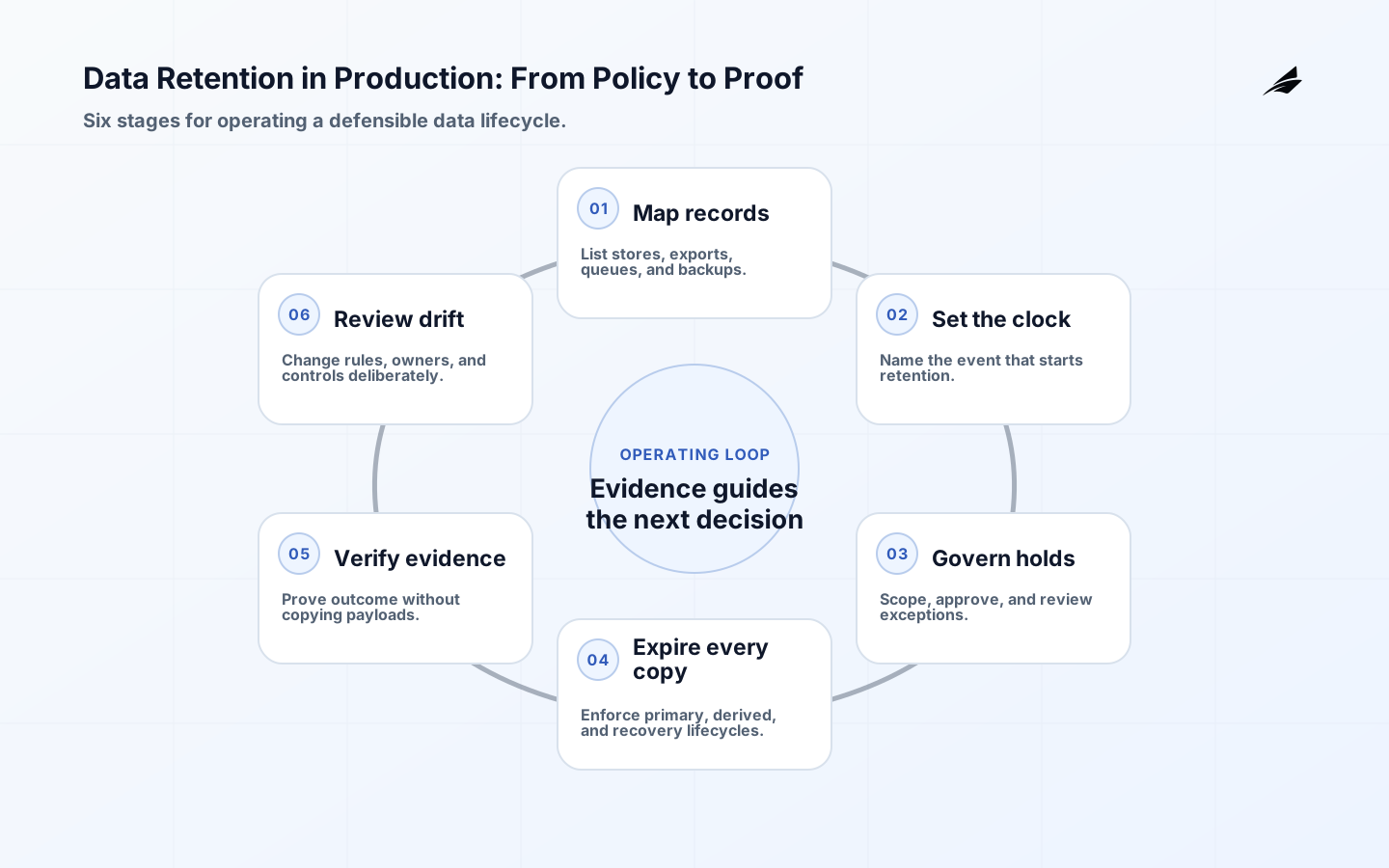
Data retention becomes a production concern when a team must honor a lifecycle rule during ordinary releases, support requests, outages, investigations, backups, and vendor changes. A number on a policy document is not enough. Someone must know why a record exists, which event starts its retention clock, where its copies live, who may pause deletion, and what evidence proves that expiry happened. Keeping everything forever increases exposure and cost; deleting without a defensible reason can damage service continuity or an investigation. The practical goal is a data lifecycle that is narrow enough to explain, enforced close to each copy, and observable without creating a second uncontrolled copy of the information.
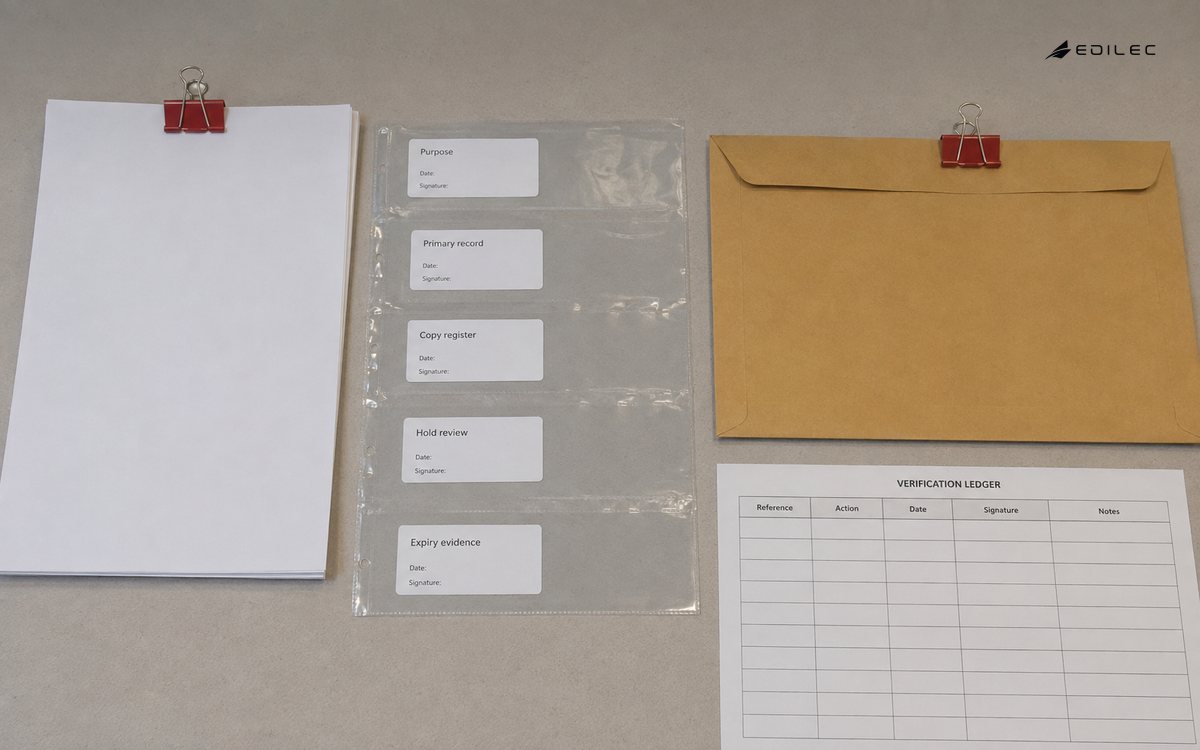
Start with a record map, not a number
Begin with the records a real workflow creates and the decisions those records support. Include primary tables, object storage, search indexes, message payloads, application logs, analytics extracts, support attachments, replicas, developer environments, and recovery media. For each class, name the purpose, owner, system of record, sensitivity, retention trigger, deletion mechanism, and evidence expected after expiry. Do not let the database schema stand in for the lifecycle: a customer export may be the most durable copy, and a queue may hold the same personal data for days after the screen stops showing it. A map that follows one record from collection to disposal gives product, privacy, security, and operations a common object to review.
Classify by purpose and consequence
Group data by the reason it must remain available, not by the team that happens to store it. A transaction record, an authentication event, a temporary upload, a support conversation, and a derived analytics table have different owners and different failure costs. Record the minimum fields needed to distinguish them. If a policy cannot say whether the clock starts at account closure, shipment completion, contract end, or the last support action, it cannot be implemented consistently. Classification also makes exceptions visible: a legal or investigative hold should point to an authorized case and an expiry review, rather than quietly turning a short-lived record into a permanent one.
| Record class | Clock starts when | Enforcement point | Proof to retain |
|---|---|---|---|
| Customer profile | Service relationship ends | Primary store and derived indexes | Policy version and deletion result |
| Order or invoice | Transaction is settled | System of record and exports | Settlement reference and hold state |
| Security event | Event is written | Log pipeline and archive | Ingestion, access, and expiry audit |
| Temporary upload | Workflow completes or is abandoned | Object store and scan queue | Object identifier and disposal outcome |
| Backup copy | Backup set is created | Backup lifecycle service | Retention class and purge confirmation |
Choose the event that starts the retention clock
A retention period is only meaningful when its start event is stable and available to the system that enforces it. Define whether the clock begins at collection, last use, fulfillment, account closure, case closure, or another business event. Keep that event as durable metadata; calculating it later from a mutable timestamp invites drift. If a record changes purpose, create a deliberate reclassification path rather than extending it silently. If the event is uncertain, mark the record pending review and give the owner a deadline. This is more honest than pretending that an incomplete integration has produced a reliable deletion date. The same rule should be understandable to a support agent, an engineer reading a job, and a reviewer examining an exception.
Keep legal and investigative holds explicit
A hold is an authoritative input to deletion, not a note attached to one database row. Store the scope, approving role, affected record classes, systems covered, reason, start date, and review or release condition. The deletion worker must check the hold before acting, and a hold release must be auditable. Test the collision between a customer deletion request and a hold before promising either outcome. When a provider or backup system cannot support the same granularity, document its actual behavior and protect the retained copy until the approved lifecycle ends.
The surrounding control surface matters. Secure administration paths help when an operator can change a schedule or place a hold, while audit-log design gives investigators a way to reconstruct that decision. Zero trust planning is a useful adjacent comparison when retention jobs cross service or tenant boundaries. Keep the ownership lines clear: retention policy, storage enforcement, privileged change, and evidence review may have different owners.
Make every copy part of the policy
A production architecture should show how a record reaches primary storage, replicas, caches, search, queues, exports, and backups, and where each copy expires. NIST's current SP 800-88 Rev. 2 guidance treats sanitization as a process that makes access to target data infeasible for a defined effort; that is a different question from marking a row deleted. At the application layer, use a durable lifecycle state, an idempotent deletion job, and a verification step. At the storage layer, configure the service's lifecycle behavior and version semantics deliberately. For example, Amazon S3 Object Lifecycle Management can expire objects, but the policy still needs to account for versions, incomplete multipart uploads, replication, and exports.
| Copy or path | Common blind spot | Production decision |
|---|---|---|
| Primary database | Delete is treated as the whole lifecycle | Record state, owner, and verified completion |
| Search or cache | Indexes outlive the authoritative record | Invalidate or rebuild with an expiry check |
| Queue or stream | Payload remains after the workflow ends | Use bounded delivery and payload minimization |
| Analytics export | A file leaves the normal policy path | Approved destination, owner, and object expiry |
| Backup and replica | Restores recreate expired data | Align backup retention and post-restore cleanup |
Ship deletion as a controlled workflow
Release one record class first, preferably one with high volume and a clear owner. Build a preview mode that lists the records eligible for expiry without mutating them, then compare the result with a business sample. Make deletion idempotent: a retry should not create a new exception or corrupt a related record. Give each run a batch identifier, a bounded scope, a reason, and a terminal state. If an external system fails, keep the record visible as incomplete work and route it to an owner. A clean dashboard should distinguish not yet due, due and processed, blocked by hold, failed, and verified. This is the difference between a scheduled script and an operable retention capability.
- Preview eligible records and compare a sample with the approved schedule.
- Use a stable retention-class and policy-version identifier on every lifecycle decision.
- Make deletion, hold checks, retries, and verification safe to repeat.
- Stop before mutation when authoritative dates, ownership, or hold status are missing.
- Protect service availability by bounding batch size, concurrency, and retry duration.
- Record exceptions with a reason, owner, affected copies, and review date.
- Exercise restore behavior so an old backup cannot quietly recreate expired information.
- Give support a customer-safe status and a path to correct an incomplete request.
Test the collisions people will actually create
The most revealing tests are not a clean delete on an empty database. Try a record that has a hold, a record copied to search and analytics, a job that stops after the primary delete, a duplicate request, a clock change, a failed provider call, a late correction, and a restore made from a backup that predates expiry. Verify both the customer-visible result and the evidence an operator needs to explain it. Test access during the transition as well: a record marked for deletion may still be sensitive until every permitted path respects its state.
Prove expiry without copying the data again
Evidence should establish what policy applied, which event started the clock, which systems were addressed, what was blocked, and who reviewed an exception. It rarely needs the original payload. Keep identifiers, timestamps, counts, job outcomes, policy versions, hold references, and verification samples under controlled access. The NIST Privacy Framework treats privacy risk as something organizations identify and manage alongside enterprise decisions; that is a useful reason to minimize telemetry as well as production data. Use NIST SP 800-53 controls as a reference for access, audit, media protection, and accountability, then adapt the evidence to the records and threats your service actually has.
Give exceptions an owner and an expiry date
Retention rules decay when exceptions have no end. Maintain a small register of schedules, record classes, system owners, policy approvers, holds, service limitations, and review dates. A change to product purpose, a new integration, a support export, or a jurisdiction should trigger review. NIST's Cybersecurity Framework 2.0 is useful here because it frames governance, identification, protection, detection, response, and recovery as connected activities rather than a one-time configuration. The register should show the current rule, the evidence supporting it, and the person who can change it. Avoid turning the register into an unreadable catalog: the best entry is short enough to guide a decision during an incident.
Use signals that lead to a decision
Measure the lifecycle as an operating process. Useful signals include the age of due records, verification coverage, failed deletion jobs, hold duration, unknown-copy findings, restore cleanup time, export expiry coverage, and the number of exceptions past review. Set an owner and response for each threshold. A growing queue of records with missing retention triggers calls for data-model work; repeated hold collisions call for governance or workflow changes; successful primary deletes with stale search results call for architecture work. Review a few real cases alongside aggregate metrics so a large volume of harmless records does not hide one consequential failure.
| Signal | What it can reveal | Decision to make |
|---|---|---|
| Due items older than the service target | Job, clock, or capacity problem | Repair, pause, or increase bounded capacity |
| Deletion verified only in primary storage | Copy map is incomplete | Add an enforcement or evidence path |
| Exceptions past review date | Temporary rule became structural | Expire, renew with authority, or redesign |
| Restore recreates expired records | Recovery lifecycle is misaligned | Change backup policy and cleanup procedure |
| Export objects without expiry | Governed data escaped the normal path | Limit destination and add owner review |
Data retention decisions worth carrying forward
- Define purpose, record class, clock-start event, owner, and evidence before choosing a storage feature.
- Map primary records, derived copies, exports, queues, replicas, and backups as one lifecycle.
- Make holds authoritative, scoped, reviewable, and visible to every deletion path.
- Release deletion in bounded batches with preview, idempotency, verification, and an owned exception queue.
- Measure expiry and copy coverage, not merely whether a policy document was approved.
Questions teams ask about production data retention
Is a retention schedule mainly a privacy document?
No. It is also an operational, security, resilience, cost, and records-management decision. Privacy risk is one important reason to minimize data, but the team must also preserve records needed for service delivery, approved investigations, and accountable reporting. The schedule should state the purpose and the owner so a future change can be evaluated rather than inherited by default.
Does deletion mean every backup copy disappears immediately?
Not necessarily. Backup sets, immutable archives, replicas, and supplier systems may have different technical lifecycles. What matters is that the organization knows the boundary, prevents ordinary access to expired data, aligns the approved backup schedule, and explains what a restore does. A customer-facing delete should not claim more than the architecture can verify.
How should a deletion request interact with a hold?
The hold should be an authoritative, scoped input that pauses the affected routine deletion and records who approved it and when it will be reviewed. Keep the customer and support status accurate without disclosing sensitive case details. When the hold ends, return the record to a normal lifecycle state and retain evidence of the release.
Conclusion: make data retention provable
Production data retention is a chain of decisions, not a date field. Map the record, define the clock, govern holds, enforce every copy, and preserve enough evidence to explain the result without reproducing the information. When teams review exceptions, restores, exports, and failed jobs as part of normal operations, the lifecycle rule stays defensible as the product changes.