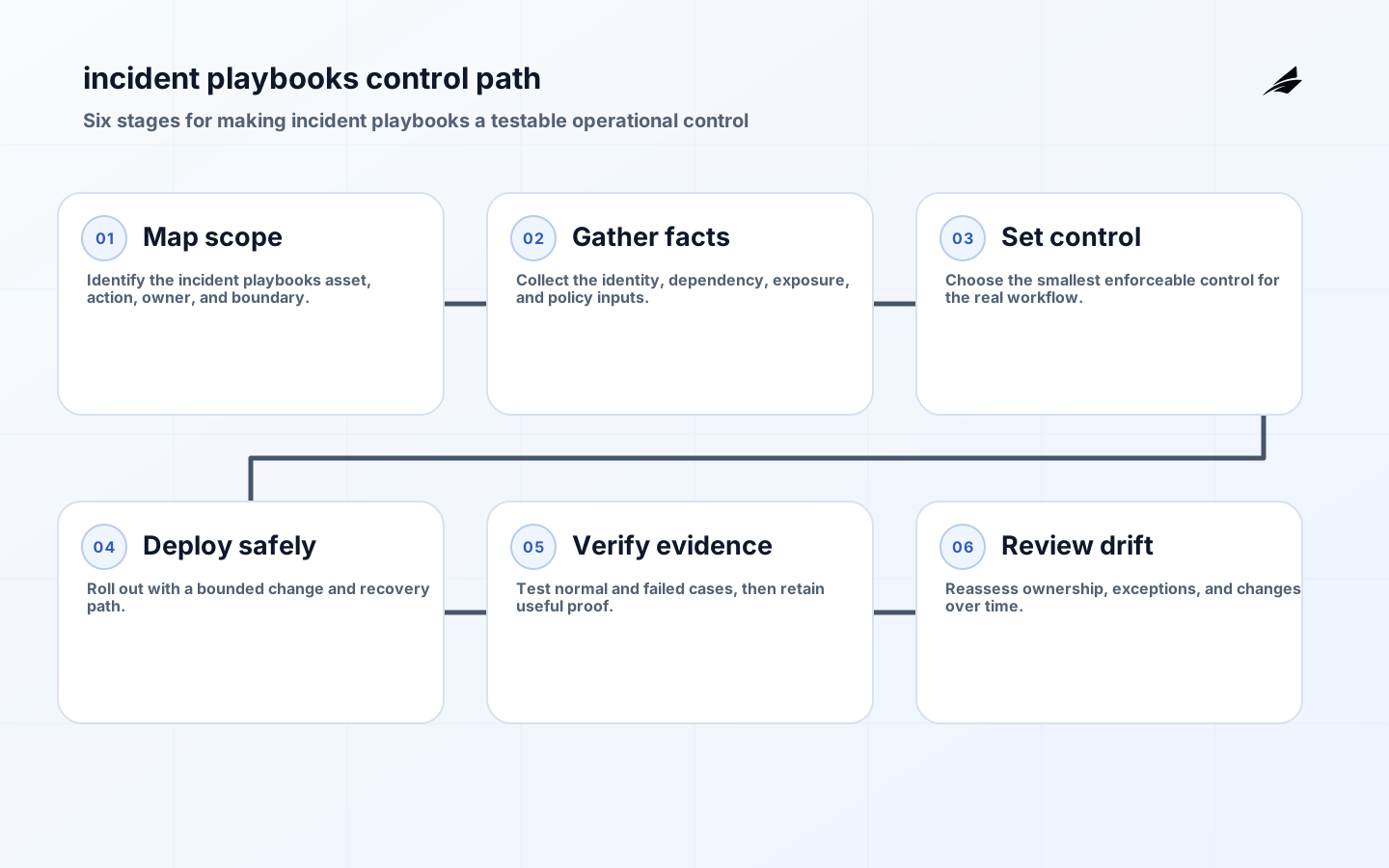
Incident playbooks are not long scripts that predict every attack. They are concise decision aids for recurring high-consequence situations: a compromised account, suspicious export, ransomware signal, exposed credential, third-party breach notice, or denial-of-service event. Under pressure, people need to know who can declare an incident, what evidence to preserve, who may contain a system, when to involve legal or communications teams, and how to recover without destroying useful facts. A playbook that assigns those choices before an event creates speed without pretending uncertainty has disappeared.
Design incident playbooks around decisions under pressure
Start with a scenario defined by observable triggers and business harm, not by a generic threat label. For example, 'potentially stolen customer-support session used to export account data' is more actionable than 'account compromise.' Identify the technical owner, incident lead, decision authority, communications owner, and external contacts. State the immediate safe actions, evidence sources, containment options, and conditions for escalation. Keep the document usable by someone who was not present when it was written; links, access paths, and contact roles should be tested.

| Decision point | Practical choice | Evidence to retain |
|---|---|---|
| Decision | Information needed | Owner |
| Declare incident | Trigger, potential harm, and confidence level. | Incident lead or designated delegate. |
| Contain account or system | Scope, blast radius, and reversibility. | Technical owner with defined authority. |
| Notify stakeholder | Known facts, legal or contractual trigger, next update. | Communications and legal liaison. |
| Recover service | Cause addressed, monitoring active, residual risk understood. | Service owner and incident lead. |
Design incident playbooks controls that can be enforced
Evidence handling should begin early. Preserve relevant audit logs, authentication records, system snapshots, tickets, and timestamps while avoiding uncontrolled copying of sensitive data. Record who collected what, from where, when, and how its integrity was maintained. Do not let an eagerness to restore service erase the facts needed to understand scope. At the same time, do not delay safe containment waiting for perfect certainty: revoke a known exposed credential, isolate an affected host, or suspend a clearly abusive account according to preapproved authority.
- Define a scenario by observed trigger and potential business harm.
- Name incident lead, technical owner, decision authority, and communications role.
- Preserve evidence while taking safe, authorized containment steps.
- State containment options with service and recovery consequences.
- Exercise realistic complications and track corrective actions to completion.
Operate incident playbooks as a controlled change
Containment choices need explicit tradeoffs. Disabling a shared integration may stop a breach but also disrupt customers; resetting all sessions may protect accounts while overwhelming support. A playbook should list the available actions, expected effect, owner, prerequisites, and rollback or recovery implication. Use tiers so the incident lead can choose a proportionate response. Where technical systems can automate a reversible protective action, test that automation and retain human escalation for cases where context matters.
Work through a incident playbooks example
Run a tabletop on a realistic scenario. Give the participants an initial alert, partial evidence, a customer question, and a complication such as an unavailable log source or a vendor not responding. Ask them to decide whether to declare, what to contain, who approves communication, and how they will verify recovery. The value is in discovering missing authority, inaccessible tooling, or unclear terminology. Capture the gaps as owned changes, then repeat the exercise after remediation rather than treating it as a one-time workshop.
Test and verify incident playbooks
Recovery requires a clear endpoint. Restore the service or account only after the team has addressed the immediate cause, validated that containment is still in place, and understood what monitoring will detect recurrence. Communicate facts, actions, and next expected updates without speculation. Customer-facing messages should be coordinated with legal and privacy obligations, but technical teams should not wait for a polished narrative before recording a truthful timeline and preserving evidence. A completed incident has documented decisions, not merely a closed ticket.
| Test or review | Expected behavior | Escalate when |
|---|---|---|
| Exercise inject | Expected response | Gap revealed by failure |
| Missing log source | Use alternate evidence and record the gap. | Playbook assumes inaccessible telemetry. |
| Vendor delayed | Escalate through prelisted contact path. | No owner knows contractual notification route. |
| Mass session reset | Assess support and customer impact before action. | Containment has no operational plan. |
| Conflicting facts | Record confidence and avoid unsupported claims. | Teams communicate speculation as fact. |
Measure and govern incident playbooks
Measure readiness with exercise cadence, time to acknowledge, time to contain, evidence availability, contact-path success, and the number of corrective actions completed after reviews. Metrics should illuminate decisions, not reward fast closure at the expense of scope analysis. Review near misses as well as declared incidents; they often reveal weak controls before there is material harm.
Govern playbooks as living operational documents. Assign an owner for each scenario, update after architecture or vendor changes, and review after incidents and exercises. Keep sensitive detail in controlled locations, but ensure responders can access what they need during an outage. Train backup roles; a plan that depends on one person being awake and reachable is not a resilient plan.
A further operational consideration for incident playbooks is that preapproved communications templates and one maintained timeline help teams state verified facts, actions, uncertainty, and next updates without producing conflicting narratives. Give this boundary a named owner and a regular review point. The useful evidence is not a generic attestation; it is a record that identifies the system, decision, and observed result. When the expected control does not hold, the response should be visible and bounded so people do not improvise an unreviewed workaround. This detail is often where a policy becomes an operating practice.
Reliable incident playbooks depends on recognizing that investigation material requires controlled collection, access, indexing, and lifecycle rules so response evidence does not create uncontrolled sensitive-data copies. Put the rule near the system that can enforce it and make the supporting workflow accessible to legitimate users. Document the inputs, authority, failure response, and recovery owner before relying on automation. That level of specificity helps teams distinguish a true requirement from a historical convenience, and it leaves a reviewer with enough context to assess whether the control still fits the current service.
In a mature incident playbooks program, incident command handoffs should record objective, scope, containment, pending decisions, next communication, and responsible people before a shift change. Test the condition through the same path used in production, including an expected failure and a recovery step. Capture concise evidence, then review it when a dependency, team, or threat assumption changes. This keeps the design connected to actual behavior instead of allowing a diagram or written rule to stand in for a control that nobody has recently exercised.
The governance implication for incident playbooks is that post-incident reviews should assess technical cause and decision quality, assign owned improvements, and verify completion through normal governance. Establish an owner who can make the necessary tradeoff, a time limit for exceptions, and an escalation path for material risk. A short, well-maintained decision record is more useful than a broad policy document because it tells operators what to do when the normal path cannot be followed and how the organization will return to it.
Playbooks should account for decision fatigue. During a prolonged event, rotate leads where possible, keep a clear action queue, and separate urgent containment work from analysis that can proceed asynchronously. A calm structure helps responders avoid repeating checks or making irreversible changes without recording why. The objective is sustained judgment, not merely faster typing.
External dependencies need their own response contacts and evidence expectations. For a vendor, cloud provider, payment processor, or identity service, know the support tier, escalation method, required account identifiers, and information the provider may request. Test the contact path in a low-stakes exercise. An incident is a poor time to discover that the only contract owner has left the company.
Playbook quality is visible in the first hour of an event. Responders should be able to identify the current lead, preserve the relevant evidence, choose a reversible containment action, and establish a reliable cadence for updates. If any of those steps depends on an inaccessible document or a single person's memory, treat it as a readiness gap. Small, repeated exercises are the most dependable way to make the sequence familiar before the stakes are high.
A playbook should also state when to stop an action. Containment that is expanding harm, evidence collection that exceeds scope, or a recovery that cannot be verified should trigger a defined escalation. Naming these stop conditions protects responders from feeling compelled to continue a failing path merely because it is written down.
Key takeaways
- Define a scenario by observed trigger and potential business harm.
- Name incident lead, technical owner, decision authority, and communications role.
- Preserve evidence while taking safe, authorized containment steps.
- State containment options with service and recovery consequences.
- Exercise realistic complications and track corrective actions to completion.
Frequently asked questions
How detailed should an incident playbook be? Detailed enough to guide roles, evidence, decisions, and actions for a defined scenario, but concise enough to use under pressure. Link to controlled technical runbooks where needed.
Can automation replace an incident lead? Automation can execute bounded containment and gather evidence, but a lead is still needed to weigh impact, scope, communication, and exceptions.
Conclusion
In conclusion, incident playbooks make response decisions premeditated without making them rigid. Define triggers, authority, evidence, containment, communication, and recovery for real scenarios; exercise the sequence; and turn lessons into owned changes. That is how a document becomes operational capability.