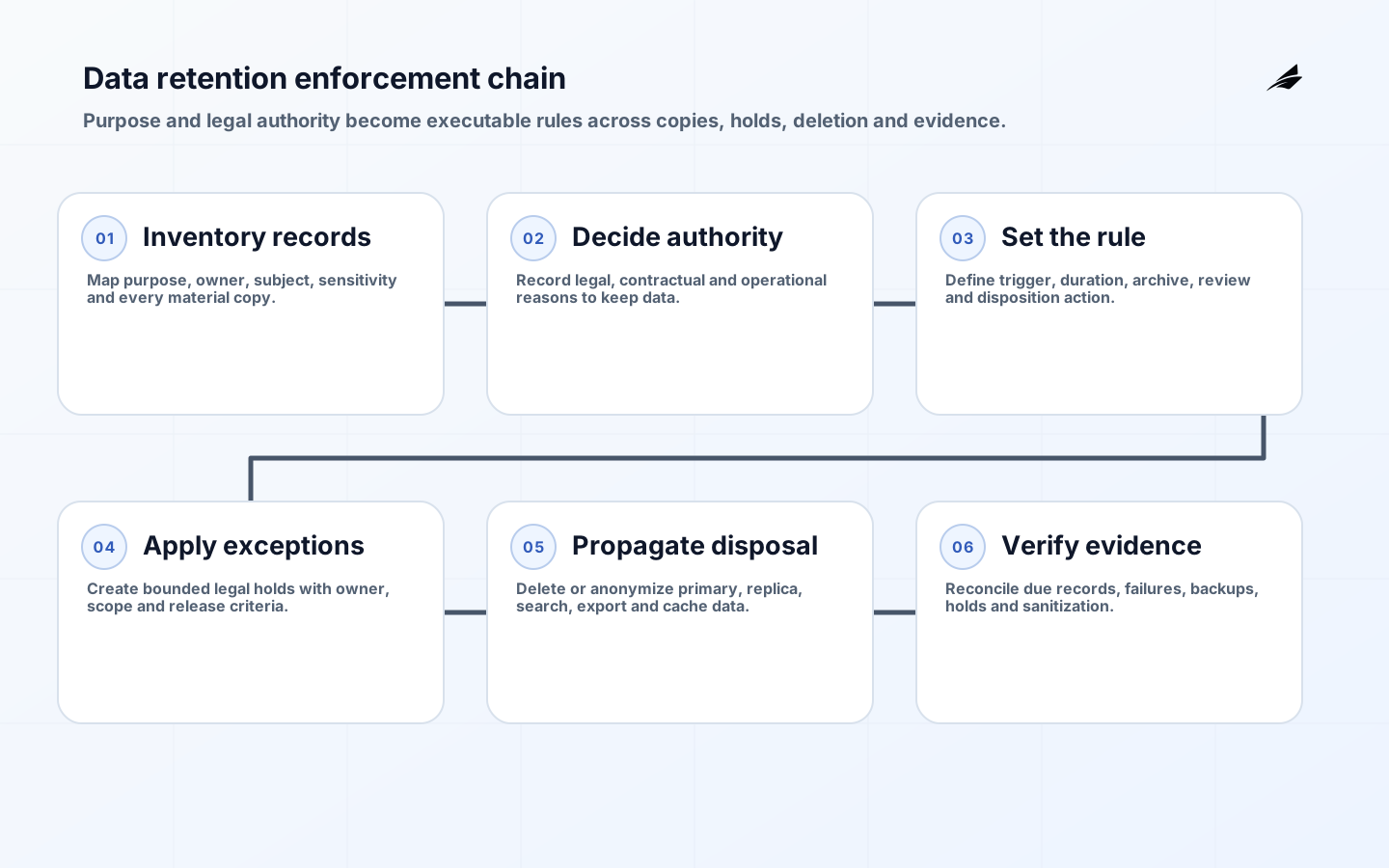
Data retention policies for business software determine how long information remains identifiable, where it moves, when it becomes unavailable to normal use and how disposal is proven. A policy document is only the beginning. The difficult work is translating purpose, legal authority, contractual obligation, operational need and litigation or investigation holds into rules that reach databases, object storage, search indexes, analytics, logs, exports, caches, devices and backups.
This guide is an engineering and governance framework, not jurisdiction-specific legal advice. Qualified legal, privacy and records specialists must decide the applicable obligations. Product and engineering teams make those decisions reliable by maintaining an inventory, using explicit lifecycle triggers, minimizing copies, designing exceptions and producing evidence. Related implementation concerns are covered in the vendor access management guide and incident evidence guide.
Inventory records by purpose, owner and copy
Begin with record classes, not database tables. Examples include customer account, employee file, invoice, support conversation, security event, consent record, product telemetry and backup. For each class, record purpose, people concerned, sensitivity, authoritative system, business owner, legal or contractual authority, lifecycle trigger and every material copy. Map exports to finance, data warehouses, search, message queues, logs, email, file storage and suppliers. A retention rule that reaches only the primary table is incomplete.
Separate data needed to provide the current service from data retained for security, legal claims, finance, research or analytics. These purposes can have different access and duration. Minimize fields before debating storage length: information never collected or promptly transformed into a non-identifying aggregate creates less retention burden. The NIST Privacy Framework provides an outcome-based approach for managing privacy risk alongside business objectives.
| Record-class field | Decision to document | Engineering consequence |
|---|---|---|
| Purpose | Why the record exists | Allowed processing and access path |
| Trigger | When the retention clock starts | Event captured with reliable timestamp |
| Duration | How long the purpose justifies keeping it | Scheduled review or disposition date |
| Disposition | Delete, anonymize, archive or transfer | Executable action per storage class |
| Exception | Legal hold or regulated preservation | Scoped override with owner and release |
Translate the retention schedule into executable rules
A rule needs a stable record class, trigger, duration, action, scope, owner and version. Triggers may be account closure, contract end, case resolution, final payment, employee departure or consent withdrawal. Calendar age from creation is often wrong. Capture the trigger as a domain event and store the calculated review or disposition date. If a record reopens, define whether and why the clock changes. Keep policy versions so the organization can explain which rule applied at a given time.

Centralize rule evaluation where feasible, but let each storage owner implement deletion according to its technology. Produce due items or signed disposition commands with idempotent identifiers. Consumers should report completed, not found, held, failed or unsupported. Reconcile expected and actual outcomes. Avoid one large deletion job with no per-record evidence. Run in bounded batches, rate-limit dependent systems and make failure queues visible. Test time zones, leap dates, reopened records and policy changes.
Choose deletion, anonymization and archive deliberately
Deletion removes the record from ordinary and recoverable product use according to the system design. Anonymization may permit continued aggregate or research use only when re-identification is not reasonably possible in context; replacing a name with a stable identifier is usually pseudonymization, not anonymization. Archive is continued retention with restricted access, not disposal. Define why each action is appropriate and ensure interfaces do not suggest data is deleted while a searchable copy remains.
Propagate the action to attachments, derived profiles, embeddings, search indexes, caches, exports and downstream processors. Decide how aggregates behave when one subject is removed. In event-sourced systems, consider cryptographic separation, redaction events and derived-view rebuild while preserving necessary transaction integrity. Avoid mutable audit records that let ordinary administrators erase evidence of their own actions. Balance security and privacy purposes through documented authority and restricted access.
| Storage location | Retention challenge | Verification |
|---|---|---|
| Primary database | Relations and shared business records | Deleted or de-identified keys plus referential checks |
| Search and cache | Stale derived copies | Reindex, purge and sampled query |
| Analytics | Replicated events and profiles | Dataset lineage and deletion acknowledgement |
| Logs | Operational need and embedded identifiers | Structured minimization and tiered expiry |
| Backup | Immutable recovery copies | Expiry, restore controls and post-restore enforcement |
Handle backups and legal holds without pretending they are ordinary data
Immutable backups cannot usually support record-by-record deletion without undermining recoverability. Define backup retention, encryption, access and expiry separately. Removed data should not return to production if an older backup is restored: run a post-restore suppression or deletion ledger before service resumes. Restrict backup use to recovery, log restores and prevent ordinary analytics or support access. Document residual duration and risk rather than claiming immediate erasure from every immutable copy.
Legal holds suspend normal disposition for a defined population and purpose. Require an authorized owner, scope, start, review date and release event. Apply holds using stable identifiers and test that policy changes do not bypass them. Keep held data access-limited and discoverable without copying it widely. When a hold ends, recalculate disposition rather than restarting the full period by default. A hold should never become an undocumented permanent exception.
Connect logical deletion with secure media sanitization
Logical deletion addresses application records; media sanitization addresses storage devices or assets leaving controlled use. NIST SP 800-88 Rev. 2 describes a program for selecting sanitization according to information sensitivity, media and disposition. Cloud customers may not handle physical devices, but contracts and provider evidence still matter. For owned laptops, disks and appliances, define clear, purge or destroy methods, approved tools, verification and chain of custody.
Cryptographic erase can be effective when encryption and key management were designed for it. Verify that keys are unique to the intended boundary, copies do not remain under other keys and key destruction is controlled and evidenced. Deleting a key without understanding snapshots, replicas or escrow can create false confidence. Keep sanitization records proportionate to risk: asset, method, tool, operator, verification, date and exception.
Govern retention through evidence and change control
Assign a business owner and technical steward for each record class. Review rules when products, laws, contracts, suppliers or data uses change. Include retention in architecture review and supplier procurement. Contracts should identify return, deletion, backup behavior, subprocessors and evidence. The ICO’s storage-limitation guidance emphasizes justified periods, documented policies, periodic review and erasure or anonymization when data is no longer needed.
Measure due records, completed actions, failures, overdue exceptions, legal holds, unsupported stores and restored-data reprocessing. Sample records end to end. Test subject or customer deletion requests with identity verification, scope and communication. Do not publish a deletion success rate that excludes difficult systems. Retention incidents should enter the same improvement process as security and reliability incidents, with root cause and prevention.
Implement lifecycle and deletion requests as controlled workflows
Account closure, customer deletion and individual-rights requests need identity verification, scope, authorization and communication. Separate the requester from the records when an organization acts for multiple users. Inventory legal or contractual reasons that prevent immediate disposal and explain them in appropriate language. Generate one case identifier and issue bounded commands to each system. The case should show expected stores, responses, exceptions and final approval.
Design for shared records. An invoice or support conversation may concern several parties and cannot always be removed as one row. Define field-level redaction, relationship preservation and access restriction according to purpose. Avoid deleting evidence needed to prove that a request was fulfilled; retain the minimum case record under its own purpose and period. Prevent support staff from reopening or copying disposed content through old exports.
Communicate status without overpromising. Received, identity pending, processing, exception review and completed are distinct. Set internal targets but allow specialists to review uncertain scope. Re-run failed system commands idempotently and escalate unsupported stores. After completion, sample queries and exports to verify absence, then record policy version and remaining bounded exceptions such as unexpired backup copies.
Test the workflow with current, closed, reopened, held and multi-tenant accounts. Include a restore from backup and confirm that suppression re-applies. Exercise supplier deletion and collect acknowledgement. A tabletop review across privacy, product, engineering, security and support often reveals conflicting customer language or hidden data paths before a real deadline does. Repeat the exercise after a material supplier, schema or policy change, and retain the failed assertions as owned engineering work.
Key takeaways
- Model retention by record class, purpose, trigger, owner and every material copy.
- Turn the schedule into versioned, idempotent and reconciled disposition work.
- Distinguish deletion, anonymization, restricted archive and legal hold.
- Prevent restored backups from reintroducing data whose retention ended.
- Link application deletion with supplier evidence and media sanitization.
Frequently asked questions
Can one retention period cover all customer data?
Rarely. Account, invoice, support, security and consent records serve different purposes and may have different authorities. Use a coherent schedule, but assign periods and triggers by record class rather than convenience.
Is soft delete acceptable?
It is useful for a short recovery window, not final disposition. Define expiry, restrict access and ensure a later job performs the required deletion or anonymization across downstream systems.
Should security logs be kept forever?
No universal period is appropriate. Retain enough for defined detection, investigation and legal purposes, minimize personal content, restrict access and use tiered storage. Document why the selected period is proportionate.
Conclusion
A credible retention policy is an operating capability. It connects purpose and authority to explicit triggers, reaches every important copy, handles holds and recovery honestly, and proves disposal through reconciliation. Designing that capability early reduces privacy risk, storage ambiguity and expensive manual cleanup as the software grows.